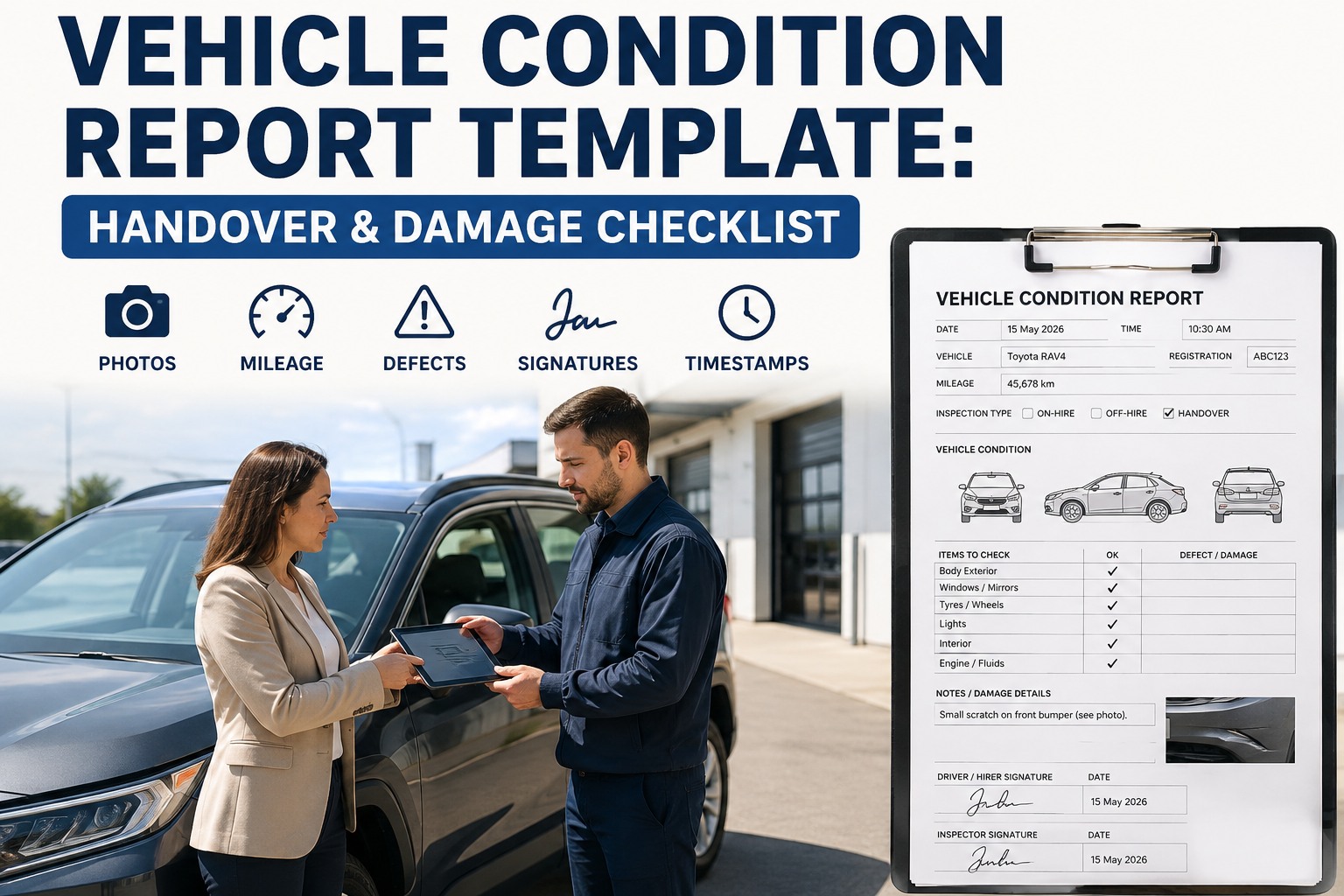
A vehicle condition report template that captures general condition without location-specific damage marks, timestamped photos, or a signed baseline is not a condition report — it's a formality that loses every dispute. Off-hire returns, driver handovers, contractor demob, and insurance claims all resolve the same way: whoever has the dated, photo-backed, signed record of pre-existing damage wins. This vehicle condition report template covers what to capture at handover for cars, trucks, trailers, and yellow iron — book a demo to digitize handover inspections in HVI.
What a Complete Vehicle Condition Report Actually Captures
Every dispute over pre-existing damage traces back to the same missing element: not a checkbox, but a dated body-diagram mark with a matching photo.
- 1Driver door lowerScratch, 4"Cosmetic
- 2Front bumperDent, 2" × 3"Major
- 3HoodPaint chipCosmetic
- 4WindscreenChip <10mmMonitor
- 5Rear panelDeep gouge, 8"Major
- 6Rear tyre RSSidewall scuffCosmetic
6 marked defects · 6 close-up photos · 2 signatures · 1 timestamped record. That's a VCR that holds up in a dispute.
The rest of this page walks the sections a complete VCR template must cover, the photo standard that separates a record from an argument, the on-hire vs off-hire comparison workflow, and where paper falls apart. Book a 30-minute demo to see per-asset condition reports in HVI.
Every vehicle condition report template needs seven sections
A generic "vehicle condition: good / fair / poor" line is not a condition report — it collapses into a subjective judgment call the moment a dispute starts. A defensible VCR breaks the vehicle down by system and captures each component's state independently, so a scratch on the driver door doesn't get swept into a "fair" overall rating and lost. Seven sections cover cars, light commercial, heavy trucks, trailers, and mobile equipment with only minor per-asset adjustment.
Vehicle identification
- Registration, VIN, or asset number
- Make, model, year, colour
- Odometer reading or engine hours
- Fuel level or charge state
- Purpose of inspection (on-hire / off-hire / handover / audit)
Metadata
- Date and time (auto-captured on digital)
- Location or site (GPS on digital)
- Inspector name and role
- Outgoing/incoming driver names
- Weather or lighting conditions if relevant
Exterior body
- Every panel walked systematically — front, sides, rear, roof
- Body diagram with location-specific damage marks
- Glass: windscreen, side windows, mirrors
- Lights: headlamps, indicators, brake lights, work lights
- Bumpers, mudguards, trim
Wheels & tyres
- Tread depth on every tyre with measurement
- Sidewall damage, cuts, bulges
- Wheel condition, kerbing damage
- Spare wheel presence and condition
- Wheel nuts torqued and secured
Cab / interior
- Seats, headrests, seatbelts
- Dashboard, controls, warning lights
- Interior trim, headliner, door cards
- Floor mats, cleanliness, odour
- Radio, air-con, wipers, washers functional
Load area / equipment
- Tray, bed, tipper body, deck condition
- Load restraints, tie-down points, curtains
- Tailgate, ramps, sides, hinges
- Attachments, PTO equipment, hydraulics if fitted
- Safety equipment: fire extinguisher, first aid, triangles
Documents, keys, accessories
- Registration papers, insurance certificate, permits
- Keys handed over — count and note spare
- Fuel card, toll transponder, telematics device
- Charger cables and connectors (EVs)
- Owner's manual, service history
Signatures & acknowledgement
- Inspector signature with timestamp
- Outgoing driver / releasing party signature
- Incoming driver / receiving party signature
- If receiving party absent: witness signature + note
- PDF copy delivered to both parties same day
The seven functional sections plus the signature block combine to make the record dispute-proof. Skip any one section and the record has a gap a returning driver or an insurance adjuster will find, because that section is exactly where the damage in question turns out to have been. Book a demo to see per-asset templates with all seven sections in HVI.
The photo standard — what separates a record from an argument
Photos are the single most decisive element of a condition report. A body-diagram mark shows roughly where damage is; a dated photo shows exactly what it looked like. In every dispute over pre-existing damage, the party with the photo wins — and the party without one negotiates from a losing position regardless of how detailed the written record is.
Four-side walkaround
Wide-angle photo from directly in front, both sides (perpendicular to the vehicle), and directly behind. Consistent distance and angle every inspection — this is the "before" baseline.
Odometer & fuel close-ups
Direct close-up of the odometer showing the exact reading, and a close-up of the fuel gauge. Both timestamped. These two photos alone settle 80% of billing disputes on rental returns.
Damage: wide + close
Every defect gets two photos: a wide shot showing the damage in context (which panel, where on the panel) and a close-up showing the damage detail. A tape measure or coin in-frame for scale.
Interior & equipment
Dashboard with warning lights visible, driver seat, passenger seat, cargo area or load bed, all accessories handed over. On EVs: charge cables and connectors laid out for inventory photo.
Digital inspection captures GPS location and device timestamp automatically on every photo, which is the difference between a photo you can defend at claim time and a photo the other party's lawyer can call into question. Photos taken on a personal phone and emailed later fail this test almost every time, because the metadata gets stripped in transit. Digital inspection tools preserve the EXIF data end-to-end. On long-term hires exceeding 30 days, interim condition inspections at monthly intervals catch developing damage before the off-hire dispute stacks up. Start a free HVI trial to capture geo-tagged, timestamped handover photos against every asset in your fleet.
On-hire vs off-hire — the comparison that resolves disputes
Every high-value dispute over vehicle condition traces back to the same question: what changed between the two inspections? The on-hire record is the baseline; the off-hire record is the comparison. Whatever damage exists on the off-hire record but not on the on-hire record is the responsibility of the party who held the vehicle in between. This is the entire mechanic of dispute resolution — and it depends on both records existing, being complete, being time-stamped, and being side-by-side comparable.
| Event | On-hire record captures | Off-hire record compares | Dispute outcome depends on |
|---|---|---|---|
| Rental return | Baseline: exterior, interior, tyres, fuel, odometer, damage log | Same seven sections + any new damage flagged with photos | Photos + signed acknowledgement at pickup |
| Driver reassignment | Outgoing driver signs current state, keys + accessories logged | Incoming driver signs receiving state, same day | Both signatures present on both records |
| Contractor demob | Full condition at mob, all equipment listed | Full condition at demob, missing items and damage flagged | Attachment / accessory inventory at mob |
| Lease return | Delivery condition report from lessor, tyre depths measured | Return condition, tyre depths re-measured, wear vs damage classified | Photographic baseline of every panel at delivery |
| Insurance claim | Pre-incident condition (last inspection before claim event) | Post-incident condition documented at claim | Regular inspection cadence with photos retained |
| Interim (30+ day hire) | Monthly interim condition check | Prior interim compared to current, developing damage flagged | Consistent monthly cadence documented |
The operational rule that follows from this table: run the off-hire inspection with the same template used for the on-hire, in the same order, with the same photo standard. Any deviation between the two templates weakens the comparison, and gives the other party grounds to argue the "new" damage wasn't actually new — it was captured differently. Standardized digital templates enforce consistency by default across every depot and every inspector, which is why multi-location rental and leasing operators see the largest dispute-win improvement after moving off paper. Book a demo to see side-by-side on-hire and off-hire comparison in HVI.
Where paper condition reports fall apart
Four failure modes that lose disputes even when the paper record technically exists
The first failure is photo separation: the condition report exists on paper, the photos exist on someone's phone, and by the time the dispute starts the photos are on a phone that's been replaced, in an inbox that's been archived, or on a memory card that's been reused. The paper form and the photos should be one artifact, not two. The second failure is signature drift: the receiving party signs a blank or half-complete form because the vehicle is being handed over in a rush, and the details get filled in later. Any signature obtained on an incomplete form is worth less than no signature at all when a dispute goes formal. The third failure is form-version drift: the outgoing operator uses a slightly older template that captures 6 sections instead of 7, and the missing section is exactly where the disputed damage lives — and the counterparty's return template captures it, so the "gap" looks like new damage. Every location using its own printed version of the form guarantees this problem eventually. The fourth failure is retrieval collapse: 18 months after a handover, when an insurance claim references a specific vehicle on a specific date, the paper VCR is in a filing cabinet at a depot that closed six months ago, or in a bankers box that got water-damaged in a leak, or in a stack that got shredded during an office move. Every paper condition report has a shelf life measured in months at best, and disputes routinely surface years after the original event. Digital condition reports address all four failure modes structurally — one artifact per asset, no partial signature capture, one template version rolled out fleet-wide, and searchable retention against the asset for the life of the record.
A regional rental operator on the switch from paper to digital VCRs
We rent 180 light commercials and 22 heavy trucks out of four depots. Paper condition reports for the first eight years. Any dispute above about $800 in claimed damage went to the same three-way fight: our depot manager, the returning customer, and their insurance broker. Winning percentage was maybe 55%. When we lost, we lost because either the photos weren't tied to the specific rental clearly, the on-hire form was missing a section that mattered, or the signed form couldn't be located within 48 hours.
Digital changed the math. Every rental has a single record: on-hire condition with photos, mid-hire mileage checks for anything over 30 days, off-hire condition, signature on both ends. Same template every depot, same photo standard every asset. Our dispute win rate is around 92% now, and the disputes we do lose are mostly claims where the damage was genuinely ours to eat. Software cost per year is a fraction of the average dispute we used to concede.
Frequently asked questions
What should a vehicle condition report template include?
A defensible vehicle condition report template covers seven functional sections plus a signature block. Vehicle identification: registration or asset number, VIN, make, model, year, odometer reading or engine hours, fuel level or charge state, and the purpose of the inspection (on-hire, off-hire, driver handover, contractor mob/demob, lease return, audit). Metadata: date and time (auto-captured on digital), location or GPS coordinates, inspector name and role, outgoing and incoming driver names. Exterior body: every panel walked systematically with a body diagram for location-specific damage marks, plus glass, lights, bumpers, mirrors, trim. Wheels and tyres: tread depth on every tyre with measurement, sidewall damage, wheel condition, spare presence. Cab or interior: seats, seatbelts, dashboard and controls, interior trim, cleanliness, radio and HVAC. Load area and equipment: tray, bed, restraints, tailgate, attachments, safety equipment. Documents, keys, accessories: registration papers, keys count, fuel card, toll transponder, EV charger cables. Signatures: inspector, outgoing party, incoming party, all timestamped, with a PDF delivered to both parties the same day. A generic "condition: good/fair/poor" line is not a condition report and loses every dispute.
What photos should be taken during a vehicle handover?
Photos are the single most decisive element of a condition report because a body-diagram mark shows roughly where damage is but a dated photo shows exactly what it looked like. Four categories of photo should be captured on every handover. Four-side walkaround: wide-angle photo from directly in front, both sides perpendicular to the vehicle, and directly behind, at consistent distance and angle every inspection. Odometer and fuel close-ups: direct close-up of the odometer showing the exact reading and a close-up of the fuel gauge, both timestamped. These two photos alone settle roughly 80% of billing disputes on rental returns. Damage close-ups: every defect gets two photos, a wide shot showing the damage in context (which panel, where on the panel) and a close-up showing the damage detail, with a tape measure or coin in-frame for scale. Interior and equipment: dashboard with any warning lights visible, driver seat, passenger seat, cargo area or load bed, and all accessories being handed over. Digital inspection tools preserve the EXIF metadata (GPS location, device timestamp, camera details) end-to-end, which is what makes the photo defensible at claim time. Photos taken on a personal phone and emailed later usually strip that metadata and lose the evidentiary weight.
What is the difference between an on-hire and off-hire inspection?
An on-hire inspection is the vehicle condition report captured at the start of the rental, hire, or handover period — it establishes the baseline condition of the vehicle at the moment responsibility transfers. An off-hire inspection is the comparison record captured at the end of the period, when responsibility transfers back or forward to the next party. The dispute-resolution mechanic is straightforward: whatever damage exists on the off-hire record but not on the on-hire record is the responsibility of the party who held the vehicle in between. This depends on both records existing, both being complete against the same template, both being time-stamped, and both being side-by-side comparable. The operational rule: run the off-hire inspection with the same template used for the on-hire, in the same order, with the same photo standard. Any deviation between templates weakens the comparison and gives the counterparty grounds to argue the "new" damage was not actually new but was captured differently. On long-term hires exceeding 30 days, interim condition inspections at monthly intervals catch developing damage before the off-hire dispute stacks up.
Who signs a vehicle condition report?
A complete vehicle condition report is signed by both parties present at the handover: the inspector or releasing party who completes the report, and the receiving driver or renter who acknowledges the recorded condition. Both signatures should be captured after the report is fully complete, not on a blank or partial form — a signature obtained on an incomplete form is worth less than no signature at all in a formal dispute. If the receiving party is not present at the handover (for example, a vehicle being prepared for pickup before the customer arrives, or a driver on leave during a reassignment), the fleet manager or supervisor should complete the inspection and note on the form that the receiving party was not present. In that case a witness signature (another employee or supervisor) supports the record, and the receiving party's signature can be captured on collection. A photograph of the receiving party signing on a digital device with device timestamp is the strongest form of the signature record because it ties the signature to a specific person, time, and device, and is not replicable after the fact.
How long should vehicle condition reports be kept?
Retention depends on the purpose of the report and the applicable jurisdiction, but the operational rule is that vehicle condition reports should be retained for the life of the vehicle or for the applicable statute of limitations on damage or insurance claims, whichever is longer. For rental fleets, most operators retain condition reports for a minimum of 7 years to cover the typical limitations period for contractual and property damage claims in most US, UK, Canadian, and Australian jurisdictions. For leased vehicles, the delivery and return condition reports should be retained for at least 7 years after the lease ends to support any post-return damage claims from the lessor. For fleet-owned vehicles, condition reports at driver reassignment, incident, or audit should be retained through the vehicle's disposal and for at least 3 years after, to support any residual value or wear-and-tear disputes. Digital condition reports address the retention challenge structurally — searchable, indexed against the asset, retained for the life of the record without physical storage constraints. Paper condition reports typically have a shelf life measured in months at best under real-world office conditions, and disputes routinely surface years after the original event.
Every handover captured. Every dispute defensible. Every record retrievable.
HVI holds condition reports against every asset in your fleet with body-diagram marks, geo-tagged and timestamped photos, both parties' signatures, and PDF delivery to both parties on completion. On-hire and off-hire records sit side by side for instant comparison. When a return dispute starts, or an insurance claim references a specific date 18 months back, the file is one screen — not a hunt through inboxes, phone camera rolls, or filing cabinets. Live in under two weeks. No hardware. No credit card.
Trusted by rental, leasing, construction & utility fleets across USA, Canada, UK & Australia · Ready on day one