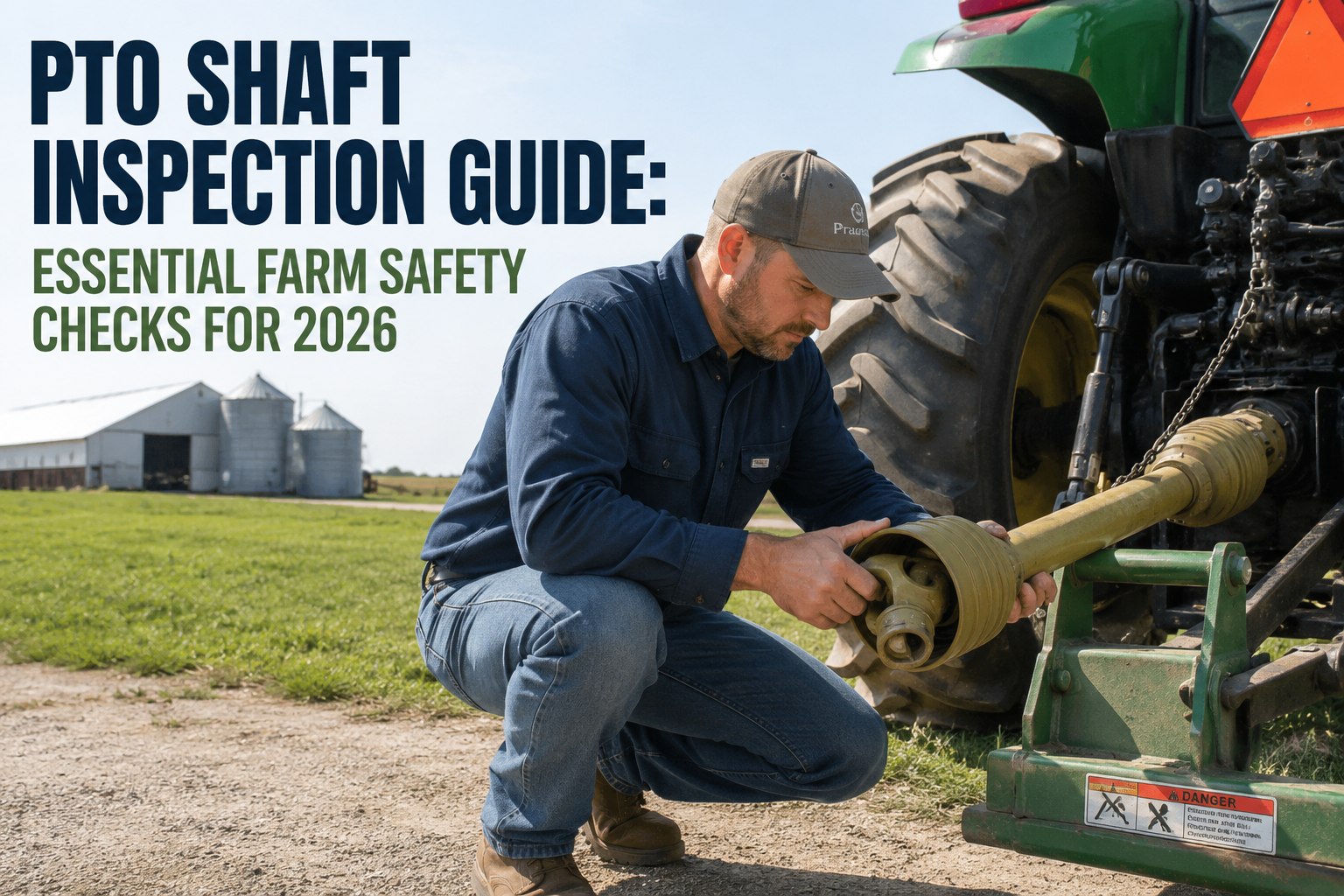
A PTO shaft spinning at 540 RPM completes nine full rotations every second and travels more than two meters in that same second. At 1,000 RPM it's nearly seventeen. There is no reaction time — by the time a sleeve cuff catches, the shaft has already wound in several turns of fabric and begun pulling a person toward it. That is why PTO entanglement nearly always results in devastating injury or death, and why it remains one of the leading causes of fatal tractor injuries. The hardest truth in the data is also the most hopeful:PTO guards were missing in 70% of entanglement cases, and missing or damaged shielding is the single main cause. That means the risk is almost entirely controllable — and the control is a guard you can check in two minutes before you engage the shaft. OSHA's field standard 29 CFR 1928.57 requires that protection, but the regulation only matters if someone actually inspects the shields and replaces the damaged ones. This guide lays out the guarding system, the pre-operation inspection, the safe inspection procedure, and how to document it all. book a 30-minute walkthrough to see PTO checklists set up for your operation.
Nine rotations a second. No reaction time. The guard you inspect is the only thing in between.
HVI runs the pre-operation PTO inspection from a phone — master shield, driveline guard, spinning shields, locking collar — flags any missing or damaged guard, tags the equipment out of service until it's fixed, and keeps the OSHA-ready record for every tractor and implement.
Why a PTO shaft is so unforgiving
The danger isn't abstract — it's a matter of physics and speed. Understanding the numbers is what makes the two-minute guard check feel non-negotiable.
Most PTO incidents happen during seemingly routine tasks — clearing debris, stepping over the shaft, adjusting an implement while it's still running. Clothing, shoelaces, gloves, jewelry, or long hair can catch instantly. The shaft doesn't snag a cuff and politely stop; it winds the fabric in, then the forearm, then the torso, faster than the brain registers contact. The guard is what prevents that first catch — which is why a missing or damaged one is a stop-work condition, not a someday repair.
The guarding system: two parts, not one
"PTO guard" is really two different protections covering two different parts of the driveline. They aren't interchangeable, and a complete inspection checks both.
Master shield
Covers the tractor's PTO stub shaft and front universal joint on three sides. Required by 29 CFR 1928.57 on all rear, mid-, and side-mounted shafts. Must be secured before operating and replaced immediately if damaged.
Driveline guard
The spinning plastic or metal tube covering the full length of the shaft between tractor and implement, including the universal joints. It must rotate freely and independently of the shaft — a seized guard is a failed guard.
A common and dangerous mistake is assuming the master shield covers the whole driveline. It doesn't — it protects only the stub and front joint. The full-length driveline guard protects everything between, and the regulation requires the driveline to be guarded along its entire length, including the joints and couplings. HVI builds both into every PTO inspection so neither is skipped.
The pre-operation PTO inspection
This is the check that prevents the catch. It takes about two minutes, runs before every engagement, and walks the points where shielding fails.
Missing or damaged shielding is the main cause of entanglement, so every one of these is a stop-work item if it fails — replace, don't run. sign up free and run a documented PTO check before every engagement, or book a demo to see farm-equipment inspection templates.
Inspect safely: shut down first, every time
The inspection itself must never become the incident. Before touching any part of the PTO or driveline, the machine has to be fully shut down — no exceptions, no "just a quick look."
Disengage the PTO
Take the PTO out of gear so the shaft is no longer driven before you approach the rear of the tractor.
Shut off & set the brake
Stop the engine completely and set the parking brake so nothing can move while you inspect or adjust.
Remove the key
Take the key out of the ignition — the simplest guarantee that no one can start the machine while you're at the shaft.
Confirm full stop
Wait for the shaft and all rotating parts to come to a complete stop before any contact. Only then inspect.
Never approach, step over, or adjust a rotating PTO shaft, and never wear loose clothing, hoodie strings, scarves, or jewelry near it. PPE will not protect against entanglement once clothing is caught — prevention is the only protection, and a clean shutdown is the foundation of every safe inspection. HVI's PTO checklist leads with the shutdown sequence so it's never skipped.
OSHA compliance & the record that proves it
For agricultural employers, PTO guarding isn't just good practice — it's a documented obligation under federal law, and the record is what proves you met it.
29 CFR 1928.57
Requires all PTO shafts — rear, mid-, and side-mounted — to be guarded by a master shield or other protective guarding, and employers to replace any missing or damaged guard.
Annual training duty
Employers must train every farmworker in safe operation and servicing at initial assignment and at least annually after — documented, not assumed.
The inspection record
A timestamped log of who inspected which guard, when, and what was found is the proof of diligence — both for compliance and after any incident.
A guard inspection that isn't documented is hard to prove happened — and proof is exactly what an OSHA review or an incident investigation demands. sign up free and keep an audit-ready record of every PTO inspection and guard replacement.
Paper checklists vs. HVI
Both technically record a guard check. Only one makes the inspection impossible to skip, tags an unguarded machine out of service, and keeps the documented history that compliance and safety demand.
Paper / informal
- Guard check skipped under time pressure
- Master shield and driveline guard confused or missed
- A seized or cracked guard run anyway
- Damaged guards noted but never replaced
- No proof the inspection happened for OSHA
- Training records scattered or missing
With HVI software
- Pre-operation PTO check on a phone, photo-verified
- Master shield and driveline guard both required items
- A failed guard tags the equipment out of service
- Every damaged guard becomes a tracked work order
- Timestamped record proves every inspection
- Training and inspection history in one place
entirely preventable. PTO entanglement is one of the most devastating injuries in agriculture — and with guards missing in 70% of cases, it's also one of the most controllable. The single act that prevents it is inspecting the shields before every engagement and replacing the damaged ones. HVI makes that check routine, documented, and impossible to skip — turning a two-minute habit into a life-safety system across every tractor and implement.
Frequently asked questions
What should a PTO shaft inspection check?
A complete pre-operation PTO inspection covers six points. The master shield must be in place and secured over the tractor's stub shaft and front joint. The driveline guard must be intact along its full length with no cracks, missing sections, or exposed shaft. All shields must spin freely and independently of the shaft — not cracked, rusted, or locked up, since a seized guard is a failed guard. The universal joints and guard bearings must be greased so the shields rotate and the dry driveline doesn't fail. The locking collar and spline engagement must be secure with no wear that could let the shaft separate. And the speed rating must match — the tractor and implement both 540 or both 1,000 RPM. Because missing or damaged shielding is the main cause of entanglement, any failure here is a stop-work condition: replace the guard, don't run the machine. HVI's inspection and maintenance software builds all six into a documented pre-operation check. sign up free and run a documented PTO check.
What's the difference between a master shield and a driveline guard?
They protect different parts of the system and are not interchangeable — a complete inspection checks both. The master shield is mounted on the tractor and covers the PTO stub shaft and the front universal joint on three sides, protecting against contact at the point where the driveline connects to the tractor. The driveline guard is the spinning plastic or metal tube that covers the full length of the shaft running between the tractor and the implement, including the universal joints along the way. A common and dangerous misconception is that the master shield protects the whole driveline; it doesn't — it covers only the stub and front joint, and the long shaft between the tractor and implement needs its own full-length guard. OSHA's standard requires the driveline to be guarded along its entire length, joints and couplings included. HVI's inspection and maintenance software lists both as required, separate items so neither is overlooked. book a demo to see the PTO inspection template.
How do you safely inspect a PTO shaft?
The inspection must never become the incident, so the machine has to be fully shut down before you touch any part of the PTO or driveline — there's no such thing as a quick look at a running shaft. The sequence is: disengage the PTO so the shaft is no longer driven, shut off the engine completely and set the parking brake, remove the key from the ignition so no one can start the machine while you're at the shaft, and then wait for the shaft and all rotating parts to come to a complete stop before any contact. Only then inspect or adjust. Beyond the shutdown, never approach, step over, or adjust a rotating shaft, and never wear loose clothing, hoodie strings, scarves, gloves, or jewelry near it — PPE won't save you once clothing is caught, because entanglement happens faster than you can react. HVI's inspection and maintenance software leads its PTO checklist with the shutdown sequence so it's never skipped. sign up free and build the shutdown step into every check.
What does OSHA require for PTO guarding?
OSHA's agricultural field standard, 29 CFR 1928.57, requires that all power take-off shafts — rear, mid-, and side-mounted — be guarded either by a master shield or by other protective guarding, and that power take-off driven equipment be guarded to protect against employee contact with the rotating members of the drive system. Employers are responsible for replacing any missing or damaged PTO guard. The standard also requires that employers train every farmworker in the safe operation and servicing of the equipment they'll use, both at initial assignment and at least annually afterward. One important nuance: OSHA standards apply to agricultural employers, not to farmers working solely their own land with no employees, and they don't compel manufacturers to fit guards — so the duty to confirm guarding rests on the employer or operator at the point of use. A documented inspection record is the proof that duty was met. HVI's inspection and maintenance software keeps that record audit-ready. book a demo to see compliance recordkeeping.
How does HVI help with PTO and farm equipment safety?
HVI is an inspection and maintenance software platform that turns the life-critical PTO check into a documented, repeatable routine. Operators run the pre-operation PTO inspection from a phone or tablet using a farm-equipment-specific template that leads with the shutdown sequence and covers both the master shield and the full-length driveline guard, the freely-spinning shields, U-joint and bearing greasing, the locking collar and splines, and the speed-rating match — with mandatory photo capture on any defect. A failed or missing guard can tag the equipment out of service until it's fixed, and every damaged guard auto-creates a tracked work order so it's actually replaced rather than just noted. The platform keeps a timestamped record of who inspected what and when, alongside training records, giving agricultural employers the audit-ready proof that 29 CFR 1928.57 and annual-training duties were met. It works offline in the field and syncs when back in range. book a demo and we'll map the software onto your operation on the call.
The guard is the only thing between an operator and a shaft that moves faster than anyone can react.
HVI runs the pre-operation PTO inspection from a phone — shutdown sequence, master shield, driveline guard, spinning shields, locking collar, speed match — flags any missing or damaged guard, tags the equipment out of service until it's fixed, and keeps the OSHA-ready record for every tractor and implement. Make the two-minute check impossible to skip.
No credit card required · Live in under two weeks · Pre-operation PTO checks + guard tag-out + work orders + OSHA records in one platform

.png)