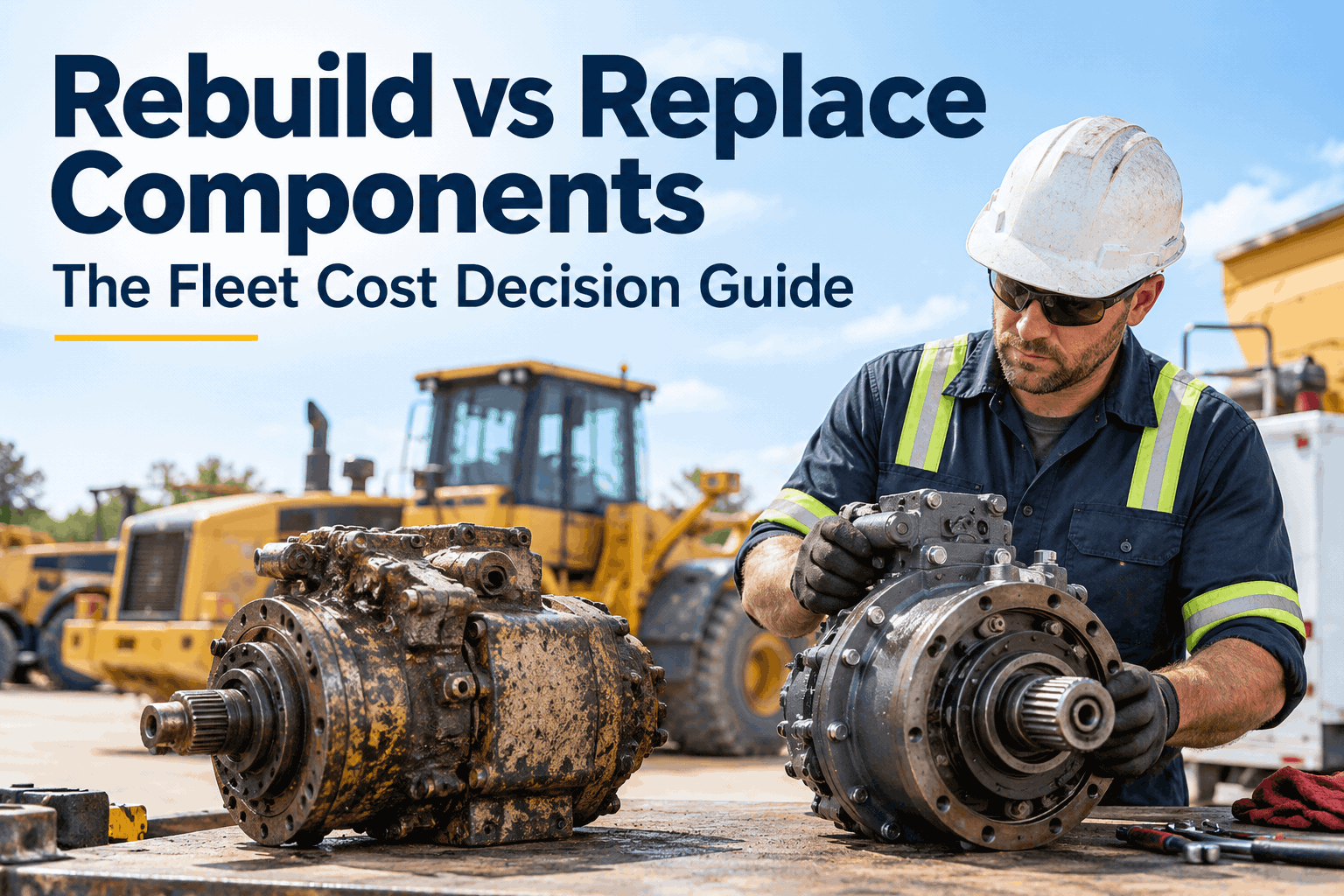
Rebuilding a failed engine, transmission, hydraulic pump or axle can look cheaper than buying a replacement. But a sound rebuild vs replace component decision must account for labor, downtime, reliability, warranty coverage and the equipment's remaining useful life—not just the supplier quote. This guide gives fleet maintenance managers a repeatable way to compare both options using documented maintenance costs.
Rebuild or replace? Make the decision with the full cost in view.
Compare component costs, time out of service and expected useful life before approving the next major repair.
Example only: a lower upfront total does not automatically mean lower lifecycle cost.
Rebuild vs replace: what actually changes?Both options can be right, depending on component condition, supportability and the fleet's operating requirements.
Rebuild the existing component
Disassemble, inspect and restore the component using approved parts and procedures, then verify performance before return to service.
- May cost less when the core is sound and parts are available.
- Can retain compatibility with the existing machine.
- Requires confidence in rebuild quality, test capability and warranty.
- May create longer downtime if machining or specialty parts are delayed.
Replace with a new or remanufactured unit
Install a replacement assembly with known specifications, documented condition and supplier support appropriate to the duty cycle.
- May reduce uncertainty about hidden wear or damage.
- Can shorten downtime when a compatible unit is in stock.
- Often requires a larger initial parts outlay.
- Warranty, core charges and installation requirements vary.
Compare total decision cost—not sticker priceUse the same cost categories for both options, including any differences in availability and follow-up risk.
Illustrative example: figures are not industry averages or supplier quotes.
| Cost element | Rebuild | Replace |
|---|---|---|
| Parts / unit | $4,500 | $9,000 |
| Labor & testing | $2,100 | $1,500 |
| Downtime impact | $2,400 | $3,000 |
| Freight / other | $800 | $800 |
| Total | $9,800 | $14,300 |
Assumes no recoverable core credit or estimated follow-up cost; add these when applicable.
Here, rebuilding saves $4,500 initially. If the rebuilt unit is likely to fail again during the fleet's required service period, a replacement may still offer better value. Compare cost per expected operating hour—not just the invoice.
The lifecycle test that changes the answerA low-cost rebuild is less attractive when it will not last through the equipment's planned service horizon.
Illustrative assumptions, not predictive HVI outputs. Expected life requires engineering judgment, duty-cycle evidence and component condition assessment.
On these assumptions, replacement has a lower cost per expected operating hour. But if the vehicle will be retired in 1,000 hours, the rebuild may be sufficient. Recalculate whenever expected life, downtime or retirement plans change.
A practical component decision matrixUse these gates to rule out unsuitable options before comparing costs.
Safety and technical suitability
Is the housing, core or critical structure rebuildable to the required specification? Are approved repair methods and competent technicians available?
Failure history and root cause
Did the unit fail repeatedly? Check contamination, overheating, lubrication, loading and installation history before approving either option.
Downtime and lead time
Compare actual shop capacity, parts lead times, rental availability and production impact—not an assumed turnaround.
Remaining equipment life
Will either option deliver the hours needed before planned retirement or major overhaul?
Warranty and final economics
Review supplier coverage, core credits, expected follow-up repairs and full installed cost.
See what a component has really cost your fleet.
Explore how HVI maintenance records, work orders and expense tracking can help your team compare past repairs before approving another rebuild or replacement.
What to capture in every rebuild-or-replace decisionConsistent records make the next component decision faster and easier to defend.
Hydraulic pump • Unit EX-204
HVI's maintenance work orders and repair history can help organize the service evidence behind a decision. Its expense tracking supports visibility into recorded parts, labor and maintenance spending. For a walkthrough of these records in your own workflow, Book a Demo of HVI Component Maintenance Tracking.
Three real-world decision patternsDifferent components demand different trade-offs; use the same framework, not the same answer.
Engine with repeat overheating
Investigate the cooling system and operating conditions first. A rebuild without correcting the root cause can repeat the failure.
Focus: reliability evidenceTransmission on a near-retirement truck
Compare remaining fleet service hours against the life of a rebuild and the full replacement cost. Avoid buying excess life the fleet cannot use.
Focus: remaining asset lifeHydraulic pump on critical equipment
Account for production impact, standby capacity, contamination control and verified lead times. A faster replacement can justify a higher purchase price.
Focus: downtime exposurePut the framework to work in four stepsStart with a single high-cost component class, then expand as your records improve.
Choose a component family
Start with engines, transmissions, pumps or axles that generate frequent high-value work orders.
Gather cost and failure evidence
Review inspection defects, repair history, labor, parts, downtime and previous replacements.
Standardize approval
Require comparable quotes, life estimates, safety review and a documented decision owner.
Review outcomes
Track repeat failures, actual cost, operating hours delivered and whether the decision met expectations.
To begin organizing the supporting records, Sign Up Free for HVI Fleet Maintenance History.
Rebuild vs replace component FAQsAnswers to the questions fleet maintenance managers ask before approving a major repair.
Is rebuilding always cheaper than replacing a component?
No. Rebuilding can have a lower initial price but cost more after labor, testing, downtime and additional failures. Compare total decision cost and expected useful life for both options.
How do I calculate rebuild vs replace cost per operating hour?
Divide the full expected cost of each option by the operating hours it is reasonably expected to deliver. Use the same cost assumptions, account for downtime, and treat life estimates as uncertain rather than guaranteed.
When should a fleet replace instead of rebuild?
Replacement may be preferable when the component is not safely rebuildable, has repeat failures, needs unavailable parts, carries high downtime risk or cannot reliably meet the remaining service requirement.
What records help support the decision?
Keep inspection findings, failure cause, prior work orders, parts and labor costs, supplier quotes, downtime estimates, warranty terms and the final approval record. These help explain the decision and assess its outcome.
How can HVI help with component rebuild and replacement decisions?
HVI maintenance history, work orders and expense records can help managers review repair patterns and documented spending. Engineering evaluation, supplier warranties and approval decisions still require the fleet's own qualified personnel.
Bring repair costs and maintenance history together in HVI.
Give your team a clearer view of recurring repairs, recorded maintenance spending and component service history before the next major approval.