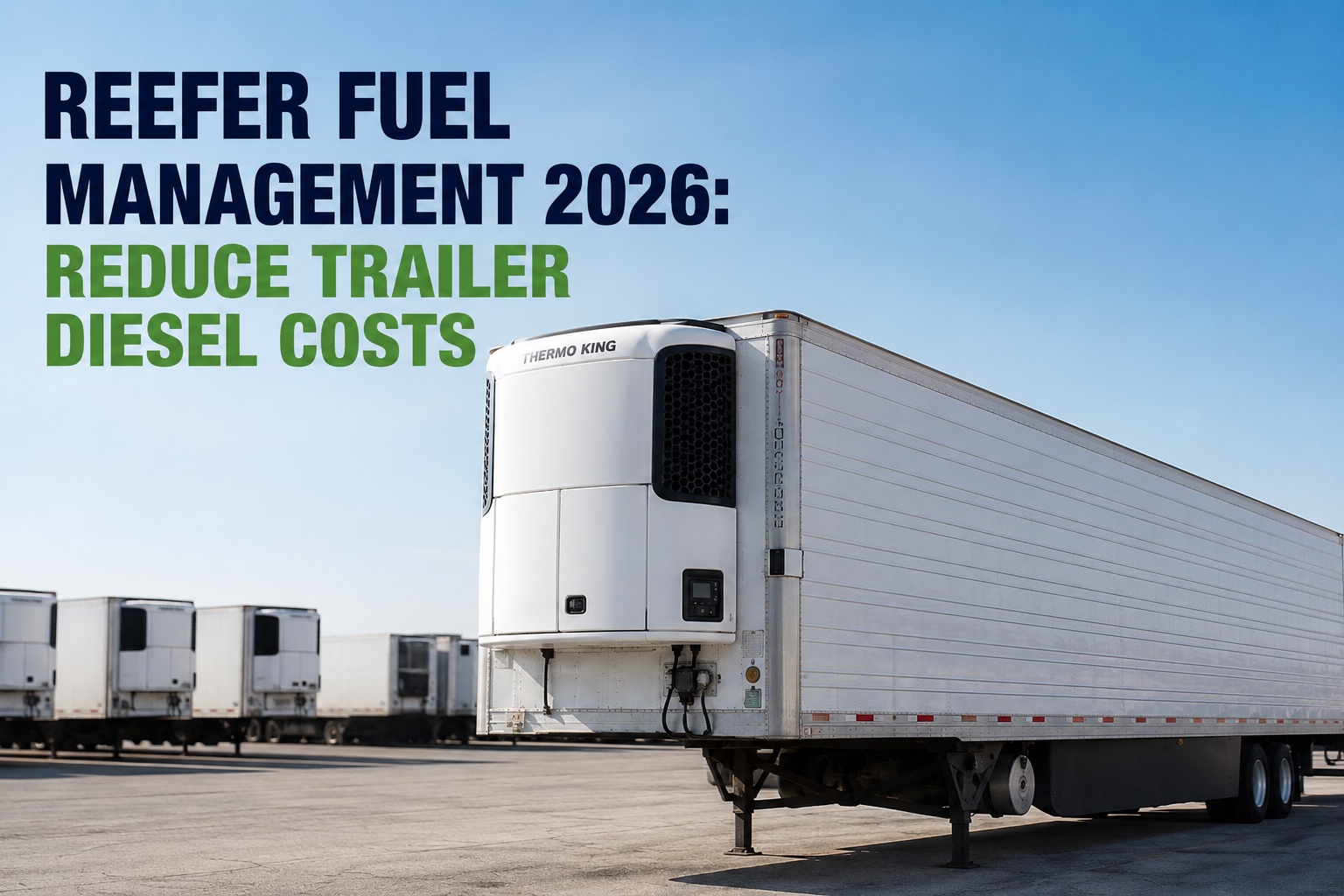
Every reefer trailer is a second diesel engine. It has its own tank, its own hour meter, its own maintenance schedule — and on most fleets, no dedicated fuel line on the P&L. A reefer unit burns 0.4 to 1.5 gallons per hour, 18-24 hours a day, whether the tractor is moving or parked overnight. On a 40-unit reefer fleet, that's $150K-$300K a year in diesel most CFOs never see broken out. This reefer fuel management playbook shows how disciplined fleets cut it 15-25%. Book a demo
The second diesel engine on every reefer trailer. Most fleets have no idea what it's costing.
A reefer unit burns diesel independent of the tractor. Different tank, different meter, different economics — and different levers. Fleets that measure reefer fuel as its own line item cut consumption 15-25% within a quarter. Fleets that don't never see the leak.
Where reefer fuel actually goes — the burn rate matrix
Reefer unit fuel burn is not a fixed number. It varies by setpoint temperature, ambient outside temperature, load type, door-open frequency, unit age, and operating mode. Understanding the matrix is what separates fleets that predict fuel spend from fleets that get surprised by it every month.
| Setpoint | Load type | Ambient 60°F | Ambient 85°F | Ambient 100°F | Daily gal (24hr) |
|---|---|---|---|---|---|
| +34°FFresh produce | Continuous | 0.5 GPH | 0.7 GPH | 0.9 GPH | 12-22 gal |
| +34°FCycle-sentry | Cycle | 0.35 GPH | 0.5 GPH | 0.7 GPH | 8-17 gal |
| 0°FFrozen goods | Continuous | 0.7 GPH | 0.9 GPH | 1.1 GPH | 17-26 gal |
| -10°FDeep frozen | Continuous | 0.9 GPH | 1.1 GPH | 1.3 GPH | 22-31 gal |
| AnyOlder unit > 5 yr | Continuous | 1.2 GPH | 1.6 GPH | 2.0-3.0 GPH | 29-72 gal |
The numbers add up faster than most fleets estimate. A single deep-frozen unit running 24/7 in southern summer heat can burn $3,700 in reefer diesel per month. Multiplied across 40 trailers on frozen routes, that's $148,000/month in reefer fuel alone — a number that never appears as a distinct line item unless the fleet tracks reefer runtime separately from tractor odometer miles. Book a demo to see reefer runtime and fuel tracked per trailer per day
Continuous vs Cycle-Sentry — the 25% lever most fleets never pull
The biggest single fuel-consumption lever on any reefer unit is the operating mode. Thermo King calls it Cycle-Sentry. Carrier calls it Automatic Start/Stop. The concept is identical: instead of running the compressor continuously to hold a tight setpoint, the unit cycles on and off within a defined temperature band. On loads that tolerate cycling, this cuts fuel burn 25-30%. On loads that don't — fresh produce, pharmaceuticals, temperature-sensitive freight — running cycle mode wrecks the load. The wrong choice in either direction is expensive.
Compressor runs constantly. Temperature held within a narrow band (typically ±1°F of setpoint). Continuous airflow across the load.
Fresh produce, floral, pharmaceuticals, live plants, seafood, freshly-baked bread, any load requiring continuous airflow or tight temperature control.
0.5-1.3 GPH depending on setpoint and ambient. Runs 22-24 hours per day at operating temperature.
Compressor cycles on and off. Runs down to setpoint, shuts off, restarts when temperature rises above the defined threshold (typically ±3-5°F band). Engine runs 40-60% of the time.
Frozen goods (ice cream, frozen vegetables, frozen meat, frozen bakery). Product is solidly frozen and minor temperature swings within the band don't degrade quality.
0.35-0.9 GPH average. On a frozen load running 24 hours a day, saves 6-10 gallons daily vs continuous.
The audit question: what percentage of your fleet's frozen loads are running in continuous mode when cycle would work? On most reefer fleets, the answer is "we don't know." The operator sets the mode based on the previous load, the previous shipper's preference, or habit — not policy. Codifying the cycle-vs-continuous decision by product type and enforcing it by dispatch instruction typically produces the fastest fuel savings on any reefer fleet. Book a demo to see mode compliance tracked per trailer per shipment
The 5 operator control levers — where the reefer fuel actually gets wasted
Reefer fuel efficiency is 60% equipment, 40% operator behavior. The equipment side (unit age, insulation condition, maintenance) determines the baseline burn rate. The operator side determines how much fuel actually goes into holding the load vs into fighting the operator's own decisions. These are the five levers:
The five levers compound. A fleet running all five poorly can burn 40-60% more reefer fuel than a fleet running them well — on identical equipment on identical routes. That's not a theoretical number; that's the observed gap between best-in-class and undermanaged reefer operations. Start free and get reefer fuel tracked as its own line item on every trailer
From a cold-chain operations manager running 60 reefer trailers
For six years, our reefer fuel was blended with tractor fuel on the same fuel cards. If a driver filled both tanks at the same stop, one line item said "diesel." We had no idea what our reefer fuel cost per trailer, per route, or per driver. When we finally separated the two — different fuel card codes for the reefer pump, runtime data pulled off the units — we found we were spending $260K a year on reefer fuel, not the $180K we'd been estimating.
First 90 days after separation: we cut reefer fuel 22%. Half of that came from switching the frozen fleet to cycle-sentry as default (we'd been running everything continuous "just to be safe"). A quarter came from finding two units running 1.6 GPH that turned out to have condenser fouling from a bad service cycle. The rest came from setpoint discipline — our drivers had been running -5°F on loads specced at +5°F for years, "for margin." The customer never cared. The fuel bill did.
Frequently asked questions
How much fuel does a reefer trailer burn per hour?
A modern reefer unit (Carrier Transicold X4 series or Thermo King Precedent) burns 0.4 to 1.5 gallons of diesel per hour depending on setpoint, ambient temperature, load type, and operating mode. Typical ranges by scenario: fresh produce at +34°F in mild ambient runs 0.5 GPH continuous or 0.35 GPH on cycle-sentry. Frozen goods at 0°F runs 0.7-1.1 GPH continuous. Deep frozen at -10°F in hot ambient (95-100°F) can hit 1.3-1.5 GPH continuous. Older units more than 5 years past service, or units with clogged condensers, dirty filters, or refrigerant issues, commonly burn 1.5-3.0 GPH — roughly 3x a well-maintained modern unit doing the same work. Cycle-sentry (Thermo King) or Automatic Start/Stop (Carrier) modes cut fuel consumption 25-30% on cycle-tolerant loads by letting the compressor shut off between temperature-band excursions. The fuel tank on most reefer trailers holds 50-100 gallons, so a fresh-produce load in cycle mode can run 3-5 days between refills while a deep-frozen load in hot ambient may need refueling every 2 days.
What's the difference between continuous and cycle-sentry mode?
Continuous mode runs the reefer compressor constantly to hold a tight temperature band (typically ±1°F of setpoint) with continuous airflow across the load. Fuel consumption is at the high end of the unit's range because the engine essentially never stops. Cycle-sentry (Thermo King branding) or Automatic Start/Stop (Carrier branding) mode allows the compressor to shut off when the setpoint is reached and restart only when temperature rises above a defined threshold (typically 3-5°F band). The engine runs 40-60% of the time instead of continuously, which cuts average fuel consumption by 25-30%. The trade-off is temperature variance — product experiences a wider swing between minimum and maximum during cycling. When to use each: continuous mode is required for fresh produce, floral, pharmaceuticals, live plants, seafood, freshly-baked bread, and any load with strict temperature or airflow specifications from the shipper. Cycle-sentry mode is appropriate for solidly frozen goods (ice cream, frozen vegetables, frozen meat, frozen bakery) where the product is already at a stable frozen state and minor cycling within the band doesn't affect quality. Getting mode selection wrong in either direction is expensive — wasted fuel on cycle-eligible loads run in continuous, or spoiled freight on continuous-required loads run in cycle.
Does the reefer draw fuel from the tractor's main diesel tank?
No, in almost all cases. Reefer refrigeration units have their own dedicated fuel tank mounted on the trailer — typically a 50-gallon tank, with some larger configurations running 75-100 gallons. The reefer engine is a completely separate diesel powerplant (often a Tier 4 Final compliant 2.2L unit) that draws only from its trailer-mounted tank. The tractor's main fuel tanks (usually 100-200 gallons total across two saddle tanks) feed only the tractor engine. This physical separation is why reefer fuel gets so easily overlooked on fleet fuel budgets: at a fuel stop, the driver may fill both the tractor tanks and the reefer tank on the same fuel card at the same pump — and unless the fuel card system codes reefer fuel separately (different PIN, different product code, different card entirely), both fills show up as one lump-sum "diesel" line item. Some newer configurations use electric standby mode when the trailer is plugged into shore power at a dock or terminal, which eliminates diesel consumption during those specific hours. But during transit and any non-shore-power dwell time, the reefer runs on its own diesel supply, independently of the tractor.
What's the fastest way to reduce reefer fuel consumption on an existing fleet?
The biggest single-quarter fuel reduction typically comes from three interventions applied together. Separate the reefer fuel line item from the tractor fuel line item: use distinct fuel card codes for reefer pumps or capture reefer fuel manually on a separate log, so per-trailer GPH becomes visible instead of buried in aggregate diesel spend. This alone often surfaces 15-25% of the eventual savings by exposing outliers. Codify the mode-selection rule by product type: enforce cycle-sentry as the default for all frozen loads with the compressor spec allowing the temperature band; enforce continuous for produce, floral, pharma, and any sensitive fresh product. This typically captures 8-12% fleet-wide fuel reduction on any fleet defaulting everything to continuous mode. Audit setpoint discipline: pull the last 30 days of setpoint history off each unit's telematics and compare against the shipper's actual product specification. Setpoints running 3-5°F colder than product requires (a common "for margin" habit) waste 10-15% fuel per shipment. Together these three interventions typically deliver 15-25% total reefer fuel savings within 90 days of implementation, before any equipment changes or PM investment. Deeper savings from unit maintenance (condenser cleaning, refrigerant charge verification, filter replacement) compound over the following months.
How does HVI help fleets manage reefer fuel?
HVI's fuel management module integrates with Thermo King and Carrier Transicold telematics to capture reefer runtime hours, fuel consumption, setpoint history, mode selection (continuous vs cycle-sentry), door-open events, and defrost cycles per trailer per day. Reefer fuel is tracked as a distinct line item — separate from tractor fuel — so per-trailer GPH, per-route fuel cost, and per-driver operational discipline become visible on the fleet dashboard. When a unit's GPH drifts above baseline (indicating maintenance needed, refrigerant loss, or mode misuse), an alert fires before the fuel bill catches up. Setpoint history is trended against shipper specifications so setpoint discipline can be enforced against actual product requirements. Preventive maintenance schedules (belt inspection, condenser coil cleaning, filter replacement, refrigerant charge verification) run on runtime hours rather than calendar days — the correct interval for a unit that runs 20 hours a day 300 days a year. For cold-chain operations managers like Tina B. running 40-60 reefer trailers, the visibility alone typically identifies 15-25% of reefer fuel savings within the first quarter, before any equipment or process changes. Book a demo to see per-trailer reefer runtime, fuel burn, and setpoint tracking.
Two engines. Two fuel bills. Track them as one and you'll manage neither.
HVI captures reefer fuel as its own line item, tracks setpoint discipline against shipper specs, and integrates with Thermo King and Carrier telematics for per-trailer GPH visibility. Fleets typically cut reefer fuel 15-25% in the first quarter of separated tracking.