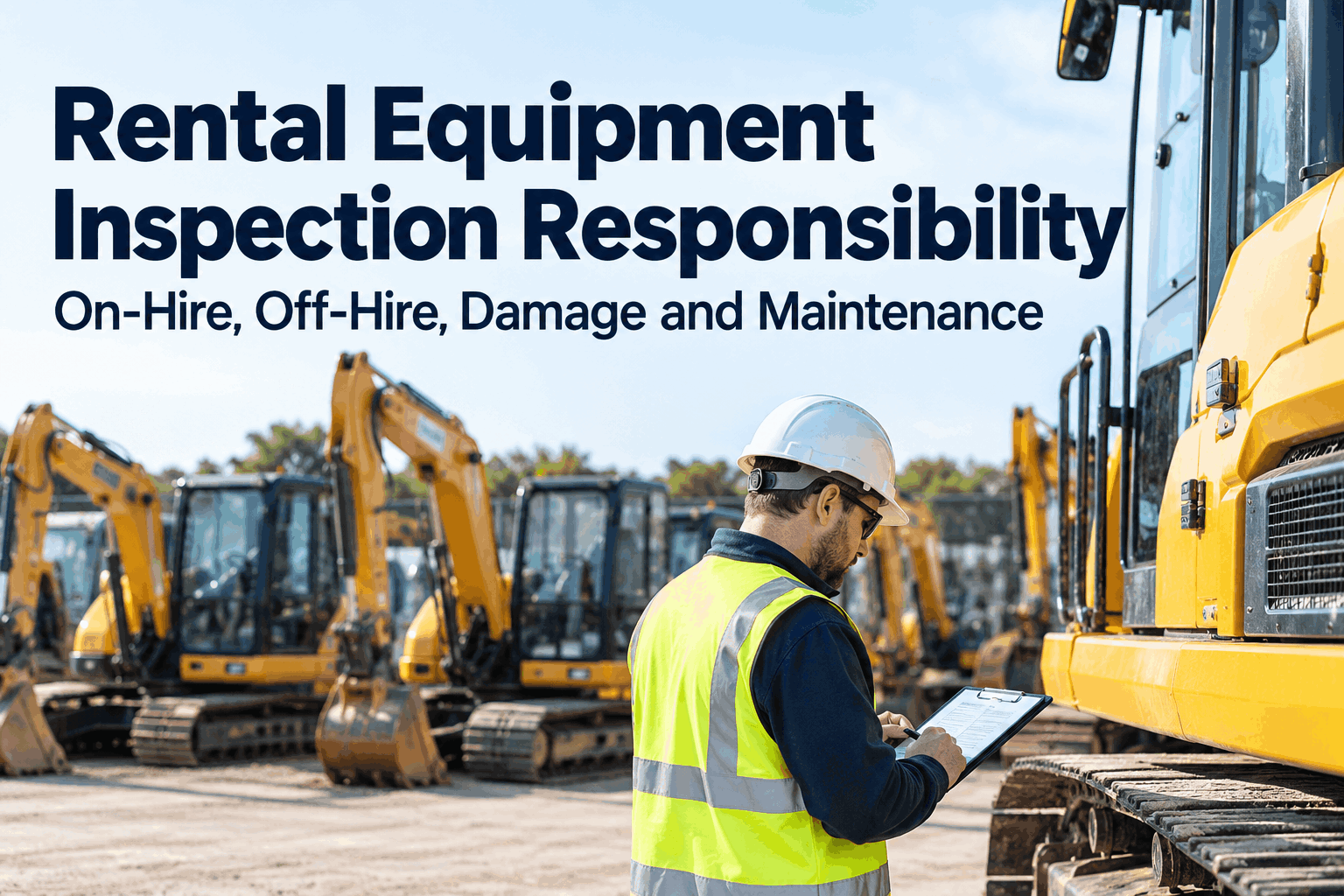
Rental equipment inspection responsibility can become unclear when a machine moves between an owner, rental company and hirer. A documented on-hire condition check, clear defect reporting process and comparable off-hire inspection help prevent avoidable disputes. The exact legal and maintenance duties depend on the hire agreement, equipment type and local safety requirements.
Rental Equipment Inspection Responsibility: Know Who Checks What, and When
Protect rental profitability and customer relationships with consistent handover checks, dated condition evidence, documented maintenance and a fair return process.
Who Is Responsible for Rental Equipment Inspections?
There is no universal rule that puts every inspection and repair on one party. Owners, rental providers and hirers may have overlapping duties. Contracts should allocate routine checks, scheduled servicing, statutory examinations, breakdown response and costs without attempting to waive non-transferable legal obligations.
| Activity | Rental company / owner | Hirer / operator | What to verify |
|---|---|---|---|
| Pre-delivery condition | Usually prepares and documents safe condition | Reviews condition at receipt | Agreement, delivery report, photos |
| Pre-use checks | Provides instructions and agreed support | Usually performs checks during use | Equipment rules and local law |
| Scheduled maintenance | As allocated by hire terms | Coordinates access and use restrictions | Service schedule and responsibilities |
| Defect notification | Receives, assesses and arranges agreed action | Reports promptly; stops unsafe use | Reporting channel and response time |
| Off-hire condition | Inspects and documents return condition | Participates or receives report | Baseline comparison and acceptance |
| Damage charges | Documents basis and repair costs | Reviews evidence and contractual allocation | Fair wear, exclusions, insurance terms |
Important: This is an illustrative allocation, not legal advice. Lifting equipment, road vehicles, powered access and regulated plant may require specific inspections, examinations or certificates by competent persons under local law. A hire contract cannot remove applicable statutory duties.
Need records that show who inspected and when? Book a demo to review HVI inspection histories and equipment records.
Build a Defensible On-Hire Condition Report
The on-hire inspection establishes the baseline for later damage comparisons. Complete it before the machine is put into service, with enough detail to identify the exact asset and its existing condition.
On-hire equipment inspection checklist
Record exceptions explicitly. “Good condition” alone is rarely enough to resolve a later disagreement.
Want a consistent digital handover process? Start free to create and retain rental equipment inspection records.
Maintenance and Defect Responsibility During the Hire Period
Long-term rentals need more than a signed delivery sheet. Define how pre-use checks are performed, who schedules maintenance, what happens when defects are found and how the equipment is taken out of service when unsafe.
Hirer-side controls
- Use competent, authorized operators and follow site rules.
- Carry out agreed daily or pre-use checks.
- Report abnormal noises, leaks, damage and faults promptly.
- Stop unsafe operation and protect the machine from further damage.
- Record incidents, meter readings and operating conditions.
Rental provider controls
- Supply suitable equipment and agreed documentation.
- Maintain the agreed preventive service schedule.
- Assess reported defects and arrange appropriate repairs.
- Record work performed, parts and return-to-service decisions.
- Coordinate replacement equipment when contractually required.
On-Hire vs Off-Hire: Compare the Same Evidence
Use the original checklist, photo angles and equipment identifiers at return. Separate pre-existing damage, expected wear, new damage and unresolved mechanical faults before discussing charges.
Before dispatch
- Meter: 1,240 hours
- Existing scrape on left counterweight
- Hydraulic hoses visually intact
- Attachment photographed from both sides
- Operator acceptance recorded
At return
- Meter: 1,392 hours
- Same scrape: not a new charge
- New hose abrasion: investigate cause
- Attachment wear: assess against usage
- Return photographs and findings shared
Do not equate every change with chargeable damage. Normal wear, accidental damage, misuse, latent defects and poor maintenance can have different contractual consequences. Assess causation, fair wear clauses, evidence and any applicable insurance excess.
Keep Condition Records Connected Across the Hire
See how HVI inspection records, photos, defect tracking and maintenance histories can help teams compare equipment condition and retrieve supporting evidence.
Example: A Disputed Hydraulic Hose Repair
A rented excavator returns with abrasion on a hydraulic hose. The rental company requests repair costs, while the hirer says the hose was already worn. The investigation should follow the evidence, not the assumption that the last user caused the problem.
Excavator EX-204 · Hose abrasion at return
Baseline
Review on-hire photos, inspection findings and the hose's visible condition at dispatch.
Hire history
Check defect notifications, site reports, operating hours and maintenance interventions.
Technical review
Have a competent person assess wear mechanism, hose routing, damage age and repair needs.
Commercial decision
Compare evidence with the hire terms, fair wear allowance, insurance and documented costs.
Possible outcome: If baseline photographs clearly show intact routing and the investigation supports external abrasion during hire, a documented claim may be appropriate. If the evidence is incomplete or points to a pre-existing defect, assigning full responsibility to the hirer may be unjustified. Keep conclusions proportional to what the records establish.
A Six-Stage Rental Inspection Workflow
A repeatable handover and return process reduces missing evidence and clarifies escalation. Make the workflow practical for dispatch teams, field operators, technicians and rental administrators.
Review agreement
Confirm maintenance duties, inspection rules, damage terms and notice periods.
Inspect on-hire
Capture asset identity, meter readings, defects and photographs.
Confirm acceptance
Share condition records and document handover exceptions.
Monitor hire
Track routine checks, defects, repairs and scheduled service.
Inspect off-hire
Repeat checklist and photo views; compare against baseline.
Close fairly
Resolve exceptions with evidence and archive final records.
Need repeatable digital checks across rental locations? Book a demo to explore HVI checklists and defect records.
Rental Equipment Documentation Checklist
Not every document applies to every machine. Select records based on the asset, local requirements, customer site and hire agreement; then check validity before dispatch and at relevant intervals.
Equipment identity
✓ Serial number and asset ID
✓ Model and attachment inventory
✓ Hour-meter or odometer reading
✓ Delivery and return dates
Safety and maintenance
✓ Inspection and service history
✓ Applicable examination certificates
✓ Defect reports and repair closure
✓ Operator manuals and instructions
Commercial evidence
✓ Signed or acknowledged condition reports
✓ Dated photographs and damage notes
✓ Hire terms and insurance details
✓ Repair estimates and dispute correspondence
For regulated equipment, verify that required examinations or certifications remain current throughout the relevant hire period. A digital record helps retrieval but does not replace the actual competent inspection or legally required certificate.
Track the Rental KPIs That Reveal Inspection Gaps
Rental inspection programs should improve equipment readiness and reduce avoidable disputes. Review these measures by branch, equipment category and customer where the data is available.
On-hire inspection completion
Completed documented handovers ÷ total dispatches.
Off-hire inspection completion
Completed return inspections ÷ total returns.
Open safety defects
Unresolved defects requiring restriction or repair.
Overdue preventive service
Assets past an agreed service threshold.
Damage dispute rate
Disputed damage claims ÷ completed hires.
Time to close claims
Elapsed time from documented claim to resolution.
How HVI Helps Organize Rental Equipment Inspection Evidence
HVI can serve as the operational record layer behind rental inspections. Consistent asset identifiers, digital inspection records, photographs, maintenance histories and defect follow-up make it easier to retrieve the information needed for a fair review.
Digital inspection checklists
Use structured checks at dispatch, during hire and return.
Photo-backed condition records
Keep visual evidence associated with the equipment and inspection.
Maintenance and defect history
Trace reported problems, completed work and follow-up actions.
Record access and exports
Retrieve relevant records for authorized teams and customer discussions.
Excavator EX-204
See how your rental team could use these records: Book a Demo — Simplify Rental Equipment Inspections with HVI.
Rental Equipment Inspection Responsibility FAQs
Who is responsible for inspecting rented equipment?
Responsibility is shared or allocated according to applicable law, equipment type and the rental agreement. Rental providers commonly inspect before supply, while hirers typically perform required pre-use checks during operation. Certain statutory duties may apply regardless of contractual wording.
What should an on-hire inspection include?
It should identify the asset, meter reading, existing damage, operating condition, safety systems, relevant certificates, accessories and any exceptions. Dated photographs and a documented handover acknowledgment strengthen the condition baseline.
Who pays for rental equipment damage?
That depends on the contract, evidence, cause of damage, fair wear provisions and insurance terms. A condition difference alone does not establish fault. Review the on-hire baseline, usage records, technical findings and itemized repair costs.
How is an off-hire inspection different from an on-hire inspection?
On-hire establishes the machine's condition before use. Off-hire documents its condition at return and compares it with that baseline, accounting for normal wear, agreed usage and any documented repairs or incidents.
Can HVI help with rental damage disputes?
HVI can help teams capture and retrieve inspections, photographs, defect records and maintenance history. Those records can inform a dispute review, but HVI does not automatically determine legal liability, fair wear or insurance coverage.
Make Every Rental Handover Easier to Prove
From on-hire condition checks to off-hire comparisons, keep the records your team needs to investigate defects, resolve questions and protect rental relationships.