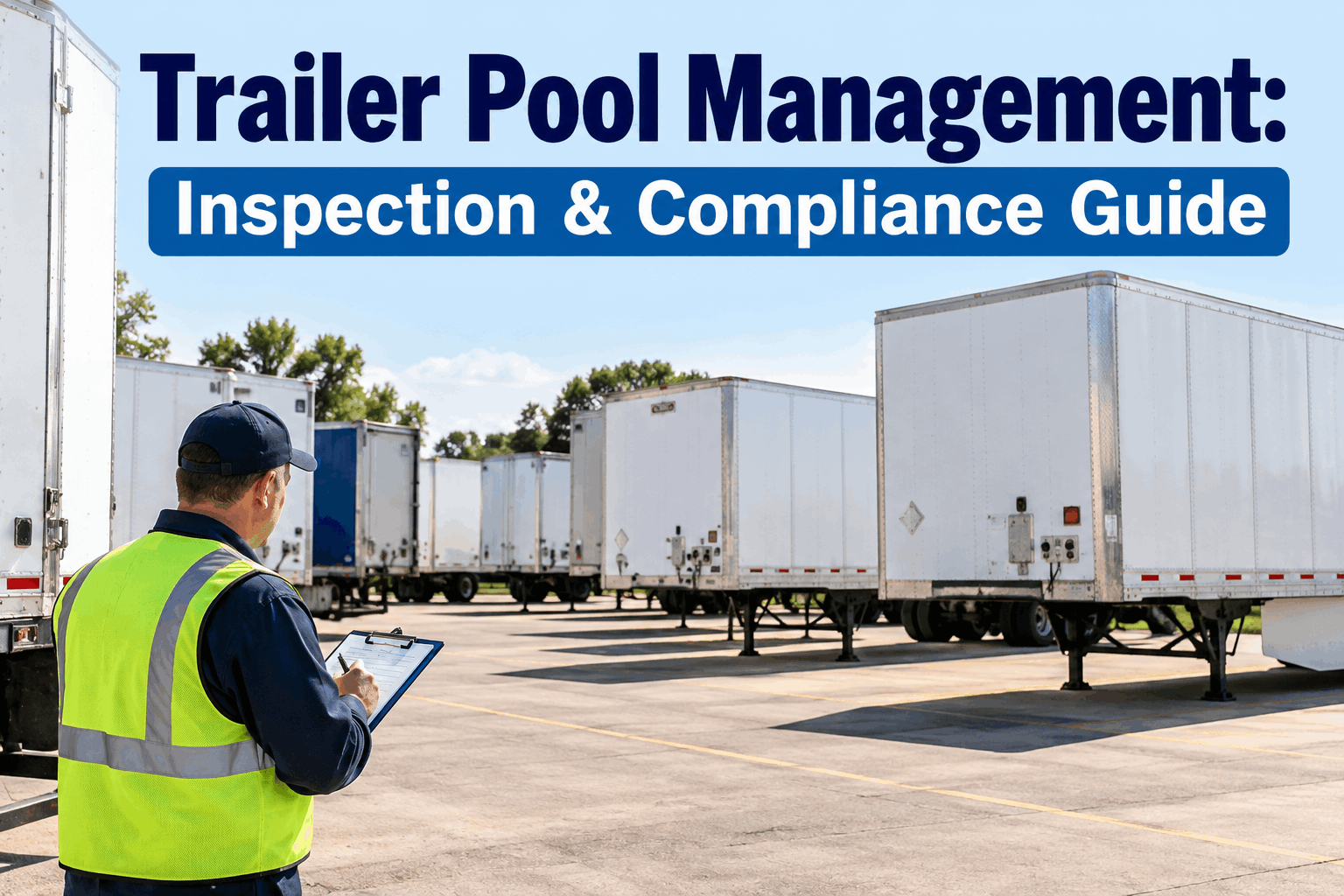
Trailer pool management is where fleet accountability quietly falls apart. When one trailer passes through several drivers, carriers and yards, "someone else will handle it" becomes the plan — until a missed annual inspection or a damage dispute lands on your desk. The trailer that belongs to everyone ends up belonging to no one. Book a demo to see every shared trailer tracked per unit.
When Every Driver Uses It, Who's Responsible for It?
Pooled and drop trailers move between carriers, drivers and yards — and the responsibility for inspections, defects and damage goes missing in the handoffs. A single record per trailer closes that gap.
Here's the full picture — why shared trailers create a responsibility gap, the five problems pooled equipment causes, how a pickup inspection and timestamped photos protect you in a dispute, and how HVI keeps every trailer in the pool visible with its own inspection clock, defect log and cost trail.
The responsibility gap in a shared trailer poolwhy "everyone's trailer" becomes "nobody's trailer"
An owned trailer has a clear home; a pooled one changes hands every few days, and at each handoff the question of who's accountable gets a little blurrier. That blur is where compliance and liability quietly fall through.
- One carrier, one yard, one schedule
- A name owns the inspection date
- Damage traced to a known operator
- Many carriers, yards and drivers
- No one owns the annual clock
- Damage becomes a he-said dispute
Closing the gap doesn't mean owning the trailers — it means giving each one a record that travels with the unit, like you would your owned trailer annual-inspection readiness. Book a demo to see a pooled trailer tracked like an owned one
The 5 problems pooled trailers createwhat shared trailer management has to solve for
Trailer pool management isn't one problem — it's five distinct ones that all trace back to the same missing record. Solve visibility per asset and each of these gets manageable.
Interchange agreements define who's liable, but without a condition record at each handoff, "who owns this problem" is a guess. Responsibility has to be captured at pickup and dropoff, not assumed after the fact when a claim already landed.
A trailer's 12-month DOT inspection clock keeps ticking at a drop yard where no one owns the schedule. Whoever hooks it next inherits the violation — and the fine, the out-of-service time, and the CSA hit that follow it.
A driver on a shared trailer often has no easy way to log a fault against a unit that isn't "theirs," so brake and light defects ride along unrecorded until they surface at a roadside stop or, worse, in a crash investigation.
Without timestamped proof of condition at pickup, a pre-existing dent becomes your bill. The party that documented it wins the dispute; the party that didn't pays — and on shared equipment, that's usually whoever had it last.
Repair and maintenance spend gets booked to a truck or a lump account instead of the trailer that incurred it, so no one sees which pooled units are money pits — or which counterparty should be billed back for the damage.
Every one of these disappears when the trailer carries its own record — owner, inspection date, defects, photos and costs — that travels with the unit instead of the driver. It's the same discipline behind proper trailer inspection requirements, applied to equipment nobody fully owns. Start free and give every pooled trailer its own record.
The pickup inspection is your best defensetimestamped photos settle drop trailer disputes before they start
The most valuable habit in trailer pool management costs two minutes: photograph the trailer at pickup, before it leaves the yard. Documented pre-existing damage is your primary protection against a claim — undocumented damage is presumed yours.
- Damage found later is presumed yours
- No timestamp to prove condition at handoff
- Dispute comes down to your word vs theirs
- You eat a repair you didn't cause
- Pre-existing damage logged before you roll
- Timestamp and asset ID prove the condition
- Evidence attached to the trailer's record
- Claims resolve in minutes, not weeks
The trick is making it effortless enough that drivers actually do it — a few tapped photos on a phone, attached to the right trailer automatically. That same evidence trail is what makes chassis and trailer DVIR reporting hold up under an IEP audit. Book a demo to see pickup photos attached to the trailer automatically
One visibility record for every trailerowned and pooled units on the same screen
The end state is simple: every trailer — owned, leased, pooled or dropped — shows up in one place with the same five facts, and the record follows the unit, not whoever's pulling it. A new driver or a fresh yard never resets the history.
Owner & location
Who holds it now and where it sits, updated at each handoff.
Inspection due date
The annual clock, with alerts before it lapses.
Open defects
Faults logged against the trailer, not lost with the driver.
Photo evidence
Pickup and dropoff shots timestamped to the unit.
Cost by asset
Repair spend booked to the trailer that earned it.
Utilization and dwell time fall out of the same record, so you can finally see which pooled trailers earn their keep and which just sit — often a pool that looked too small is just poorly tracked. Start free and put every trailer on one screen.
The 5 handoff moments to capturewhere the record has to update as a pooled trailer moves
A shared trailer's record only stays honest if it's updated at the points where custody changes. These are the five moments in every pool cycle where a quick capture keeps responsibility and compliance intact.
Miss any one of these and the chain of custody breaks — which is exactly the moment a dispute or a lapsed inspection slips through. Book a demo to see each handoff captured automatically
Spreadsheet tracking vs. a live trailer recordwhy manual pool tracking falls apart at the first handoff
Most fleets try to manage the pool in a spreadsheet. It holds up until the first trailer changes hands off-hours, the tab goes stale, and a lapsed inspection surfaces at a roadside stop. Shared equipment moves too fast for a file someone has to remember to update.
- Updated by hand, if someone remembers
- Inspection dates go stale and get missed
- Photos live on phones, not on the trailer
- No proof of who held it when damage appeared
- Each trailer is a tracked asset, owned or pooled
- Annual-inspection alerts fire before the lapse
- Pickup photos attach to the unit automatically
- Full custody and defect history per trailer
When the record updates itself at each handoff, the pool stops being a blind spot and becomes just another set of assets you can see. Book a demo to see a live trailer pool record
From a fleet compliance officer
Our worst month was a pooled trailer that failed a roadside because its annual inspection had lapsed while it sat at a customer yard — nobody owned the date. Right behind it, a damage claim we couldn't fight because we had no pickup photos. Once every trailer, ours or pooled, got its own inspection alert and a two-tap photo at pickup, both problems just stopped. Now a shared trailer has a paper trail, not a shrug.
How HVI keeps the whole pool visiblecalendar PM, inspection alerts and photo capture per trailer
Trailer pool management works when every unit carries its own record instead of depending on whoever last touched it. HVI's Calendar PM, annual-inspection alerts and photo capture give each pooled trailer the same visibility as an owned asset.
Add each trailer as an asset
Owned or pooled, every unit gets a Calendar PM schedule and an annual-inspection date.
Get alerts before the clock lapses
Annual-inspection alerts fire ahead of the due date so a yard-bound trailer never falls behind.
Capture photos & defects per unit
Pickup photos and reported defects attach to the trailer, building a custody and evidence trail.
See how pooled and owned trailers share one screen inside HVI's inspection and maintenance platform. Line it up in a quick demo
Trailer pool management: quick answers
What is trailer pool management?
It's the practice of tracking and maintaining trailers that are shared across multiple drivers, carriers, or locations — pooled, drop, or interchanged units. The goal is to keep every shared trailer visible with a clear owner, a current inspection date, logged defects, photo evidence, and costs assigned to the right asset, so responsibility never falls through the handoffs.
Who is responsible for a shared or interchanged trailer?
Under a standard interchange agreement, the carrier in possession is generally presumed responsible for damage found during their turn — unless they documented that it existed before pickup. That's why a timestamped pickup inspection matters: it's the carrier's primary defense against a claim for pre-existing damage on equipment they don't own. The equipment provider still owns registration and titling, but day-to-day condition and compliance sit with whoever's pulling it.
Do pooled trailers still need an annual DOT inspection?
Yes. Every commercial trailer over 10,001 lbs must pass a periodic inspection at least once every 12 months under 49 CFR 396.17, regardless of who's using it or where it sits. A trailer parked at a drop yard is a common blind spot — the clock keeps ticking, and whoever hooks it next inherits any lapse as a violation.
How do you document damage on a drop trailer?
Inspect the trailer at pickup and take timestamped photos before it leaves the yard, noting any existing damage on the interchange receipt. Attaching those photos to the trailer's record — not just the driver's phone — proves the condition at handoff and protects you from being billed for damage you didn't cause. Repeat the same shots at dropoff so your period of possession is bookended with evidence on both ends.
How does HVI help manage a trailer pool?
HVI tracks each pooled or owned trailer as its own asset with a Calendar PM schedule, annual-inspection alerts, timestamped photo capture at pickup, defect logging, and cost-by-asset. Every shared trailer gets one visibility record — owner, due date, defects, photos and spend — so responsibility, compliance and disputes all have a paper trail, whether the unit is in your yard or three carriers away.
Give every pooled trailer an owner, a clock, and a paper trail
HVI tracks each shared, drop, or interchanged trailer as its own asset — Calendar PM, annual-inspection alerts, pickup photos and defects, and cost by unit. The trailer that used to belong to no one becomes fully visible, and the responsibility gap closes for good.
No credit card · Pooled & owned trailer tracking on day one
- Owner & current location
- Annual inspection date & alerts
- Calendar PM schedule
- Defects & pickup photo evidence
- Cost, utilization & dwell by asset