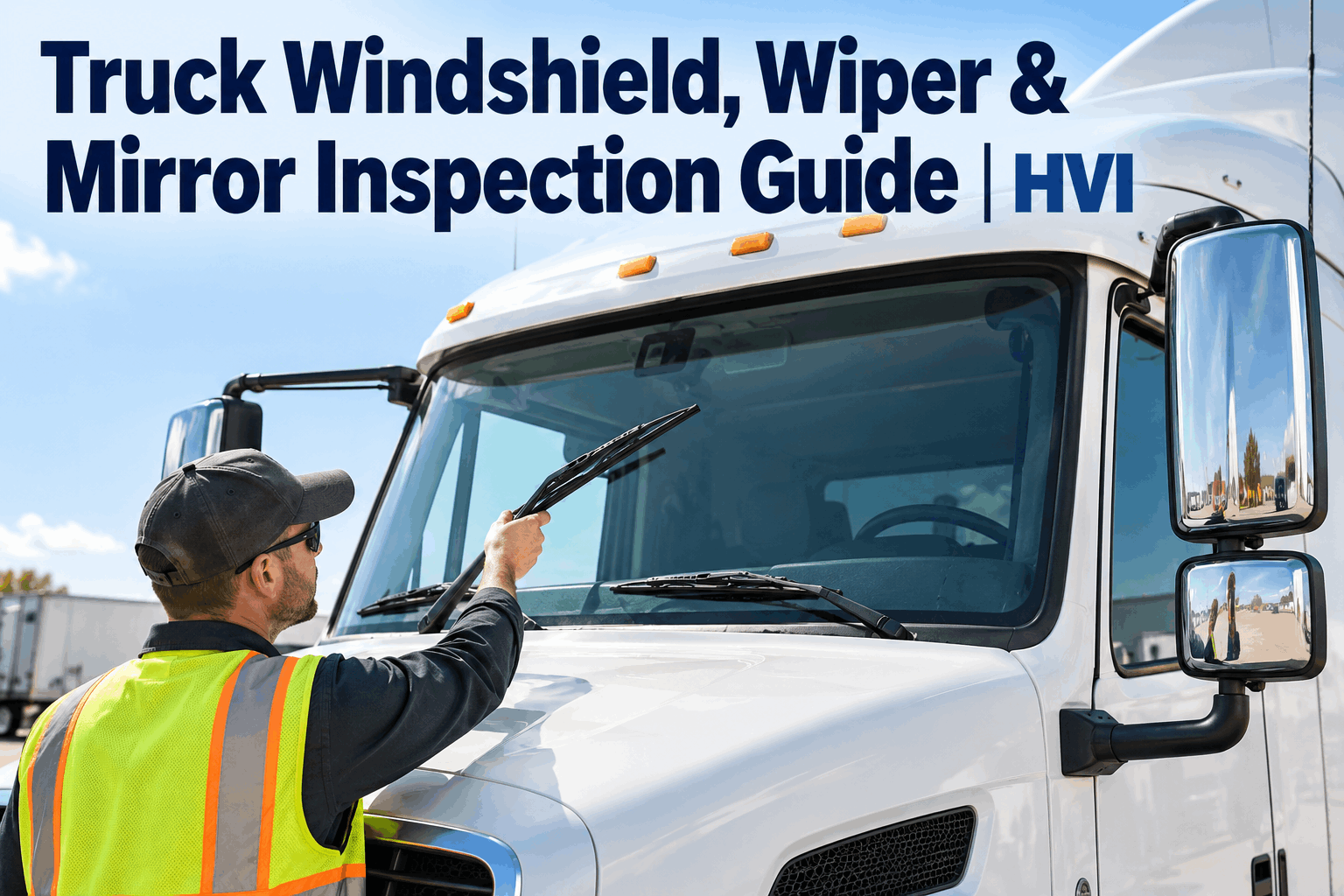
A truck windshield inspection sounds like the easiest check on the walkaround — glance at the glass, wiggle a wiper, move on. But the glass, wipers and mirrors are the driver's entire field of view, and a crack in the wrong spot, a blade that skips, or a mirror knocked out of aim can put a truck out of service or cause the wreck it was meant to prevent. Where the damage sits matters as much as whether it's there. Book a demo to see it tracked per truck.
The Same Crack Can Be Legal or Out of Service
On a truck windshield, the rule isn't just how big the damage is — it's where it sits. Right in the driver's sight line, a small chip fails. The glass, wipers and mirrors are one visibility system, and each has its own spec.
Here's the full walk — how the crack criteria actually work, why the driver's sight line is judged differently from the rest of the glass, what makes a wiper or washer a defect, how to check mirror coverage and mounting, and how to route every visibility fault so it's fixed instead of forgotten.
Windshield crack criteria — where beats how bigthe truck windshield inspection rule most drivers get wrong
The common belief is that a crack under some magic length is always fine. It isn't. The U.S. rule in 49 CFR 393.60 judges damage by location first: the area right in front of the driver — the acute area — is held to a far stricter standard than the rest of the glass, because that's where the driver actually looks down the road.
Outside that sight line, limited damage is tolerated. Inside it, almost none is. That's why two identical chips can get two different verdicts — one an inch to the side is legal, the same chip dead center is a defect. Knowing which zone a crack sits in is the whole judgment call.
- A single crack not intersected by any other crack
- A damaged spot that fits under a 19 mm (¾ inch) disc
- Such spots kept at least 76 mm (3 inches) apart
- Tint that still passes at least 70% light transmittance
- Any damage in the acute area right ahead of the driver
- Intersecting cracks that branch into each other
- Chips clustered closer than 3 inches together
- Damage large enough to distort or block the view
The acute area is defined tightly — it runs upward from the top of the steering wheel, minus a 2-inch strip at the top and a 1-inch strip at each side. If a crack touches that box, treat it as a defect and get it assessed, not waved off. HVI's DOT pre-trip inspection guide covers where glass sits in the wider walkaround. Book a demo to log a crack with its location and a photo
The three parts of the visibility systemglass, wipers and mirrors each get their own check
A driver visibility inspection isn't one item — it's three systems that have to work together. The glass has to be clear, the wipers have to keep it clear in the rain, and the mirrors have to show what the windshield can't. A fault in any one shrinks what the driver can see, so each gets checked on its own terms.
Windshield & glass
Check for cracks, chips and pitting by zone, plus tint that's too dark, hazing, or delamination that scatters light at night.
Wipers & washer
Both blades must clear the glass without streaking or chatter, the arms must hold tension, and the washer must spray and reach.
Mirrors
Every required mirror present, clean, undamaged, firmly mounted, and adjusted so the coverage areas down each side have no blind gap.
The mistake is checking only the glass because it's the obvious one. A truck can pass on a spotless windshield and still be unsafe with a blade that smears in the first downpour or a mirror vibrating loose on its arm. Start free and check all three as one guided visibility inspection.
Wiper and washer checks that actually matterwhat makes a truck wiper inspection a real pass or fail
Wipers are the part everyone assumes works until the rain hits. The federal rule requires a working wiping system with a blade on each side of the windshield centerline, and on modern trucks a washer that delivers fluid to the glass. A truck wiper inspection is about proving they clear the view, not just that they move.
| Item | What good looks like | Defect to flag |
|---|---|---|
| Wiper blades | Rubber clears the glass in one clean pass | Streaking, skipping, chatter, or split/hardened rubber |
| Wiper arms & tension | Arm holds the blade flat with even pressure | Weak spring, lifting at speed, bent or loose arm |
| Wiper motor & speeds | All speeds and intermittent work, parks correctly | Dead speed, won't park, slow or straining sweep |
| Washer system | Sprays both sides and reaches the swept area | Empty reservoir, clogged jets, spray misses the glass |
Run them against a wet windshield during the check, not a dry one — a blade that looks fine dry can smear badly on glass, and a dry sweep can even scratch it. Note the actual behavior, so a blade slowly going hard shows up before it fails in weather. Book a demo to capture wiper condition on every inspection
Mirror requirements and mountingthe truck mirror inspection covers coverage, not just the glass
Mirrors are what let a driver see the two-thirds of the truck the windshield never shows. A truck mirror inspection checks three things at once: that every required mirror is there, that each is clean and undamaged, and — the one people skip — that they're aimed to give continuous coverage with no blind gap down the side.
A flat main mirror each side, plus convex (wide-angle) mirrors and any fender or look-down mirrors the truck needs for its blind zones.
Glass unbroken and unhazed, backing intact — a cracked or fogged mirror distorts distance just when the driver is judging a lane change.
Bracket firm with no vibration blur, and aimed so the coverage areas overlap down each side with no gap a car can hide in.
A mirror that vibrates at highway speed is effectively useless even if the glass is perfect, so check mounting tightness, not just the reflection. Set a standard aim per truck type and re-check it after any knock. Start free and set a mirror standard every driver checks against.
Route visibility defects before they become violationsfrom a clipboard maybe to a tracked fault per vehicle
Glass, wiper and mirror defects share a weakness: they're easy to defer. A crack that's "not that bad yet," a blade that "still mostly works," a mirror that "just needs a nudge." None stops the truck today, so each gets postponed — until the crack spreads into the sight line or the blade fails in a storm. The point of the inspection is to move the fault to the shop while it's still small.
- "Windshield OK" with no note of where the crack is
- No photo to prove the location or size
- Blade flagged, then forgotten by next shift
- Same crack spreads with no record it was seen
- Crack logged with zone, size and a photo
- Defect routes to the shop as a work order
- Corrective work assigned and tracked to close
- Recurring visibility faults surface per vehicle
That per-vehicle view is where the pattern shows: a truck that keeps chewing through blades or cracking glass in the same season is telling you something a single report can't. Book a demo to see visibility defects trended by vehicle
From a fleet maintenance manager
We had a driver run a chip for weeks because it was small — but it was dead in his sight line, and it finally spread across the whole windshield on a hot afternoon. That's a full glass replacement and a truck down, from something a photo on day one would have flagged. Now every crack gets logged with where it sits, and if it's near the driver's line it's a defect, not a judgment call at the yard gate.
How HVI keeps visibility on the recordguided inspection, routed defects, per-vehicle trends
A truck windshield inspection holds up when it captures where the damage is, not just that it exists. HVI's fleet inspection, defect routing and analytics turn glass, wiper and mirror checks into photographed, routed, trended records — so a visibility fault is fixed on a schedule, not discovered at a scale house.
Inspect glass, wipers & mirrors
A guided visibility check with condition and a photo that captures exactly where a crack sits.
Route the defect & assign work
A flagged fault becomes a work order to the shop, corrective work assigned and tracked to close.
Trend issues by vehicle
Analytics surfaces trucks with recurring glass or wiper faults, so the pattern gets addressed.
See how glass, wiper and mirror checks live on one screen inside HVI's fleet inspection, alongside the rest of the walkaround in the annual inspection report. Line it up in a quick demo
Truck windshield inspection: quick answers
Can a truck pass inspection with a cracked windshield?
It depends on where the crack is and its type. Under 49 CFR 393.60, the area right in front of the driver — the acute area — must be essentially free of damage. Outside that sight line, limited damage is tolerated: a single crack not intersected by others, or a damaged spot that fits under a 19 mm (¾ inch) disc and sits at least 76 mm (3 inches) from any similar spot. Intersecting cracks or damage in the driver's line of sight will fail.
What is the "acute area" of a truck windshield?
It's the critical viewing zone directly in front of the driver. The regulation defines it as the area extending upward from the top of the steering wheel, excluding a 51 mm (2 inch) border at the top of the windshield and a 25 mm (1 inch) border at each side. Damage in this zone is judged far more strictly than damage elsewhere on the glass, because it's where the driver looks down the road.
What are the wiper requirements for a commercial truck?
49 CFR 393.78 requires a working windshield wiping system, with the standard being a blade on each side of the windshield centerline, plus a washer system on modern vehicles. For an inspection, both blades should clear the glass in a clean pass without streaking or chatter, the arms should hold tension, all wiper speeds should work, and the washer should spray and reach the swept area.
What does a truck mirror inspection check?
Three things: that every required mirror is present and the right type (flat main mirrors plus convex and any fender or look-down mirrors the truck needs), that each is clean and undamaged, and that they're firmly mounted and adjusted for continuous coverage down each side with no blind gap. A loose mirror that vibrates at highway speed is a defect even if the glass is perfect.
How does HVI help manage windshield, wiper and mirror defects?
HVI turns the visibility check into guided pass/fail items for glass, wipers and mirrors, each captured with condition and a photo — so a crack is logged with exactly where it sits. Any defect routes to the shop as a work order, corrective work is assigned and tracked to close, and its analytics surface vehicles with recurring visibility issues so the pattern gets addressed instead of re-reported.
Stop letting a small chip grow into a truck-down repair
HVI checks glass, wipers and mirrors as guided items, captures where a crack sits with a photo, routes any defect as assigned work, and trends recurring visibility faults per vehicle. The driver's field of view stops being a glance and becomes a tracked, provable record.
No credit card · Visibility inspections ready on day one
- Windshield crack zone, size & photo
- Wiper blade, arm & washer condition
- Mirror presence, damage & mounting
- Corrective work assigned & tracked
- Recurring faults per vehicle