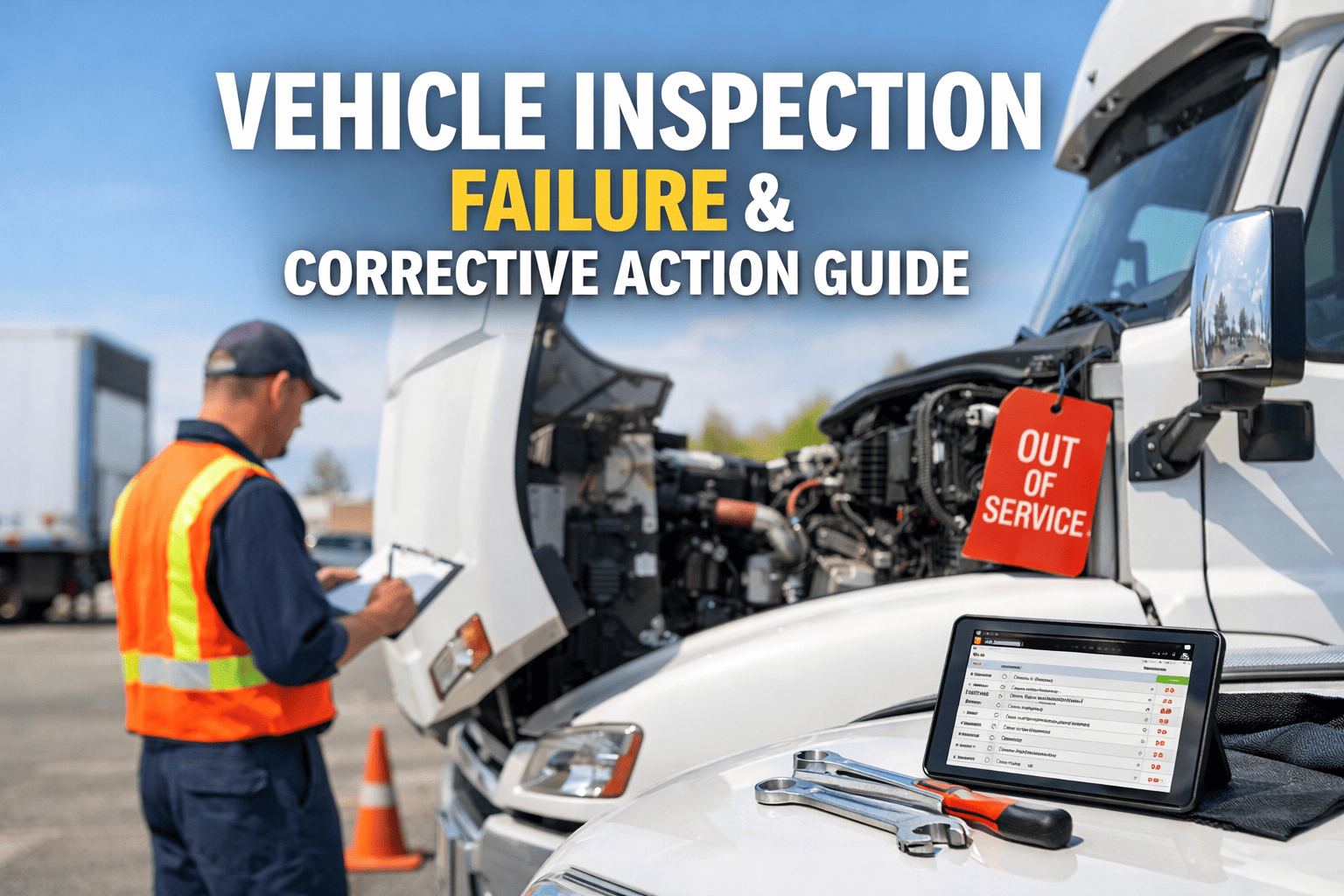
In the 2025 CVSA International Roadcheck, 22.6% of inspected vehicles were placed out of service — meaning 1 in 5 trucks failed on the spot. The vehicle could not move until every violation was corrected. But the roadside stop is only the beginning. The carrier must sign and return the completed inspection report within 15 days, certifying all violations have been corrected. That report stays on file for 12 months. The violation feeds your CSA score for 24 months. Insurance premiums increase 10-30%. Shippers check your safety data before booking loads — five of seven BASICs are publicly visible. And if an accident follows a pattern of unresolved inspection failures, plaintiff attorneys find those records and turn them into negligence evidence. The average trucking verdict reached $27.5 million between 2020 and 2023. This guide covers what happens after an inspection failure — step by step: defect severity classification, out-of-service rules, the required repair and certification workflow, the 15-day return deadline, CSA score impact, and how HVI's digital platform closes the loop from defect discovery to documented resolution. Book a demo to see the corrective action workflow, or start your free trial.
What happens after a failed inspection. Out-of-service rules, defect severity, the repair certification workflow, the 15-day return deadline, CSA impact, and how to close every corrective action loop digitally.
What Happens After a Failed Inspection
Whether the failure comes from a roadside inspection, a daily DVIR, or an annual periodic inspection, the corrective action requirements follow the same chain. Every link must be documented.
Driver or inspector finds a condition affecting safe operation. Documented with defect description, severity, and vehicle ID.
OOS defect = vehicle cannot move until fixed. Non-OOS defect = vehicle can operate but must be repaired before next dispatch cycle.
Qualified technician corrects defect. Documents parts used, labor, root cause, and completion date on original inspection report.
Carrier official or mechanic signs the original report certifying that repairs are complete or were deemed unnecessary.
Before operating, the next driver reviews the report, confirms repair status, and signs acknowledgment. Vehicle cleared for service.
Defect Severity: OOS vs Non-OOS
Not all defects carry the same urgency. The distinction between out-of-service and non-OOS determines whether the vehicle can continue operating or must stop immediately.
Vehicle cannot move until corrected. Roadside repairs or tire replacements must be completed on-site — or the vehicle must be towed. OOS violations carry CSA severity weight of 2 under the 2026 scoring system. Each is recorded and affects your carrier profile for 24 months.
Vehicle can continue operating — but must be repaired before next dispatch. Non-OOS violations carry CSA severity weight of 1 under 2026 scoring. Still recorded and visible on your carrier profile. Repeated non-OOS violations escalate audit likelihood.
Compliance Deadlines After Failure
The Cascading Cost of Unresolved Defects
How HVI Closes Every Corrective Action Loop
The most common compliance failure is not missing the defect — it is losing the paperwork between defect discovery and documented resolution. HVI eliminates every gap in that chain.
Driver flags defect with severity level and photo → maintenance notified instantly via push notification → no paper delay, no waiting until driver returns. Time from defect to awareness drops from hours to seconds.
Every defect automatically creates a maintenance work order linked to the original inspection report. Mechanic documents repair with parts, labor, root cause, and photos. No separate system. No manual transfer.
System requires driver signature, mechanic repair certification, and next-driver acknowledgment before the vehicle status changes to "cleared." No link can be skipped. Timestamps on every signature.
Fleet-wide view of every open defect, repair in progress, and pending acknowledgment. Aging defects escalate automatically. Nothing slips through. Managers see which vehicles are cleared and which are blocked.
Complete defect-to-resolution records with GPS, timestamps, photos, and digital signatures. Search by vehicle, date, defect type, or technician. Produce for auditors in seconds. Stored indefinitely — far exceeding the 12-month minimum.
The 2026 "Driver Observed" BASIC split scores items drivers should catch during pre-trip separately. HVI's documented inspections prove your drivers catch defects proactively — protecting your score even when violations occur.
Frequently Asked Questions
No. An out-of-service vehicle cannot move under its own power until every OOS violation is corrected. Repairs must be completed on-site (roadside repair) or the vehicle must be towed to a repair facility. Operating an OOS vehicle carries fines up to $19,277 per occurrence and results in automatic CSA score damage. The only exception is movement to the nearest safe location if remaining stationary creates a greater hazard — and this must be documented.
OOS violations must be corrected immediately before the vehicle can operate. For all violations (OOS and non-OOS), the carrier must sign the inspection report certifying all violations are corrected and return it within 15 days. The driver must deliver the report to the carrier within 24 hours of the inspection. A copy must be retained for 12 months. HVI automates the entire 15-day workflow with deadline alerts and digital certification. Book a demo to see it in action.
A DVIR defect is reported by your own driver during daily inspection — it triggers an internal corrective action process. A roadside OOS is issued by a CVSA inspector and is recorded in the federal SMS database, affecting your CSA scores. Both require the same corrective action chain (repair, certify, acknowledge), but roadside violations carry public visibility and CSA score impact. Catching defects on your own DVIRs before a roadside inspector finds them is the entire point of a proactive inspection program.
Failure to return the signed, corrected inspection report within 15 days is itself a violation under 49 CFR 396.9(d). It generates additional CSA points, signals to FMCSA that the carrier may not be correcting defects, and can escalate audit likelihood. During a compliance review, auditors specifically check for timely report returns. Repeated failures suggest a "non-systematic" maintenance program — one of the primary triggers for an Unsatisfactory safety rating. Start your free trial to automate 15-day tracking.
Three major changes: OOS violations now receive a severity weight of 2 (non-OOS = 1), making them more impactful. The Vehicle Maintenance BASIC splits into "Vehicle Maintenance" and "Driver Observed" — meaning defects drivers should catch during walk-around are scored separately. And the scoring window moves to 12 months (from 24). Together, these changes mean every inspection failure counts more visibly, and documented pre-trip quality becomes a direct defense.
Yes. FMCSA's DataQs system allows carriers to challenge roadside inspection violations they believe were issued incorrectly. Carriers submit a Request for Data Review (RDR) with supporting evidence — repair records, photos, technician statements, or inspection data. Successful challenges remove the violation from your CSA profile. Digital inspection records with timestamps, GPS, and photos provide significantly stronger evidence than paper records when filing DataQs challenges.
Instant defect alerts, auto-generated work orders, enforced 3-signature chain, open defect dashboard, 15-day deadline tracking, and audit-ready corrective action records — one platform that closes every loop.
No credit card • No hardware • Works offline • FMCSA-compliant records