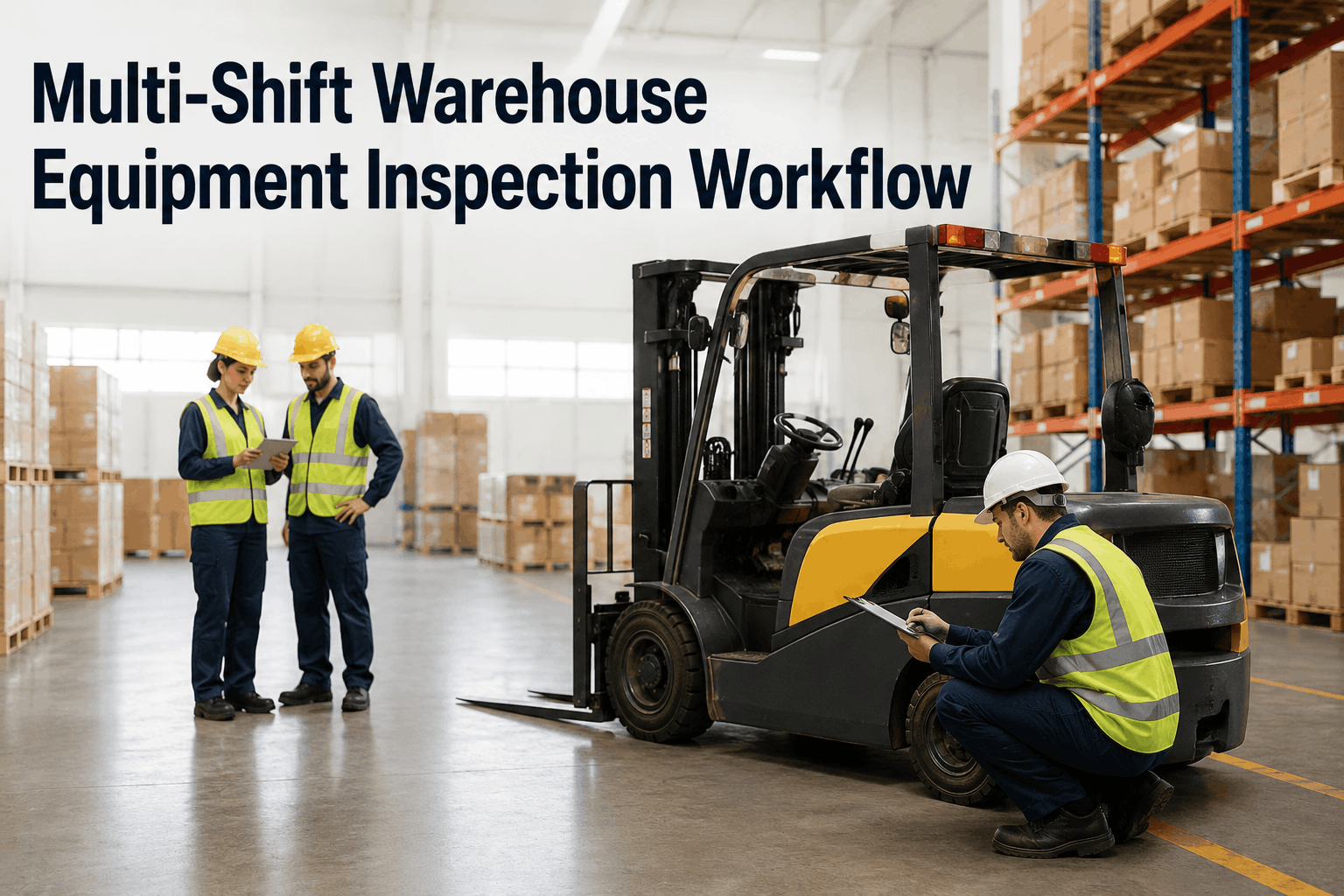
In a single-shift warehouse, a forklift gets inspected once a day and the same operator lives with whatever they find. In a 24/7 operation running two or three shifts, that same truck changes hands every eight hours — and every handover is a chance for a defect to fall through the cracks. OSHA is explicit about this: under 29 CFR 1910.178(q)(7), powered industrial trucks must be examined before being placed in service, at least daily, and where trucks run round-the-clock, they must be examined after each shift. Most warehouse managers know the per-shift rule. What trips them up is the workflow between shifts — the handover where the night operator's "the lift pulls left a little" never reaches the day operator, the end-of-shift defect that gets verbally mentioned and forgotten, and the total absence of shift-level data to see which shift, truck, or operator is generating the most problems. With 85 fatal forklift accidents and roughly 34,900 serious injuries reported annually, those gaps aren't administrative — they're the failure points. HVI's warehouse inspection software closes them by making the per-shift inspection, the handover, the end-of-shift defect rollup, and shift KPIs one connected digital workflow. This guide lays out how a multi-shift MHE inspection program should actually run. schedule a 30-minute walkthrough with our team to see it mapped to your shift pattern.
A 24/7 fleet changes hands every shift. Every handover is where defects get lost.
HVI runs the per-shift inspection, digital handover, end-of-shift defect rollup, and shift-level KPIs as one connected workflow — so a defect found at 2am is visible to the 6am crew and the office, not stuck in someone's memory.
What OSHA actually requires for multi-shift fleets
The single most misunderstood rule in warehouse MHE compliance is the per-shift requirement. For round-the-clock operations, daily isn't enough.
Before each shift
29 CFR 1910.178(q)(7) requires powered industrial trucks be examined before being placed in service, at least daily. A truck failing examination cannot be placed in service until corrected.
After each shift, round-the-clock
Where trucks are used on a round-the-clock basis, they must be examined after each shift. In a three-shift operation that's three inspections a day per truck — not one.
Document & retain
Logs must identify the truck, date, inspector, items checked, and defects. Defects are reported and corrected immediately, and records are kept one to three years per OSHA.
85 fatal forklift accidents and roughly 34,900 serious injuries are reported in U.S. workplaces each year. In a multi-shift operation, the inspection that prevents one is only as good as the handover that carries its findings to the next crew.
The multi-shift inspection loop
A 24/7 fleet runs a continuous cycle, not a once-a-day event. Each shift both inherits the last shift's machine state and hands off its own. Here's the loop — and where HVI lives in it.
Pre-shift inspection
Incoming operator runs the per-shift check before placing the truck in service — forks, mast, hydraulics, brakes, tires, controls. They also see the outgoing shift's flagged items first, so they start informed, not blind.
Shift operation
The truck works the shift. Any fault that appears mid-shift — a new leak, a warning light, a steering pull — is logged the moment it happens, with a photo, against that truck and operator.
End-of-shift rollup
At shift end, the round-the-clock post-shift examination plus a rollup of everything found — passed, flagged, and out-of-service. One clear summary instead of scattered notes.
Digital handover
The rollup carries straight to the incoming shift and the office — no verbal pass-down, no clipboard left on a desk. The next operator's pre-shift check opens with it. The loop repeats.
The handover is the weakest link in every multi-shift program — and the one paper can't hold. sign up for a free HVI account and make every shift handover a digital record the next crew actually sees, or schedule a live demo to watch an end-of-shift defect roll straight into the next shift's view.
Why the handover is where fleets break
The per-shift inspection itself is well understood. It's the space between shifts where multi-shift operations quietly lose control — these are the four failure points.
Verbal pass-down — "watch the left brake" said at clock-out never reaches the operator who clocks in two hours later
Defect left on paper — a flagged issue sits on a clipboard while the truck keeps running across the next two shifts
No out-of-service enforcement — a truck a tired operator pulled off the floor gets started again by the next shift, unaware
No shift-level visibility — the office can't see that nights logs three times the defects of days, so the pattern never gets fixed
In HVI, a critical defect locks the truck out of service automatically — no supervisor override, no "I'll report it later." The lockout persists across the shift change, so the next crew physically can't place an unsafe truck in service. sign up free and turn end-of-shift defects into enforced lockouts that survive the handover.
Shift-level KPIs the office should watch
Multi-shift data is only useful if it's sliced by shift. These are the metrics that turn three shifts of inspections into a managed operation — and HVI surfaces each automatically.
Inspection completion by shift
Percentage of required pre- and post-shift inspections actually completed, per shift. A night shift sitting at 70% completion is an OSHA exposure and a safety gap — visible instantly instead of at audit time.
Defects by shift, truck & operator
Which shift, which truck, and which operator generate the most defects. When one shift logs three times the issues, that's a training or staffing signal — not noise.
Open vs. closed defects
How many flagged items are still open at any moment, and how fast they close. This is the real measure of whether defects are being acted on or just accumulating across shifts.
Fleet status at shift start
A live dashboard showing which trucks are ready, flagged, or out of service the moment each shift begins — so a supervisor assigns equipment from fact, not assumption.
Paper handovers vs. HVI multi-shift workflow
Both run a per-shift inspection. Only one carries findings across the shift change and gives the office a shift-by-shift view of the whole operation.
Paper & verbal handover
- Night-shift findings passed verbally — or not at all
- Defect on a clipboard while the truck runs two more shifts
- An out-of-service truck restarted by the next crew, unaware
- No way to know which shift skipped inspections
- No defect patterns by shift, truck, or operator
- Audit means reconstructing three shifts from scattered paper
With HVI software
- Every handover a digital record the next shift opens with
- Defects route to a work order the moment they're flagged
- Critical items auto-lock the truck out — across shift changes
- Completion tracked per shift, gaps visible instantly
- Defect trends sliced by shift, truck, and operator
- Audit-ready records across all shifts export in seconds
inspections per truck in a 24/7 operation — before and after every shift, as OSHA requires for round-the-clock fleets. That's three times the chances to catch a defect and three handovers where it can be lost. HVI connects every one into a single workflow, cutting equipment downtime by up to 40% while keeping every shift compliant and informed.
Frequently asked questions
How often must forklifts be inspected in a multi-shift warehouse?
OSHA 29 CFR 1910.178(q)(7) requires powered industrial trucks to be examined before being placed in service, at least daily — and explicitly states that where trucks are used on a round-the-clock basis, they must be examined after each shift. In practice, that means a truck running three shifts needs a per-shift inspection at the start of each shift, and round-the-clock fleets add a post-shift examination too. So a single forklift in a 24/7 operation can require inspection three or more times a day, not once. A truck that fails examination cannot be placed in service until the defect is corrected. HVI schedules and tracks the per-shift inspections automatically for every shift.
What is a shift handover for warehouse equipment, and why does it matter?
A shift handover is the transfer of a machine's status — including any defects, flagged items, or out-of-service conditions — from the outgoing shift to the incoming one. It matters because in a multi-shift operation the same truck changes hands every eight hours, and a defect found by the night operator is useless if the day operator never hears about it. The traditional handover is verbal or a note left on a clipboard, both of which fail constantly: the message gets garbled, forgotten, or never delivered. A digital handover carries the end-of-shift defect rollup straight to the next operator's pre-shift view and to the office, so nothing depends on memory. It's the single highest-leverage fix in multi-shift MHE management.
What should an end-of-shift defect rollup include?
An end-of-shift rollup is a single summary of every inspection finding from the shift, organized so the next crew and the office can act on it immediately. It should include each truck's status (ready, flagged, or out of service), any defects found during the shift with photos and timestamps, the operator and time for each, and which items have open work orders versus closed. The goal is to replace scattered verbal notes and paper forms with one clear, carried-forward record. Combined with the round-the-clock post-shift examination OSHA requires, the rollup ensures the incoming shift starts with full knowledge of the fleet's state rather than discovering problems the hard way mid-shift. HVI generates the rollup automatically at shift end.
Which shift-level KPIs should warehouse managers track?
The most useful metrics are sliced by shift, because multi-shift problems are often shift-specific. Track inspection completion rate by shift (a night shift at 70% is a compliance and safety gap); defects by shift, truck, and operator (to spot whether one shift, one machine, or one operator is generating disproportionate issues); open versus closed defects and time-to-close (the real measure of whether findings are acted on); and fleet status at shift start (a live view of which trucks are ready, flagged, or out of service). These turn three shifts of raw inspection data into patterns a manager can act on — reassigning training, rebalancing equipment, or fixing a recurring defect. HVI surfaces all of these automatically.
How does HVI handle multi-shift warehouse inspections?
HVI runs the whole multi-shift loop as one connected workflow. Operators complete the per-shift inspection from a phone or tablet, opening with the previous shift's flagged items so they start informed. Mid-shift faults are logged in real time with photos, and at shift end an automatic defect rollup plus the round-the-clock post-shift examination carries straight to the incoming crew and the office — no verbal pass-down. Critical defects lock the truck out of service automatically, and the lockout persists across the shift change so the next crew can't restart an unsafe machine. Managers get shift-level KPIs — completion by shift, defects by shift/truck/operator, open versus closed, and live fleet status at shift start — plus audit-ready records across all shifts that export in seconds, cutting downtime by up to 40%. schedule a demo and we will set it up around your specific shift pattern and fleet on the call.
Make every shift handover a record the next crew actually sees.
HVI connects per-shift inspections, digital handovers, end-of-shift defect rollups, and shift-level KPIs into one workflow built for 24/7 warehouse fleets. Stop losing defects between shifts and discovering them the hard way. Meet OSHA 1910.178(q)(7) on every shift, keep unsafe trucks locked out across handovers, and see your whole operation shift by shift. Sign up free today.
No credit card required · Live in under two weeks · Per-shift inspections + handovers + defect rollups + shift KPIs in one platform