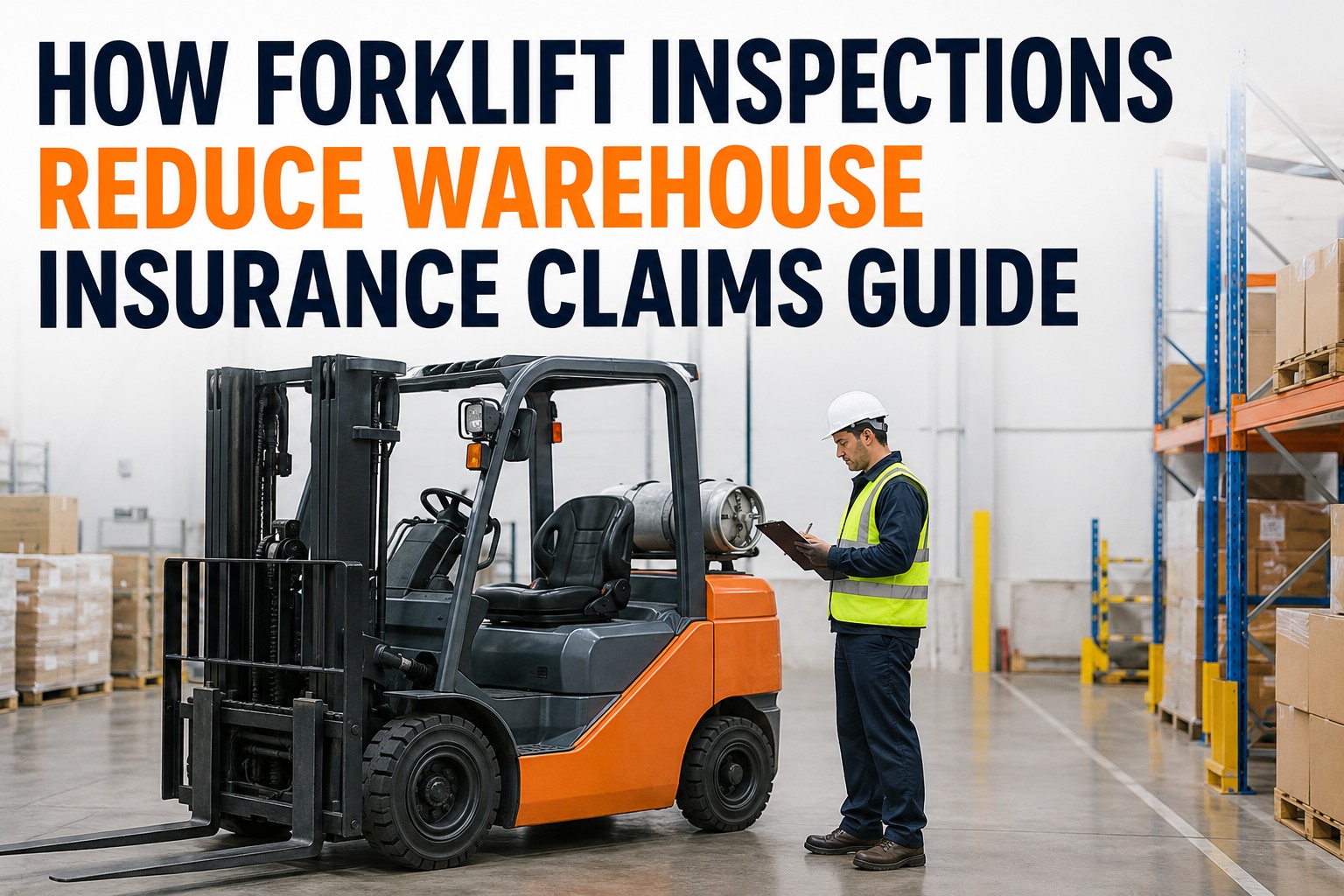
Every forklift claim starts as a moment nobody documented. A brake that felt soft at shift start and never got written up. A hydraulic leak someone meant to report. A mast chain stretched past its limit that no one measured. Then a load drops, a rack gets hit, or an operator gets pinned — and now it's a workers' comp file, an equipment-repair invoice, an OSHA citation, and an insurance premium that climbs at renewal and stays up for years. The numbers are sobering: forklifts cause around 97,000 injuries a year in the U.S. — 35,000 serious, 62,000 non-serious — and roughly 85 to 100 deaths, with a single injury costing $38,000 to $41,000 in direct workers' comp alone and far more once legal and indirect costs land. The encouraging half of the data is that about 70% of forklift accidents are preventable, and the pre-shift inspection is the cheapest, most direct control there is. This article connects the dots insurers already connect — from a missed daily check to a filed claim — and shows how a documented inspection program breaks that chain at the first link. HVI's warehouse inspection & maintenance software puts the OSHA daily check on every operator's phone and builds the record that protects you when a claim comes. Book a 30-minute walkthrough to see it for your fleet.
Every forklift claim starts as a defect nobody wrote down. The daily inspection is where you write it down.
Documented daily forklift inspections cut the accidents, equipment damage, and compliance failures that drive warehouse insurance claims — and build the paper trail insurers and OSHA ask for. HVI inspection & maintenance software runs the OSHA pre-shift check on a phone, tags unsafe trucks out of service, raises work orders on defects, and keeps a timestamped record for every lift — fully offline on the floor.
The claim problem, in numbers
Forklifts punch far above their weight in warehouse risk. These are the figures that show up in loss runs and drive premium decisions — and every one of them is something inspections touch.
A forklift injury doesn't cost $40,000 once. It costs the claim, then the premium increase at renewal, then the years an insurer flags the account as higher-risk — plus repair bills, lost productivity, retraining, and the OSHA fine if the inspection paperwork isn't there. The daily check is the single cheapest place to interrupt that entire cascade.
How a missed check becomes a claim
Claims don't appear out of nowhere — they follow a chain. A documented inspection breaks the chain at the first link, before the defect ever reaches the floor.
A defect goes unlogged
Soft brakes, a hydraulic leak, a worn mast chain, a bad horn — noticed but never written up, so the truck keeps running.
The failure happens
The defect fails at the worst moment — a dropped load, a rack strike, a tip-over, a pedestrian struck at a blind corner.
The claim & citation land
Workers' comp, equipment repair, and an OSHA look at your records — and with no inspection log, the missing daily check becomes its own violation.
Premiums climb, and stay up
The loss hits your record, renewal premiums rise, and the insurer flags the account as higher-risk for years to come.
The break point is link one — a defect that gets logged, tags the truck out, and becomes a work order never reaches link two. sign up free and make every daily check logged, enforced, and impossible to skip, or book a demo to see an unsafe truck tagged out of service automatically.
Where the inspection does the work
The OSHA pre-shift check targets exactly the systems behind the most common and most expensive claims. Four areas carry most of the risk.
Brakes & steering
Soft brakes and loose steering cause the collisions and dock incidents that injure operators and pedestrians. A pre-shift function test catches them before the shift, not after the impact.
Mast, forks & chains
A stretched mast chain, cracked fork, or leaking lift cylinder is how loads drop and racks get hit. Measuring wear and checking the hydraulics is the difference between a swap and a claim.
Tires & stability
Worn or under-inflated tires and an off-balance truck feed the tip-overs behind 42% of forklift deaths. Tire condition and data-plate/capacity checks keep the truck stable under load.
Horn, lights & alarms
A dead horn, backup alarm, or warning light removes the warnings pedestrians rely on at blind corners and intersections. These take seconds to test and prevent struck-by claims.
The compliance side insurers care about
Preventing the accident is half the value. The other half is proving you did your part — because a documented inspection program is what protects you when a claim or auditor arrives.
OSHA 1910.178(q)(7) requires forklifts to be examined at least daily — after each shift on round-the-clock operations — and defects found must be immediately reported and corrected. Missed daily inspections were the #4 forklift citation, and any truck found unsafe must be pulled from service until repaired.
OSHA fines reach around $16,131 per serious violation, with far more for repeat or willful ones — and total forklift penalties topped $8 million in a single recent year. A missing inspection log turns one accident into an accident plus a paperwork citation.
When a claim is investigated, the first question is whether the truck was inspected and whether known defects were corrected. Timestamped digital records answer both instantly; a missing or back-dated paper log does the opposite, and investigations of major forklift accidents repeatedly cite missing pre-use inspection records.
This is why insurers reward documented safety programs and flag the ones without them. An inspection record isn't just a compliance box — it's evidence of diligence that shapes both the claim outcome and the premium.
Paper checklist vs. HVI inspection & maintenance software
Both record the daily check. Only one enforces it, tags out the unsafe truck, and produces the timestamped proof that protects you when a claim lands.
Paper / clipboard
- Checks skipped or back-filled at the end of the day
- Defects noted, then the truck keeps running anyway
- No proof a specific truck was inspected on a date
- Logs lost, coffee-stained, or missing at audit
- No photo of the defect that caused the claim
- No visibility across trucks, shifts, or sites
With HVI software
- Pre-shift check enforced before the truck can run
- Unsafe truck auto-tagged out until repaired
- Timestamped record per truck, per shift, per operator
- Defects auto-raise a tracked work order
- Mandatory photo capture on every defect
- Missed-inspection alerts and full fleet visibility
Put the numbers together and the case writes itself: a few minutes of enforced, documented inspection per truck per shift stands between a warehouse and a cascade of claims, citations, and premium hikes that runs into six figures. The inspection is the cheapest line item in the whole equation.
Frequently asked questions
How do forklift inspections reduce insurance claims?
They break the chain that turns a defect into a claim. Most forklift claims trace back to a mechanical fault — soft brakes, a hydraulic leak, a stretched mast chain, a dead horn — that was present before the accident and could have been caught in a pre-shift check. A documented daily inspection catches that fault, tags the truck out of service until it's fixed, and prevents the dropped load, tip-over, or struck-by incident that would have become a workers' comp claim and equipment-repair bill. Because roughly 70% of forklift accidents are preventable, consistent inspections directly reduce the frequency of loss events that drive premiums. And when a claim does occur, the timestamped inspection record is evidence of diligence that shapes both the claim outcome and the insurer's view of the account at renewal. HVI enforces the check, tags out unsafe trucks, and builds that record automatically.
What does OSHA require for forklift inspections?
OSHA 1910.178(q)(7) requires that powered industrial trucks be examined before being placed in service and at least daily — and where trucks run round-the-clock, after each shift. Any condition that adversely affects safety means the truck can't be placed in service, and defects found must be immediately reported and corrected. A related provision, 1910.178(p)(1), requires that any truck found defective or unsafe be removed from service until repaired. These daily-inspection and unsafe-equipment rules are among the most-cited forklift violations year after year, with missed daily inspections ranking fourth. Beyond the pre-shift check, OSHA also mandates operator training and certification and refresher training every three years or after an accident or near-miss. Fines run to about $16,131 per serious violation. HVI is built to satisfy the daily-inspection and remove-from-service requirements with a timestamped, auditable record.
What should a daily forklift inspection cover?
The pre-shift check targets the systems behind the most common claims. Brakes and steering get a function test, since soft brakes and loose steering cause collisions and dock incidents. The mast, forks, and lift chains are checked for cracks, stretch, and hydraulic leaks — the faults behind dropped loads and rack strikes. Tires are checked for wear and inflation, and the load capacity and data plate confirmed, because worn tires and overloading feed the tip-overs behind a large share of fatalities. Safety warnings — horn, backup alarm, lights, seatbelt — are tested because they protect pedestrians at blind corners. And fluid levels, leaks, the overhead guard, and forks round it out. Both a visual walkaround and an operational check (with the truck running) are part of a complete inspection. HVI delivers all of it as a phone checklist that enforces completion before the truck can be used.
Why do missing inspection records make accidents more expensive?
Because they add a second, avoidable cost on top of the accident itself. When a serious forklift accident is investigated, one of the first things OSHA and insurers look for is whether the truck was inspected and whether any known defects were addressed. If the daily inspection was never done — or was done on paper that's now missing or can't be trusted — that becomes its own citation under 1910.178(q)(7), separate from whatever caused the accident. Investigations of major forklift incidents repeatedly cite missing pre-use inspection records as a contributing failure. Just as damaging, the absence of records undermines your position on the workers' comp claim and signals to the insurer that the safety program is weak, which affects premiums at renewal. Timestamped digital inspection records flip all of that: they demonstrate diligence, answer the investigator's first question instantly, and protect the account.
How does HVI's inspection & maintenance software help a warehouse?
HVI turns the OSHA daily forklift check into an enforced, documented program that directly reduces claims exposure. Operators complete the pre-shift inspection on a phone or tablet before the truck can be used, so the check can't be skipped or back-filled, and a missed-inspection alert fires if a truck isn't checked. Any failed safety-critical item automatically tags the truck out of service until it's repaired — satisfying OSHA's remove-from-service requirement — and raises a tracked work order with mandatory photo capture, so a known defect can't quietly keep running. Every inspection is a timestamped record tied to the truck, shift, and operator, giving you the exact proof an investigator or insurer asks for after a claim, and preventive maintenance is scheduled per truck to keep the fleet reliable. Managers get visibility across every truck, shift, and site, and it all works offline on the warehouse floor. The result is fewer accidents, a defensible compliance record, and a stronger position at renewal. book a demo and we'll set it up around your specific fleet and facility on the call.
Break the chain at link one — before it becomes a claim.
HVI inspection & maintenance software enforces the OSHA daily forklift check, tags unsafe trucks out of service, raises work orders on defects, and keeps a timestamped record for every lift, every shift — all working offline on the floor. Cut the accidents, citations, and premium hikes that a skipped inspection sets in motion.
No credit card required · Live in under two weeks · Enforced daily checks + auto tag-out + work orders + timestamped OSHA records, fully offline
.png)