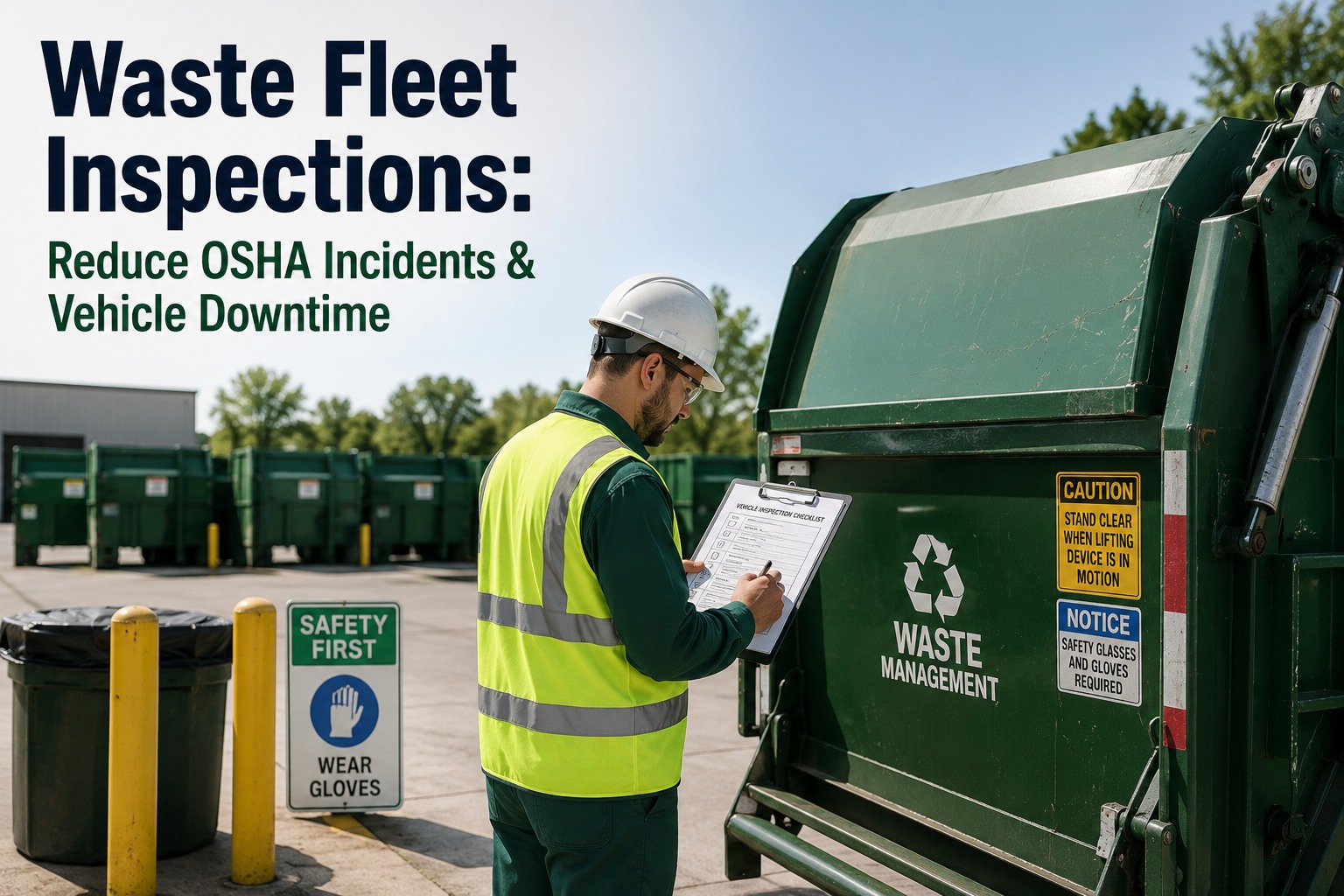
Most serious garbage-truck injuries don't come out of nowhere — they come at the end of a chain that started with something an inspection would have caught. A hydraulic interlock that wasn't tested, a riding step worn smooth, a backup alarm that stopped working, a pinhole leak in a hydraulic line nobody red-tagged: each is a small, visible defect, and each sits one link away from a crush, a fall, a reversing strike, or a fluid-injection injury. That's what makes refuse different from almost any other fleet. OSHA publishes no refuse-collection-specific standard, so enforcement runs through the General Duty Clause and the ANSI Z245.1 safety standard for mobile refuse and compaction equipment — meaning the program that protects your crews isn't a federal form, it's your own daily inspection, reversing protocol, and lockout discipline. And the same defect that threatens a worker usually threatens the route, because mechanical failure drives a large share of truck breakdowns and a truck down mid-route costs well over a thousand dollars an hour. This guide works backward from the incident: the chain that leads to a refuse injury, the few defects that start it, the daily check that breaks it, and how the body type changes the risk. book a 30-minute walkthrough to see it on your fleet.
Every refuse injury is the last link in a chain. The daily inspection breaks the first one.
HVI digitizes the refuse DVIR — hydraulic interlocks, packer and hopper guards, riding steps, backup alarms and cameras, brakes and hydraulics — red-tags the defect that starts the chain, auto-creates the work order, and keeps the photo-and-GPS record that survives an OSHA inspection.
How a refuse incident actually unfolds
Serious injuries follow a predictable sequence. Seeing the chain shows exactly where a daily inspection cuts it off — almost always at the very first link.
A small defect goes unrecorded
A hydraulic interlock that doesn't fully engage, a worn riding step, a weeping hydraulic fitting, a dead backup alarm — minor, visible, and easy to miss on a rubber-stamped paper form.
The truck goes out anyway
Without a check that catches and red-tags the defect, the truck runs its route with the failure latent — the guard that won't stop the blade, the step that won't hold a boot.
A routine moment turns dangerous
A worker clears a jam, steps onto the riding platform, or stands behind the truck during backing — the everyday actions of the job, now without the safeguard that was supposed to be there.
The incident
Crush in the packer, fall from the step, reversing strike, or a fluid-injection injury — a lost-time injury, a workers' comp claim, and OSHA in the yard, all traceable to link one.
The whole point of a daily inspection is to break this chain at step one, where it's cheap and harmless — a logged defect and a red tag — instead of at step four, where it's a hospital and an investigation. A paper form that gets initialed without a real check leaves every link intact. HVI makes the chain-breaking check required and photo-verified.
The four defects that start most chains
A handful of small, inspectable failures sit at the root of most serious refuse injuries. Each has a hazard it leads to and a check that stops it.
Packer / hopper interlock fails
A worker clearing a jam is caught in the compaction blade — lockout/tagout failure is the root cause.
The check
Daily hydraulic-interlock test, guards and emergency stops confirmed, strict LOTO before any blade work.
Backup alarm or camera dead
A worker on the ground is run over during a reversing maneuver — backing is the deadliest moment of the route.
The check
Backup alarm audible, 360° cameras and sensors working, mirrors clean — the SWANA backing protocol needs working devices.
Pinhole hydraulic leak
High-pressure fluid injects through the skin — a surgical emergency from a leak the size of a pin.
The check
Visual line check every shift, cardboard test for suspected leaks never a hand, red-tag any leak immediately.
Worn step or loose handhold
A helper is thrown from or slips off the rear riding step — often while the truck is in motion.
The check
Inspect step grip and handhold integrity daily; enforce ANSI Z245.1 riding rules and no backing while occupied.
Four small defects, four daily checks, four serious injuries prevented — that's the entire logic of a refuse safety program. sign up free and make each chain-starting defect a required check, or book a demo to see the hazard-mapped DVIR.
Why waste has no federal checklist — and what that means
The regulatory gap is the single most important thing to understand about waste-fleet safety. It shifts the entire burden onto your own program.
The General Duty Clause
With no refuse-specific rule, OSHA enforces through the requirement to provide a workplace free of recognized hazards — and refuse hazards like crush, struck-by, and injection are well recognized.
ANSI Z245.1
The consensus standard for mobile refuse collection and compaction equipment — covering guarding, controls, and the riding-step rules that govern how crews work the back of the truck.
Your internal program
Because there's no form handed to you, your daily inspection and its documentation are both the protection and the proof — the recognized-hazard control OSHA looks for when it arrives.
This is why documentation matters so much in waste: a paper DVIR that disappears leaves you with no evidence of a control, while OSHA does not accept "the records are at another office." A mobile DVIR with photo, GPS, and signature turns a safety program into a defensible operational system. HVI keeps that record automatically on every truck, every shift.
The risk shifts with the body type
Rear, side, front, and roll-off trucks don't share the same chain — the loading mechanism moves the hazard, and the inspection follows it.
Crew on the back means the highest exposure to step falls, hopper crush, and reversing strikes — riding steps, hopper guards, packer cycle, and rear cameras lead the check.
An automated grabber arm cuts crew exposure but adds an arm to inspect for leaks, wear, and cycle, plus the in-cab camera and control system.
Forks lift commercial bins overhead — fork condition, lift cylinders, overhead clearance, and the absolute rule against riding a container are the priorities.
A hoist with cable or hook handles open containers — the cable, hook, hoist cylinders, container locking, and load stability are the failure points.
One generic form can't cover four different loading mechanisms — the inspection has to adapt to the truck in front of the driver. sign up free and run body-specific refuse templates.
The daily DVIR that breaks the chain
This is the pre-route walk-around that catches the link-one defect. Each item is a pass-or-red-tag decision before the truck leaves the yard.
The same check that breaks the injury chain catches the developing breakdown that would strand the route — one discipline, two payoffs. sign up free and replace the paper DVIR that disappears.
Paper DVIRs vs. HVI
Both technically record a check. Only one breaks the chain at link one, red-tags the truck, and keeps the documented record that survives an OSHA inspection.
Paper / reactive
- Form initialed without a real check
- Hydraulic interlock never actually tested
- Worn step & dead alarm slip through
- Pinhole leak found after an injury, not before
- Paper DVIRs disappear before an audit
- No pattern view of route or driver risk
With HVI software
- Body-specific templates mapped to ANSI Z245 hazards
- Interlock & LOTO checks required, photo-verified
- Step, handhold, alarm & camera confirmed each shift
- Hydraulic-line check catches the leak before injury
- Mobile DVIR with photo, GPS & signature, audit-ready
- Hazard analytics surface route & driver hotspots
is where you win. Every serious refuse injury and most mid-route breakdowns trace back to a small, inspectable defect that a disciplined daily check would have caught and red-tagged before the truck rolled. Breaking the chain at link one is cheap, fast, and entirely within your control — and because waste safety rests on your own program, the documented DVIR is also your defense when OSHA arrives. HVI makes that check required, body-specific, and impossible to rubber-stamp.
Frequently asked questions
What OSHA standards apply to waste collection fleets?
OSHA does not publish a refuse-collection-specific standard, which surprises many operators. Enforcement rests on two things instead. The first is OSHA's General Duty Clause, Section 5(a)(1), requiring employers to provide a workplace free from recognized hazards likely to cause death or serious harm — and refuse hazards like hopper crush, reversing strikes, and hydraulic injection are well-recognized. The second is the consensus standard ANSI Z245.1, Safety Standards for Mobile Refuse Collection and Compaction Equipment, covering guarding, controls, and the riding-step rules for crews. Because there's no federal checklist handed to you, the program that actually protects your drivers and helpers is your own — your daily inspection, reversing protocol, and lockout discipline — and your documentation of it is your defense in an inspection. A documented daily DVIR is the backbone. HVI's inspection and maintenance software builds the ANSI Z245 hazard points into refuse-truck templates and keeps the audit-ready record. sign up free and build your defensible program.
What are the most common serious injuries on a garbage truck?
Most serious refuse injuries fall into four categories, and each starts with a small inspectable defect. Packer or hopper crush happens when a worker clearing a jam is caught in the compaction blade, with lockout/tagout failure as the root cause — the control is a daily hydraulic-interlock test and strict LOTO. Reversing strikes, where a ground worker is run over during backing, are countered by a working backup alarm, 360-degree cameras and sensors, and a spotter protocol. Hydraulic injection injury is a surgical emergency where a pinhole leak forces fluid through the skin, so any leak is red-tagged and suspected leaks are checked with cardboard, never a hand. Riding-step falls — workers thrown from or slipping off the rear step, often while the truck is moving — are addressed by inspecting step grip and handhold integrity daily and following ANSI Z245.1 riding rules. Each of these is the last link in a chain that began with a defect a daily inspection would have caught. HVI's inspection and maintenance software ties each check to the injury it prevents. book a demo to see the hazard-mapped checklist.
How does a daily inspection prevent both injuries and breakdowns?
Because the defect that threatens a worker is very often the same one that threatens the route, so one inspection delivers two returns. On the safety side, catching a failed hydraulic interlock, a worn riding step, a dead backup alarm, or a pinhole leak before the route starts breaks the chain that leads to a crush, fall, reversing strike, or injection injury. On the uptime side, the same walk-around catches the developing mechanical problem — a brake issue, a hydraulic fault, a failing tire — that would otherwise strand the truck mid-route. Mechanical failure is behind a large share of truck accidents, and a truck down mid-route costs well over a thousand dollars an hour in lost productivity, so finding the fault in the yard is far cheaper than finding it on the street. Operators who inspect consistently report meaningfully higher reliability on top of the injuries they never have. It's the rare discipline that improves safety and the budget at once. HVI's inspection and maintenance software runs that dual-purpose check and tracks every defect to repair. sign up free and protect safety and uptime together.
Do different refuse truck body types need different inspections?
Yes. All refuse trucks share the chassis basics — brakes, steering, tires, lights, and fluids — but the loading mechanism differs by body type and moves the hazard. A rear loader has crew working on the back, so riding steps, hopper guards, the packer cycle, and rear cameras carry the highest priority. A side loader, often automated, adds a hydraulic grabber arm to inspect for leaks, wear, and cycling, plus its camera and control system. A front loader lifts commercial containers overhead on forks, so fork condition, lift cylinders, overhead clearance, and the prohibition on riding a container are critical. A roll-off uses a hoist with cable or hook for open containers, making the cable, hook, hoist cylinders, container locking, and loading stability the key failure points. A single generic checklist can't cover all four well, which is why a good program adapts the inspection to the body type. HVI's inspection and maintenance software provides body-specific templates for rear, side, front, and roll-off trucks. book a demo to see body-specific templates.
How does HVI help waste fleets reduce incidents and downtime?
HVI is an inspection and maintenance software platform built for the specific hazard profile of refuse collection. Drivers run the daily DVIR from a phone or tablet using body-specific templates — rear, side, front, and roll-off — that map each check to the hazard it controls under ANSI Z245.1: the hydraulic-interlock and LOTO check for packer and hopper crush, riding-step and handhold integrity, backup alarm and camera function for reversing, and the hydraulic-line inspection for injection-injury leaks, with mandatory photo capture and GPS. A defect red-tags the truck and auto-creates an assigned work order, so an unsafe vehicle is removed from service and the fix is tracked. Preventive maintenance fires on each truck's mileage and hours per the manufacturer schedule, and every DVIR is retained with photo, GPS, and signature for an audit-ready record that survives an OSHA or DOT inspection — replacing the paper DVIRs that disappear. Pattern analysis surfaces route- or driver-specific risk hotspots. book a demo and we'll map the software onto your fleet on the call.
Break the chain at link one — on every refuse truck, every shift.
HVI digitizes the refuse DVIR with body-specific templates mapped to ANSI Z245.1 hazards — hydraulic interlocks, packer guards, riding steps, backup alarms and cameras, brakes and hydraulics — red-tags the defect that starts the chain, auto-creates a work order, fires PM on mileage and hours, and keeps a photo-and-GPS record that survives an OSHA inspection. Protect your crews and keep every route running.
No credit card required · Live in under two weeks · Hazard-mapped refuse DVIRs + body-specific templates + red-tag & work orders + audit-ready records in one platform