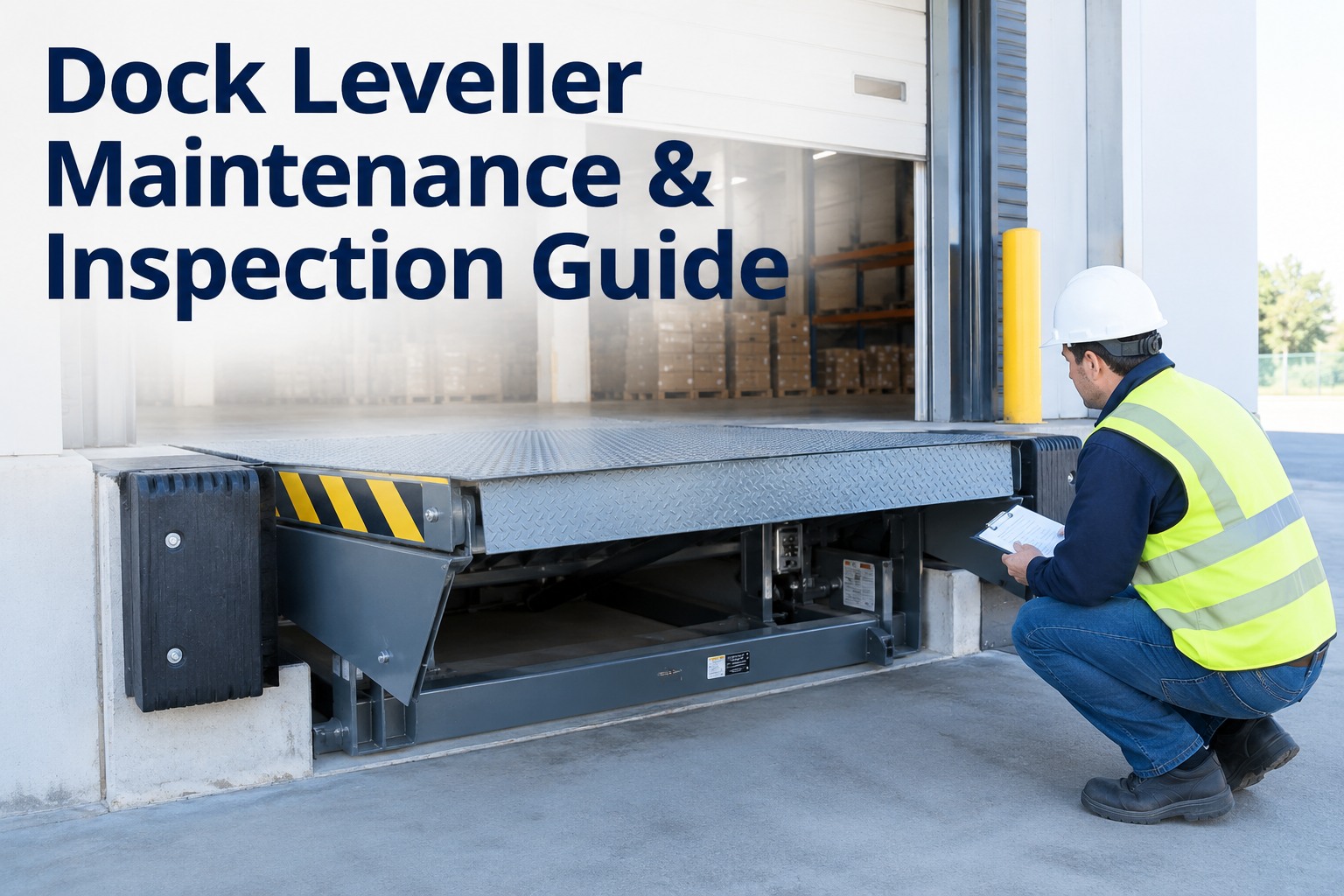
The pallet jack was halfway across when the lip dropped two inches without warning. Nobody got hurt that time, but that near-miss is the version of dock leveller maintenance most warehouses only think about after the fact. This guide covers what actually wears out on a leveller, restraint and dock door — and how often each one needs real eyes on it. See dock PM run per bay in HVI
Give Every Dock Bay Its Own Inspection Record, Not a Clipboard Nobody Can Find
A dock is five systems working together — and a skipped check on any one of them fails under a loaded pallet jack. HVI puts daily, weekly and monthly checks on one schedule that runs itself, offline on the dock floor.
- Each interval on its own trigger — cycles or calendar days
- A failed check opens a work order automatically
- Repeat-deficiency bays flagged before one fails
A dock leveller doesn't look like "equipment" the way a forklift or a loader does. It's a steel plate bolted into the floor. That's exactly why it gets skipped — and exactly why, when it fails, it fails under a loaded pallet jack with nowhere for the load to go but down.
Why Dock Leveller Maintenance Gets Skipped — Until Something Breaksthe numbers behind a "small" dock problem
Nobody schedules downtime for a leveller. Trucks have to hit their delivery windows, the yard is already backed up, and a plate that's "working fine, just a bit stiff on the lip" gets waved through inspection after inspection. The dock leveller inspection gets treated as optional right up until the day it isn't — and by then the cost has already moved from a maintenance line item to a safety incident file.
Every one of those numbers starts the same way: a restraint, a leveller, or a door that nobody had eyes on that week. Run enough shifts on a dock without a real dock leveller inspection routine and the odds stop being theoretical. See how one skipped check turns into a flagged bay in HVI.
Five Pieces of Equipment Hiding Behind the Word "Dock"it's never just the leveller
Say "dock equipment" to most people and they picture the steel plate. In reality your dock is five separate systems working together, and a failure in any one of them puts the other four at risk. A dock leveller inspection that ignores the restraint next to it is only half the job.
Dock leveller
Deck, lip, hinge pins and hydraulic or spring cylinders take the full weight of every loaded pallet jack pass — and a busy bay racks up thousands of those cycles a year on the same welds.
Vehicle restraint
The hook, chain, or wheel-chock system that keeps a trailer from creeping away mid-load. A dock restraint inspection checks the interior and exterior indicator lights match reality, not just that the light bulb works.
Dock doors
Tracks, springs, and rollers on high-cycle overhead doors. Dock door maintenance is mostly about catching a bent track or worn cable before it de-rails mid-cycle over a loaded trailer.
Bumpers & seals
The rubber that absorbs a trailer backing in and closes the weather gap. Compressed past their functional depth, bumpers stop protecting the building — and the leveller frame behind them.
Lights & comms
The red/green signal system telling a driver and a forklift operator whether it's safe to move. If it lags the restraint status by even a few seconds, it's telling someone the wrong thing.
Track these five as one connected asset instead of five separate afterthoughts, and the picture of your dock's real condition gets a lot clearer. Sign up free and put all five dock systems on one record
A Dock Leveller Maintenance Schedule That Doesn't Live in Someone's Headdaily, weekly, monthly — and who actually owns each one
Most docks run on tribal knowledge: the senior operator "just knows" a leveller sounds off, and the restraint gets a real look whenever someone remembers. That works until that person is on leave, or the site adds a second shift nobody trained the same way. A written interval structure is what turns loading dock inspection from a personality trait into a process.
Before the first trailer of the shift
Visual check on the leveller deck and lip, restraint engagement confirmed on both indicator lights, bumper condition, and the door cycles cleanly top to bottom. Two minutes per bay, done by whoever opens it.
Functional test, not just a look
Cycle the leveller through its full range, listen for the hydraulic cylinder or spring mechanism under load, check hinge pins for play, and confirm the restraint releases cleanly under simulated trailer movement.
Hydraulic, structural, and torque checks
Hydraulic fluid level and leaks, weld inspection on the deck and frame, lip hinge lubrication, bolt torque on the restraint mounting, and door spring tension. This is where a stiff lip usually turns out to be a cracked weld starting to travel.
Capacity and compliance review
Confirm the leveller's rated capacity still matches the forklifts actually crossing it — fleets get heavier over time, ratings don't move on their own — and pull the inspection history for anything overdue or repeatedly flagged.
The schedule itself isn't the hard part; keeping it running when the person who wrote it moves to a different site is. That's the gap a paper checklist almost always falls into eventually. See each interval fire on its own trigger and route to the right tech — HVI tracks cycle count for the leveller and calendar days for the quarterly review, and pushes the work order automatically, whether that's your in-house team or a contracted service provider working from a printed inspection checklist template.
Because most docks sit in steel buildings with patchy signal, the person doing the daily check needs the form to work without a connection. HVI's offline mode captures the inspection on the device, timestamps it, and syncs the moment the phone finds a signal — so a bay in the back corner of the warehouse doesn't quietly stop getting checked because the app couldn't load. Everything then rolls into one reporting view that flags which bay is generating repeat deficiencies before it becomes the bay that fails.
The Daily Dock Bay Inspection Checklistthe two-minute pass every bay needs before the first trailer
This is the check whoever opens the bay should run before the first trailer of the shift — the items that catch a problem while it's still cheap to fix. Keep it on the phone at the bay so it happens every morning, not just the mornings someone remembers. Use this dock inspection checklist online free, with photo evidence and a work order raised the moment a box fails.
From a site supervisor who stopped guessing
For years our dock inspection was whoever opened the bay that morning, glancing at the leveller and moving on. We only found out how bad it was when a restraint indicator light was wired wrong and had been showing green for three months on a bay that wasn't actually locked.
Now every bay has its own schedule — daily visual, weekly cycle test, monthly hydraulic check — and if someone skips one, it shows up red on the dashboard the next morning, not six months later during an audit. The leveller repairs dropped because we're catching the stiff lip before it's a cracked weld, not after.
Rachel's story is common once a site actually looks at its dock data closely — the surprise usually isn't that something's wrong, it's how long it had been wrong for. See the dashboard that turns a skipped check red the next morning.
Frequently asked questions
How often should a dock leveller be inspected?
A dock leveller needs a quick visual check before the first trailer of every shift — deck condition, lip movement, and the area underneath clear of debris. Beyond that, run a full functional cycle test weekly and a hydraulic, structural, and hinge-lubrication check monthly. Busy bays that cycle dozens of times a day wear hinge pins and welds faster than a low-traffic dock, so high-cycle bays often benefit from tightening the monthly check to a shorter interval based on actual usage rather than the calendar alone.
What are the most common dock leveller failures?
The most frequent issues are a lip hinge losing its pivot movement (usually from lack of lubrication or bent pins), hydraulic cylinder leaks that let the deck drift under load, cracked or fatigued welds at the deck-to-frame joint from repeated heavy cycles, and worn or missing safety legs and toe guards that were supposed to stop the platform if the hydraulic system failed. Most of these show early warning signs — stiffness, noise, a slight drift — well before they become a sudden drop, which is exactly what a routine dock leveller inspection is designed to catch.
What should a vehicle restraint inspection actually check?
A dock restraint inspection needs to confirm three things every time: the hook or chock physically engages the trailer's rear impact guard or wheel, the interior and exterior indicator lights genuinely match that physical state (not just that the bulb lights up), and the release mechanism works cleanly without sticking. A restraint that shows green when the trailer isn't actually locked is more dangerous than having no restraint at all, because it gives everyone false confidence to proceed.
How does dock door maintenance differ from leveller maintenance?
Dock door maintenance focuses on the track alignment, spring tension, roller condition, and cable wear on a high-cycle overhead door, since these components fail through fatigue rather than sudden overload. Leveller maintenance deals with load-bearing components under direct forklift weight — hinges, welds, and hydraulics. Both need to sit on the same inspection schedule for a bay, because a door that de-rails mid-cycle or a leveller that drops mid-transfer create the same outcome: a stopped bay and a potential injury, just from different mechanical causes.
Why does dock leveller capacity rating matter over time?
A leveller's rated capacity is set for the forklifts and load weights in use when it was installed. Fleets get replaced with heavier electric or IC models over the years, and load weights per pallet often creep up too, but the leveller's rated capacity doesn't change on its own. Reviewing capacity against your current forklift fleet on a regular basis — not just at installation — is what keeps a technically "passing" leveller from being quietly overloaded on every single pass.
Give every dock bay its own inspection record, automatically
HVI schedules and tracks dock leveller maintenance, restraint checks, and door inspections alongside the rest of your fleet and yard equipment — one connected system instead of a leveller logbook, a separate door contractor, and a clipboard nobody can find. Live in under two weeks.
No credit card · Works offline on the dock floor · Mixed-asset PM ready on day one