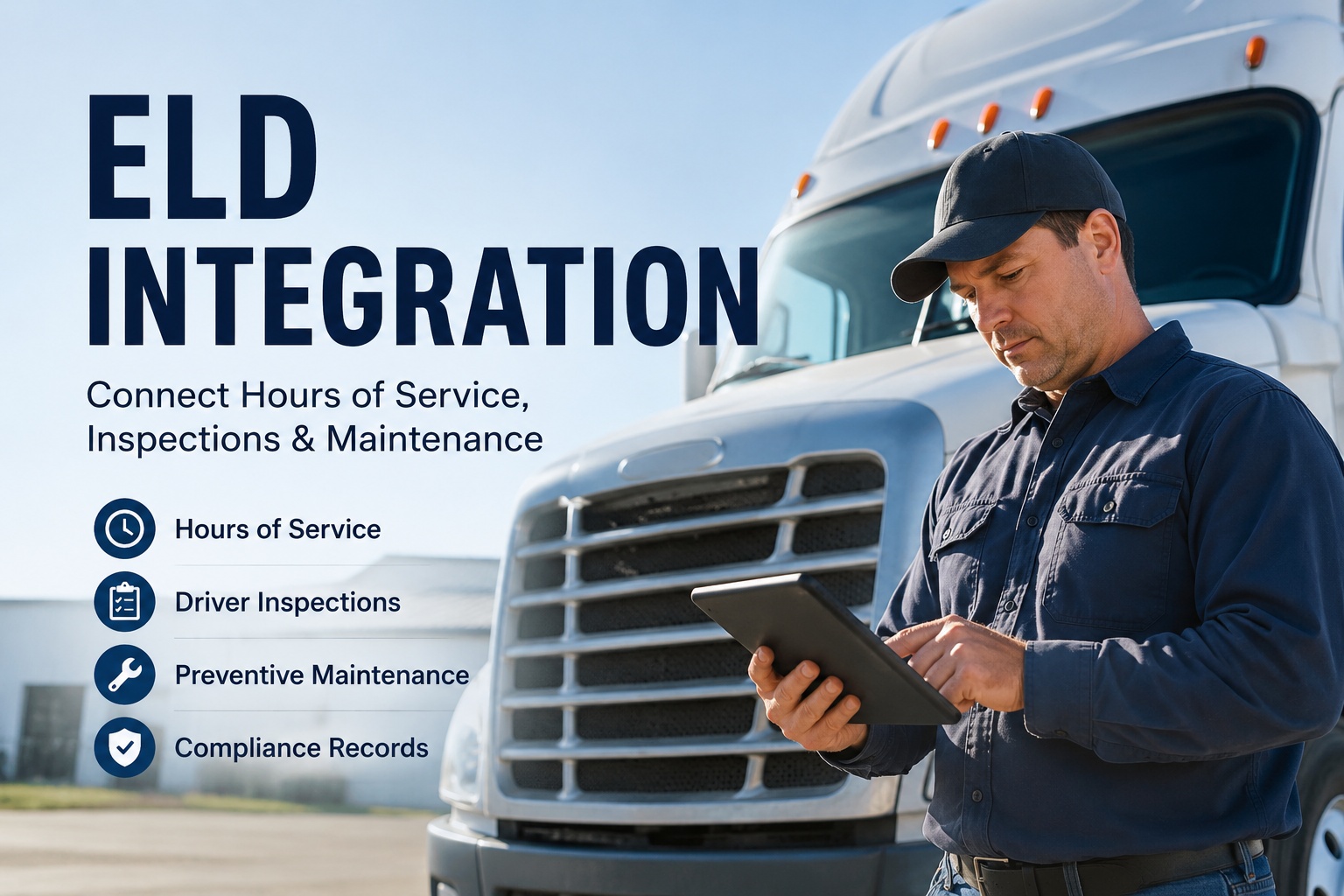
Every ELD-equipped truck in the country captures 200+ data points per hour — driver duty status, engine metrics, GPS, fault codes, odometer, engine hours, hard-brake events. Most fleets use maybe 5% of that data, because the ELD talks to itself and the FMCSA and no one else. ELD integration is the bridge that turns raw telemetry into operational value: HOS drives dispatch, engine diagnostics trigger maintenance work orders, engine hours schedule preventive maintenance automatically. When these systems stop working in isolation, the fleet stops running in isolation too. This guide covers what ELD integration actually means, the 3 critical data flows that create business value, the major ELD providers HVI connects with, and the typical deployment path. Book a demo to see your ELD data working across inspections and maintenance.
Your ELD data, connected to every fleet system
See how one continuous data stream powers dispatch, inspections, maintenance, and compliance — without duplicate entry, without gaps, without delays
What ELD integration actually does
An Electronic Logging Device is federally mandated under the FMCSA ELD rule (49 CFR 395.20) for most commercial motor vehicles. It automatically records driver hours-of-service, and manufacturers layer in additional capabilities: GPS tracking, engine diagnostics (DTC fault codes), engine hours, odometer, hard-brake and hard-acceleration events. That data lives on the ELD provider's platform — useful for HOS compliance, largely unused for anything else.
ELD integration takes that data stream and pipes it directly into the fleet's inspection, maintenance, and compliance systems. When a driver logs into their DVIR app, the unit information is already pre-filled from the ELD. When a truck's engine throws a fault code, a maintenance work order gets created automatically. When engine hours cross a preventive maintenance threshold, the PM schedule triggers without a human touching a calendar. The ELD stops being an isolated compliance device and becomes the operational data source the entire fleet runs on. Start a free trial to see this data flow live on your own vehicles this week.
The 3 critical data flows every integration should enable
Not all ELD integrations are equal. A "read-only" integration that pulls HOS data once a day is functionally different from a real-time bidirectional integration that pipes engine diagnostics into a live maintenance queue. Three data flows separate a compliance-only integration from an operational one.
HOS + Driver Status → Dispatch & DVIR
Driver's remaining hours-of-service, current duty status, and location stream continuously into dispatch. Load assignments respect available driving hours. DVIR sessions inherit the driver's active vehicle assignment automatically — no manual unit entry, no wrong-truck DVIRs.
Vehicle Fault Codes (DTCs) → Maintenance Work Orders
When a truck throws a diagnostic trouble code (DTC) — check-engine, brake system warning, DPF regeneration issue — the ELD detects it via the J1939 CAN bus. Integrated maintenance systems receive the code within seconds and auto-create a work order with severity level, code translation, and vehicle context.
Engine Hours + Odometer → PM Scheduling
Engine hours and odometer reads sync continuously. Preventive maintenance schedules based on meter thresholds (every 25,000 miles, every 250 engine hours) trigger automatically. No manual meter reading, no drift between actual and recorded mileage, no PMs missed because someone forgot to log the odometer.
Fleets that implement all three flows typically report 15-25% reductions in unplanned downtime within the first year — not because the equipment is different, but because the data finally reaches the people and systems that can act on it. Book a demo to see all three flows configured for your specific ELD provider
Supported ELD providers
HVI integrates natively with the major FMCSA-registered ELD platforms in the US market, plus supports generic API/webhook integration for any ELD provider not listed. Integration setup is typically completed in 2-5 business days per provider.
For fleets running multiple ELD providers across acquired subsidiaries, HVI supports simultaneous connections to different platforms on different vehicle segments. The data is normalized into a single unified schema before it hits dispatch, maintenance, or compliance modules. Start a free trial to test-connect your specific ELD provider this week.
What integrated ELD data unlocks
The business case for ELD integration isn't compliance — the ELD already handles that. The business case is operational leverage from data that's already being collected. Four specific value categories separate connected fleets from siloed ones.
Fault-code-driven work orders catch failures 24-72 hours before roadside breakdown. Fewer emergency repairs, fewer missed dispatch windows.
Automated meter-based PM scheduling eliminates the human error and calendar drift that keep manual PM programs stuck at 60-75% compliance.
No more manual odometer entries, duplicate DVIR unit selection, or copying HOS data into dispatch. The data flows itself.
Load assignments respect real-time available hours. Dispatchers can't book a driver beyond their duty limits because the system won't allow it.
Every number above compounds over time. A 20% downtime reduction in year one becomes 25-30% by year two as PM data quality improves and fault-code response times shrink. Book a demo to see the specific value model calculated on your fleet's ELD and vehicle counts
The 4-phase integration deployment path
Most fleets go from "considering integration" to "fully connected" in 4-6 weeks. The path breaks into four sequential phases, each with a clear deliverable and go/no-go checkpoint.
Fleet provides API credentials from the ELD provider. HVI establishes the connection, validates data flow, and confirms the vehicle roster syncs correctly. Typical duration: 1-3 business days.
Map fault-code definitions, PM thresholds, unit identifiers, and driver assignments. Configure business rules: which DTCs trigger work orders automatically vs. requiring supervisor approval; PM intervals per vehicle class.
Enable integration on a pilot subset of vehicles. Monitor data quality, alert response, and workflow adoption. Adjust business rules based on real operational feedback before full rollout.
Roll integration out across the full fleet. Track PM compliance, DTC-to-work-order time, and HOS violation rates over the first 30-60 days. Ongoing tuning based on operational metrics.
Fleets running 20-100 trucks typically complete all four phases within 4 weeks. Larger fleets (250+ vehicles) may run Phase 3 across multiple subsets over 4-6 weeks before Phase 4 activation. Book a demo to see the specific deployment plan for your ELD provider and fleet size
From a fleet operations manager who cut unplanned downtime by 22%
We'd been using our ELD provider for HOS compliance for years. It sat there collecting hundreds of data points per truck per hour, and we looked at maybe five of them — hours available and current location. Everything else went to a dashboard nobody opened.
The integration changed the whole dynamic. Engine-fault codes now hit our maintenance team's phones in under a minute. PM schedules run themselves off actual engine hours instead of a spreadsheet someone updates once a week. Unplanned downtime dropped 22% in the first 8 months. We're not spending more on maintenance — we're spending it earlier, before things fail. The ELD data was always there. We just weren't listening to it.
Frequently asked questions
What does ELD integration actually connect?
ELD integration connects the data stream from Electronic Logging Devices installed in commercial motor vehicles to downstream fleet management modules: dispatch, driver vehicle inspection reports (DVIRs), preventive maintenance scheduling, and compliance reporting. The ELD captures hours-of-service under 49 CFR 395.20, and modern ELDs additionally capture GPS location, engine diagnostics via the J1939 CAN bus (including diagnostic trouble codes, engine hours, odometer readings, hard-brake and hard-acceleration events), and driver identity. Native integrations use the ELD provider's API to pull this data in real-time (or near-real-time depending on the provider), normalize it into a unified schema, and route it to the appropriate module. The result: a truck's engine throwing a fault code creates a maintenance work order in seconds; a driver's remaining hours-of-service is visible to dispatch continuously; PM schedules run automatically off actual engine hours; and audit-ready records assemble themselves without manual data entry. Fleets that were previously running ELDs as standalone compliance devices transform them into the operational data source the rest of the fleet runs on.
Which ELD providers work with HVI?
HVI integrates natively via API with the major FMCSA-registered ELD platforms in the US market: Samsara, Motive (formerly KeepTruckin), Geotab, Verizon Connect, Omnitracs (now part of Solera), Trimble/PeopleNet, EROAD, ISAAC Instruments, and Fleet Complete. For fleets running an ELD provider not on the native-integration list, HVI supports generic API and webhook integration with any FMCSA-registered ELD that exposes an API — which is now most providers in the market, since the FMCSA ELD rule effectively standardized data exchange. For fleets running multiple ELD providers across acquired subsidiaries or regional operations, HVI supports simultaneous connections to different platforms on different vehicle segments, with the data normalized into a single unified schema before it reaches dispatch, DVIR, maintenance, or compliance modules. The typical integration setup runs in 2-5 business days per provider for native integrations, and 1-2 weeks for generic API integrations that require custom mapping.
Do I need to replace my current ELD to integrate?
No — one of the primary benefits of ELD integration is that it works with the ELD you already have. FMCSA-registered ELDs are required to expose standardized data via API for regulatory purposes, and most major providers additionally expose expanded APIs for third-party integration with maintenance, dispatch, and fleet management platforms. HVI's approach is to sit alongside the existing ELD, not replace it — the driver still uses the ELD interface for hours-of-service logging, the fleet still uses the ELD provider's platform for HOS compliance dashboards, and HVI adds the operational data layer that connects ELD telemetry into inspections and maintenance workflows. This preserves the fleet's existing investment in ELD hardware and driver training. Fleets typically maintain their ELD subscription and add the HVI subscription as a complement, not a replacement. The combined cost is usually lower than replacing to a single-vendor "all-in-one" platform, and the integration approach avoids the operational disruption of an ELD swap.
How long does ELD integration setup take?
Native API integrations with major ELD providers (Samsara, Motive, Geotab, Verizon Connect, Omnitracs, and others) typically go live in 2-5 business days after the fleet provides API credentials. The full deployment path — from initial credential exchange to full-fleet activation with all three critical data flows (HOS, fault codes, PM scheduling) — usually runs 4-6 weeks broken into four phases. Phase 1 (week 1) is credential setup and connection validation. Phase 2 (week 2) is data mapping and business rules configuration. Phase 3 (week 3) is pilot rollout on 10-20% of the fleet to validate the integration under real operational load. Phase 4 (weeks 4-6) is full-fleet activation with performance monitoring for the first 30-60 days. Fleets running 20-100 trucks typically complete this in 4 weeks; larger fleets with 250+ vehicles may extend Phase 3 across multiple vehicle subsets. Generic API integrations for less-common ELD providers typically add 1-2 weeks to the timeline for custom data mapping work.
What's the difference between ELD integration and a "single-vendor all-in-one" platform?
The two approaches solve similar problems from different directions, with meaningful trade-offs. A single-vendor all-in-one platform (ELD + DVIR + maintenance + dispatch from one provider) offers unified UI, one contract, and typically simpler support. The trade-off: fleets lock into one vendor's roadmap, one vendor's pricing model, and one vendor's approach to each module. Integration-based architecture (best-of-breed ELD + best-of-breed fleet management platform like HVI, connected via API) preserves optionality: the fleet can swap ELD providers without disrupting maintenance workflows, or upgrade to a better inspection platform without changing HOS compliance. The trade-off: two vendors instead of one, and the integration itself has to work reliably. In practice, most fleets over 30-50 vehicles find integration-based architecture more cost-effective because best-of-breed products typically outperform single-vendor modules in the specific areas the fleet cares most about (inspection defensibility, maintenance workflow, PM automation), and the total cost is often lower than the all-in-one alternative once volume discounts and feature-per-dollar comparisons are done. For smaller fleets under 25 vehicles, single-vendor platforms can be simpler operationally. The right answer depends on fleet size, existing ELD investment, and how deep the operational sophistication needs to run.
Stop paying for ELD data your fleet software never uses
HVI connects natively with every major ELD provider — Samsara, Motive, Geotab, Verizon Connect, Omnitracs, and more. Setup in days. Real-time bidirectional sync. Complete audit trail. Live for your fleet in under two weeks — typical carriers see 15-25% unplanned downtime reduction in the first 8 months.
No credit card · Works with any FMCSA-registered ELD · 4-6 week deployment