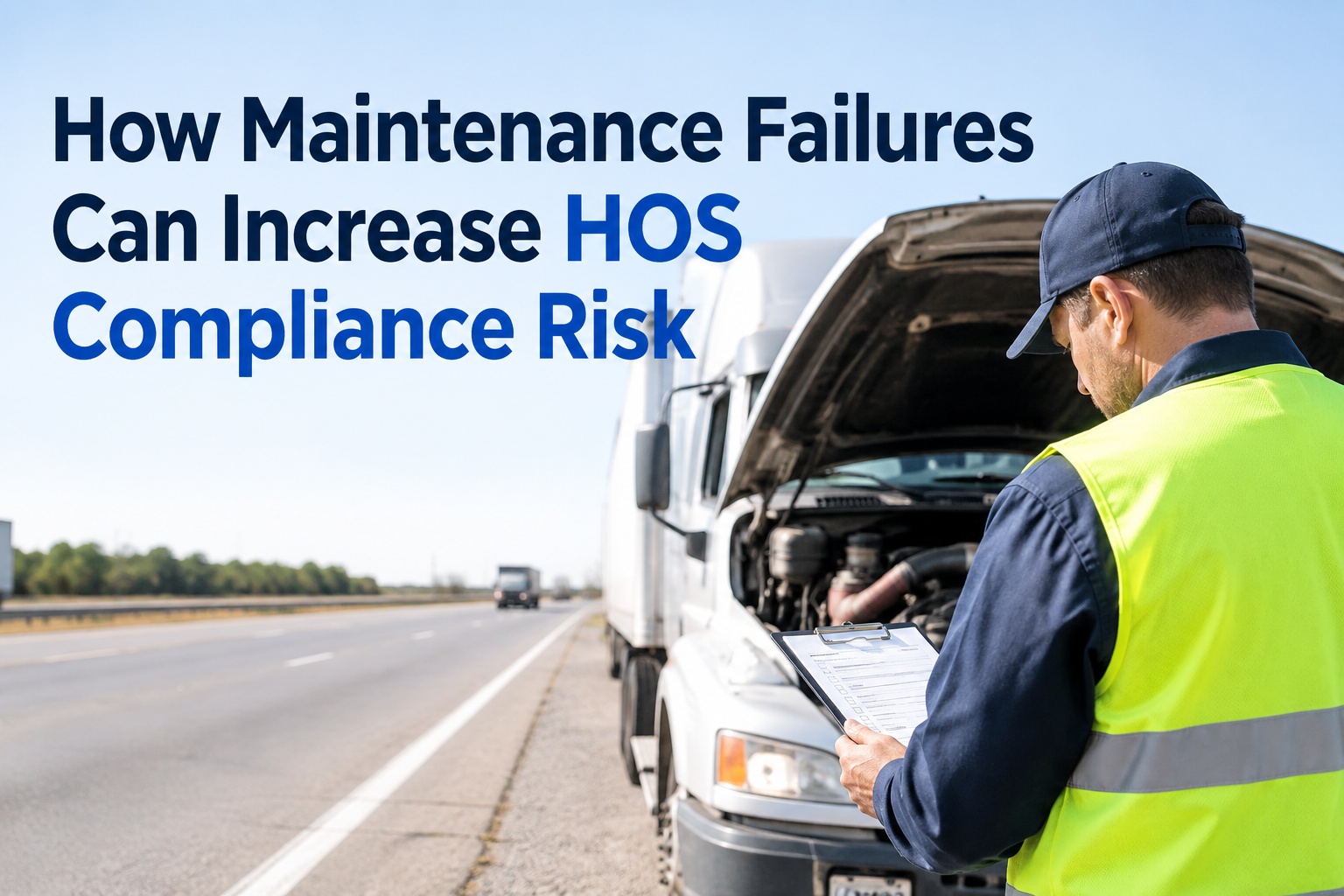
Most fleets manage maintenance and hours of service in two different rooms — the shop worries about breakdowns, the safety desk worries about the log. But they're the same problem. When a truck breaks down mid-shift it burns the driver's 14-hour clock while the machine sits, and a roadside inspection eats the window too — and that pressure is one of the leading causes of hours-of-service violations. Here is how one control reduces both risks at once. See defects caught before dispatch, before they cost a clock
Watch a breakdown burn the driver's clock
Same route, same driver, same 14-hour window. Switch in a mid-shift breakdown and see the delivery get pushed past the line.
No breakdown, no roadside stop. Driving and on-duty time fit inside the 14-hour window with margin to spare. The load is delivered legally and the clock never comes close to the line.
A mid-shift breakdown and the roadside inspection that follows consume hours of on-duty time the driver can't get back — the 14-hour window doesn't pause for a repair. The remaining drive now runs past the line. The driver either stops short of the delivery, or feels the pressure to push over it. That pressure is where HOS violations come from.
The maintenance event didn't just cost a repair bill — it cost the driver's clock, and turned a legal day into a choice between a missed delivery and a violation. That's the connection most fleets miss.
Hours of service is treated as a logging discipline — run the ELD right, count the hours, don't fudge the record. That's necessary but incomplete, because it assumes the day goes to plan. The reality is that a huge share of HOS pressure comes from days that don't: a breakdown, a defect found at the roadside, a repair that runs long. Every one of those is a maintenance event, and every one of them steals from the same 14-hour window the driver has to work inside. Understanding that link is the difference between a fleet that manages HOS reactively and one that removes the pressure at its source.
First, the clock that doesn't stop
To see why maintenance and HOS are linked, you have to understand the one rule that makes the window unforgiving: under 49 CFR Part 395, the 14-hour on-duty window runs continuously and never pauses.
The window is a fixed budget. Anything unplanned that spends it pushes the driver toward the edge — and all of this burns it whether the driver is working or just waiting:
That's the trap: a driver can have driving hours left on the 11-hour limit and still be out of time because the 14-hour window closed. The two most common HOS violations reflect exactly this — driving past 11 hours and operating after 14 — each carrying CSA weight and, if far enough over, a roadside out-of-service order. Start free and keep the unplanned events that burn the budget off the road
The three ways a maintenance failure steals hours
A maintenance problem doesn't create an HOS violation directly — it does it by consuming the window until there's no legal room left for the work that remains. There are three distinct ways it happens, and a single bad day can stack all three.
1. Breakdown downtime
A truck that fails mid-route strands the driver while the clock keeps running. Waiting for roadside assistance, a tow, or a mobile repair can burn hours of the window — time the driver spends on-duty-not-driving or worse, all of it counting against the day.
2. Roadside inspection time
A roadside inspection — especially a full Level 1 — takes real on-duty time inside the window. If it's triggered or prolonged by a visible defect, that's a maintenance failure directly consuming the clock. A clean, well-maintained truck moves through faster.
3. Out-of-service repair delay
If an inspection finds an out-of-service defect, the truck can't move until it's fixed — the driver waits out the repair on the clock, or the day is lost entirely. A defect that should have been caught in the yard becomes hours gone at the roadside.
Note what these are not: a breakdown is generally not an "adverse driving condition" a driver can use to legally extend the window. The adverse-conditions exception covers weather, road closures, and traffic unknown before departure — not a mechanical failure that better maintenance would have prevented. So the hours a breakdown consumes are simply gone, with no relief. That's what makes the maintenance-to-HOS link so unforgiving, and why preventing the event beats managing its fallout. Book a demo to see defects surfaced before a truck ever leaves the yard
The pressure chain: how a burned clock becomes a violation
The maintenance failure doesn't write the violation — the pressure it creates does. This is the mechanism that connects a shop problem to a safety-desk problem, and it runs in a predictable chain. FMCSA's own analysis notes that the common HOS violations often stem from pressure to complete a delivery and from late or disrupted schedules — which is exactly what a breakdown produces.
The dangerous end of the chain isn't just an honest over-hours violation — it's the temptation to falsify the log to cover the lost time, which is the most severely weighted HOS violation of all. And here the two records converge in the worst way: after a crash, plaintiff attorneys pair HOS violations with maintenance records to build a negligence case, arguing the carrier both ran an unsafe truck and pushed a fatigued driver. The breakdown that started the chain becomes Exhibit A. Breaking the chain at the first link — the failure that never should have reached the road — is worth far more than managing any link after it. Book a demo to see the failures stopped before they start the chain
The control that fixes both: catch it before dispatch
Here's the payoff of seeing maintenance and HOS as one problem: a single control addresses both. If the defect never leaves the yard, it can't break down on the route, can't trigger a roadside OOS, and can't burn the clock. Three things make that real.
A pencil-whipped walkaround that passes a bad truck is worse than none — it launders a defect onto the road. Score inspection quality and require photo evidence on the items that matter, so the check is a real filter.
A unit with an open critical defect can't be released until it's corrected and recorded — so a known problem physically cannot become a mid-route breakdown that burns the clock.
Disciplined preventive maintenance on a proper interval keeps brakes, tires, lights, and coupling — the defects most cited at roadside — from ever reaching the failure point.
Do those three and you don't just reduce breakdowns — you protect every driver's clock and remove a whole category of HOS pressure before it forms. Configure the controls to your operation and the applicable FMCSA and provincial rules. Book a demo to see the pre-dispatch filter that protects both records
The pre-dispatch check that protects the clock
This is the walkaround that keeps a defect off the road — and off the driver's 14-hour window. Run it before every unit is released, and log any find with a photo. Use this pre-dispatch checklist online free, so a flagged defect locks dispatch instead of becoming a mid-route breakdown.
From a safety manager who connected the two dashboards
For years our HOS problems and our maintenance problems were two separate meetings with two separate people. Then I actually mapped our worst HOS weeks against our breakdown log and they lined up almost perfectly. The drivers weren't reckless — they were getting stranded by trucks that shouldn't have gone out, losing three or four hours to a breakdown and an inspection, and then staring at a delivery they couldn't legally reach.
We tightened the pre-trip so it actually catches things, put photo evidence on the safety-critical items, and locked dispatch on any open critical defect. Breakdowns dropped, and our hours-of-service pressure dropped right alongside them — because the drivers stopped losing their afternoons to trucks that failed on the road. The two problems were one problem the whole time. We just weren't looking at them together.
Maintenance & HOS compliance FAQs
How does a vehicle breakdown affect a driver's hours of service?
A breakdown burns hours because the 14-hour on-duty window doesn't pause for it. Under 49 CFR Part 395, driving must happen inside a window that runs continuously from when the driver comes on duty — so the time a truck sits dead, plus any roadside inspection, comes straight out of that window and can't be recovered. Enough lost time and the remaining drive runs past the line.
Can a roadside inspection cause an HOS violation?
Indirectly, yes — not the inspection itself, but the on-duty time it eats inside the fixed 14-hour window. A full Level 1 inspection takes real time, and finding a defect adds more. That lost time can push the remaining drive past the 14-hour limit, turning a clean day into a violation.
Why do maintenance and HOS compliance need to be managed together?
Because they're causally linked, even though most fleets silo them. Maintenance failures eat the HOS window three ways — breakdown downtime, roadside-inspection time, and out-of-service repair delay — and none of it can be recovered. Managing them together means fewer failures burning the clock in the first place.
Does a dispatch lock help with HOS compliance?
Yes — indirectly but meaningfully. A dispatch lock ties a truck's release to its defect status, so a unit with an open critical defect can't leave the yard until it's fixed and recorded. That stops the mid-route breakdown before it happens, which is the event that would have burned the driver's clock.
What are the most common HOS violations and how do they connect to maintenance?
FMCSA data shows five account for most citations: exceeding the 11-hour driving limit, operating past the 14-hour window, exceeding the 60/70-hour weekly limit, falsifying logs, and missing the 30-minute break. The first two tie directly to maintenance — unplanned breakdowns and roadside stops are exactly what pushes a driver past those limits.
Stop breakdowns from becoming hours-of-service violations
HVI catches defects at pre-dispatch inspection, scores inspection quality so the checks are real, documents repairs with photo evidence, and locks dispatch on open critical defects — so the failures that strand drivers and burn their 14-hour clock never reach the road. Fewer breakdowns, fewer roadside surprises, and less of the schedule pressure that turns a lost afternoon into an HOS violation. See it on your own fleet.
No credit card · Pre-dispatch defect control from day one · Protects maintenance and HOS records together