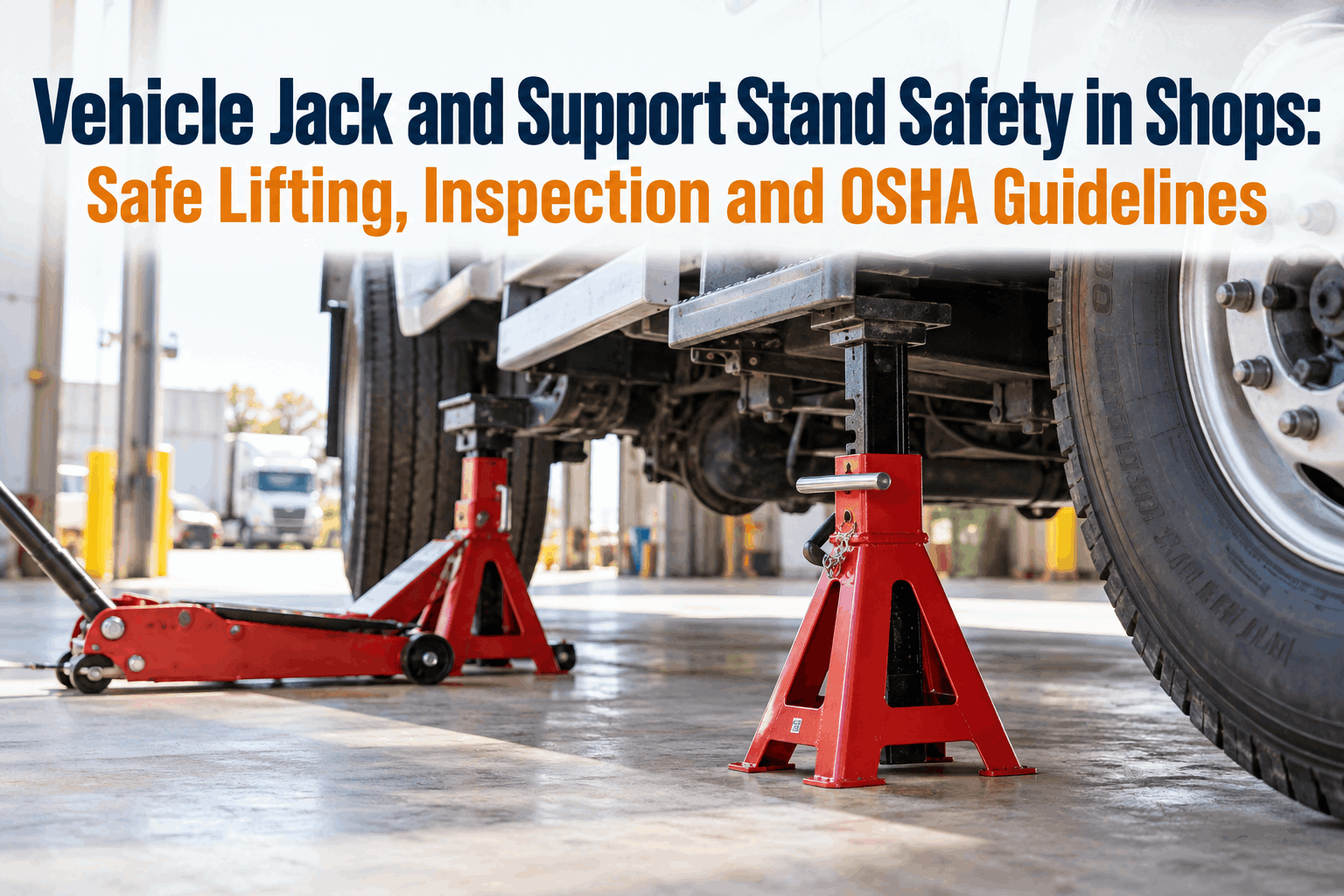
Jack stand safety is essential whenever technicians work beneath or around a raised vehicle. A hydraulic jack lifts a vehicle, but it is not a substitute for properly rated and positioned support stands. For fleet shops handling trucks, buses and service vehicles, consistent lifting procedures, equipment inspections and clear defect records help prevent dangerous shortcuts.
Jack Stand Safety: Lift It Right. Support It Safely.
Know where to lift, how to support a vehicle and what to inspect before anyone enters the work area beneath it.
A Jack Lifts. A Stand Supports.
Confusing these roles is one of the most serious shop lifting hazards. Support the vehicle with equipment designed and rated for the job before beginning work underneath.
Hydraulic jack
Used to raise the vehicle at an approved lifting point. Check its rating, condition and operating instructions.
Do not rely on the jack alone.Support stand
Provides stable support when correctly rated, placed and loaded at approved vehicle support points.
Verify stability before work.For consistent pre-use checks, book a demo to see how HVI can document shop lifting-equipment inspections.
Six Checks Before Anyone Goes Underneath
Use this sequence as a planning guide, not a replacement for equipment-specific lifting procedures, technician training or site rules.
Plan the lift
Identify vehicle mass, load distribution, approved lift points and required support equipment.
Secure the area
Use firm, level ground; control movement; apply the parking brake and chock wheels as appropriate.
Inspect equipment
Check jack and stands for leaks, cracks, bent parts, missing pins and unreadable capacity labels.
Lift correctly
Follow the manufacturer's lift procedure and keep personnel clear of unstable load zones.
Place rated stands
Position stands at approved support points and lower the vehicle onto them in a controlled manner.
Verify before entry
Confirm the vehicle is stable and properly supported before allowing under-vehicle work.
What Can Go Wrong in a Fleet Repair Bay?
These conditions deserve immediate attention during a jack stand safety inspection. If support integrity is uncertain, keep people out of the hazard area and follow the shop's safe correction procedure.
Insufficient capacity
The selected equipment may not safely support the applied load or its distribution.
Check each device's rated capacity.Wrong support point
A stand placed on an unsuitable component can slip, deform it or create instability.
Use manufacturer-approved points.Unstable floor
Sloped, damaged or soft surfaces can compromise support even when the stand is rated.
Confirm a suitable level surface.Damaged equipment
Bent frames, faulty locks, hydraulic leaks and missing parts can undermine safe operation.
Tag out defective equipment.Make Jack and Stand Inspections Easier to Document
Use HVI to organize equipment checklists, capture defects and coordinate maintenance follow-up across your shop.
Jack Stand Inspection Checklist for Technicians
Build a checklist around the manufacturer's inspection instructions and your shop's equipment types. A failed item should trigger appropriate isolation and review.
Hydraulic jack
- Capacity label is present and legible
- No visible hydraulic fluid leakage
- Frame, saddle and wheels are undamaged
- Controls operate as specified
- No signs of unauthorized modification
Support stands
- Correct rating for the intended load
- Frame and base are free of cracks or bending
- Locking mechanisms and pins are complete
- Contact saddles are in suitable condition
- No unstable, damaged or altered components
What OSHA Guidance Means for Jack Stand Safety
There is no single OSHA rule that covers every vehicle jack-and-stand setup. Applicable duties depend on the work, equipment and industry, alongside manufacturer instructions and recognized safe practices.
Choose the right equipment, train technicians and control hazards.
Employers should evaluate lifting hazards, use suitable equipment, follow applicable standards and provide relevant training. Equipment-specific instructions are essential.
Remove defective jacks and stands from use until appropriately repaired or replaced.
Use documented lifting methods suited to the vehicle, load and repair task.
Maintain useful inspection and corrective-action records where required or appropriate.
For regulatory review, assess applicable OSHA requirements, state-plan rules, manufacturer guidance and relevant standards for your specific shop. This article is general safety guidance, not a certification or legal determination.
Turn Equipment Defects into Documented Follow-Up
HVI helps teams record inspections and maintenance actions. It does not independently verify lifting capacity, approve support points or replace a qualified technician's judgment.
Inspect — Complete a digital jack or stand checklist.
Flag — Record an unsafe condition and keep the equipment out of service.
Follow up — Assign or document the maintenance action.
Close out — Retain the inspection and service history.
Book a demo to see HVI defect tracking for maintenance shop equipment.
Suspected frame deformation. Tagged out pending qualified assessment.
Jack Stand Safety FAQs
Is it safe to work under a vehicle supported by a hydraulic jack?
No. A hydraulic jack alone is not an acceptable substitute for appropriately rated, correctly positioned support equipment. Follow the vehicle and lifting-equipment manufacturers' procedures.
Where should jack stands be placed on a truck or bus?
Use the vehicle manufacturer's designated support locations for the exact model and task. Do not assume that a point suitable for lifting is automatically suitable for prolonged support.
How do I choose the correct jack stand capacity?
Determine the loads each support will carry, consider weight distribution and follow the stand and vehicle manufacturers' instructions. Do not treat a set's combined rating as the rating of every individual stand unless the manufacturer explicitly states that.
What should technicians inspect before using jack stands?
Check labels, frames, bases, saddles, pins and locking mechanisms for damage, missing parts or unauthorized changes. Remove questionable equipment from service for appropriate evaluation.
Can HVI help manage shop lifting-equipment inspections?
HVI can help organize digital inspections, defect records and maintenance follow-up. A demo can show how those capabilities may fit your shop's checklist and asset-record workflow.
Keep Jack Stand Inspections and Repairs Organized with HVI
Give technicians a clearer way to document equipment condition, flag unsafe findings and maintain inspection history across the fleet workshop.