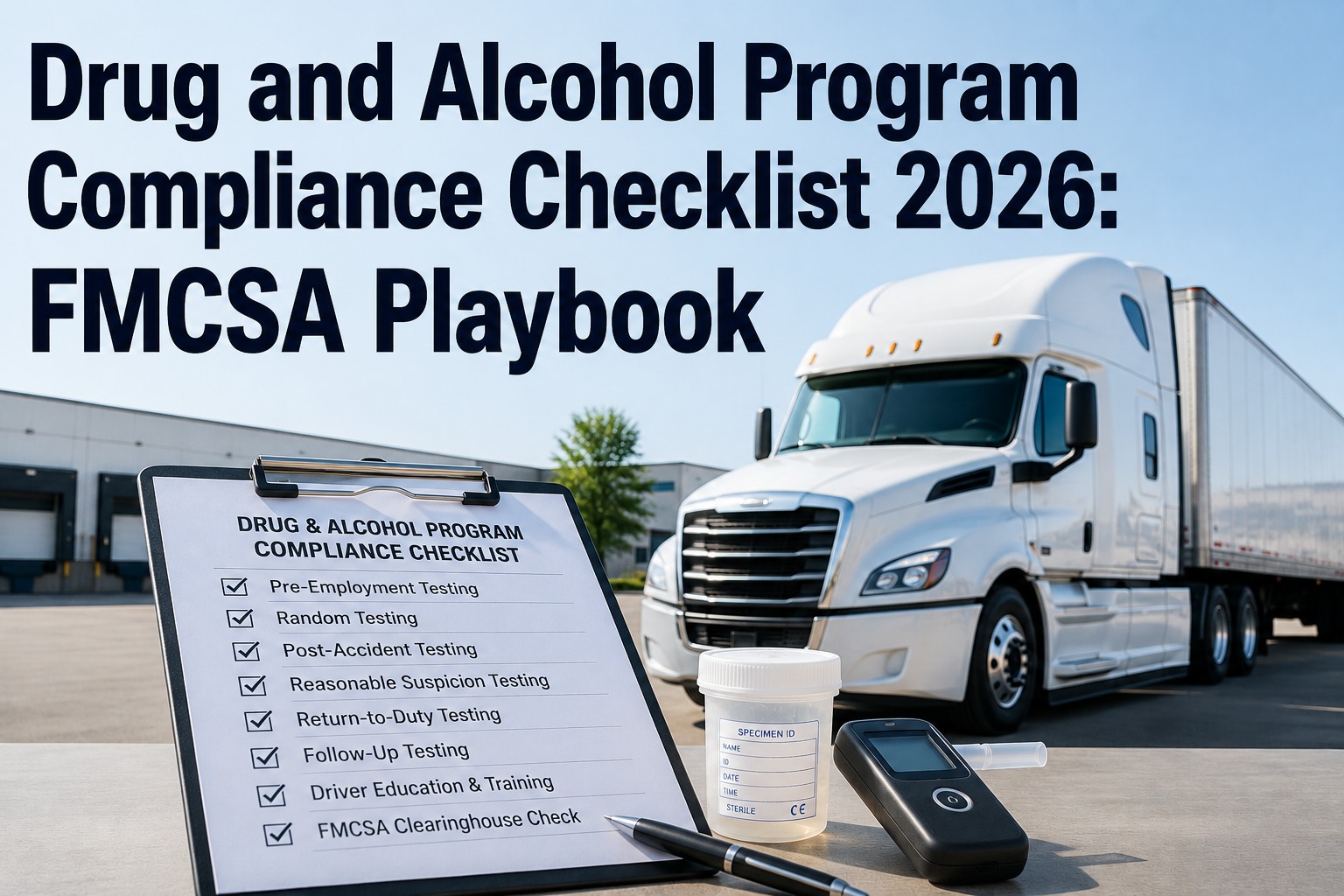
The Twelve-Point D&A Program
Six testing types. Two Clearinghouse queries per driver. Every gap is a scored audit finding.
Why the D&A Program Runs on a Different Timeline
Audit Weight
- Drug and alcohol program deficiencies carry the highest weight in an FMCSA compliance review. A missing annual Clearinghouse query, a supervisor without documented training, or a random-rate shortfall is scored as an acute or critical violation depending on the fact pattern — and even a single critical violation can trigger a Conditional safety rating.
The Prohibited Pool
- As of January 2026, over 200,000 CDL drivers hold prohibited status in the FMCSA Clearinghouse — roughly one in every thirty CDL holders. That's the pool your pre-employment screening is filtering against every time you hire. Miss the query, and the prohibited driver ends up in your seat.
Refusal = Positive
- The FMCSA treats a testing refusal — including missed test, tampered specimen, inadequate sample without medical justification, or walking out mid-collection — as equivalent to a positive result. Same reporting to Clearinghouse. Same removal from safety-sensitive functions. Same return-to-duty pathway.
Return-to-Duty Cost
- The return-to-duty pathway after a positive or refusal typically runs $2,000 to $5,000 per driver, spans 12+ months of unannounced follow-up testing, and includes a SAP evaluation, treatment or education plan, and directly observed RTD test. Most prohibited drivers never complete the pathway and return to the workforce.
Ready to digitize the whole program? Start your free trial or book a live demo.
1. Written Policy & DER Designation
The written policy is the foundation of the program — without it, every other block sits on air. FMCSA inspectors read the policy first, then verify the practices match. Book a demo to see policy versioning tracked automatically inside HVI.
Written Policy
Distribution
DER Designation
2. Supervisor Training (§382.603)
Every supervisor of CDL drivers must complete 60 minutes of drug training and 60 minutes of alcohol training — total 120 minutes. Missing training is a common audit finding because it's easy to forget when a supervisor is promoted from within.
Training Content
Coverage
Documentation
3. Pre-Employment Testing (§382.301)
No CDL driver performs a safety-sensitive function until a verified negative pre-employment drug test result is on file. Missing this test on even one driver hire is a strict-liability compliance failure.
Pre-Hire Sequence
Prior Employer Check
Exemptions Documented
4. Random Testing Program (§382.305)
Random testing is the highest-audit-touch element. FMCSA looks for the correct rate (50%/10%), scientifically valid selection, tests spread across the year, and driver enrollment continuity. Any shortfall is an acute or critical violation.
Rate Compliance
Selection Method
Execution
5. Post-Accident Testing (§382.303)
Post-accident testing is triggered by specific criteria, not by every incident. Trigger assessment, timing windows, and documentation of missed windows are all scored separately.
Trigger Assessment
Timing Windows
Documentation
6. Reasonable Suspicion & Return-to-Duty
These two tests bookend the compliance risk zone. Reasonable suspicion must be based on supervisor observation and documented before the test. Return-to-duty is directly observed and cannot happen without a completed SAP process.
Reasonable Suspicion (§382.307)
Return-to-Duty (§382.309)
Follow-Up (§382.311)
7. Clearinghouse Queries (§382.701)
The Clearinghouse is the current #1 D&A audit-finding source. Two queries per driver: a full query at pre-employment and a limited query annually. Missing either is a per-driver violation.
Registration
Pre-Employment Full Query
Annual Limited Query
8. Record Retention & Documentation (§382.401)
D&A record retention is tiered by record type. FMCSA reviews retention completeness first — a full audit trail is the difference between defending a review and losing a safety rating.
5-Year Records
3-Year Records
1-Year Records
How HVI Runs the Full D&A Program
Every element of the twelve-point program, automated:
- ✓ Written policy library with version control and driver acknowledgment tracking
- ✓ DER designation and Clearinghouse registration linked to your account
- ✓ Supervisor training tracked with re-training reminders
- ✓ Pre-employment testing workflow integrated with hiring pipeline
- ✓ Random pool management with 50%/10% rate compliance tracking
- ✓ Post-accident testing prompts triggered from incident record (§382.303 criteria)
- ✓ Clearinghouse annual queries scheduled per driver with automated reminders
- ✓ Return-to-duty and follow-up testing pathway managed end-to-end
- ✓ Record retention tiers (1-yr / 3-yr / 5-yr) automated by record type
- ✓ Audit-ready export bundle for FMCSA compliance review
Ready to run the D&A program digitally? Start your free HVI trial or book a live demo.
Drug & Alcohol Program Compliance FAQ
1. What is the FMCSA random drug and alcohol testing rate for 2026?
The FMCSA-required minimum annual random drug testing rate for 2026 is 50% of the average number of driver positions in the random pool. The minimum random alcohol testing rate is 10%. Both rates were confirmed unchanged in the January 8, 2026 Federal Register notice — the sixth consecutive year at these levels. The 50% drug rate has held since January 2020, when FMCSA raised it from 25% after industry-wide positive test rates crossed the 1% threshold. To return to 25%, positive rates would need to fall below 1% for two consecutive calendar years. Fleets may test above the minimum (some run 75% or 100% programs), but all DOT random selections must follow proper protocols and be tracked separately from non-DOT testing.
2. Do I need to query the Clearinghouse every year for every CDL driver?
Yes. Every employer of CDL drivers must conduct a limited query in the FMCSA Clearinghouse for every active CDL driver at least once every 12 months. This is separate from the pre-employment full query required before a new hire's first safety-sensitive function. The annual limited query is one of the most common D&A audit findings — "no annual limited Clearinghouse query for current CDL drivers" is scored as a per-driver violation. If the limited query returns evidence of new prohibited-status information, the employer must then run a full query within 24 hours. Standing driver consent (a one-time form) covers all annual limited queries for that driver's tenure.
3. What counts as a refusal to test, and what happens after?
Refusal is treated the same as a positive result. Refusals include: failing to appear for a test within a reasonable time, leaving a collection site before completing the test, refusing to provide a specimen or breath sample, providing an adulterated or substituted specimen, providing an inadequate sample without valid medical justification, and refusing to complete the SAP evaluation process. Consequences: the driver is removed from all safety-sensitive functions immediately, the refusal is reported to the Clearinghouse (same as positive), and the driver cannot return to duty until completing the full SAP evaluation, treatment plan, and RTD test process. Most drivers who reach prohibited status via refusal never complete the return-to-duty pathway.
4. How much does the return-to-duty process cost and how long does it take?
The typical return-to-duty pathway costs the driver (or employer if covered) between $2,000 and $5,000 and spans at least 12 months of active oversight. Components include: initial SAP (Substance Abuse Professional) evaluation, a prescribed treatment or education program, SAP follow-up evaluation, a directly observed return-to-duty test that must be negative, and then a minimum of six unannounced follow-up tests in the first 12 months of return to safety-sensitive duty. The SAP may extend the follow-up testing period up to 60 months at their discretion. Employer obligations continue through the entire follow-up period — missing a follow-up test is itself treated as a refusal. Start your free trial to get RTD tracking built in.
5. Who has to complete FMCSA supervisor training and how often?
Under 49 CFR §382.603, every supervisor who oversees CDL drivers must complete 60 minutes of training on drug use indicators plus 60 minutes on alcohol use indicators — 120 minutes total. FMCSA does not require annual re-training as a rule, but the training must be documented and retained for the supervisor's tenure. Common gaps: (a) supervisors promoted from within who never received the training after promotion, (b) terminal or satellite location supervisors overlooked in a corporate rollout, (c) documentation missing the required elements (date, duration, content covered, trainer identification). Best practice is to re-train every 3-5 years or after material regulatory updates, even though not federally mandated.
6. What are the top D&A audit findings small carriers should watch?
Based on FMCSA compliance review patterns, the top D&A violations at small carriers are: (1) missing or below-minimum random testing rate, (2) no annual limited Clearinghouse query for current drivers, (3) missing pre-employment drug test on a driver hire, (4) supervisor without documented 120-minute training, (5) written D&A policy missing or not distributed to drivers with signed receipts, (6) prior-employer inquiry not completed for new hires, (7) post-accident test triggers not documented per incident, (8) return-to-duty tests not directly observed, (9) Clearinghouse violation not reported within 3 business days, and (10) record retention gaps (typically missing 5-year records for positives/refusals). Each of these can escalate from acute to critical if patterns show systemic weakness.
Digital D&A Program, One Dashboard
Twelve compliance points, one platform. HVI runs the whole D&A program — written policy versioning, DER designation, supervisor training tracking, pre-employment workflow, random pool with rate compliance, post-accident triggers, Clearinghouse queries, RTD pathway, and tiered record retention — all automated and audit-ready. Start your free trial now (no credit card required) or book a 15-minute demo.
Close Every D&A Audit Gap Before It Becomes a Finding
Join fleets running their FMCSA drug and alcohol program as an integrated digital compliance stack — automated Clearinghouse queries, random pool rate tracking, supervisor training reminders, tiered record retention, and audit-ready export. Set up in minutes. Live before your next compliance review.