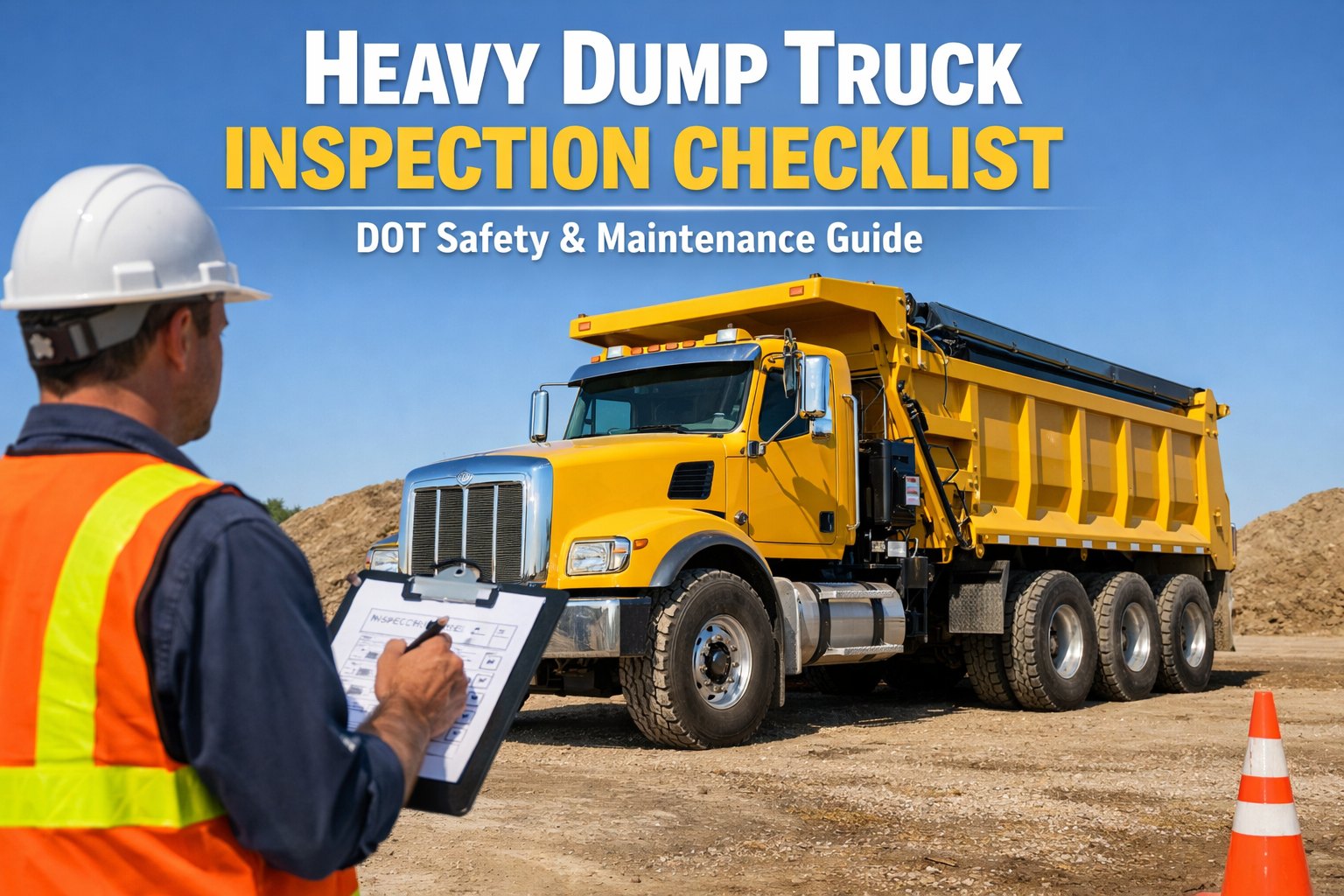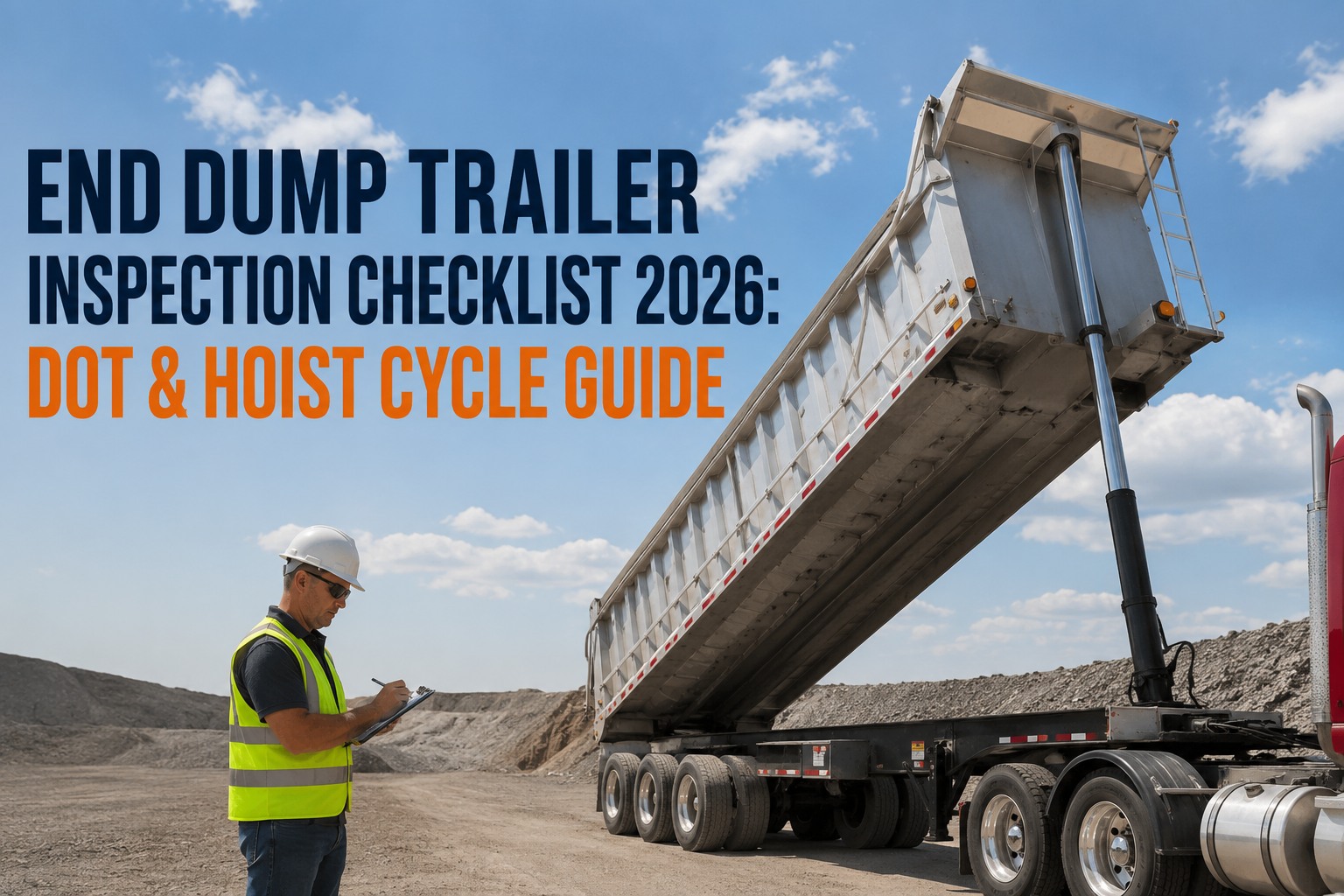
The 8-Zone End Dump Pre-Trip
Hoist. Tailgate. Subframe. Chassis. Site read. Every dump cycle logged, every leak flagged, every rollover risk documented.
Why End Dumps Roll Over More Than Any Other Trailer
The rollover physics is unforgiving. When the hoist raises a loaded body, the trailer's center of gravity climbs above the frame rails — and any single residual risk factor tips the balance. FMCSA data attributes roughly 340 fatal crashes per year to dump trucks across the 2011-2016 window.
Load Distribution Failure
- Material sticking to one side of the body during unloading shifts the center of gravity sideways at exactly the moment the body reaches maximum elevation. Wet clay, damp aggregate, and asphalt millings are the worst offenders — once the tipped load starts, the hoist can't correct it.
Ground & Alignment Risk
- Ruts, humps, and softer soil on one side under a set of tires create a lateral tilt the trailer isn't designed to compensate for. Residual tractor-trailer misalignment amplifies the effect. The dump-site foreman is the first line of defense; the driver's judgment is the second.
Mechanical Wear
- Worn hoist pins and bushings introduce play in the pivoting body — small tolerances at the base become large angular movements at the top. Tire pressure asymmetry compounds the effect by tilting the trailer before the hoist ever engages. Both are pre-trip checkpoints.
Zone 1 — Hoist Cylinder & Hydraulic System
The hoist is the heart of the end dump. A hydraulic failure mid-cycle is one of the two most common rollover triggers — the other being ground conditions. Cylinder inspection is non-negotiable at every pre-trip.
Cylinder Body
Mounting & Hydraulics
Controls & Warnings
Zone 2 — Tailgate & Rear Sealing System
A stuck tailgate at the top of a dump cycle is the classic rollover trigger — the load hangs, the body climbs higher trying to shake it loose, and the center of gravity climbs with it.
Hinges & Latches
Release & Seal
Chains & Frame
Zone 3 — Subframe & Structural Body Integrity
The subframe carries the load from the body down to the trailer chassis. Cracked crossmembers, fatigued welds at high-stress joints, and elongated bolt holes at the body-to-frame connections all telegraph structural degradation.
Attachment Points
Frame Structure
Body Integrity
Zone 4 — Chassis, Suspension & Axles
Standard trailer DVIR items with dump-specific attention on the components that carry high shock loads during off-highway operation and material loading.
Coupling & Air Suspension
Springs & Hardware
Wheel Ends & Landing
Zone 5 — Brake System & Air Lines
Brake defects were 41.1% of all vehicle out-of-service violations at the 2025 CVSA International Roadcheck. On an end dump running loaded down grade or backing into a dump site, brake failure isn't just an OOS — it's a rollover setup.
Foundation Brakes
Slack & Chambers
Air Lines & ABS
Zone 6 — Tires, Wheels & Lug Nuts
Tire violations were the second most common OOS category at 2025 Roadcheck (21.4% of vehicle violations). On an end dump, tire pressure asymmetry is also a rollover risk factor.
Tire Health
Sidewalls & Rims
Fittings & Flaps
Zone 7 — Lights, Reflectors & Electrical
Beyond regulatory compliance under 49 CFR 393.9, lights and reflectors are critical on end dumps that operate before dawn at aggregate quarries and after dark on backhaul.
Rear Lighting
Marker & Reflective
Electrical & Warning
Zone 8 — Dump-Site Read & Side-Slope Discipline
The final zone isn't part of the trailer inspection — it's the site inspection the driver performs after arrival and before the body goes up. This is the discipline that separates fleets with clean rollover records from fleets with regular incidents.
Ground Read
Alignment & Load
Personnel & Discipline
Cycle Tracking — The Wear Indicator Fleets Miss
Hoist cylinder seals are rated for 50,000 cycles under manufacturer spec. Fleets that track hoist cycles as a maintenance metric replace seals proactively at 40,000 cycles — before the leak that triggers a mid-cycle failure. Fleets that don't track cycles replace cylinders reactively, at rollover response cost.
Under 20,000 Cycles
- Standard PM — inspect seals visually at every pre-trip, log any weeping. No preventive replacement scheduled.
20,000 – 40,000 Cycles
- Watch phase — increase seal inspection frequency, plan next cylinder rebuild during scheduled downtime.
40,000 – 50,000 Cycles
- Preventive replacement window — schedule cylinder rebuild or replacement. Do not push beyond 50,000 rated cycles.
Over 50,000 Cycles
- Past rated life — every additional cycle is a failure risk. Take the unit out of service and rebuild before next dispatch.
How HVI Runs End Dump DVIR
Paper DVIR gets lost, misfiled, or backfilled after the fact — and none of those hold up in a rollover incident report. HVI closes the operational gap in three places.
Photo-Verified Zone Inspection
- Every one of the 8 zones inspected with photo evidence attached to the trip record. Hoist cylinder condition, tailgate seal, subframe welds — all captured against the timestamp and archived per unit.
Cycle & Refusal Tracking
- Every dump cycle logged against the unit's cumulative count with preventive alerting at 40,000 cycles. Zone 8 refusals recorded with reason (unstable ground, overhead obstruction, load composition) for the audit trail.
CSA-Ready Archive Export
- Complete DVIR history exported for CSA scoring, insurance renewal, and incident defense. 3-year retention per 49 CFR 396 aligned with regulatory requirement.
End Dump Trailer Inspection FAQ
1. How often should an end dump trailer be inspected?
Under 49 CFR 396.13 and 49 CFR 396.11, every commercial motor vehicle including trailers requires a driver pre-trip inspection before operation and a Driver Vehicle Inspection Report (DVIR) at the end of each duty day. For end dumps, the daily walkaround should specifically include the eight zones covered above, with additional focus on the hoist cylinder and hydraulic system before every dump cycle — not just once per day. Annual periodic inspection is required under 49 CFR 396.17 for every CMV in interstate commerce. Aggregate fleets typically layer a weekly hoist-and-hydraulics inspection on top of the daily DVIR, with quarterly structural inspections of the subframe and body-to-frame connections.
2. What are the most common causes of end dump trailer rollovers?
The four operational risk factors that drive most end dump rollovers are: (1) load asymmetry — material sticking to one side of the body during the dump cycle, particularly wet clay, damp aggregate, and asphalt millings; (2) uneven dump-site ground — ruts, humps, or soft spots under one side of the tires that create lateral tilt when the body is elevated; (3) hoist pin and bushing wear — play in the pivoting body that amplifies as the body rises; and (4) tire pressure asymmetry — a soft tire on one side creating lateral tilt before the hoist ever engages. Behind all four is a failure of pre-dump discipline — the driver's site read that either flags one of these factors or waves the cycle through despite them. FMCSA data attributes roughly 340 fatal crashes per year to dump trucks across the 2011-2016 measurement window.
3. What should I check on the hoist cylinder before every dump cycle?
Eight items, in order: (1) cylinder rod chrome plating — no scoring, pitting, or bent sections; (2) rod end seal — no active weeping, no oil film on the rod at full retraction; (3) cylinder base and rod end pins — no visible cracks, no fresh metal marks from movement; (4) cylinder mounting brackets — welds intact, no elongated pin holes; (5) high-pressure hydraulic lines — no chafing, no visible seepage at fittings; (6) hydraulic reservoir — fluid level correct, no milky appearance indicating water intrusion; (7) PTO engagement — smooth engage/disengage; (8) body-up warning indicator — illuminates when hoist is engaged. Anything active on the list means the cycle doesn't happen until it's addressed. Try HVI free to log every hoist inspection with photo evidence.
4. How long do dump trailer hoist cylinder seals last?
Heavy-duty dump trailer hoist cylinders operating at 3,000 PSI use seal packages rated for approximately 50,000 cycles from OEM specification. In practice, fleets that track cycles proactively replace seals at 40,000 cycles as a preventive measure, which brings actual seal replacement into scheduled downtime rather than reactive response after a leak. Fleets that don't track cycles typically discover seal wear via weeping observation during pre-trip inspection — useful, but not proactive. Environmental factors (extreme temperature swings, contamination from aggregate dust, water intrusion into the reservoir) can shorten cycle life below the rated figure. The 50,000-cycle number is a design ceiling, not a guarantee.
5. What's the difference between an end dump and a side dump inspection checklist?
Most of the walkaround is identical — brakes, tires, lights, suspension, chassis, DVIR requirements — because both are CMV trailers under the same 49 CFR framework. The differences are hydraulic geometry and dump discipline. End dumps use one large primary hoist cylinder that lifts the whole body vertically, with pivot pins at the rear of the trailer; the cylinder inspection is more critical because the body reaches higher elevation and center of gravity is more sensitive. Side dumps use dual cylinders or a lower-elevation tilt mechanism, with a lower center of gravity during the cycle; the cylinder inspection is still critical but the rollover exposure is meaningfully lower. On dump discipline, end dumps require stricter tractor-trailer alignment and ground condition checks because there's no lateral forgiveness. Fleet inspection checklists should be separate documents even where the DVIR items overlap.
End Dump DVIR, One Digital Workflow
Eight zones, one platform. HVI runs the full end dump DVIR — hoist cylinder photo verification, tailgate seal checks, subframe integrity documentation, chassis and brake compliance, tire pressure asymmetry alerts, hoist cycle tracking against seal-life thresholds, side-slope refusal documentation, and 3-year audit archive per 49 CFR 396. Start your free trial now (no credit card required) or book a 15-minute demo.
Prevent the Rollover Before It Becomes an Incident
Join aggregate fleets running their end dump DVIR as an integrated digital compliance stack — photo-verified zone inspections, automated hoist cycle tracking, side-slope refusal documentation, and audit-ready export for CSA scoring and insurance renewal. Set up in minutes. Live before your next dispatch.