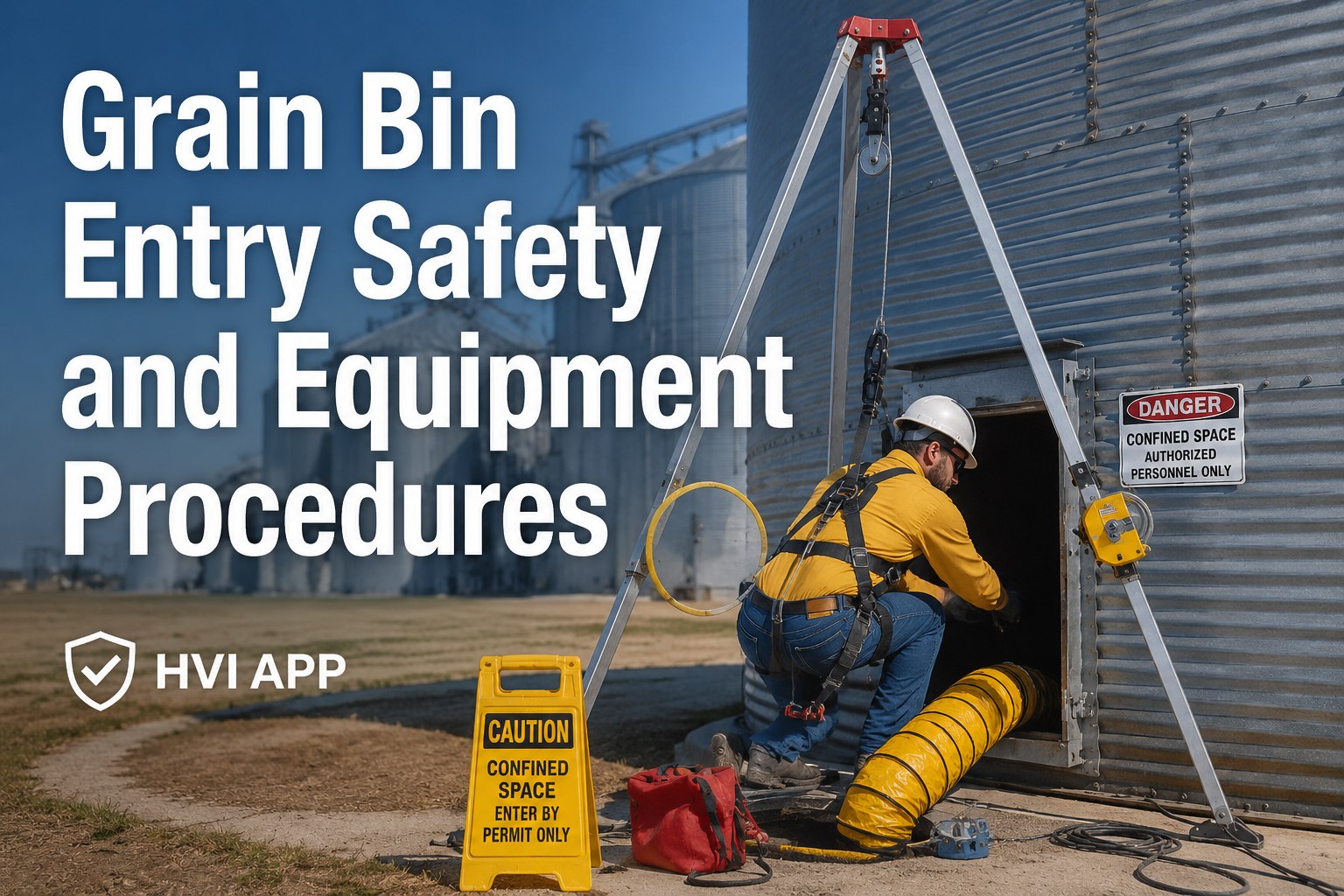
Grain bin entry safety is the line between a routine five-minute job and a fatality, because flowing grain can bury a person in under five seconds and most victims are experienced hands who climbed in to break up a bridge because it felt faster than the alternative. The work tends to fall on the same people running your trucks and trailers, and the controls that keep them alive, lockout, atmospheric testing, an observer, and a harness, only work if the equipment behind them is actually inspected and in date. If your team is still tracking gas monitor calibrations and rescue gear on a clipboard, it is worth a conversation to see how that looks digitised on your own yard before the next harvest push.
Flowing grain buries a person in seconds. Are your controls and equipment actually ready?
Lockout, atmospheric testing, an observer, and a harness and lifeline are the four controls that stop a grain bin entry becoming a fatality. The equipment behind those controls, gas monitors, harnesses, lifelines, and rescue kits, has to be checked, calibrated, and in date, or the controls are just paperwork.
Why grain bin entry safety can't be a paperwork exercise
Grain entrapment kills quickly and the victims are frequently experienced people who entered a bin to break up bridged grain because it was faster than the alternative. The four numbers below are why the control set, and the gear behind it, has to be verified every single time.
The pattern is well-documented across agricultural safety bodies in the US, Canada, and Australia. A bin is running, grain has bridged or crusted over the auger intake, and the quickest fix looks like climbing in with a pole to knock it down. The operator has done it before and it worked. The problem is that grain behaves like a fluid under the crust, and once the bridge collapses, the person at the bottom has seconds, not minutes. If the auger is still energised, the outcome is worse. If nobody is watching from outside, nobody knows it happened until it is too late. That is why the control set exists, and why every piece of equipment supporting it, from the lockout padlock to the gas monitor to the rescue tripod, has to be tracked. Paper binders and memory do not survive a serious incident, and they do not survive an audit either.
The grain bin entry procedure that keeps people alive
Every safe bin entry rests on four controls applied in order. Skip one and the other three lose their margin. The workflow below is the procedure your observer should be running through before anyone breaks the plane of the entry hatch.
Lockout and tagout all powered equipment
Every auger, conveyor, fan, and unloading system associated with that bin must be de-energised at the disconnect and locked out with a personal padlock before entry. The tag identifies who placed the lock and when. This is the single control that prevents mechanical injury during entry, and it is the one most often faked when people are in a hurry. If the lock is not yours, the auger is not safe. Book a walk-through of the lockout checklist on your own bins to see how it digitises on a phone.
Atmospheric testing before and during entry
Test for oxygen, combustible gases, and any fumigants or decomposition products, from the top down. Fumigants settle, low-oxygen pockets form from grain respiration and spoilage, and carbon dioxide builds up in spoiled grain. Test before anyone goes in, and keep the monitor running on the entrant. A monitor that is out of calibration is worse than no monitor because it gives false confidence.
Observer stationed outside with communication
A trained observer stays outside the bin for the entire entry, maintains visual or voice contact with the entrant, and knows how to call for rescue without entering the bin themselves. The observer's first job is to stop a second person becoming a victim. They need a radio, a phone, and the authority to shut the job down.
Harness, lifeline, and rescue provision where entry is unavoidable
If entry cannot be eliminated, the entrant wears a full-body harness tied to a lifeline that keeps them above the grain surface and allows retrieval from outside. Rescue equipment, a tripod, winch, and additional trained personnel, must be on site before entry, not called for after. Response times to a rural farm site are long, and a buried entrant does not have that time.
Never walk down grain, and the mechanical alternatives that avoid entry
Walking down grain to make it flow is prohibited for a reason, it is one of the most reliable ways to kill someone in a bin. The mechanical alternatives exist specifically to remove the need for a human body inside the structure at all.
Never do this
- Walk on or walk down grain to break a bridge or make it flow
- Enter a bin from the bottom while grain is being unloaded
- Use a pole or bar to poke grain from below the crust
- Send a second person in to retrieve the first
Use these instead
- Grain vacuum systems to remove spoiled or bridged grain from outside
- Bin sweep or powered sweep augers designed for unattended operation
- Long-handled remote tools to break crusts from the roof hatch, tied off
- Wait for the bin to empty naturally before any inspection or cleaning
The instinct to walk down grain is strong because it looks like the fastest fix when the auger is running and trucks are waiting. But the same grain that looks solid on the surface can be hollow underneath, and a person's weight is enough to collapse the bridge. The entry procedure above only applies when entry is genuinely unavoidable, for example, structural inspection or a blockage that no mechanical tool can reach. In every other case, the safe answer is to stay out of the bin entirely. Start logging your pre-entry inspections free with HVI so you have a timestamped record of who signed off on the decision to enter, or not to enter, on any given day.
Bin entry equipment that has to be tracked, calibrated, and inspected
The four controls only work if the physical equipment supporting them is functional. That equipment has expiry dates, calibration cycles, and inspection intervals, and they are the first thing an investigator or auditor will ask about after an incident.
| Equipment | What it supports | Inspection requirement | Failure mode if unchecked |
|---|---|---|---|
| Gas monitor | Atmospheric testingBump test before each use, full calibration per manufacturer cycle, typically every 30 to 180 days | Falsely reads safe oxygen or fumigant levels, entrant enters a deadly atmosphere believing it is clear | |
| Full-body harness | Entrant retrieval and fall arrest | Visual inspection before each use, documented inspection at least every 6 to 12 months | Webbing cut, frayed, or UV-degraded, harness fails under retrieval load |
| Lifeline and retrieval winch | Keeping entrant above grain surface | Function check before each use, load-rated inspection annually | Winch slips or jams, entrant drops into grain, observer cannot retrieve |
| Rescue tripod | Non-entry rescue from outside | Setup verification before entry, annual inspection | Legs collapse under load, rescue becomes a second entry |
| Lockout padlocks and tags | Lockout tagout of augers and conveyors | Lock condition check each use, tag legibility and identification | Lock defeats or key is shared, auger starts while entrant is inside |
| Communication radio | Observer-to-entrant contact | Battery and channel check before entry | Observer loses contact, does not know if entrant is safe, calls rescue too late |
The gap that catches most operations is not the big stuff. It is the gas monitor that was last calibrated eleven months ago because nobody got the reminder, or the harness that has been sitting in the cab of the grain truck through a summer of UV. Paper tracking systems fail because they rely on a person remembering to look at a binder. A digital system that flags calibration and inspection expiry automatically, and sends the alert to the person who actually owns that piece of gear, is what turns the gear list from a liability into a control. See how HVI tracks calibration expiry and inspection dates in a live setup, and whether it fits how your yard already works.
Paper vs digital tracking for bin entry permits and gear
Most operations that have a bin entry procedure on paper cannot produce a clean, date-stamped record of the last entry when asked. The table below is what that gap costs you, and what changes when the permit, the gear, and the calibration are all in one place.
| What goes wrong | Paper binder and clipboard | HVI digital permit and gear tracking |
|---|---|---|
| Bin entry permit | Permit filled on paper, filed in a binder, lost or illegible, no photo evidence | Permit built from a template on a phone, time-stamped, photo-backed, retrievable in seconds |
| Gas monitor calibration | Sticker on the monitor, nobody checks it until after an incident | Asset record with calibration due and overdue alerts pushed to the responsible person |
| Harness and lifeline inspection | Annual inspection logged on paper, no reminder when it lapses | Inspection schedule with due-date alerts, defect capture, and full history per asset |
| Lockout tagout record | Written on a tag, not cross-referenced to the entry permit | Lockout steps embedded in the entry workflow, sign-off required before entry proceeds |
| Audit and incident evidence | Days to reconstruct, gaps in the chain, lawyer-friendly failures | One-click report showing permit, gear status, and sign-offs for any date or asset |
The paper system feels cheaper until you count the hours spent looking for a permit, the re-inspection costs when a harness record cannot be found, and the exposure if something goes wrong and the documentation does not hold up. A small fleet running a handful of bin entries a season can still generate enough paperwork to drown a manager, and the bigger the operation, the worse the paper problem gets. Moving to a digital system is less about the technology and more about having one source of truth that survives a turnover, a flood, or an audit. Walk through the permit and gear-tracking workflow on your own units before the next busy season.
Stop tracking bin entry safety on paper. See HVI on your operation.
Build bin entry permits from a template, track gas monitor calibration and harness inspections with due-date alerts, and have audit-ready records in one place.
One platform for permits, gear, and the people who sign off on both
HVI is built for the realities of mixed fleet and site operations, where the same people inspecting trucks and trailers are the ones making a bin entry call. These are the capabilities that map directly to grain bin entry safety and the equipment that supports it.
Entry permit templates
Build a grain bin entry permit from a saved template on any phone or tablet. Required fields, lockout steps, atmospheric test results, observer sign-off, all time-stamped and photo-backed before the entry is authorised.
Calibration and inspection expiry alerts
Track every gas monitor, harness, lifeline, and rescue kit as an asset. HVI pushes due and overdue alerts for calibration cycles and inspection intervals to the person who owns that gear, so nothing silently lapses.
Audit-ready evidence in seconds
When an auditor, insurer, or investigator asks for the last bin entry record, pull it up in one click, permit, gear status, sign-offs, and photos. No binder, no reconstruction, no gaps in the chain.
One platform across trucks and site
HVI covers your trucks, trailers, buses, off-road plant, and the shop and safety gear that supports them. No separate spreadsheet for bin entry, no separate app for vehicle DVIRs, one source of truth across the operation.
The payback of getting bin entry safety right
The return on this is not abstract. It is measured in incidents that do not happen, audits that do not turn into fines, and hours not lost to paperwork. The worked example below is illustrative but the numbers are real for a mid-sized operation.
Consider a 40-vehicle operation that runs grain carts, road trucks, and a couple of site loaders, and does maybe six to eight bin entries across a season for cleaning and inspection. On paper, that is eight permits, each with a gas monitor calibration check, a harness inspection, and a lockout sign-off, all filed somewhere. If one harness record cannot be found during an audit or an incident investigation, the whole entry is questionable. If a gas monitor is used after its calibration lapsed, the atmospheric test result is effectively invalid. The cost of not knowing is not just a fine, it is the legal and human exposure if something goes wrong on a job where the controls were not actually in place. Digitising the permit and the gear tracking is a few hours of setup, and it pays back the first time an auditor asks for a record and you have it on your phone in under a minute. Book a demo and see the permit and gear workflow live against your own operation.
Grain bin entry safety is a control set, not a single rule
The core of grain bin entry safety is that four controls, lockout, atmospheric testing, an observer, and a harness and lifeline, only work when they are applied together and when the equipment behind them is verified. Here is what to remember and what to do next.
Never walk down grain
The fastest-looking fix is the most lethal one. Use mechanical alternatives, grain vacuums, powered sweeps, and remote tools, before any entry is considered.
Entry is the last resort
If entry is unavoidable, all four controls must be in place and verified. Skip one and the others lose their margin. The permit exists to force that verification.
Track the gear, not just the permit
Gas monitors, harnesses, lifelines, and rescue kits have calibration and inspection cycles. If those are not tracked with reminders, the controls are only on paper.
Confirm with your authority
Requirements vary by region and operation type. Confirm the specific permit, training, and equipment requirements with your relevant occupational safety authority before the season starts.
The bin entry permit was always on a clipboard in the office, and the gas monitor calibration sticker was the only thing tracking whether the thing actually worked. We moved it all to HVI after a near miss where a monitor was eight months past calibration and nobody knew. Now the permit, the gear, and the sign-offs are on my phone, and I get an alert before anything lapses. That is the piece that lets me sleep during harvest.
Grain bin entry safety questions, answered straight
What is the most important rule of grain bin entry safety?
Never walk down grain or enter a bin to break up bridged or crusted grain while unloading equipment is running. Flowing grain can bury a person in seconds, and most entrapment victims are experienced operators who took a shortcut they had taken before. Use mechanical alternatives like grain vacuums and powered sweeps, and treat bin entry as a last resort with all four controls in place. You can start logging pre-entry checks free with HVI to build the habit.
What are the four controls for safe grain bin entry?
The four controls are lockout and tagout of all powered equipment including augers and conveyors, atmospheric testing for oxygen and fumigants before and during entry, a trained observer stationed outside with communication, and a harness and lifeline with rescue provision where entry is unavoidable. All four must be verified before anyone breaks the plane of the entry hatch.
How often should a gas monitor be calibrated for grain bin entry?
A bump test should be performed before each use, and a full calibration should follow the manufacturer cycle, typically every 30 to 180 days depending on the sensor and usage. A monitor that is out of calibration gives a false safe reading, which is worse than no monitor because it removes caution. The calibration date and next-due date should be tracked digitally, not on a sticker. See how HVI tracks calibration expiry with alerts in a live demo.
Can a second person enter the bin to rescue an entrant?
No. A significant share of grain bin incidents involve a second victim, the would-be rescuer who enters the bin and is also engulfed. Rescue must be attempted from outside using a tripod, winch, and lifeline, and only by trained personnel. The observer's job is to call for help and operate retrieval equipment, not to go in after the entrant.
Do I need a written bin entry permit every time?
In most jurisdictions and under most occupational safety frameworks, yes, a written or digitally recorded permit is required for confined space entry including grain bins. The permit documents lockout, atmospheric test results, observer assignment, and equipment status. Confirm the exact requirement with your relevant authority, but a digital permit template in HVI gives you a defensible, time-stamped record every time.
Book a demo and see grain bin entry safety digitised on your operation
Permit templates, calibration alerts, gear tracking, and audit-ready records, all on any phone or tablet, across your trucks, trailers, and site equipment.
Free to start, Works on any phone, No card needed