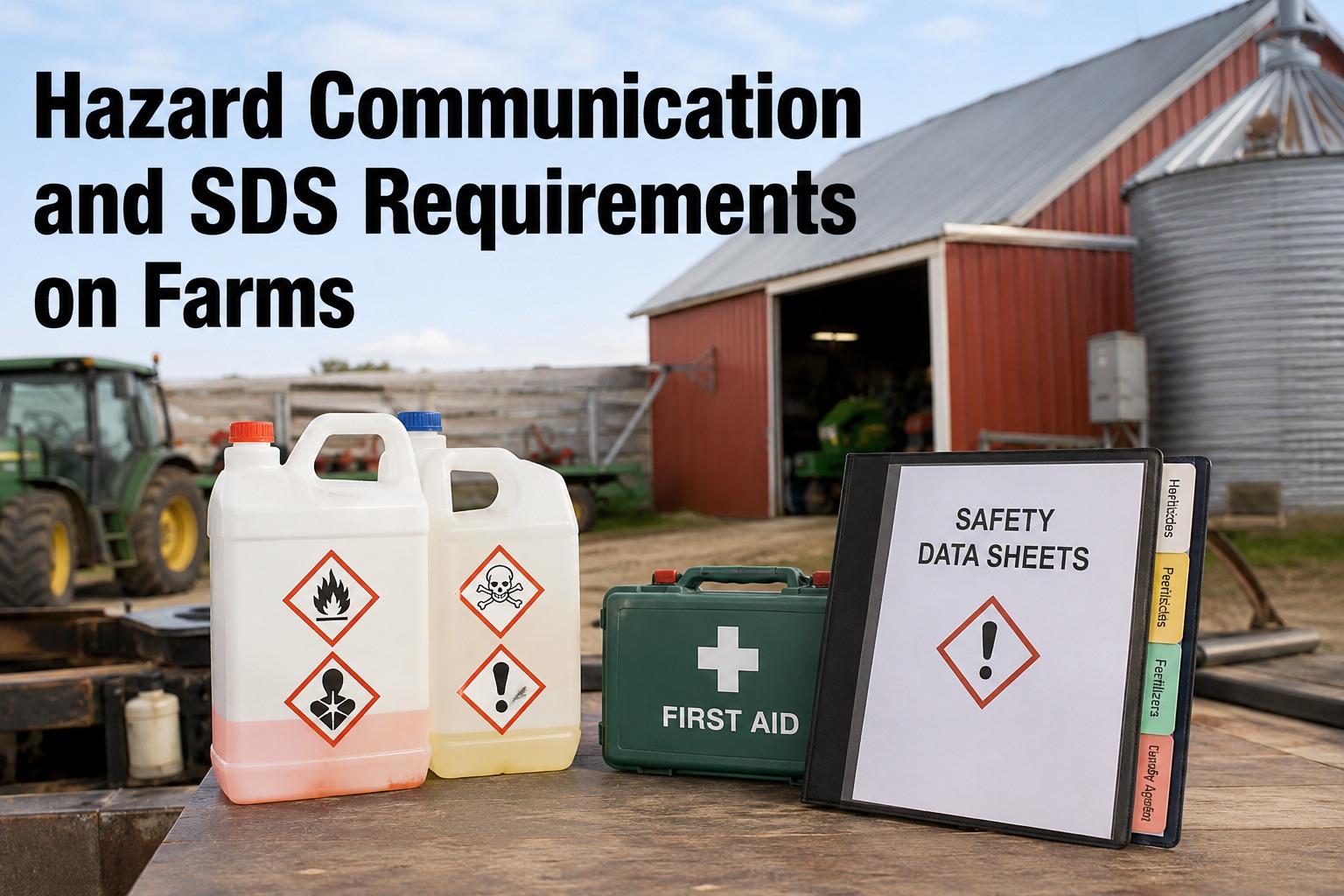
The chemical shed door sticks, the light is dim, and you are looking for the safety data sheet on a generic-looking white drum while a sprayer sits idle outside. Hazard communication on farms is one of the few general industry standards that reaches agricultural operations, and during an OSHA inspection it usually fails on two straightforward points: sheets that are not accessible and training that was never documented. If the SDS binder is sitting in the house, or the spray mix was decanted into an unlabelled jerry can, a routine visit turns into a citation. You can see how a digital setup handles this on a walk-through, but the core requirement is simple: current sheets, proper labels, and a record that workers were trained on the hazards they actually handle.
If the SDS binder is in the farmhouse, it is not accessible
HazCom 1910.1200 applies to agriculture. The two things inspectors flag first are safety data sheets nobody can reach in the field and worker training that exists only in someone's memory. Get both right and the inspection goes quiet.
Four numbers that define farm chemical safety risk
Every gap below is a point OSHA inspectors check, and each one ties directly to a cost: a fine, a shut sprayer, or a worker exposure event you cannot explain.
What hazard communication on a farm actually requires
HazCom in agriculture is not a single binder. It is four moving parts, and every one has to be current, on site, and provable. The grid below maps each requirement to what it looks like in a real farm shop or chemical shed.
Chemical inventory
A written list of every hazardous chemical on the farm, including pesticides, fuels, coolants, adjuvants and shop solvents. The inventory has to match what is actually on the shelf, not what was there last spring.
Current, accessible SDS
A safety data sheet for every product on the inventory, available to any worker at the point of use. Sheets in a filing cabinet in the house do not serve someone mixing spray in a shed half a mile away.
Proper container labelling
Every container carries the product identifier, hazard warning and manufacturer details. The breakdown is decanting: product poured into an unlabelled jerry can or spray tank without a transfer label is a direct violation.
Documented worker training
Workers must be trained on the hazards of the chemicals they work with and how to read an SDS. Experience is not proof. You need a signed, dated record showing what was covered and who was in the room.
Mapping HazCom agriculture compliance to evidence an inspector accepts
When an inspector arrives, they do not want a story about how you do things. They want to see a record. The table below maps each HazCom requirement to the specific evidence that satisfies it, and flags where farms typically fall short.
| HazCom requirement | What inspectors ask to see | Where farms typically fail |
|---|---|---|
| Chemical inventory | A current list matching products on site | List is a year old, missing new adjuvants or removed products |
| SDS accessibility | Any worker can pull an SDS in minutes at point of use | Only copy is a binder in the farmhouse or a locked office |
| Container labelling | Every container, including transfer vessels, labelled | Product decanted into unmarked jerry cans or spray tanks |
| Worker training | Signed, dated record of training content and attendees | Training assumed from experience, no documentation exists |
| Pesticide interaction | EPA Worker Protection Standard records separate and additional | Farms assume HazCom covers pesticide-specific requirements |
Where farm chemical safety breaks down in practice
The four pillars look clean on paper. In the field, three situations account for almost every citation. Each one is a gap between what the rule expects and what actually happens when the pressure is on.
The inaccessible binder
A worker is mixing adjuvant in a chemical shed 400 metres from the farmhouse. A reaction starts. The SDS binder is on a desk in the house, and nobody can find the key to the office. The 15-minute access window OSHA expects is gone. The sheet has to be at the point of use, not in a building the worker cannot reach. You can walk through how that changes when sheets live on a phone instead of a desk.
The unlabelled transfer
A drum of product is decanted into a 20-litre jerry can for the spray rig. Nobody writes the product name, hazard pictogram or manufacturer on the can. Three days later, a different operator picks it up and has no idea what is inside. This is the single most common labelling failure, and it is a per-container citation. If you want to see how a digital chemical handling workflow handles transfer labelling, it is worth a 30-minute screen share.
The training that was never recorded
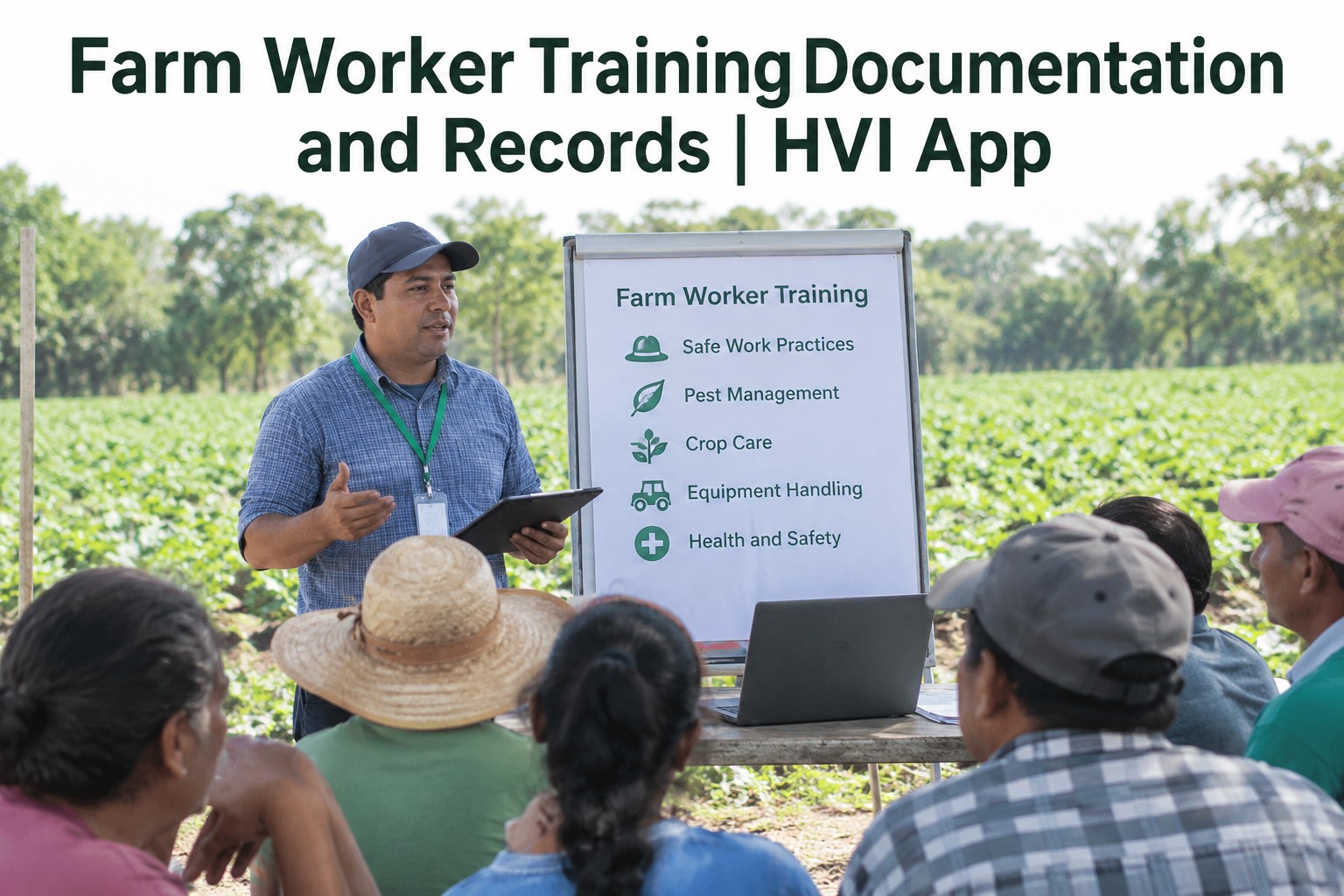
A seasonal worker has been spraying for two seasons and knows the products. But when the inspector asks for the training record, there is nothing on file. The worker's experience does not count as documentation. You need a signed, dated record showing the hazards covered, the SDS system explained, and the worker's name. If your records are scattered, you can start building audit-ready training logs free and backfill what is missing.
See HVI running on your own fleet and chemical inventory
Book a 30-minute demo and we will show you how digital SDS access, training records and chemical asset tracking work on a phone in the shed.
How pesticide SDS requirements interact with HazCom
Pesticides carry their own labelling and training requirements under the EPA Worker Protection Standard for Agriculture, 40 CFR Part 170, and equivalent regulators in other countries. These are separate from and additional to HazCom 1910.1200. A farm that is compliant on pesticide labelling is not automatically compliant on general hazard communication, and vice versa.
General hazard communication
- Covers all hazardous chemicals: fuels, solvents, coolants, adjuvants
- Requires SDS in the 16-section international format
- Requires a written HazCom program and inventory
- Training covers reading SDS and understanding labels
EPA WPS and pesticide rules
- Covers agricultural pesticides specifically
- Requires the pesticide label itself to be accessible
- Requires pesticide safety training for workers and handlers
- Includes application exclusion zones and REI posting
Always confirm current requirements with OSHA and your relevant pesticide authority. The interaction between the two frameworks is where mixed-operation farms get caught: they satisfy the pesticide label requirement but miss the SDS for the diesel fuel in the same shed. If you want to see how a single platform can track both, book a quick demo and we will map it to your products.
Audit-ready farm chemical documentation in one platform
HVI is cloud and mobile inspection and maintenance CMMS software. On the chemical safety side, it turns paper binders and memory into timestamped, photo-backed records that live on every worker's phone. These are the four capabilities that map directly to HazCom agriculture compliance.
Chemical handling equipment as tracked assets
Sprayers, nurse tanks and transfer pumps are logged as assets with inspection schedules. You know when a pump was last checked and by whom, and the record is photo-backed and timestamped.
Training records with expiry alerts
Every worker's chemical safety training is logged with a date and an expiry. HVI sends an alert 30 days before it lapses, so you retrain before the inspector arrives, not after.
Audit-ready documentation in seconds
When the inspector asks for proof, you pull up the full training log, chemical inventory and equipment inspection history on a phone. No binder, no scramble, no missing pages.
Cloud access from any shed or field
SDS and training records are not locked in an office. Any worker with the app can pull them up at the point of use, which is exactly what the accessibility rule demands.
What hazard communication on a farm comes down to
If you remember four things, you will pass most HazCom inspections without a citation. None of them require expensive infrastructure, but all of them require a system that is current, accessible and documented.
Accessibility is about location, not existence
Having an SDS somewhere on the property is not enough. It has to be reachable by the worker at the point of use, within minutes, not after a walk to the farmhouse and a search for a key.
Every container, every time
If you decant product into a transfer vessel, label it immediately. Product name, hazard pictogram, manufacturer. The unlabelled jerry can is the citation that writes itself.
Training that is not recorded did not happen
A worker who knows the job is valuable, but that knowledge is not proof of compliance. You need a signed, dated record of what was covered and who attended.
Pesticide rules are separate and additional
HazCom compliance does not cover pesticide-specific requirements. Confirm both frameworks with OSHA and your pesticide authority, and document them independently.
The inspector asked to see our SDS for the adjuvant we were mixing that morning. The binder was in the house, locked, and nobody could find the key. That was a 20-minute conversation I do not want to have again. We moved everything to the app the next week. Now the sheet is on the phone in the shed, and the training log is right behind it.
Farm hazard communication questions, answered
Does OSHA hazard communication apply to farms?
Where do SDS sheets need to be stored on a farm?
Do I need to label containers if I decant chemicals on the farm?
Is pesticide training the same as HazCom training?
How often do farm workers need HazCom refresher training?
Get your farm chemical records audit-ready this week
Book a 30-minute demo and we will show you how HVI handles SDS accessibility, training logs and chemical asset tracking on your phone, in your shed.
Free to start — Works on any phone — No card needed