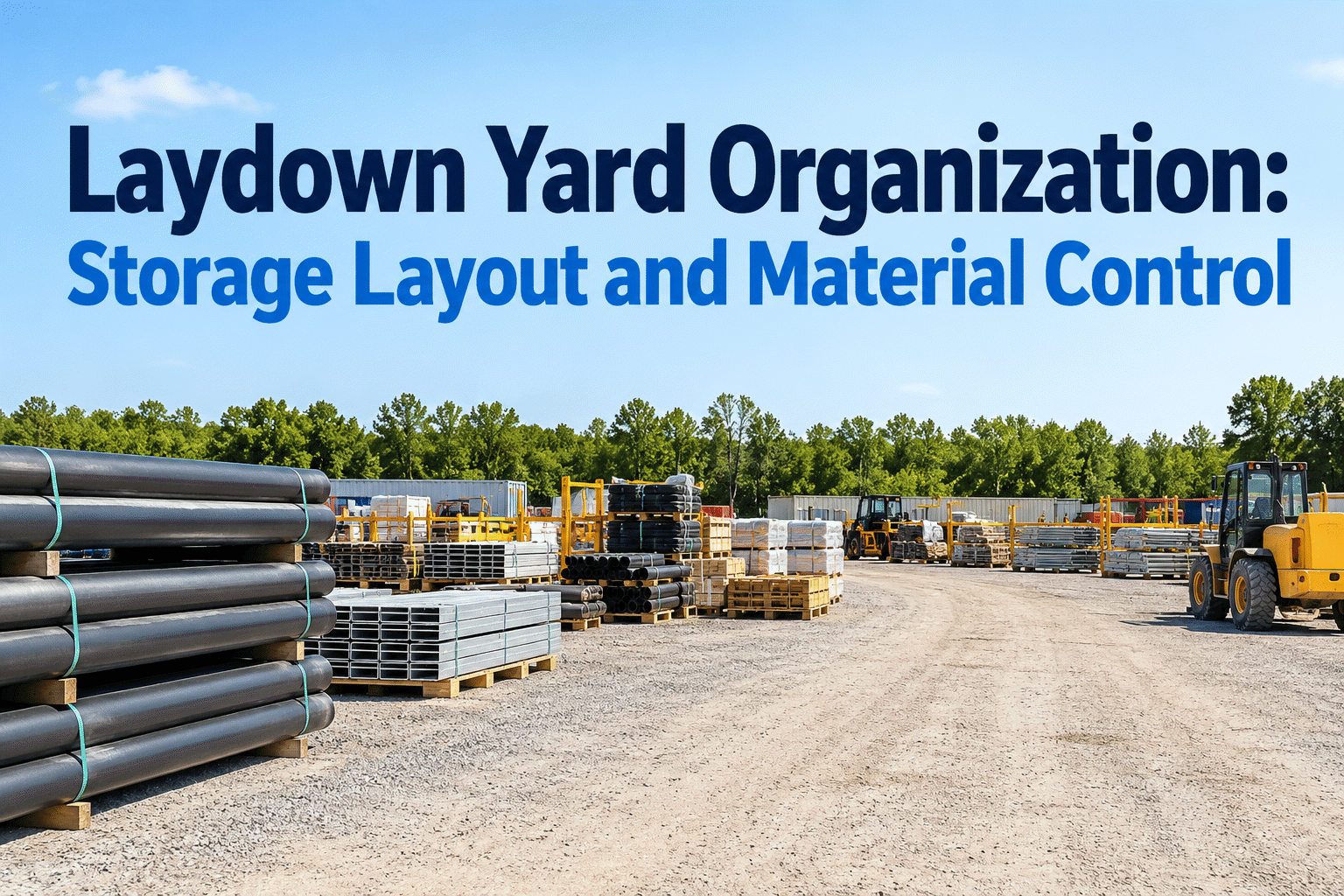
Good laydown yard organization is the difference between a crew that starts at 7am and one still hunting for a coupling at 7:40. Material lands faster than anyone can log it — then a foreman needs twelve joints of 6-inch and nobody knows if they're on site or never delivered. This guide covers the storage zones, location labels, and in-and-out logs that make a yard findable again. Book a demo to track yard material in one place.
Laydown Yard Organization That You Can Actually Find Things In
Zones, labels and logs — so every piece of material has an address, and every address matches what's really on the ground. Here's the layout, mapped.
A laydown yard isn't a warehouse — it's open ground that changes every week as deliveries land and crews pull material. That's exactly why it drifts into chaos without a system. Below are the three things that keep it under control: zoning the ground, giving every spot an address, and logging what comes in and goes out. Get those right and "where is it?" stops being a daily question.
01Zone the ground before anything lands on it
The first move in laydown yard organization is deciding where material goes before the truck arrives, not after. Group by material type and by how often it's pulled — fast-moving fittings near the access lane, long steel where a crane can reach it, attachments on firm hardstand. A zoned yard means a driver can be told "Zone A, pipe" and a crew knows where to look without a scavenger hunt.
Pipe & linear stock
Racked or dunnaged by size and spec. Crane-accessible, clear of the lane so long loads don't block traffic.
Structural steel
Stacked on level dunnage by heat/mark number so the right member comes out first — no digging to the bottom of the pile.
Attachments & equipment
Buckets, couplers and heavy attachments on firm hardstand, logged to the machine or work order they serve.
Fittings & small parts
Containerized and shelved near the access lane — the high-churn items that cause the most searching when loose.
Receiving & issue point
One gate in, one counter out. Nothing enters the yard or leaves a crew's hands without passing through here.
Zoning is also what makes everything else possible — you can't label a location or log a movement until the ground has a structure. Start a free trial and set your zones up as stored locations so every part already knows which zone it belongs to.
02Give every spot an address with location labels
A zone tells you roughly where something is; a location label tells you exactly. The fix that ends most yard searching is a simple, consistent addressing scheme painted on the ground and printed on the tag: Zone, Row, Bay, Slot. "A-03-B-2" means Zone A, Row 3, Bay B, Slot 2 — and anyone with that code walks straight to the material.
Keep the scheme short and paint the zone and row markers large enough to read from a loader cab. When those same codes live in your parts and inventory system as the stored location for each item, the label on the ground and the record on the screen finally say the same thing. Book a demo to see location-based stock lookups
03Log what comes in and what goes out
Zones and labels organize the ground. The two logs — receiving in, issue out — are what keep the record honest. Without them, your yard inventory is a guess by Thursday. With them, every piece of material has a paper (or digital) trail from the gate to the crew that used it, and your material control actually reconciles.
Receiving log
material in- Delivery checked against the PO — quantity, spec, damage
- Each item tagged with its zone and location code
- Received qty and date recorded against the part
- Short or damaged loads flagged before the truck leaves
Issue log
material out- Material pulled against a work order or crew request
- Issued qty deducted from the location's stock
- Who took it, when, and for which task recorded
- Returns logged back so stock isn't double-counted
When both logs feed one system, stock levels stay live instead of going stale between counts — and barcode or QR scanning on a phone means the crew logs a movement in seconds, not on a clipboard that never makes it back to the office. Book a demo to see receiving and issue on mobile
What disorganized yards actually cost
The cost of a messy laydown yard doesn't show up as a line item — it hides inside labor hours, re-orders and schedule slips. A few numbers worth keeping in view when you weigh whether organizing the yard is worth the effort (it is).
lost to crews searching for material that's on site but can't be found — time billed to the job with nothing to show for it
of material that was already delivered but written off as missing, paying twice for the same part and the freight to rush it
slips when a crew is ready but the right pipe, member or fitting can't be located at the moment it's needed
Exact figures vary by project size and trade — track your own yard's search time and re-order rate for a month and the case for organizing it usually makes itself. The point isn't a headline percentage; it's that every one of these costs is recoverable with zones, labels and logs. Book a demo to see your yard's numbers tracked
The weekly material-control checklist
Organization isn't a one-time setup — a yard drifts if nobody tends it. Run this short loop once a week to keep laydown yard material control tight and catch discrepancies while they're still small.
Done consistently, this loop takes under an hour and keeps your construction material storage trustworthy enough that the system can be believed over a physical hunt. Start free and build this reconciliation loop into your yard routine.
From a yard manager who sorted it out
Our yard was a junkyard with a fence. Material would come in, get dropped wherever, and two days later we'd be buying it again because nobody could find the first lot. I once had three guys for half a morning looking for valves that were sitting in plain sight under a tarp.
We painted zones, put a Row-Bay-Slot code on everything, and made one gate the only way in or out. The thing that actually fixed it was logging receipts and issues on a phone — once the screen matched the ground, people trusted it and stopped searching. Re-orders for "missing" material basically stopped.
Frequently asked questions
What is a laydown yard in construction?
A laydown yard (also called a laydown area or material staging yard) is a designated open space on or near a construction site where materials, equipment and attachments are received, stored and staged before they're moved to the point of use. It's where pipe, structural steel, rebar, fittings, precast, and heavy attachments wait between delivery and installation. Unlike an enclosed warehouse, a laydown yard is usually open ground, exposed to weather and constantly changing as deliveries arrive and crews pull material. That dynamic nature is exactly why organization matters so much: without defined storage zones, location labels and receiving-and-issue logs, a laydown yard quickly becomes a place where material is technically on site but effectively lost. Good laydown yard organization treats that open ground like a managed inventory location — with addresses, records and a single point of control — rather than an overflow dumping area.
How do you organize a construction laydown yard?
Organize it in three layers. First, zone the ground: divide the yard into areas by material type and pick frequency — pipe and linear stock in one zone, structural steel in another, attachments on firm hardstand, fast-moving fittings near the access lane, and a dedicated receiving-and-issue point. Second, label every location with a short, consistent addressing scheme such as Zone-Row-Bay-Slot (for example, A-03-B-2), painted on the ground and printed on each item's tag so any code leads straight to the material. Third, log movement: record every delivery received against the purchase order and tag it with its location, and record every issue when material is pulled for a work order or crew. Keep those zones, labels and logs in one system rather than on scattered clipboards, and add barcode or QR scanning so the crew can log a movement from a phone in seconds. Finally, run a short weekly reconciliation walk to keep the record matching the ground. Zones give it structure, labels give it precision, and logs keep it honest.
What is material control in a laydown yard?
Material control is the discipline of always knowing what material you have, where it is, and where it went. In a laydown yard, that means three things working together: an accurate record of what was received (checked against the purchase order), a precise location for where each item is stored, and a record of what was issued out and to which work order or crew. When material control is working, your yard inventory reconciles — the quantity in the system matches the quantity on the ground, and any difference points to a specific gap you can investigate. When it's not, you get the classic laydown-yard failures: paying twice for material that was already delivered, crews idle while someone searches, and schedule slips because the right part can't be found at the right moment. Strong material control is what lets a manager trust the system enough to answer "do we have it, and where?" from a screen instead of sending someone to walk the yard.
How does inventory software help with laydown yard management?
Inventory software turns the yard's zones, labels and logs into one shared, live record instead of scattered paper. Each item is assigned a stored location (your Zone-Row-Bay-Slot code) so a lookup tells anyone exactly where material sits. Receiving is logged against the purchase order, and issuing deducts from stock automatically when material goes out on a work order, so levels stay current between physical counts. Barcode and QR scanning on a mobile app means crews log receipts and issues in the field in seconds rather than on a clipboard that may never reach the office. For multi-site operations, cross-location visibility lets you check another yard before re-ordering, so you stop buying material you already own somewhere. HVI's parts and inventory module is built for exactly this: multi-location stock, stored-location fields, barcode receiving and stock issue, and dashboards that roll several yards into one view — the practical toolkit for turning a disorganized laydown yard into a controlled inventory location.
What's the best way to label material in a laydown yard?
The best labeling system is short, consistent, and readable from a distance. Use a hierarchical address that goes from general to specific — most yards land on Zone-Row-Bay-Slot (for example, A-03-B-2) — and apply it in two places: painted large on the ground markers (zone letters and row numbers a loader operator can read from the cab) and printed on a durable tag attached to each item or pallet. Add a barcode or QR code to the tag so the same location can be scanned rather than typed, which both speeds up logging and eliminates transcription errors. Keep the scheme stable: don't renumber zones mid-project, and make sure a newly received item gets its tag at the receiving point before it's moved into storage, not later. The goal is that the code painted on the ground, printed on the tag, and stored in the inventory system are always the same three things — so the label a crew reads and the record a manager sees never disagree.
Give every piece of material an address — and make the record match the ground
HVI's parts and inventory module lets you set yard zones as stored locations, tag items with location codes, log receiving and issuing from a phone, and roll multiple yards into one live view. Stop paying for material you already own and crews who can't find it.