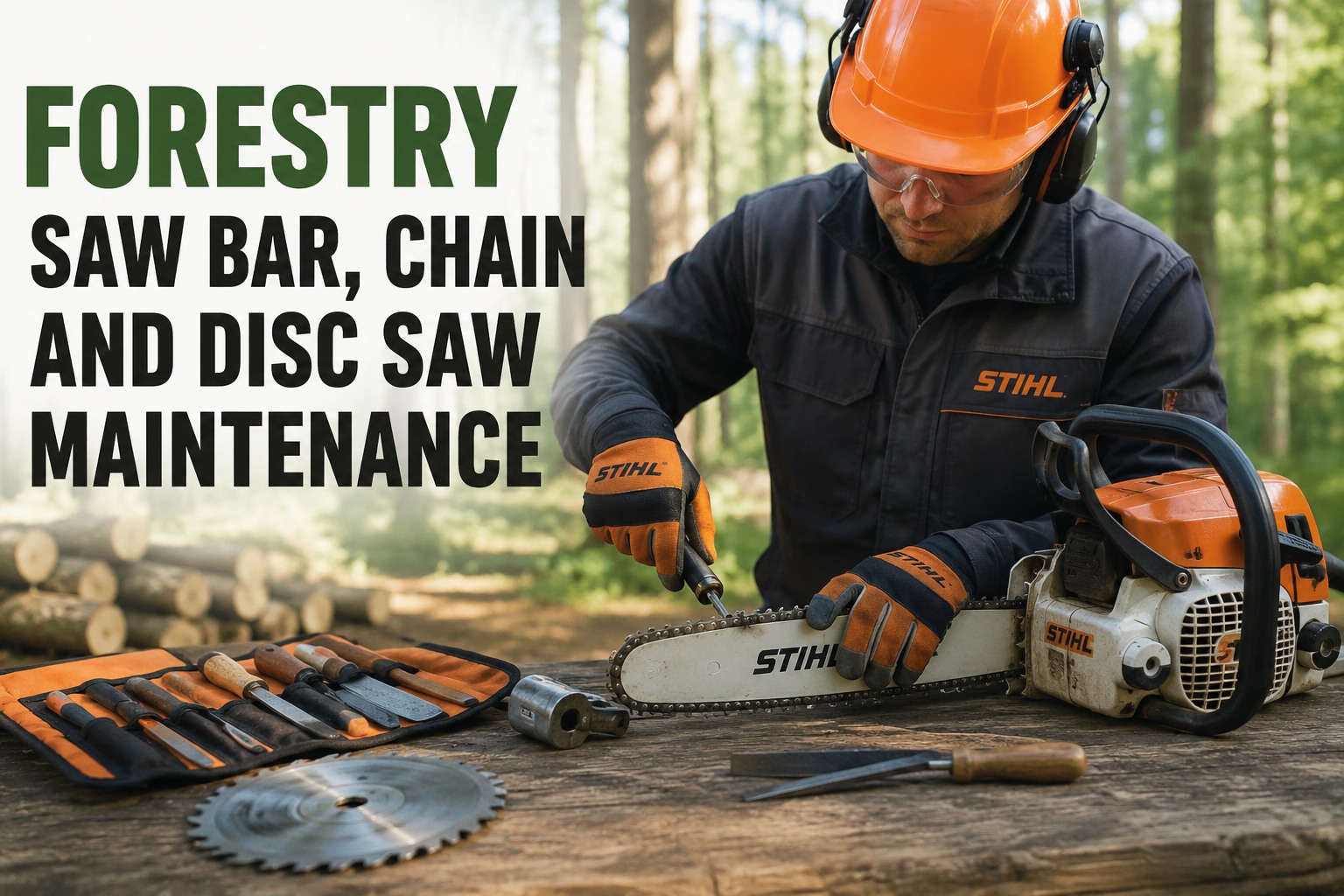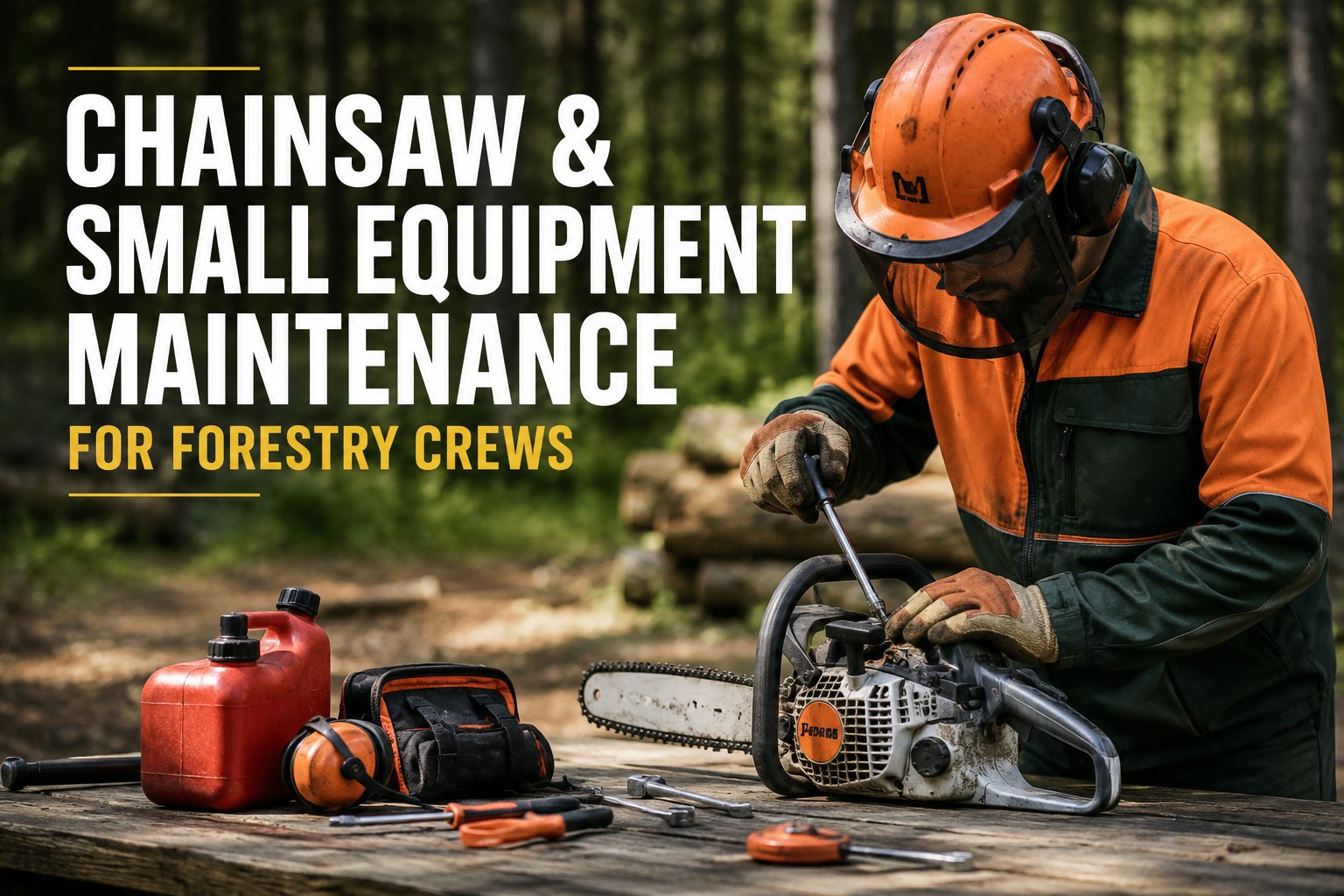
A chainsaw is a safety-critical working asset a forestry crew holds against a live power source at chest height, all day, in dusty conditions. Every safety device on it has to work — chain brake, throttle interlock, chain catcher, anti-vibration mounts, stop switch, hand guard — and every wear component (chain, bar, filters) has to be maintained on the cadence the operating environment demands. This 2026 guide walks the safety inspection anatomy and assignment discipline. Book a demo .
The Chainsaw Anatomy Inspection — What Must Be Verified Before Every Shift
Six inspection points that separate a saw fit for the cutting face from one that shouldn't leave the truck.
- 1Chain brakeKickback protection. Test operation and inspect brake band at every use.
- 2Chain catcherCatches broken/thrown chain. Confirm intact, not loose or damaged.
- 3Anti-vibration mountsReduce HAVS risk. Inspect for cracks, wear, or fluid leaks.
- 4Throttle interlockPrevents accidental throttle. Verify lock engages and releases correctly.
- 5Stop switchEmergency shutoff. Test function — both cold-start and running.
- 6Bar oiler flowContinuous chain lubrication. Verify oil throw against a stump before first cut.
Forestry crews carry chainsaws, brush cutters, pole saws, and small backup equipment to the cutting face every shift. These aren't background tools — they're the primary production equipment for tree felling, limbing, bucking, and clearing work. When a saw fails mid-shift, the crew loses production time and often has to hike back to the truck for a backup. When a saw fails unsafely, the crew loses a member to injury. The maintenance discipline for small forestry equipment sits on three legs: pre-use safety inspection (every shift, seconds per check), operational checks during use (chain tension, bar oil), and scheduled deeper service (filters, spark arrestor, bar rotation, fuel system). Each leg has a different cadence and a different failure profile.
Chain and bar service — the wear cycle that never stopsThe consumables that get used up shift by shift and where the maintenance rhythm lives
Chain and bar are the working end of the saw and the highest-wear components. A crew felling and bucking 15–30 trees per shift is putting the chain through a full cycle of dulling, tensioning, and sharpening within days — not months. The maintenance rhythm has to match the wear rhythm. Book a demo to see chain/bar consumption tracked per saw in HVI
Chain sharpness + depth gauges
Chain sharpness checked before every significant use — a dull chain doesn't just cut slowly, it forces the operator to push harder and dramatically increases kickback risk. Sharpen in the field with the correct file diameter for the chain pitch; depth gauges checked and adjusted at every 3rd or 4th sharpening as cutter height drops.
Chain tension — check at every refuel
Chain warms up during cutting and stretches; retensioning is required through the shift. Rule of thumb: check tension at every fuel-and-bar-oil refill. Chain should lift off the bar just enough to see daylight, then snap back cleanly when released.
Bar rotation for even wear
Guide bars wear unevenly — the down side of the bar takes more load on most cuts. Rotate the bar daily (or every second day, minimum) to distribute wear evenly across both rail edges. Bar life doubles with disciplined rotation compared to run-until-dead.
Bar groove cleaning + oiler port
Pull the bar every few tanks and clean out the groove — sawdust and pitch pack into the groove and restrict chain travel + oil flow. Check that the bar's oiler port (near the powerhead) isn't blocked. Blocked oiler = burned bar rails within a shift.
Sprocket wear inspection
A worn sprocket wears chains faster and rides rough. Check the sprocket wear pattern when swapping chains — deep witness marks or asymmetric wear signals replacement due. Common miss: crews assume the chain is dulling fast when the sprocket is the actual root cause.
Bar and chain oil supply
Chain lubrication is continuous during cutting — the saw pumps bar oil to the chain the entire time the engine is running. Fill bar oil at every fuel stop; a saw runs out of bar oil at roughly the same rate as fuel by design. Running dry on oil is a fast path to bar and chain destruction.
Filters, fuel, and the dusty-environment penaltyWhere forestry saws differ from occasional-use consumer chainsaws
A homeowner chainsaw sees maybe 5 hours of use per year. A forestry-crew saw sees that in a day. The air, fuel, and cooling systems on a professional saw operate in far dustier conditions than manuals assume, and the maintenance intervals have to compress accordingly.
Air filter
Spark arrestor screen
Fuel filter + fuel system
Cooling fins + flywheel
Duty-cycle-matched intervals only work if someone is watching consumption per saw and flagging when a specific unit is running through filters or plugs faster than fleet norm. Book a demo to see per-saw consumables tracking in HVI
Assignment and accountability — the discipline that separates fleets from tool pilesWhy assigning small equipment to individuals or crews changes maintenance outcomes
The single biggest determinant of small-equipment care isn't inspection quality — it's who owns the asset. A saw shared across a rotating crew with no assigned owner gets treated like a shared saw: sharpened when someone remembers, cleaned when someone has time, checked when it visibly needs it. A saw assigned to a specific operator or crew with return-to-supervisor accountability gets treated like personal equipment. Start a free trial and configure assignment records for the fleet.
One saw, one operator
Each saw assigned to a specific operator or two-person team — not to a crew pool. The assigned operator is the person answering the question "what condition was this saw in when you signed out today?" Personal accountability drives daily inspection completion in a way that rotating pool assignment does not.
Sign-out / sign-in per shift
Every saw signed out at shift start and returned at shift end. Sign-in triggers a post-shift check — damage flagged, consumables noted, defects captured before the saw goes into storage. Sign-out at the next shift includes a pre-use inspection sign-off.
Defect capture with photo evidence
Post-shift defects captured with photo evidence and routed to the shop for service. Distinguishes normal wear (chain dulling, bar rotation due) from actual damage (bar bent, powerhead cracked, safety device broken) that pulls the saw from service until repaired.
Consumables burn-rate tracking
Chain, bar, filter, spark plug, and 2-stroke oil consumption tracked per saw catches operators or crews burning through consumables faster than the fleet average — usually a training issue (chain sharpening technique) or an operating condition (unusually abrasive material) that can be addressed once visible.
Warranty and service history per saw
Serial-number-level maintenance history per saw supports warranty claims and dealer service diagnostics. When a saw goes back to the dealer with a persistent issue, the maintenance record is what the dealer uses to distinguish operator issue from manufacturer defect.
Contractor accountability where applicable
Contractor crews using company-owned saws sign the same assignment records as employed crews. Bond or replacement responsibility for damage-through-misuse (as opposed to normal wear) documented in the contractor agreement. Assignment record is the enforcement mechanism.
Assignment records, sign-out/sign-in workflow, and defect capture per operator are what turn a shared tool pool into an actual small-equipment fleet. Book a demo to see equipment assignment workflows in HVI
From a forestry crew supervisor on the assignment-based discipline shift
We ran a shared saw pool for years — 12 saws, 20 crew members, whoever grabbed a saw at shift start had it for the day. Consumables budget was 40% over target consistently, and we were breaking saws faster than replacement schedule assumed. Nobody was doing anything wrong on purpose; nobody was doing anything right either. The saws belonged to no one.
We switched to two-person team assignment — 10 teams, each team responsible for their assigned pair of saws. Sign-out at start, sign-in at end, post-shift check documented. Consumables came in under budget the first quarter, and we stopped buying replacement saws mid-year. Same crew, same saws, same work. Assignment discipline was the whole difference.
Frequently asked questions
What should a chainsaw pre-use inspection cover?
A chainsaw pre-use inspection should cover six safety-critical checkpoints and the working consumables. Safety devices: chain brake function test (the kickback-prevention mechanism), chain catcher intact and not loose, anti-vibration mounts free of cracks or damage, throttle interlock engages and releases correctly, stop switch functional (test cold-start and running), and front hand guard undamaged. Working systems: bar oiler flow verified against a stump before first cut, chain tension correct (chain lifts off bar just enough to see daylight, snaps back cleanly), chain sharpness (dull chain forces operator to push harder and dramatically increases kickback risk), air filter clean, bar rails and groove free of debris, fuel and bar oil topped up. Each of these takes seconds to verify. The safety devices are non-negotiable — a saw with a non-functional chain brake, damaged chain catcher, or broken stop switch does not leave the truck. Pre-use inspection is the operator's protection first and the fleet's maintenance signal second.
How often should chainsaws be maintained in a forestry operation?
Forestry-crew chainsaws operate on a compressed maintenance schedule vs occasional-use consumer chainsaws. Every use: pre-use safety inspection (6 checkpoints), chain sharpness check, bar oil top-up. Every refuel: chain tension check, bar oil refill (bar oil consumes at approximately the same rate as fuel by design). Daily to every-other-day: bar rotation for even wear. Every few tanks: bar removal + groove cleaning, oiler port check, air filter inspection (clean or replace as needed). Weekly during hard use: sprocket wear inspection when swapping chains, cooling fins and flywheel cleaning, deeper visual inspection for cracks or wear. Every 25 hours or per manufacturer: spark arrestor screen cleaning (clogs quietly and slowly kills power — commonly missed). Annually or when symptoms suggest: fuel filter replacement. The manuals written for occasional consumer use understate all of these intervals substantially in a forestry-crew duty cycle. Match the interval to the actual use rate, not to the printed number.
Why does chainsaw assignment to operators matter for maintenance?
The single largest determinant of small-equipment care outcomes is not inspection quality — it's ownership. A saw shared across a rotating crew with no assigned owner gets treated like a shared saw: sharpened when someone remembers, cleaned when someone has time, checked when it visibly needs it. A saw assigned to a specific operator or two-person team with sign-out and sign-in at each shift, post-shift check, and personal accountability for damage gets treated like personal equipment. Consumables consumption typically drops, saw lifespan extends, and defect capture rates rise because the assigned operator is the person answering the question "what condition was this saw in when you signed out today?" Assignment discipline also enables per-saw consumables tracking (chain, bar, filter, spark plug, 2-stroke oil consumption per saw), per-saw defect history for warranty and dealer service diagnostics, and contractor accountability where company-owned equipment is used by contract crews. The mechanism is behavioral, not technical — but the behavioral change produces the maintenance outcomes.
Does HVI support small equipment and chainsaw fleet management?
Yes. HVI supports tracking small forestry equipment (chainsaws, brush cutters, pole saws, backup saws, and other small engine equipment) as maintainable assets in the fleet inspection and maintenance platform. Features include configurable pre-use inspection templates covering the 6 safety-device checkpoints (chain brake, chain catcher, anti-vibration mounts, throttle interlock, stop switch, front hand guard) plus bar oiler flow and chain condition, parts and consumables tracking for chains, guide bars, air filters, spark arrestor screens, fuel filters, and 2-stroke oil, equipment assignment records to responsible operators or crews where supported by the workflow, defect capture with photo evidence for post-shift check, and searchable maintenance and consumables history per saw serial number for warranty claims, dealer service diagnostics, and accountability tracking. HVI is not a small-engine repair service, a chainsaw OEM (Husqvarna, Stihl, Echo), a dealer service or warranty authority, or a personal PPE tracking system. Sharpening skill, warranty repair, and OEM diagnostic work remain with trained technicians and the dealer network.
What are the recurring maintenance failures on forestry chainsaws?
Field data across forestry crew operations converges on a short list of recurring maintenance failures. Blocked bar oiler port (usually from packed sawdust and pitch in the bar groove) leading to bar rail burn and chain damage within a shift — caught by bar removal and groove cleaning every few tanks. Clogged spark arrestor screen slowly killing engine power — caught by inclusion in the 25-hour or manufacturer-interval service. Dull chain from worn sprocket rather than the assumed cause (chain wearing quickly) — caught by sprocket inspection when swapping chains. Air filter clog in dusty forest environments causing rich running and power loss — caught by inspection every few hours of saw time. Overheating from packed cooling fins — caught by cleaning at every deeper service. Wrong 2-stroke oil ratio destroying engines from lean-running or fouling from over-oiled mix — caught by fuel mixing discipline and standardized fuel supply. Chain catcher damage or loosening that goes unnoticed until a broken chain event — caught by pre-use inspection every shift. All are catchable with the right inspection cadence written into the pre-use and periodic templates.
Give forestry supervisors accountability over every saw and small engine in the crew
HVI supports small forestry equipment as maintainable assets, configurable pre-use inspection templates for chainsaw safety-device checks, parts and consumables tracking per saw, equipment assignment records to responsible operators or crews, defect capture with photo evidence, and searchable maintenance history per saw serial number. Sharpening skill, warranty repair, and OEM diagnostic work remain with trained technicians and the dealer network. HVI is the asset-management and inspection layer that pairs with them.
No credit card · No hardware · Small equipment templates ready on day one