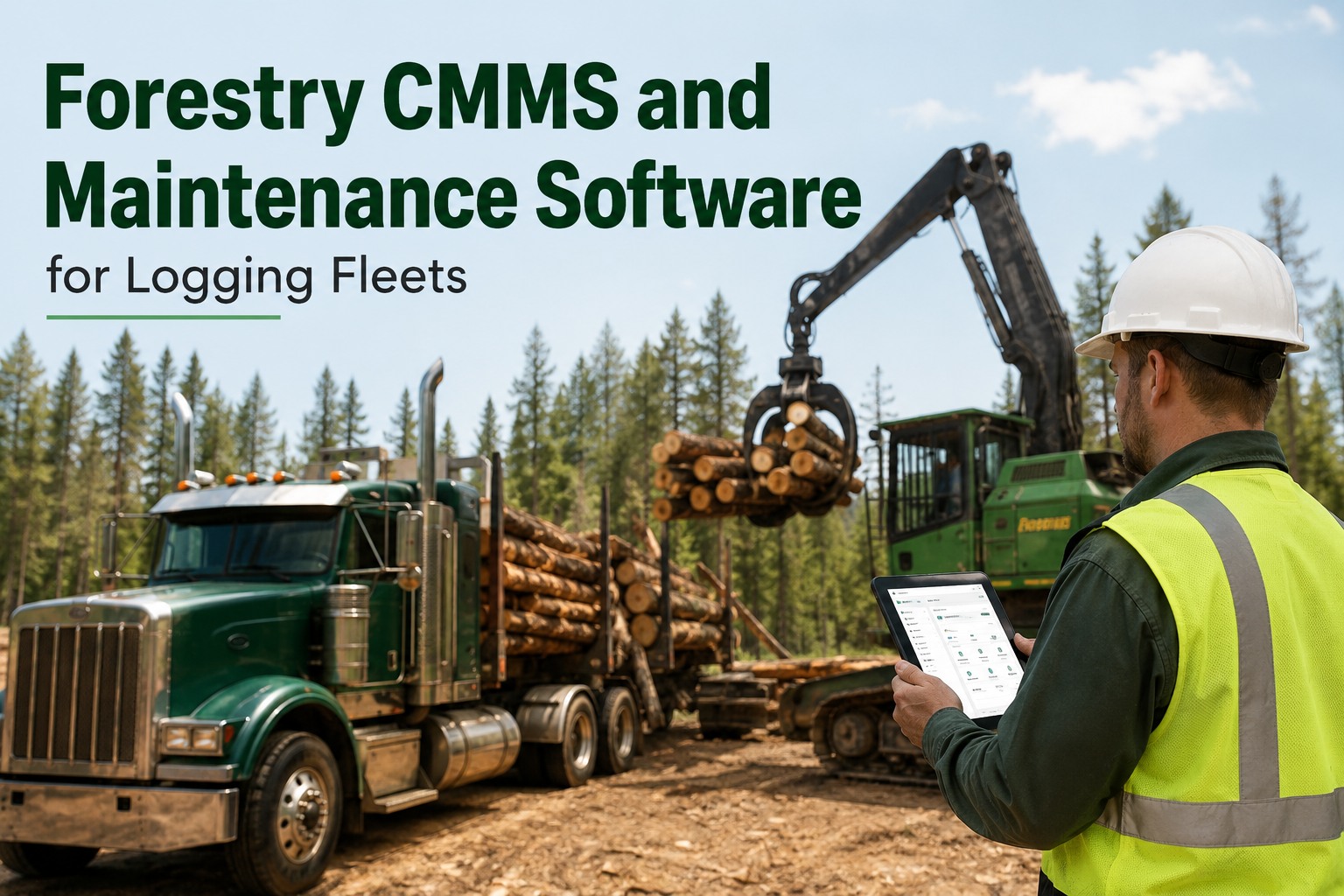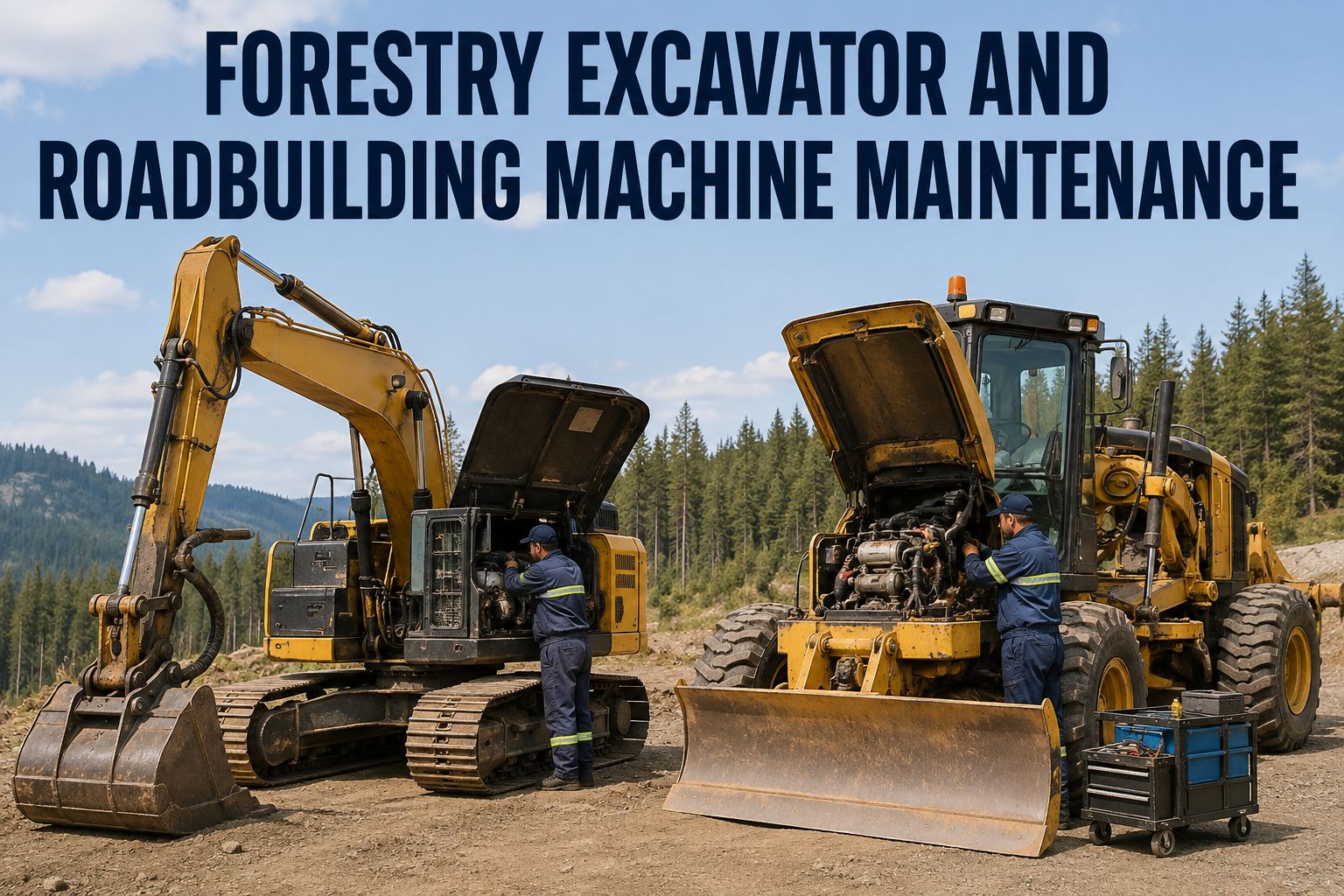
Forestry excavator maintenance starts where civil construction ends: your machines build the access roads every other unit depends on, working rock, stumps and steep sidehill ground that eats undercarriages and hydraulic lines far faster than any highway job. A roadbuilding crew running logging road construction can't afford a machine down mid-cut — the whole operation waits behind it. This guide covers the guarding package, undercarriage discipline, attachment inspections and drainage obligations that keep forest road machinery earning instead of leaking money, and how to walk through it on your own iron in a 30-minute demo.
The machine that builds the road decides when everyone else works
Forestry-spec excavators and roadbuilding machines run in conditions civil iron never sees. Here's what changes — and what it costs when it doesn't get tracked.
Civil-spec machine, forestry job
- No belly pans — stump punches through the oil pan on day three
- Exposed cylinder rods scarred by brush and rock throw
- Undercarriage wear measured by guess, not gauge
- Brush cutter hours never logged against hydraulic PM
Forestry-duty machine, tracked properly
- Guarding package inspected as its own checklist item
- Undercarriage measured on schedule, photos on file
- Every attachment hour counted toward service intervals
- Defect-to-work-order before the crew leaves the landing
Four numbers every road crew manager should know
Forestry excavator guarding: the checklist civil machines skip
A civil-spec excavator sent into logging road construction is a repair bill waiting to happen. The guarding package isn't optional equipment — it's the difference between a machine that survives the season and one that gets hauled out in October with a punched oil pan and scarred rods. Each item below needs its own inspection line, not a glance.
Belly pans & sump guards
Full-coverage belly pans protect the oil pan, hydraulic tank and swing motor from stump strikes and rock shelves. Inspect mounting bolts weekly — a pan hanging by two bolts is worse than none, because it catches debris against the very components it protects. Look for impact dents that have transferred force to the pan rail.
Cylinder rod guards
Boom, stick and bucket cylinder rods take constant brush and rock-throw abuse in forestry duty. A single deep score across the chrome destroys the rod seal within hours of operation and turns a $200 guard into a $3,000 cylinder rebuild. Check guard clamps for looseness and rods for fresh scoring at every daily walk-around.
Cab screens & glass protection
Polycarbonate screens over the front and top glass are standard forestry excavator protection — falling limbs and brush-cutter throw don't announce themselves. Inspect screen frames for cracks at the weld points and confirm the emergency exit path still works with the guarding installed. An operator who can't exit through the hatch in a tip-over is a safety finding, not a maintenance note.
Lights, wiring & hydraulic line guarding
Work lights get torn off by sweepers; exposed wiring harnesses and hose runs get stripped by brush. Forestry-spec machines route hoses inside the boom where possible and guard what's left. Add hose-wrap condition and chafe points to the inspection template — a burst line on a steep grade is a fire risk and an environmental spill in one event.
The practical move is building these into a forestry-specific daily template rather than relying on the generic excavator checklist that shipped with the machine. With HVI you can sign up free and clone a guarding checklist per machine class in minutes, so the operator on the brush cutter and the operator on the hoe get different cards.
Excavator undercarriage wear in forestry: measure it or buy it twice
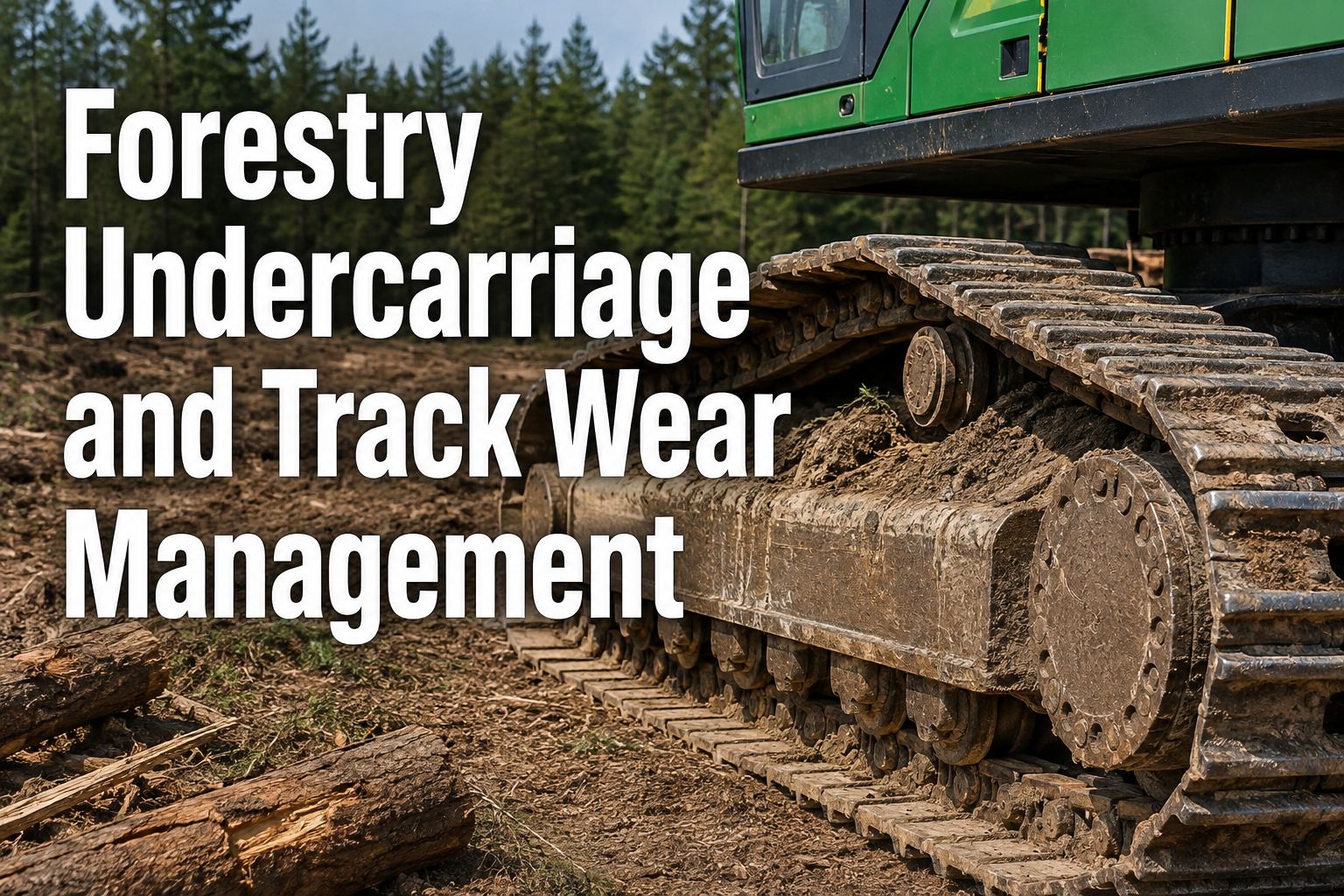
The undercarriage is roughly half the lifetime maintenance cost of a tracked machine, and forestry roadbuilding accelerates every wear mode at once: abrasive rock, constant turning on sidehill ground, packing in the chain from mud and duff, and impact from stumps and boulders. The crews that control this cost share one habit — they measure on a schedule and keep the readings where the next decision gets made.
Measure every 250–500 hours, not "when it looks worn"
Track link height, bushing diameter, sprocket tooth profile and roller flange with a gauge, and record the numbers against the machine. On rock, wear between measurements can exceed what a civil machine sees in a full season. Photo capture at each measurement point turns an argument with the dealer into a documented trend.
Turn pins and bushings on the data, not the calendar
A pin-and-bushing turn done too late buys nothing; done too early it wastes half the component life. The measurement history tells you the wear rate per hundred hours on your ground — that's the number that schedules the turn, and it's different for the machine building road on shot rock than the one skidding on the landing.
Track tension and packing daily in mud season
Packed duff and mud in the chain tightens the track as it compresses, accelerating bushing and sprocket wear and loading the final drives. A two-minute daily tension check with a photo is cheap insurance against a $15,000 final drive failure on a machine that's a four-hour lowboy ride from the nearest shop.
Match the shoe to the ground — and record the swap
Triple-grouser shoes for general roadbuilding, wider pads for soft ground, single-grouser only where traction demands it. Swapping shoes changes wear behaviour, so log the configuration with the hours. When the wear rate suddenly doubles, the configuration history is the first place you look.
A worked example: the 60-hour gap
A roadbuilding contractor runs two 20-tonne excavators on a 14 km access road job. Machine A gets measured every 250 hours; the readings show bushing wear tracking toward the turn point at 2,900 hours, so the turn is scheduled during a planned rain shutdown — parts on site, zero lost production. Machine B runs on feel. The bushings wear through at 3,100 hours mid-cut, the chain jumps on a sidehill pull, and the machine sits for six days waiting on a track frame crew. At $1,800 a day in lost production plus the emergency callout, the gap between the two machines is over $12,000 on a single component — and the only difference was a gauge and a record. If you want to see how measurement logging works on your own fleet, book a demo and bring one machine's history to the call.
Buckets, thumbs, grapples and brush cutters: every attachment is its own machine
A forestry excavator isn't one asset — it's a carrier plus a rotating set of tools, each loading the hydraulic system differently and each failing in its own way. Treating attachment hours as "machine hours" is how brush cutters run 400 hours past a bearing service and thumbs crack at the welds unnoticed.
| Attachment | Primary failure modes | Inspection focus | Interval driver |
|---|---|---|---|
| Digging / ditching bucket | Edge wear, cracked gussets, worn pins and bushings | Tooth and edge condition, side-wall cracks, pin play at the coupler | Daily visual; pin measurement at 500 hrs |
| Hydraulic thumb | Weld cracks at the tine root, cylinder pin wear, hose chafe | Weld toes, pin bosses, hose routing against the stick | Daily visual; crack check at 250 hrs |
| Grapple / processor-style | Rotator seal leaks, tine bending, bearing play | Rotator weep, tine alignment, pivot grease purge | Daily grease; rotator check weekly |
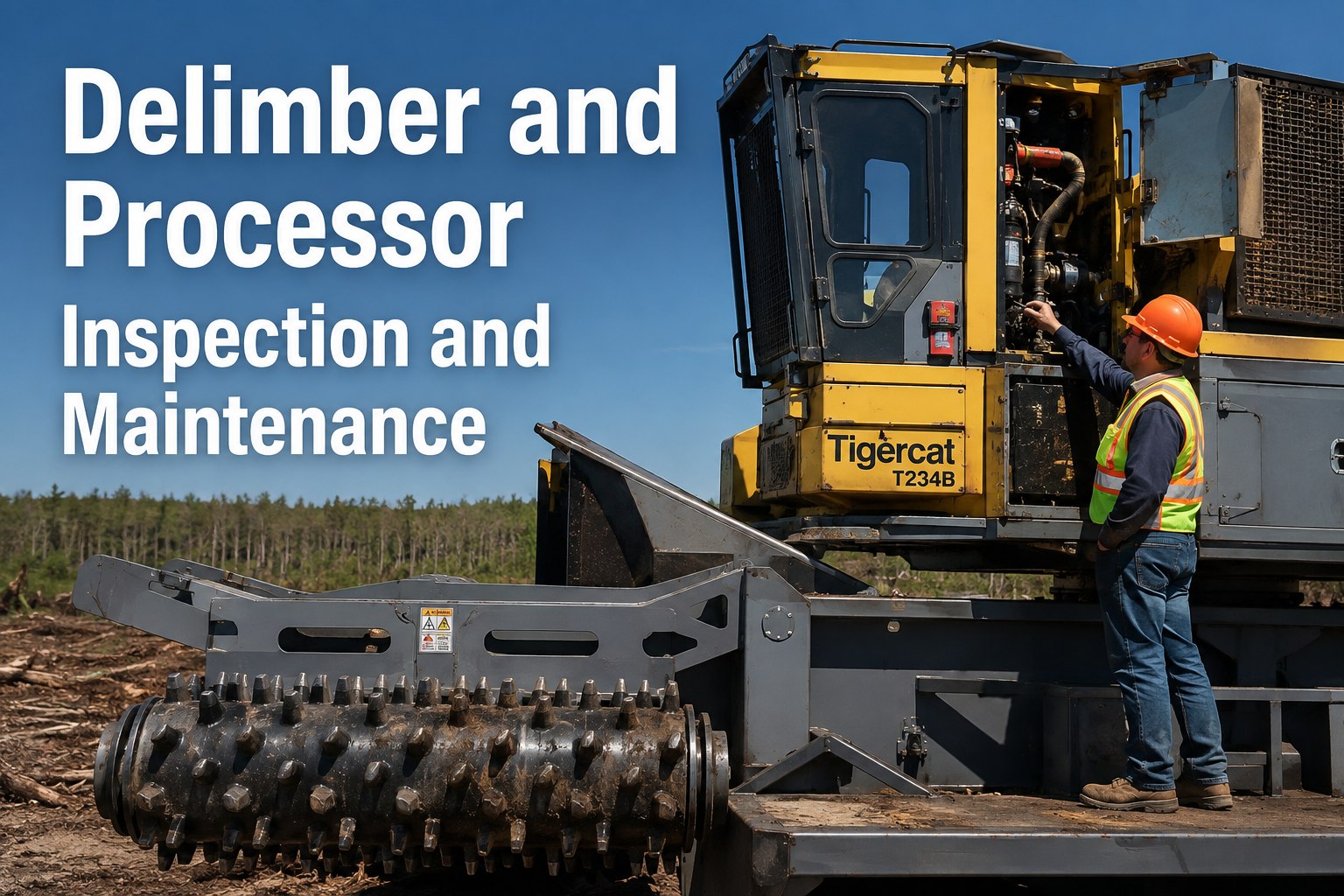
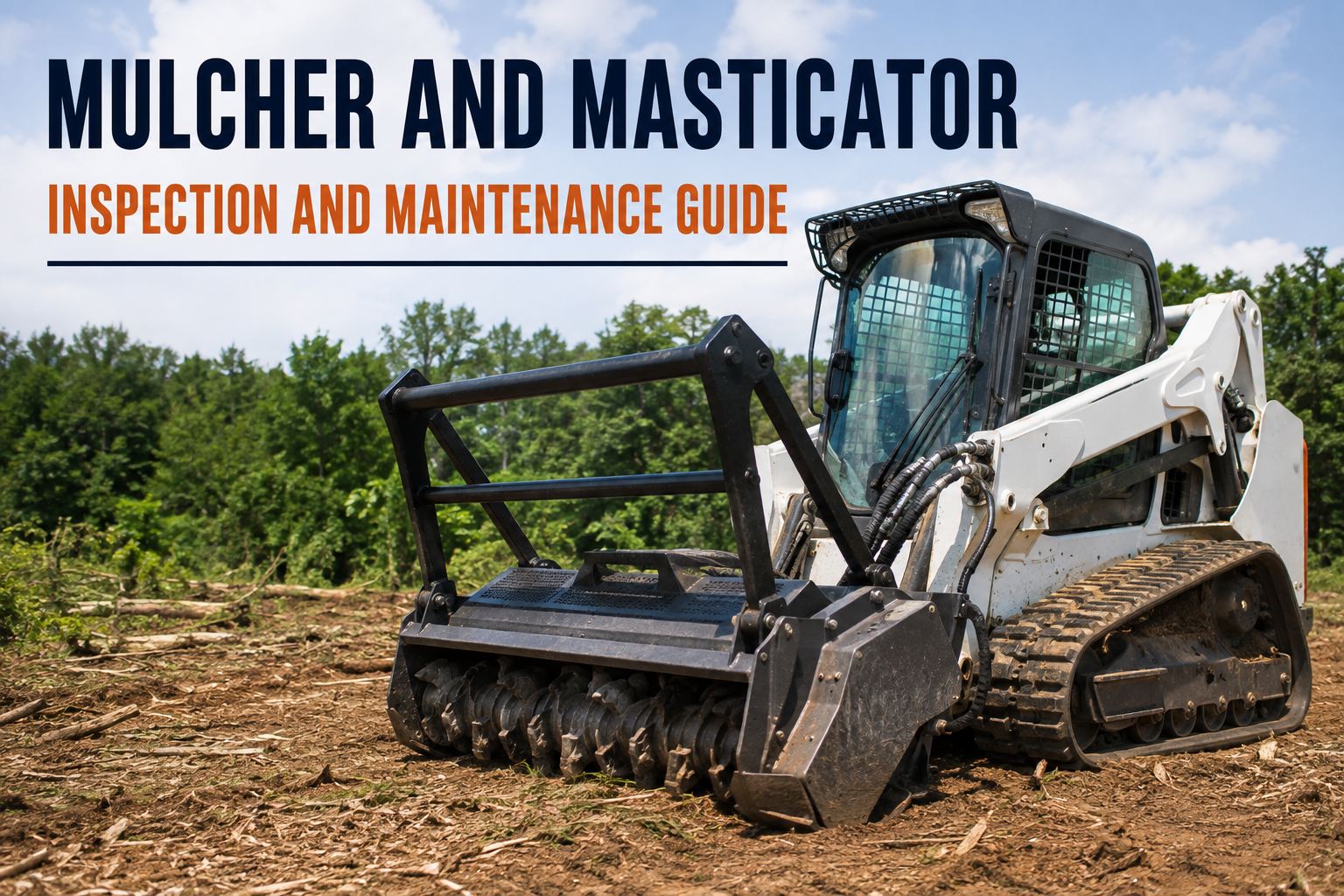
| Brush cutter / mulcher head | Bearing failure, tooth holder wear, hydraulic motor heat | Bearing temperature and noise, tooth pattern, case-drain flow | Bearing service by head hours, not machine hours |
| Hydraulic hammer (culvert & rock work) | Tool bushing wear, nitrogen charge loss, bracket cracks | Tool retention, grease, accumulator pressure, mount bolts | Grease every 2 operating hours; service by hammer hours |
The hydraulic system ties all of this together. High-flow attachments like mulchers run the oil hot and shear it down faster; hammer duty sends pressure spikes back through the return circuit. Oil analysis on a fixed schedule — and a PM interval that counts attachment hours separately — catches the pump that's starting to shed metal before it takes the whole system with it. HVI's engine-hour PM scheduling handles this natively: each attachment carries its own hour counter and its own service plan, and you can see the multi-attachment setup in a live demo before you commit anything.
Steep ground, sidecast and the road you still own after demob
Stability on sidecast and fill
Forest road construction means working on ground you just built — uncompacted fill, sidecast edges and bench cuts above a drop. Machine condition is a stability factor: worn swing bearing play changes how the machine loads its tracks at full reach, a sticking track tensioner leaves one side loose on a sidehill pull, and a brake or travel-motor fault on a 30% grade is a runaway, not a breakdown. Daily checks on swing play, track tension and travel function belong on the forestry template specifically because of where these machines work.
- Swing bearing play logged with a photo at every PM
- Travel motor and brake function verified daily on grade work
- Rollover protection and cab guarding certified and documented
The road maintenance obligation
Building the road is the start of the cost, not the end. Culverts plug with debris, ditch lines silt up, and the surface washboards under log-haul traffic. A plugged culvert on a grade becomes a washout that closes the road — and the machine that has to come back to fix it bills at emergency rates. Logging road maintenance equipment needs its own schedule: culvert inspection after every major storm, ditch and surface grading on a traffic-based interval, and photo records that prove the drainage was functional when you handed the road over.
- Culvert condition photographed and mapped per crossing
- Surface grading triggered by haul traffic, not guesswork
- Storm-response inspections documented for liability
Built for roadbuilding fleets that work where the pavement ends
Configurable templates per machine and attachment
The excavator on brush-cutting duty gets a different card than the one on culvert installation — guarding, attachment and hydraulic checks included. Operators complete them on any phone at the landing, even offline, and nothing relies on a paper book surviving the cab.
Undercarriage measurement with photo capture
Log link height, bushing and sprocket readings against each machine with photos at every point. Wear-rate trends per hundred hours tell you when to turn pins and bushings — and give you the documentation when a component fails early under warranty.
Engine-hour PM that counts attachments separately
Preventive maintenance triggers by engine hours, with separate counters for mulcher heads, hammers and grapples. Due and overdue alerts reach the field mechanic before the interval passes — no more discovering a 400-hour-overdue bearing service at failure.
One-click defect-to-work-order from the field
A scored cylinder rod flagged at the morning walk-around becomes a work order with photos before the operator finishes the checklist. The field mechanic arrives with the seal kit, not a notepad — cutting the parts-run downtime that kills remote jobs.
See HVI running on your own roadbuilding fleet
Bring one machine and one attachment to a 30-minute demo — we'll show you the forestry template, the undercarriage log and the defect-to-work-order flow on your actual setup.
Forestry excavator maintenance, in five lines
Guarding is a maintenance item, not a purchase option — belly pans, cylinder guards and cab screens need their own inspection lines and their own repair budget.
Undercarriage wear on forestry ground runs two to three times civil norms; measurement every 250–500 hours with photos is the only version of control that works.
Every attachment is its own asset with its own hour counter — brush cutters and hammers fail on their own schedules, not the carrier's.
Machine condition is a stability factor on steep ground: swing play, track tension and travel brakes are safety checks, not just wear items.
The road maintenance obligation outlives construction — culvert and drainage records protect you long after the last load of surfacing is placed.
None of this requires a bigger shop or more people. It requires the checks to happen, the numbers to land somewhere useful, and the defect to become a work order while it's still cheap. That's the whole argument for moving forest road machinery off paper and into a CMMS that works at the landing — and you can book a demo to test that claim against your own fleet before spending a dollar.
"I used to find out about undercarriage problems when the track came off. Now I get the measurement photos every 250 hours whether I ask or not, and I budget the pin-and-bushing turns in January instead of explaining a six-day shutdown in August. The number I watch is cost per engine hour on each hoe — since we started logging it properly, it's dropped by a fifth, and I can prove why to the owner in one screen."
Dan Kowalski — Fleet & Maintenance Manager, roadbuilding and logging contractor
Forestry excavator and roadbuilding maintenance FAQs
How often should you measure the undercarriage on a forestry excavator?
What guarding does an excavator need for forestry and roadbuilding duty?
Should attachments like brush cutters and hammers have separate service schedules?
What does a downed excavator actually cost a roadbuilding crew?
How do you keep inspection records useful for warranty and liability on forest roads?
Your road crew's next breakdown is already scheduled — you just can't see it yet
Put forestry-duty inspections, undercarriage logs and attachment-hour PM on one platform that works at the landing, on any phone, with no paper to lose.
Free to start — Works on any phone — No card needed