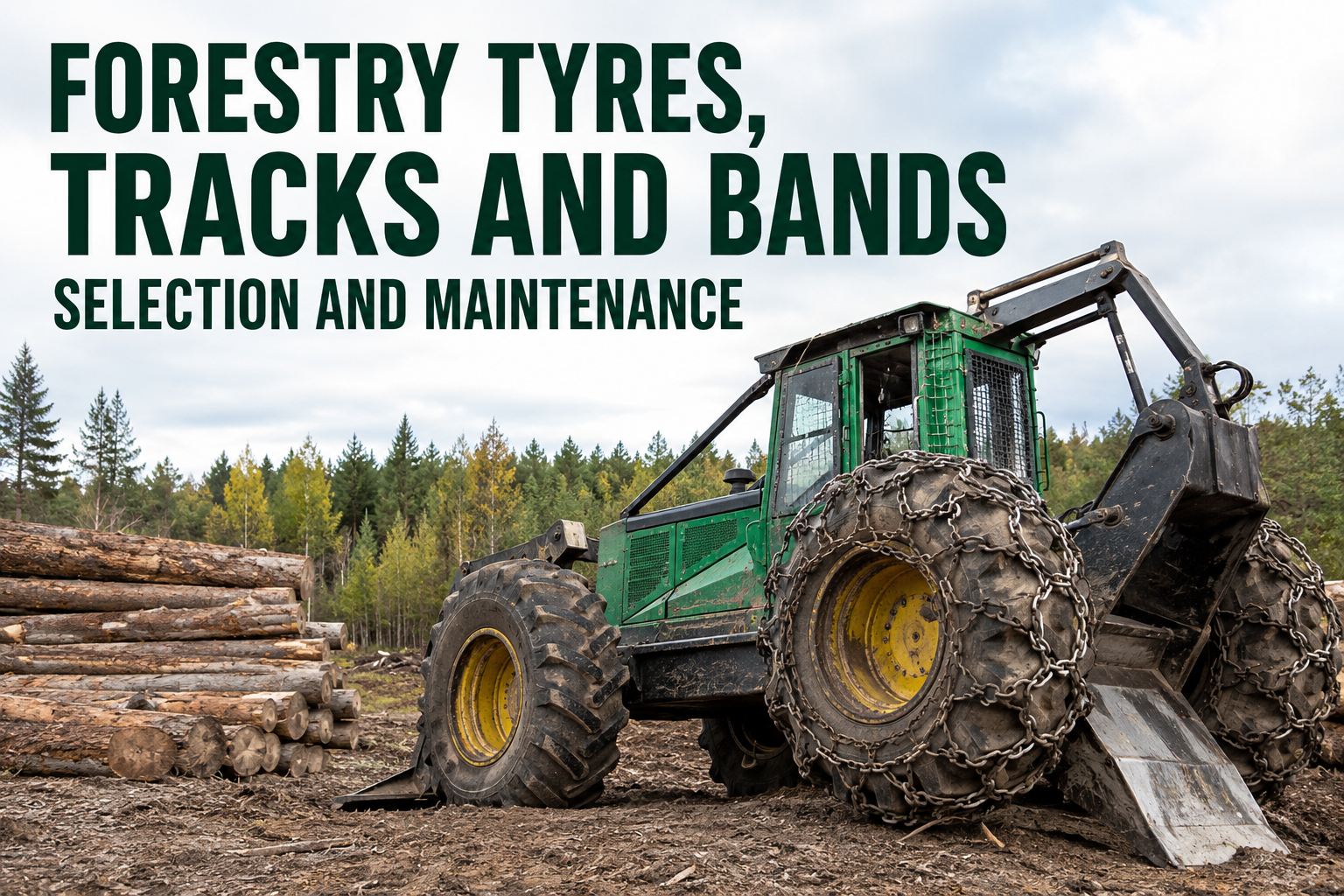
Forestry tyre selection is a three-way fight between flotation, traction and protection, and the wrong call shows up fast: a forwarder buried to the belly pan on a wet skid trail, a $4,000 tyre written off by one stump through the sidewall, or a failed environmental inspection because your ground pressure tore up a sensitive site. No other industry asks this much of a tyre. You need low ground pressure to work soft ground without rutting, aggressive traction to climb out of a wet cut block, and enough protection to survive stumps, slash and rock that would shred a highway tyre in a week. This guide walks through how to choose between flotation tyres, chains, bogie bands and tracks, how to manage pressure for both flotation and casing life, when to repair versus replace, and how to track cost per hour so the decision is based on numbers instead of gut feel. If you want to see how digital inspections catch tyre damage before it becomes a write-off, walk through it on your own units with a 30-minute demo.
Flotation, traction or protection? You need all three, and the wrong balance costs you tyres, ground damage and days stuck in the mud.
A forestry tyre that works on a dry summer block fails on a wet winter site. Chains that save a tyre can destroy it if tensioned wrong. This guide gives you the selection logic, the maintenance routine and the cost math to get it right.
How ground pressure decides whether you work or sink
Ground pressure is the weight of the machine divided by the contact patch of the tyre or track. Lower pressure means less soil disturbance and the ability to work softer ground without getting stuck. Higher pressure means better traction on firm ground but more rutting and a higher chance of bogging down when the weather turns.
Flotation tyres
Wide, low-pressure tyres designed to spread the load. A 600/55-26.5 flotation tyre on a forwarder can drop ground pressure to 3–5 psi, compared to 8–12 psi on a standard tyre. That difference lets you work wet ground without leaving ruts that fail environmental inspections or require costly remediation.
Best for: Soft ground, wet sites, areas with soil protection requirements, and operations where you need to minimise site damage to meet contract or regulatory conditions.
Standard forestry tyres
Narrower, higher-pressure tyres with aggressive tread. They bite harder on firm ground and rock, giving better traction and less sidewall flex. Ground pressure runs 8–15 psi depending on load, which is fine on dry sites but will rut soft ground and can get you stuck when conditions turn.
Best for: Dry sites, rocky terrain, steep ground where traction matters more than flotation, and operations where soil disturbance is less of a constraint.
The mistake is running the same tyre setup year-round. A forwarder that works a dry summer block on standard tyres will bury itself on a wet winter site unless you switch to flotation or add tracks. Many contractors now run flotation tyres as the base setup and add chains or bands when traction demands it, rather than switching tyres seasonally. If you are tracking ground pressure and site conditions in a digital inspection system, you can see which sites are causing the most tyre and ground damage and adjust your setup before it costs you a machine-day.
When to chain up, band up or go to tracks
Tyres alone cannot always deliver the traction you need. Chains, bogie bands and tracks each solve a different problem, and each has a maintenance cost that shows up in tyre wear, fitting time and ground damage if you get it wrong.
Tyre chains
Steel chains fitted over the tyre to bite into mud, snow and ice. They add traction but also add weight, increase ground pressure and can damage the tyre if tensioned wrong. Chains need daily inspection for broken links, correct tension and even wear.
Cost: $800–$2,000 per set. Life: 1–3 seasons depending on terrain and maintenance.
Bogie bands
Steel or rubber bands that wrap around the bogie axles on a forwarder, spreading the load and adding traction. They reduce ground pressure compared to chains and protect the tyre from sidewall cuts, but they need correct tensioning to avoid damaging the tyre or the bogie.
Cost: $3,000–$8,000 per set. Life: 2–5 seasons with proper tension checks.
Tracks over tyres
Rubber or steel tracks fitted over the tyre, turning a wheeled machine into a tracked one. They offer the lowest ground pressure and best flotation, but they are expensive, heavy and slow to fit. Best for extreme soft ground or sites with strict soil protection rules.
Cost: $15,000–$40,000 per set. Life: 3–7 seasons depending on terrain.
The tensioning rule that saves tyres
Chains and bands that are too loose will slip, wear the tyre and damage the sidewall. Too tight and they cut into the tyre, overheat the casing and cause premature failure. The correct tension is snug enough that you cannot twist the chain or band by hand, but loose enough that the tyre can still flex. Check tension after the first hour of work, then daily. A loose chain that slips for a week can take 30% off the life of a $4,000 tyre. If your operators are logging chain tension checks in a mobile app, you catch the problem before it costs you a tyre.
Why sidewall cuts kill more forestry tyres than tread wear
In most industries, tyres wear out from tread abrasion. In forestry, they die from sidewall cuts, impact breaks and bead damage. A stump, a rock or a sharp piece of slash can open a sidewall in one pass, and once the casing is cut, the tyre is done.
Sidewall cuts
The most common failure. A stump or rock slices the sidewall, exposing the cords. If the cut is deep enough to damage the casing, the tyre cannot be repaired and must be replaced. Sidewall cuts account for 60–70% of forestry tyre failures.
Prevention: Tyre protection chains, careful route planning to avoid stumps, and operator training to spot hazards before they hit the tyre.
Impact breaks
A hard hit on a rock or stump that bruises the casing without cutting the rubber. The damage is invisible from the outside but weakens the cords, and the tyre fails days or weeks later from a blowout or bulge. Impact breaks are the second most common failure mode.
Prevention: Lower tyre pressure to absorb impacts, slower speeds on rough ground, and daily visual inspections for bulges or deformities.
Bead damage
The bead is the part of the tyre that seals against the rim. Running too low pressure, overloading or hitting a rock can damage the bead, causing air leaks and eventual failure. Bead damage is often caused by incorrect fitting or running a flat tyre.
Prevention: Correct pressure, proper fitting technique, and immediate inspection after any impact or air loss.
Tread wear
The least common failure in forestry. Tread wears slowly because the ground is soft and the speeds are low. Most forestry tyres are replaced due to sidewall or casing damage long before the tread is worn out.
Prevention: Not a primary concern, but correct pressure and rotation can extend tread life if the casing survives.
The practical takeaway: if you are tracking tyre condition in pre-start inspections, you catch sidewall cuts and impact damage early, before they become blowouts. A small cut that is spotted and repaired can save a tyre. A cut that goes unnoticed for a week will grow, let in moisture and dirt, and destroy the casing. If your operators are photographing tyre damage in a digital DVIR, you have a record of when the damage happened and can decide whether to repair or replace based on the actual condition, not a guess.
How tyre pressure affects flotation, traction and casing life
Tyre pressure is the single most adjustable variable in forestry tyre management. Lower pressure increases flotation and absorbs impacts. Higher pressure improves traction on firm ground and reduces sidewall flex. The wrong pressure costs you tyre life, ground damage or both.
| Pressure | Ground pressure | Flotation | Traction | Casing life | Best use |
|---|---|---|---|---|---|
| Low (20–30 psi) | 3–5 psi | Excellent | Moderate | Good (absorbs impacts) | Soft ground, wet sites, soil protection |
| Medium (30–45 psi) | 5–8 psi | Good | Good | Best | Mixed terrain, general forestry work |
| High (45–60 psi) | 8–12 psi | Poor | Excellent | Fair (more impact damage) | Firm ground, rocky terrain, steep slopes |
The mistake is setting pressure once and forgetting it. A forwarder that starts the day on a dry ridge at 50 psi will be over-pressured when it moves to a wet bottom at midday. Operators who adjust pressure for the terrain get 20–30% more tyre life and fewer stuck machines. The challenge is making sure operators actually check and adjust pressure, not just guess. If pressure checks are part of a digital pre-start checklist, you get a timestamped record that the check was done, and you can see which operators are skipping it.
See how HVI tracks tyre condition, pressure checks and cost per hour across your fleet
Book a 30-minute demo and we will walk you through digital inspections, tyre management and cost tracking on your own machines.
When to repair a forestry tyre and when to write it off
A large forestry tyre costs $3,500–$6,000. A repair costs $200–$800. The decision to repair or replace depends on the location and size of the damage, the age of the tyre and the cost of downtime if the repair fails.
Repair if:
- The cut is in the tread area, not the sidewall
- The cut is less than 1 inch long and does not expose cords
- The tyre has less than 50% tread wear
- The casing is not bruised or deformed
- The bead is not damaged
Replace if:
- The cut is in the sidewall or shoulder
- The cut exposes or damages cords
- The tyre has a bulge or deformity from an impact break
- The bead is damaged or leaking
- The tyre has been run flat or severely under-inflated
The cost per hour math
A $4,000 tyre that lasts 2,000 hours costs $2.00 per hour. A $600 repair that extends the tyre another 800 hours costs $0.75 per hour for the extended life. If the repair fails after 100 hours, you lose the $600 and still have to replace the tyre, so the failed repair costs $6.00 per hour. The decision rule: repair if the damage is minor and the tyre has significant life left. Replace if the damage is major or the tyre is near the end of its life. If you are tracking tyre cost per hour in a CMMS, you can see which tyres are costing the most and whether repairs are paying off or just delaying the inevitable.
Track tyre condition, pressure checks and cost per hour in one system
HVI is cloud + mobile Vehicle Inspection and Maintenance Work Order CMMS software built for fleet-heavy businesses. It replaces paper inspection books, spreadsheets and group chats with a single system that tracks tyre condition, maintenance schedules and cost per asset across your entire fleet.
Digital pre-start inspections
Operators complete a tyre and track checklist on any phone or tablet before each shift. They photograph sidewall cuts, check chain tension, log pressure and flag defects. You get a timestamped, photo-backed record that the inspection was done, and defects turn into work orders automatically.
Tyre management
Track every tyre by serial number, position, hours, pressure history and damage. See which tyres are costing the most per hour, which machines are destroying tyres fastest, and when to repair versus replace based on actual cost data, not guesswork.
Parts and inventory
Track tyre stock, chains, bands and repair materials across multiple shops or sites. Get alerts when stock is low, see which parts are used most, and avoid the downtime of waiting for a tyre to be delivered when you have one sitting in another yard.
Cost tracking per machine
See cost per hour for every machine, broken down by tyres, fuel, parts and labour. Compare the cost of flotation tyres versus standard tyres, chains versus bands, and repair versus replace. Make decisions based on what the numbers say, not what feels right.
HVI works on any phone or tablet, in the yard, on the roadside or at a remote site. It is audit-ready, with timestamped and photo-backed records for DOT, client, safety and insurance audits. It works across trucks, trailers, buses, off-road plant and shop equipment, so you can track your entire fleet in one system. If you want to see it running on your own machines, book a 30-minute demo and we will walk you through it.
Forestry tyre selection and maintenance: the five rules that save money
1. Match the tyre to the ground, not the calendar
Flotation tyres for soft ground, standard tyres for firm ground, and chains or bands when traction demands it. Do not run the same setup year-round.
2. Tension chains and bands correctly
Too loose and they slip and wear the tyre. Too tight and they cut the casing. Check tension after the first hour, then daily.
3. Adjust pressure for the terrain
Lower pressure for soft ground and impacts. Higher pressure for firm ground and traction. Check and adjust daily, not once a season.
4. Inspect for sidewall cuts and impact damage daily
Sidewall cuts kill more forestry tyres than tread wear. Catch them early and repair them. Miss them and you lose the tyre.
5. Track cost per hour, not just purchase price
A $4,000 tyre that lasts 2,000 hours costs $2.00 per hour. A $600 repair that extends it 800 hours costs $0.75 per hour. Make decisions based on the math.
6. Use a CMMS to track it all
Paper inspection books and spreadsheets do not give you the data you need to make good decisions. A digital system tracks condition, cost and compliance in one place.
"I used to lose a tyre every couple of weeks to sidewall cuts, and I had no idea which machines or which sites were causing it. Now every operator photographs tyre damage in the pre-start, and I can see exactly where the problem is. We cut tyre cost per hour by 30% in the first six months just by catching cuts early and adjusting pressure for the terrain."
Forestry tyre and track questions answered
What is the best tyre for soft, wet ground in forestry?
How tight should tyre chains be on a skidder or forwarder?
Can a sidewall cut on a forestry tyre be repaired?
What tyre pressure should I run for forestry work?
How do I track tyre cost per hour across my fleet?
Stop guessing. Start tracking tyre condition, pressure and cost per hour in one system.
HVI replaces paper inspection books and spreadsheets with a single mobile system that tracks tyre condition, maintenance schedules and cost per asset. See it running on your own machines.
Free to start - Works on any phone - No card needed