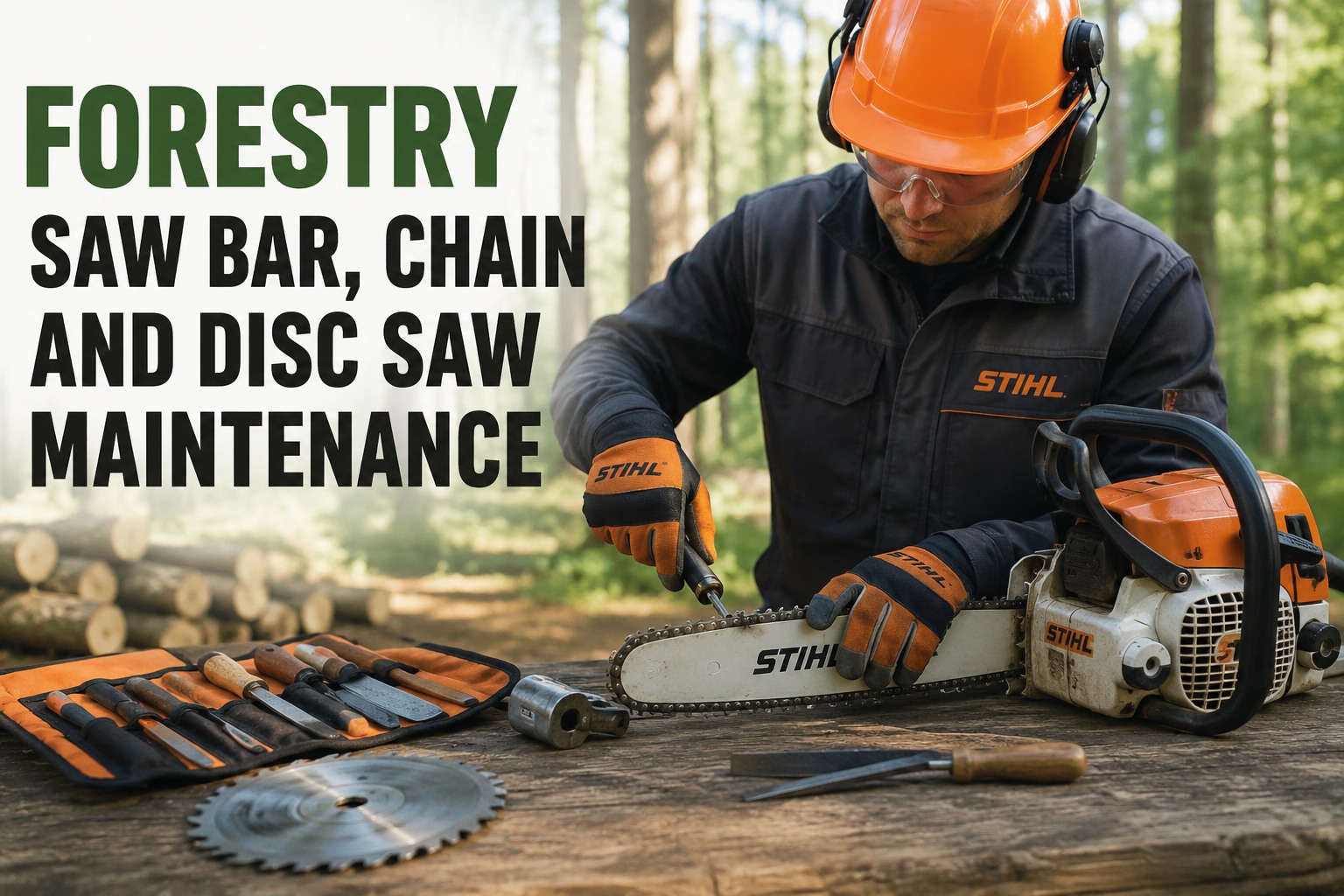
Forestry saw bar maintenance is the single highest-frequency-impact job in a logging fleet: every felling cycle, every delimbing pass and every cut-to-length stroke depends on the condition of the bar, chain or disc teeth at that exact moment. A harvester head that ran a sharp chain yesterday can be burning bar rails, stretching a loose chain and throwing stems out of tolerance today, and most of that damage starts silently with a weak bar oil supply or a tension check that got skipped at shift change. The frustrating part is that none of these failures are surprises. Bar rail wear, sprocket hook, chain catcher condition, disc tooth retention and saw motor hydraulics all follow predictable wear curves, yet they are still managed by feel on most crews. This page breaks down the full cutting system on harvester and processor heads and feller buncher disc saws, the daily and interval checks that actually protect cutting speedand how to track it all without paper. If you want to see this running on your own heads, you can book a 30-minute walkthrough with the HVI team and bring your toughest machine.
Forestry cutting systems
Is your saw bar maintenance schedule written down, or does it live in one operator's head?
Bar oil delivery, chain tension, rail wear and disc tooth condition decide your cutting speed on every single cycle. When those checks are managed by feel, you find out about failures at the worst possible time: mid-stem, mid-shift, with a processor waiting.
What worn cutting components actually cost
The numbers behind bar, chain and disc saw wear
None of these are dramatic breakdowns. They are slow leaks in productivity, fuel and parts spend that add up across a season.
Daily pre-start checklist
Saw bar, chain and disc saw checks that belong in every pre-start
The saw bar is already a named pre-start checkpoint in HVI's forestry inspection templates. Here is what a proper daily pass covers, grouped by system so nothing gets skipped at 5 a.m. in the dark.
Bar and chain system
- Chain tension: slight sag on the bar underside, drive links still seated in the rail
- Bar rail wear: check for burrs, uneven rail height and rail spread with a straight edge
- Sprocket condition: look for hooking and dishing that eats new chains
- Chain catcher intact and undamaged, ready to stop a thrown chain
- Bar straightness: roll test on a flat surface after any pinch event
Bar oil supply
- Tank level and cap seal before first cut, not after the smoke appears
- Delivery rate test: run the saw and confirm a visible oil line off the chain
- Oil passages and bar groove clear of packed chips and fines
- Pump output and lines checked for seepage at fittings
- Correct oil grade for the season, winter viscosity in cold starts
Disc saw on feller bunchers
- Tooth wear: compare against the discard line, not against yesterday's memory
- Retention: every tooth seated, torqued and locked, no missing keepers
- Disc face cracks around tooth pockets and hub
- Guard and debris deflectors secure before the first tree of the day
- Any tooth loss event logged immediately, even if the disc looks fine
Saw motor and hydraulics
- Saw motor case drain temperature and any whine under load
- Hose condition at the head: chafing where lines flex through the tilt
- Fittings weeping at the saw valve block
- Chain speed under load versus spec, logged weekly
- Pressure and flow test results filed against the unit, not in a notebook
Where the money goes
Four cost leaks in cutting component maintenance, and what plugs them
A worked example: one harvester running 2,000 hours a year. Small leaks in each of these four areas quietly turn into a five-figure annual problem.
Dull chain discipline
A dull chain does not stop the machine, it just slows it. Operators compensate with feed pressure, which raises fuel burn, heats the bar and hammers the stem end. On a head cutting 400 stems a day, a 10% cycle slowdown is roughly 40 stems of lost production daily, plus accelerated rail and sprocket wear. The fix is a sharpening or swap rule tied to cut counts or hours, not to an operator's judgement at hour nine of a shift.
Silent bar oil failure
Bar oil delivery determines bar and chain life more than any other single factor, and it fails without a warning light. A kinked line, a tired pump or a blocked groove cuts flow, and the first evidence is a heat-blued bar and a chain stretched past salvage. A daily delivery-rate test takes under a minute and is the cheapest insurance in the whole system.
Skipped bar rebuilds
At around 2,000 hours a harvester saw bar needs a proper rebuild: rails ground true, groove reconditioned, sprocket replaced. Push past it and the worn rails destroy every new chain you fit, so you pay for the rebuild anyway, plus the chains. Scheduling this as a tracked preventive maintenance interval, the way HVI structures the 2,000-hour saw bar rebuild in its PM templates, turns it into a planned half-day instead of a mid-block failure.
Empty shelf at change time
A chain that should be swapped at 10 a.m. gets run until dark because the right loop is not on the shelf. A disc tooth gets replaced Monday because the keeper kit ran out Friday. Consumable inventory is what decides whether a change happens promptly, and auto-deduction from work orders is what keeps the count honest without a clipboard. If you want to see how that stock tracking works in practice, you can walk through it on a live demo with your own parts list.
Interval map
Saw bar maintenance schedule: daily, weekly and hour-based tasks
A defensible schedule splits cutting system maintenance into three cadences. This is the structure you can load straight into a CMMS as recurring tasks.
| Cadence | Task | What you are preventing | Record to keep |
|---|---|---|---|
| Every pre-start | Chain tension, bar oil delivery test, catcher and sprocket visual, disc tooth count | Thrown chains, heat damage, tooth-loss disc damage | Timestamped inspection with photos of any defect |
| Weekly | Rail wear measurement, bar roll test, chain speed under load, hose and fitting check | Uneven rail wear eating chains, hydraulic seepage becoming a burst | Measurements logged against the unit's history |
| By cut count or hours | Chain sharpening or swap, disc tooth rotation or replacement | Cutting speed loss, fuel waste, stem damage | Parts used auto-deducted from inventory |
| 2,000 hours | Saw bar rebuild: rails ground, groove reconditioned, sprocket replaced | Worn rails destroying new chains, chronic tension problems | Work order with parts, labour hours and before/after photos |
| Seasonally | Saw motor flow and pressure test, oil grade change for temperature | Slow chain speed misdiagnosed as dull chains, cold-start oil starvation | Test values trended in analytics for early drift |
See your saw bar schedule running as tracked tasks, not memory
Book a 30-minute demo and we will load a harvester head pre-start, a 2,000-hour bar rebuild PM and a chain inventory with auto-deduction, live in front of you.
How HVI helps
Four HVI capabilities built for cutting system maintenance
HVI is a cloud and mobile CMMS for fleet-heavy operations: digital inspections, work orders, preventive maintenance, parts and inventory, fuel, tires, safety and analytics in one platform. Here is what that means for bars, chains and disc saws specifically.
Pre-start with the saw bar named
Forestry inspection templates include the saw bar as a named checkpoint with photo capture. A flagged chain catcher or low oil delivery becomes a work order instantly, not a text message that gets buried.
PM by engine hours
The 2,000-hour saw bar rebuild sits in the preventive maintenance structure alongside weekly rail measurements. Due and overdue alerts go to the planner before the interval slips, not after the bar is scrap.
Parts and inventory with auto-deduction
Chains, bars, sprockets, disc teeth and keeper kits are counted across every shop and service truck. When a work order closes, stock deducts automatically and reorder alerts fire before the shelf is empty at change time.
Cost and uptime analytics
See cost per head, chain consumption per thousand stems and downtime by cause. When one machine starts eating chains twice as fast as its twin, the data flags it before the parts bill does.
Key takeaways
What good cutting component maintenance looks like
Treat oil delivery as the master check
Bar oil supply decides bar and chain life more than anything else, and it fails silently. A one-minute delivery test every pre-start protects the most expensive wear parts in the system.
Replace by rule, not by feel
Chain sharpening and swaps tied to hours or cut counts hold cutting speed steady. Disc tooth checks tied to a discard line prevent the one-tooth event that writes off a disc.
Protect the 2,000-hour rebuild
The saw bar rebuild is the interval that protects every consumable downstream of it. Scheduled and tracked, it is a planned half-day. Skipped, it is a stream of ruined chains and a mid-block failure.
Let inventory decide the speed of the fix
A change only happens promptly if the part is on the shelf. Auto-deducted stock and reorder alerts are the difference between a ten-minute swap and a machine waiting two days on a chain. You can start logging these checks free and have your first digital pre-start running this week.
My gripe was never the big failures, it was the slow ones. A harvester losing ten percent of its cutting speed to a dull chain does not phone anyone, it just quietly costs you forty stems a day. Now I track two numbers per head: chain consumption per thousand stems and days since the last rail measurement. When either one drifts, we look before the parts bill tells us to.
Dale Kowalski, Maintenance Manager, contract logging and hauling operation
Common questions
Saw bar, chain and disc saw maintenance FAQ
How often should a harvester saw chain be sharpened or replaced?
What are the signs of bar oil supply failure before damage happens?
When does a harvester saw bar need a rebuild instead of a flip or dress?
Why does one lost disc saw tooth matter so much on a feller buncher?
How do I keep chains, bars and disc teeth in stock without over-ordering?
Put your cutting system on a schedule that holds
Pre-starts with the saw bar named, hour-based PMs for the 2,000-hour rebuild, and parts that deduct themselves. See it on your own units in a 30-minute demo, or start free today.
Free to start - Works on any phone - No card needed