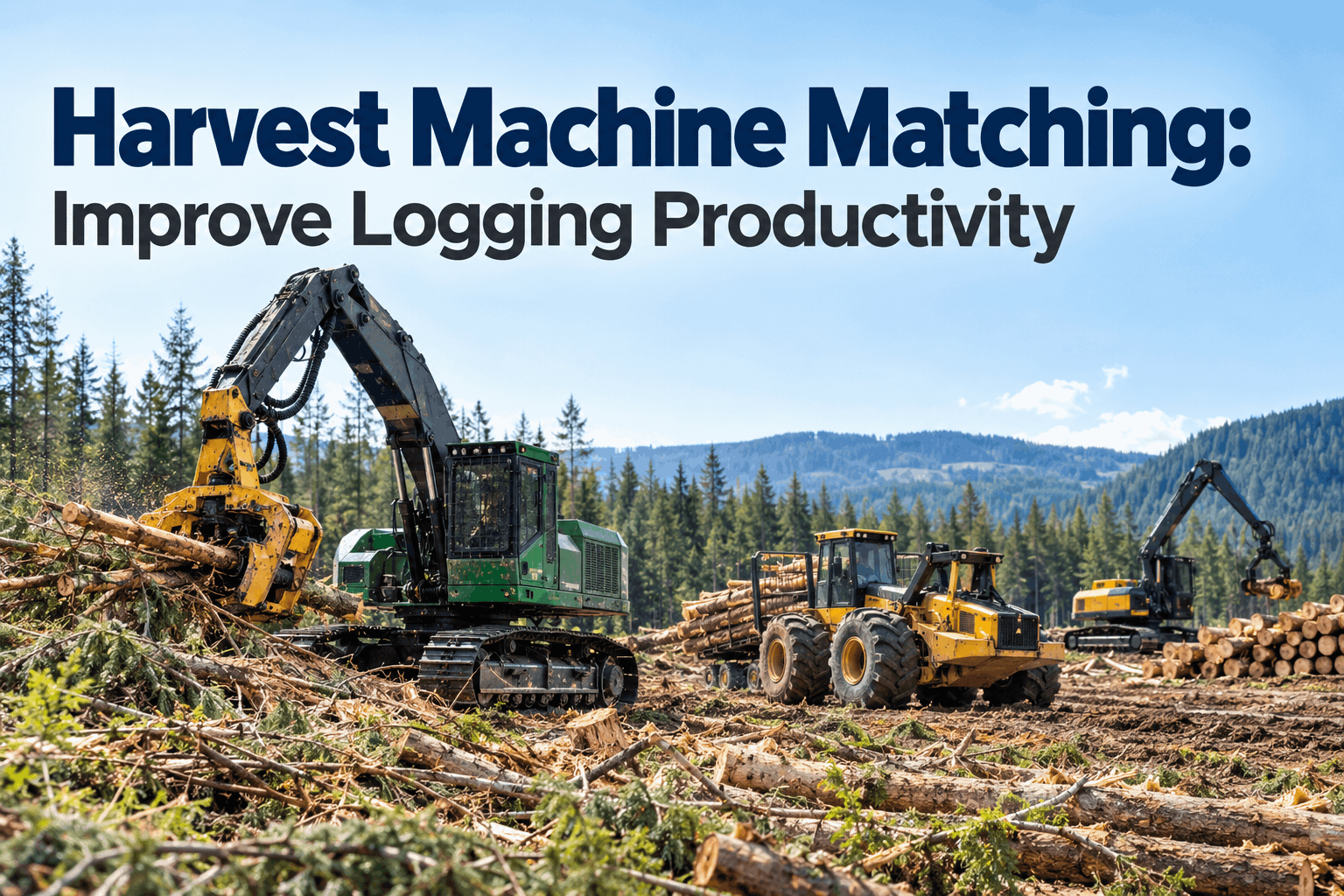
Harvest system machine matching is the practical work of keeping felling, extraction and processing capacity in balance. A fast feller buncher does not improve production if skidders cannot clear the wood, and adding a processor rarely helps when stems arrive irregularly. This guide shows logging managers how to identify the true bottleneck, calculate workable capacity, and keep machines available. Book a demo to explore HVI forestry equipment records and reporting.
Match the harvest system.
Keep the wood moving.
From the first cut to the landing, every machine must feed the next at a sustainable pace. See the bottleneck before it becomes an idle crew or an overloaded machine.
Example only: tonnes per productive machine hour, not an industry benchmark. Capacities depend on timber, terrain, distance and operating conditions.
What Harvest System Machine Matching Actually MeansBalance the complete production chain, not the specification sheet
A logging system produces at the rate its slowest necessary operation can sustain. For a tree-length operation, the feller buncher creates bundles, skidders move them to the landing, and a processor converts incoming stems into products. If one stage falls behind, the others either wait or accumulate work-in-process. That mismatch consumes fuel, labor and available machine hours without increasing delivered volume.
Matching is not simply buying machines with equal rated horsepower. It means comparing their effective output under the same harvest-block conditions: species and piece size, slope, skid distance, landing space, operator experience, weather and mechanical availability. A balanced fleet today can become unbalanced when the next block adds a longer extraction route.
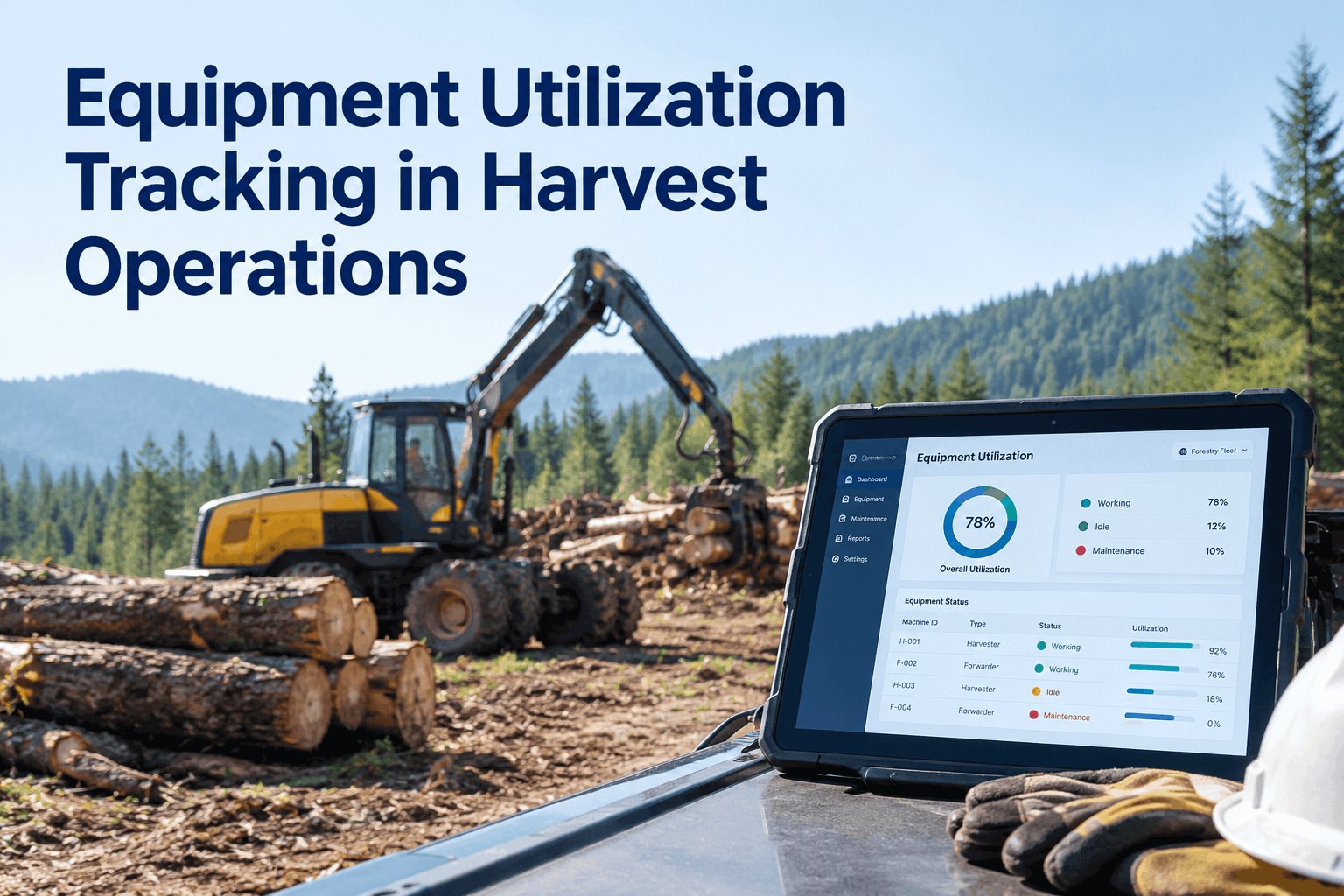
Production planning determines how many machines each stage needs. Maintenance management helps those machines remain available. HVI supports the second decision with equipment inspections, maintenance records, asset histories and reporting; production-rate estimates still require measured operational data.
Find the Bottleneck Before Adding Another MachineA capacity comparison that shows where the system loses output
Start with a common unit such as tonnes per productive hour. Compare the achievable output of each stage over the same time window, rather than mixing engine hours, shift hours and best-case manufacturer specifications.
The skidder system is the limiting stage in this example. Buying another processor would not raise output until extraction improves. The next questions are operational: Is travel distance too long? Are turns undersized? Is the landing congested? Are machines frequently waiting for repairs? Book a demo to see how HVI helps review equipment downtime and maintenance history.
Calculate a Practical Machine MatchUse effective capacity and availability, not theoretical peak output
Measured productive output ÷ productive operating hours
Effective rate × scheduled hours × mechanical availability
Target shift volume ÷ output per available machine, rounded up
Mechanical availability is not the same as utilization. A machine may be mechanically available but waiting for wood, trucks or a safe work area. Likewise, high utilization can hide a machine that is overloaded and repeatedly failing. Track both, then validate the calculations over multiple representative shifts.
For a cut-to-length system, replace the feller buncher–skidder–processor sequence with harvester and forwarder capacity. The principle remains unchanged: balance the rate at which material is produced with the rate at which it can be transported and cleared.
Five Variables That Change the Right Machine MixWhy a match on one harvest block can fail on the next
Extraction distance
Longer skid routes increase cycle time. A skidder that keeps up on a short block may fall behind on a remote landing. Measure loaded and empty travel separately.
Timber size and presentation
Stem size, bunch quality and sorting requirements change how quickly a processor can handle incoming wood. Inconsistent bunches can make nominal capacity misleading.
Terrain and access
Slope, ground bearing, turning room and weather affect safe travel speeds and payload. Never use a planning target to justify operation outside equipment or site limits.
Landing and truck interface
A congested landing may delay skidders even when machines are mechanically sound. Track queue time, pile space and truck arrival patterns alongside production.
Maintenance and availability
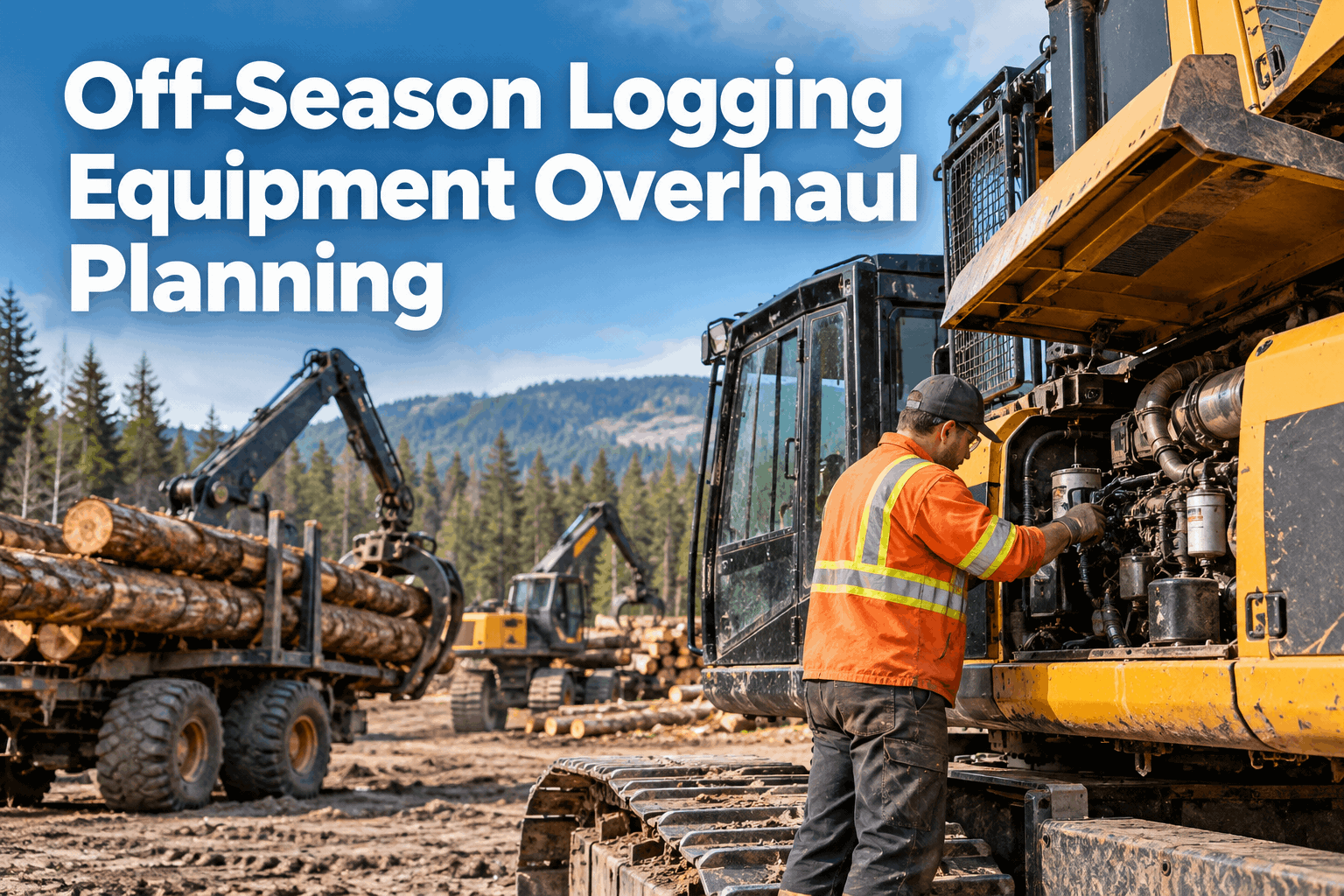
Repeat hydraulic leaks, undercarriage problems and overdue service reduce actual capacity. The weakest stage deserves priority maintenance attention, not just another machine.
A Field Checklist for Harvest Machine MatchingReview the full system before committing machines to a new block
Use this as a supervisor's planning checklist, not a substitute for site-specific risk assessments or manufacturer operating procedures. Record exceptions and assign a responsible person before mobilization.
A Production demand
- Target tonnes or volume per shift agreed
- Piece size and species mix estimated
- Felling and processing rates measured
B Extraction route
- Skid/forward distance and grade reviewed
- Safe payload and route limits confirmed
- Landing congestion and truck access assessed
C Machine readiness
- Pre-start inspections completed
- Critical defects corrected before release
- PM status and spare parts checked
D Shift coordination
- Operator and relief coverage confirmed
- Production and delay codes agreed
- Daily bottleneck review assigned
Inspection results, equipment service history and outstanding maintenance items should be visible to the people making deployment decisions. Sign up free to organize forestry equipment inspections and maintenance records in HVI.
Distinguish Production Delays From Maintenance DowntimeA delay code makes the next investment decision more reliable
A stalled skidder does not always need repair. It may be waiting for the feller buncher, unable to enter a crowded landing, or stopped because of a route restriction. If every nonproductive hour is labeled breakdown time, the analysis will overstate maintenance problems and conceal scheduling constraints.
HVI can support the maintenance side through inspections, work orders and asset records. A reliable production study should also collect operational delay codes from shift reports or other mine/forestry operations records. Reconcile the two sources before drawing conclusions about utilization.
How to Improve Harvest System Productivity Without OverbuyingFollow the bottleneck and test one change at a time
Establish a clean baseline
Record production volume, productive hours, delay causes and machine availability across representative shifts. Separate exceptional weather days from ordinary operating conditions.
Test the lowest-cost constraint fix
Improve bunch placement, landing layout, operator handoffs or PM timing before adding another machine. Document the change and its expected effect.
Rebalance machine allocation
If extraction remains the constraint, test a different skidder assignment or a revised route. Ensure additional capacity will not simply move congestion to processing or hauling.
Check results against cost and reliability
Review delivered volume, equipment hours, maintenance events and operating expense together. A faster system is not automatically a more profitable or safer one.
Maintain the same unit of measure throughout the study. Tonnes per productive hour, tonnes per scheduled shift and cost per tonne each answer different questions. Use all three to understand both the machine match and the business result.
Where HVI Fits in Forestry Equipment Performance ReviewsConnect equipment reliability evidence to your operating decisions
Capture machine condition and defects through structured inspection records.
Plan preventive maintenance and document corrective work before reliability falls.
Use maintenance and equipment history to identify recurring service problems.
Combine that evidence with measured production data when adjusting fleet assignments.
HVI is a maintenance and asset-management support layer, not a forestry production simulation tool. It does not automatically determine the optimal skidder-to-feller ratio or calculate harvest-block output. Book a demo of HVI forestry asset and maintenance reporting to assess how it fits your existing operating workflow.
A 30-Day Machine-Matching Improvement PlanStart with one crew, one block and a repeatable daily review
Measure
Choose one harvest system, define the production unit and capture actual cycle times, machine hours and delay categories.
Diagnose
Compare stage capacities and mechanical availability. Confirm the suspected constraint with operators and supervisors.
Adjust
Trial one operational or maintenance change while preserving safe operating limits and existing site controls.
Verify
Compare throughput, downtime and cost per tonne with the baseline. Keep the change only if results are repeatable.
Review the outcome before copying the machine mix to another harvest block. Terrain, timber and transport distance can invalidate a ratio that performed well at the first site. The goal is a repeatable decision process, not a permanent universal fleet formula.
Harvest System Machine Matching: FAQsPractical answers for logging operations and equipment managers
What is harvest system machine matching?
It is the process of balancing the effective capacities of felling, extraction, processing and related equipment so that one stage does not repeatedly starve or overload the next. The correct match depends on measured production, terrain, timber characteristics and machine availability.
How do I know whether I need another skidder?
Compare extraction capacity with felling output and processor demand over representative shifts. First check skid distance, queueing, payload, mechanical downtime and landing design. Add a machine only if extraction remains the constraint and the downstream operation can handle more volume.
Should I match machines using rated or actual capacity?
Use actual effective capacity from comparable site conditions. Rated production is useful for initial screening, but machine matching should account for productive hours, availability, route restrictions, operator variability and normal delays.
How does maintenance affect logging equipment productivity?
Unexpected failures reduce available machine hours and can turn an otherwise balanced system into a bottleneck. Planned inspections, timely preventive maintenance and repair histories help managers address recurring equipment issues and coordinate service with production needs.
Can HVI automatically optimize harvest machine ratios?
No. HVI supports equipment inspections, preventive maintenance, maintenance records and reporting. Harvest production rates and optimal machine ratios must be calculated using operational measurements and site-specific engineering or supervisory judgment.