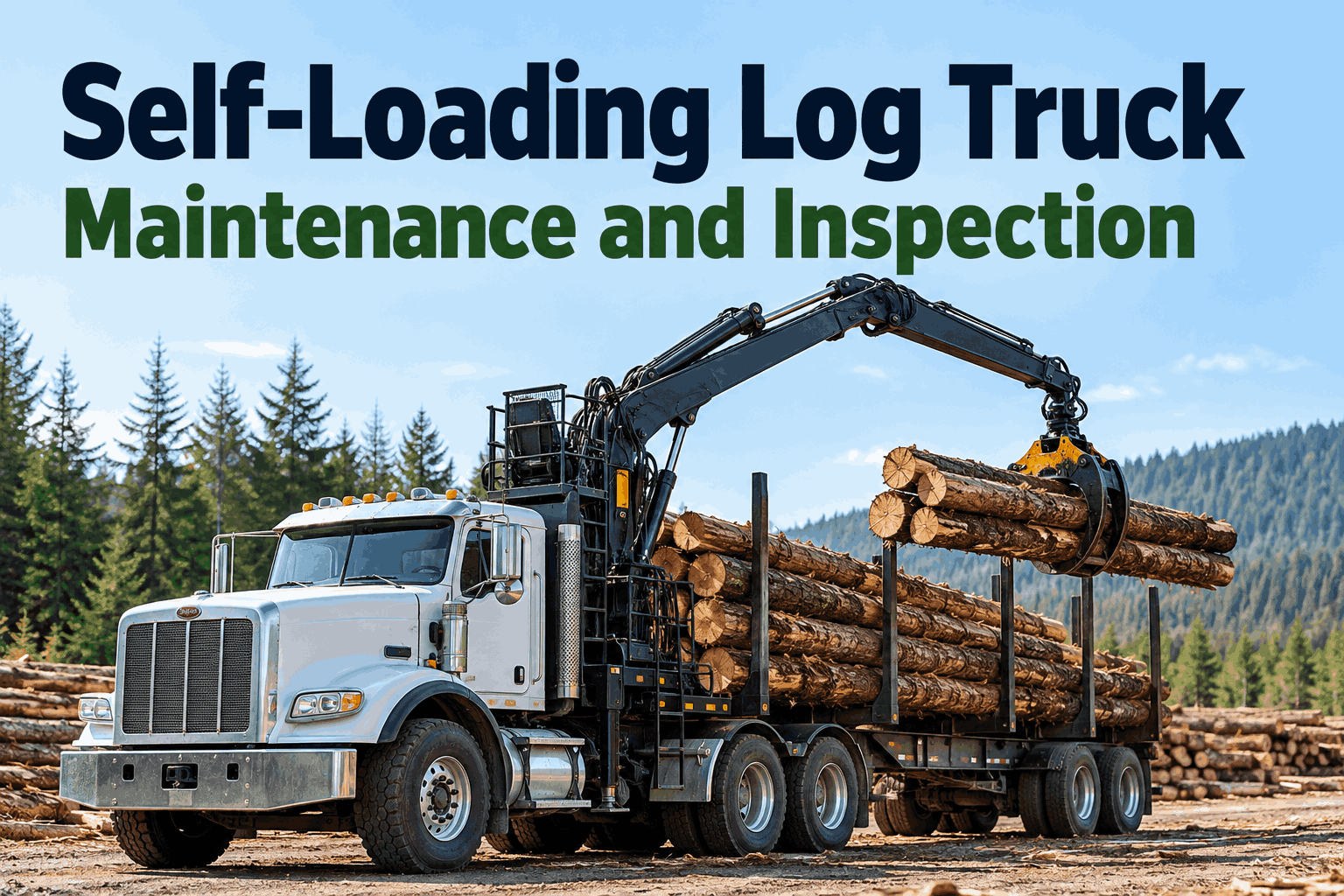
Self loading log truck maintenance has a trap built into it: you service the thing like a truck, but half of it is a crane. The chassis gets oil changes and brake checks on a truck schedule, while the mounted loader, its hydraulics and outriggers quietly rack up cycles no one is tracking — until a boom pin or a hose lets go at the landing. One vehicle, two maintenance worlds, and the loader half is the one that gets forgotten. Book a demo to see whole-vehicle inspections in HVI.
One Chassis. Two Machines. Half of It Gets Forgotten.
A self-loading log truck is a road truck and a hydraulic loader bolted together. Maintain only the truck half and the loader half fails you at the worst moment — so the inspection has to cover both.
- Engine & drivetrain
- Brakes & steering
- Tires & lights
- Boom & grapple
- Hydraulics & hoses
- Outriggers & slew
The reason self-loaders break down in surprising ways is that the two halves age on completely different clocks. The engine and drivetrain wear by the mile; the loader, hydraulics and outriggers wear by the cycle — every pick, swing and drop, hundreds of times a shift, whether the truck moved or not. A maintenance plan built around road miles can't see the loader's real workload, so the crane half drifts out of service while the truck half looks fine.
Why a Truck Schedule Misses Half the Vehicle
Put the two halves side by side and the gap is obvious. One wears on the odometer, the other on a cycle counter — and a mileage-only plan only watches the first.
- Engine, transmission, driveline
- Brakes, suspension, steering
- Tires, wheels, lighting
- Serviced on familiar road intervals
- Boom, stick, grapple & rotator
- Hydraulic pump, hoses, cylinders
- Outriggers, stabilizer pads, slew bearing
- Accrues wear even when parked and loading
The fix is a single inspection that covers both clocks, so the loader can't hide behind the truck's service history. HVI gives the whole vehicle one digital inspection — truck systems and loader systems on the same walkaround. Book a demo to see both halves on one check.
The Hydraulic System Is Where Self-Loaders Fail
When a self-loader goes down unexpectedly, the loader's hydraulics are usually behind it. These are the high-duty points that need eyes on them before the boom does, not after.
Catching these early is a cycle-based job, not a calendar one — which is why the loader belongs on an hours or cycle trigger, not the truck's mileage plan. For the loader structure in depth, see our knuckleboom loader inspection guide. Sign up free and put the hydraulics on a real schedule.
How PM Timing Works for a Two-in-One Vehicle
The truck half and the loader half shouldn't share a trigger. The answer isn't two systems — it's one plan that runs each half on the clock that actually measures its wear.
HVI schedules preventive maintenance on hours, miles or dates — or a combination — so a self-loader's two halves each get the right trigger under one preventive maintenance plan. Book a demo to see dual-trigger PM.
The Pre- and Post-Trip That Covers Both Jobs
A self-loader does two safety-critical jobs — it lifts heavy logs and then hauls them on the highway. The daily check has to clear both, documented, every shift.
Running it as a guided digital check means a flagged hose becomes a tracked defect, not a verbal note lost by morning. HVI's safety and defect tracking keeps the documented pre- and post-trip behind every load. Book a demo to see the daily check logged.
A Logging Contractor's Take
We ran our self-loaders on the same PM as the straight trucks for years, and the trucks were fine. It was always the loader side that bit us — a hydraulic cylinder or a hose, right in the middle of loading, hours from anywhere.
Once we started counting the loader on engine hours instead of pretending it ran on miles, the surprises stopped. Same truck, same drivers — we were just finally looking at the half we'd been ignoring. The hydraulic failures basically went away.
Logging ContractorSelf-loader fleet · stump-to-mill hauler
Self-Loading Log Truck Maintenance FAQs
What does self-loading log truck maintenance involve?
It covers two systems on one vehicle: the road-truck chassis — engine, drivetrain, brakes, tires and lights — and the mounted loader — boom, grapple, hydraulics, outriggers and slew bearing. Each wears differently, so the maintenance plan has to inspect and service both halves rather than treating the unit as a standard truck.
Why maintain the loader on hours instead of mileage?
The loader accrues wear every pick, swing and drop — often while the truck is parked at a landing — so road mileage doesn't reflect its workload. Engine-hour or cycle-based triggers match the loader's real duty cycle, catching hydraulic and boom wear that a mileage-only schedule would miss entirely.
What should a self-loading log truck inspection check?
Both halves: truck systems (engine, brakes, steering, tires, lights) and loader systems (boom and grapple, hydraulic hoses and cylinders, outriggers and stabilizer pads, slew bearing). Add the daily safety items — a documented pre- and post-trip, outrigger stability, balanced load and a minimum of two wrappers before transport.
What fails most often on a self-loader?
The loader's hydraulics — chafed or burst hoses, scored cylinder rods and seal drift — along with outrigger cylinder drift and slew-bearing wear. These are cycle-driven failures that build up during loading, which is why they surprise fleets running the vehicle on a truck-only service schedule.
How does HVI help manage self-loading log trucks?
HVI puts the truck and loader on one standardized inspection, schedules preventive maintenance on miles for the chassis and engine hours for the loader, tracks defects to closure, and keeps an audit-ready service record for the whole vehicle — so both halves stay maintained and documented, not just the truck.
Maintain Both Halves of Every Self-Loader
Inspect truck and loader on one check, trigger PM on the clock each half actually runs on, and keep defects and service history for the complete vehicle — so the loader never slips through on the truck's schedule again.
No credit card · See whole-vehicle maintenance in a short demo