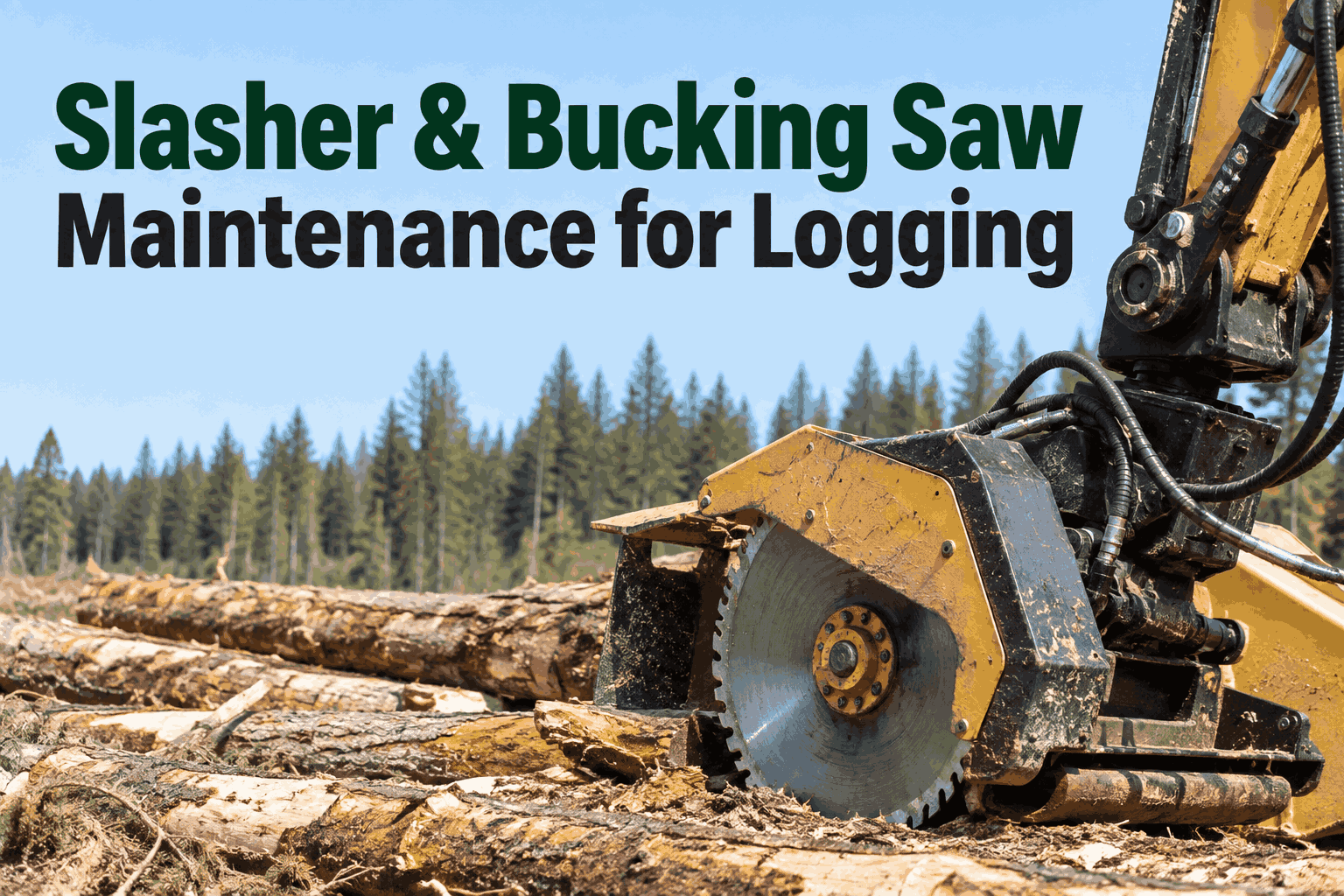
At the landing, every tree-length stem passes through one machine before it ships: the slasher. It bucks the wood to length all day, and when its saw bar, chain, drive or hydraulics let go, the whole landing stops — trucks wait, the deck backs up, nothing leaves. Slasher saw maintenance is what keeps the wood moving. Book a demo to see saw checks run by machine-hours.
The slasher is the gate every log has to clear
One bucking saw stands between your deck and the trucks. Keep its four systems sharp and guarded, and the landing never waits on the saw.
A landing slasher looks simple — a bar, a chain, a drive and a hydraulic swing — but it's the busiest cutting tool in the whole operation, bucking stem after stem with almost no rest. That duty cycle chews through bar rails, stretches chains and loads the drive and hydraulics hard. And because every broken chain is a potential chain-shot hazard, the saw is also the machine where maintenance and safety are the same job.
What keeps the bucking saw cutting
Four systems carry the load, and each shows wear differently. For the cutting components specifically, we go deeper in our saw bar, chain and disc maintenance guide; this is the whole-saw program that ties them together.
Saw bar
Rails wear and spread, the nose sprocket seizes, and a worn groove lets the chain wander — rough, slow cuts and faster chain wear.
Saw chain
Cutters dull, tie-straps crack and stretch sets in. A worn or loose chain cuts poorly — and is the root of chain-shot risk.
Saw drive
The motor, sprocket and bearings that spin the chain take constant load. Worn bearings or a hooked sprocket rob power and eat chains.
Hydraulics
Cylinders swing the saw and clamp the stem. Weeping seals and chafed hoses slow every cut and drop one mid-stem at the worst time.
All four are spottable on a walkaround by someone who knows the saw — and recordable, so wear is a trend you watch, not a surprise you discover. Book a demo to see a slasher inspection in the field.
On a bucking saw, a worn chain is a safety issue
This is the one that makes a slasher different from any other saw on site. A chain that breaks under power can whip its broken end out at bullet-like speed — a hazard known as chain shot. The defenses are maintenance and guarding, and both have to be inspected.
Cracked tie-straps and over-stretch are how chains fail. Pulling a worn chain before it breaks is the first line of defense.
Chain-shot guards and the cab shield exist for exactly this. A cracked, missing or modified guard is a failed inspection, not a minor note.
A dated record of chain hours and replacements is both a safety trail and the data that tells you when the next one is due.
When chain retirement, guard checks and change records all live in one inspection, safety stops depending on memory — which is exactly where it shouldn't live. Book a demo to see guard and chain checks on one record.
Daily slasher inspection checklist
Here's the walkaround itself — the checks a slasher needs before and during a cutting shift, grouped by system. Run it every day; log it so each check compares against the last.
On paper this list gets photocopied, filled in once and filed where nobody sees it again. In HVI it's the operator's daily inspection — each box dated, each flagged item turned into a work order, each shift compared to the last. Book a demo to see this checklist live on a device.
What a down slasher actually costs you
The repair bill is the small number. The real cost is everything that stops behind it. Watch the cascade when the one saw at the landing quits mid-shift.
A snapped chain, seized bar nose or dropped cylinder, mid-stem.
Stems pile at the landing with nothing to buck them.
Booked loads miss their window; haul time is wasted.
Crew and iron sit — paid, producing nothing, until the saw's back.
A chain pulled at the right hour is a five-minute change on a down-day. The same chain run to failure is this cascade. That gap is the entire payback of a saw program. Start free and stop the cascade before it starts.
A saw rhythm that rides on cutting hours
A slasher cuts hard hours, so the checks ride on machine-hours, not the calendar. Confirm exact intervals against your OEM manual.
Tension, sharpness, bar groove, guard condition before the first cut.
Bar oil, chain lube, hydraulic leaks and hose condition.
Chain stretch, bar rail wear, sprocket and drive condition logged.
Drive service, chain retirement and hydraulic checks at set hours.
Tie it to hours and nothing waits for a failure to remind you. This sits alongside the handheld side of the operation in our chainsaw and small-equipment guide. Book a demo to see an hours-based saw schedule.
A maintenance manager on the one machine you can't lose
The slasher is the machine I lose sleep over, because when it's down the landing is down — crew, loader, trucks, all of it waiting on one saw. We used to run chains till they broke; now chain hours and guard checks are logged on machine-hours and I swap them on a schedule. Cheaper chains, no chain-shot scares, and the wood keeps moving. For the cost of a logged walkaround, I stopped gambling the whole landing on one saw.
Run the saw program on HVI
Field inspection checklists
Digital inspections put the slasher walkaround — bar, chain, guards — in the operator's hand, signed and dated.
PM scheduled by machine-hours
Preventive maintenance ties drive service and chain retirement to cutting hours.
Chain & guard records
Maintenance records keep chain hours, changes and guard checks as a dated safety trail.
Downtime & cost reporting
Reporting shows what the saw costs per hour and when it's trending toward trouble.
One record per saw, built on the walkaround the operator already does — so the landing's most critical machine stops being the one that surprises you. Start free and put your slashers on a program.
Slasher saw maintenance questions
Q1What does slasher saw maintenance involve?
Keeping four systems in shape — the saw bar, the chain, the drive, and the hydraulics — plus the guards. It runs from a shift-start check of chain, bar and guards through hours-based drive service and chain retirement. On a bucking saw, that maintenance is also the main safety control.
Q2Why is chain condition a safety issue on a slasher?
A chain that breaks under power can fling its broken end at extreme speed — a hazard called chain shot that can injure or kill. Retiring chains before they over-stretch or crack, and keeping chain-shot guards intact, are the main defenses, which is why both belong in the inspection.
Q3How often should a slasher saw be inspected?
Chain, bar and guards at shift start; lube and leaks daily; measured wear weekly; drive service and chain retirement at set machine-hours. Tie it to cutting hours rather than the calendar, since a busy landing saw wears fast. Confirm intervals against your OEM manual.
Q4Why does a down slasher cost so much?
Because it's usually the single machine every stem passes through. When it stops, the deck backs up, trucks wait or leave empty, and the whole crew idles — so the lost-production cost dwarfs the repair. Catching wear early turns a landing-stopping failure into a quick scheduled change.
Q5How does HVI help with slasher saw maintenance?
HVI runs the walkaround as a digital inspection, schedules bar, chain, drive and hydraulic service by machine-hours, and keeps chain-change and guard checks as dated records — so the saw stays cutting and the safety trail is intact. It's an inspection and maintenance layer, not an OEM service or safety manual.
Put your slashers on a maintenance program
Run the walkaround as a digital inspection, schedule bar, chain, drive and hydraulic service by machine-hours, and keep chain and guard records dated — so the wood keeps moving and the saw stays safe. Live in weeks, not quarters.
No credit card · Inspections by machine-hours · Built for forestry fleets