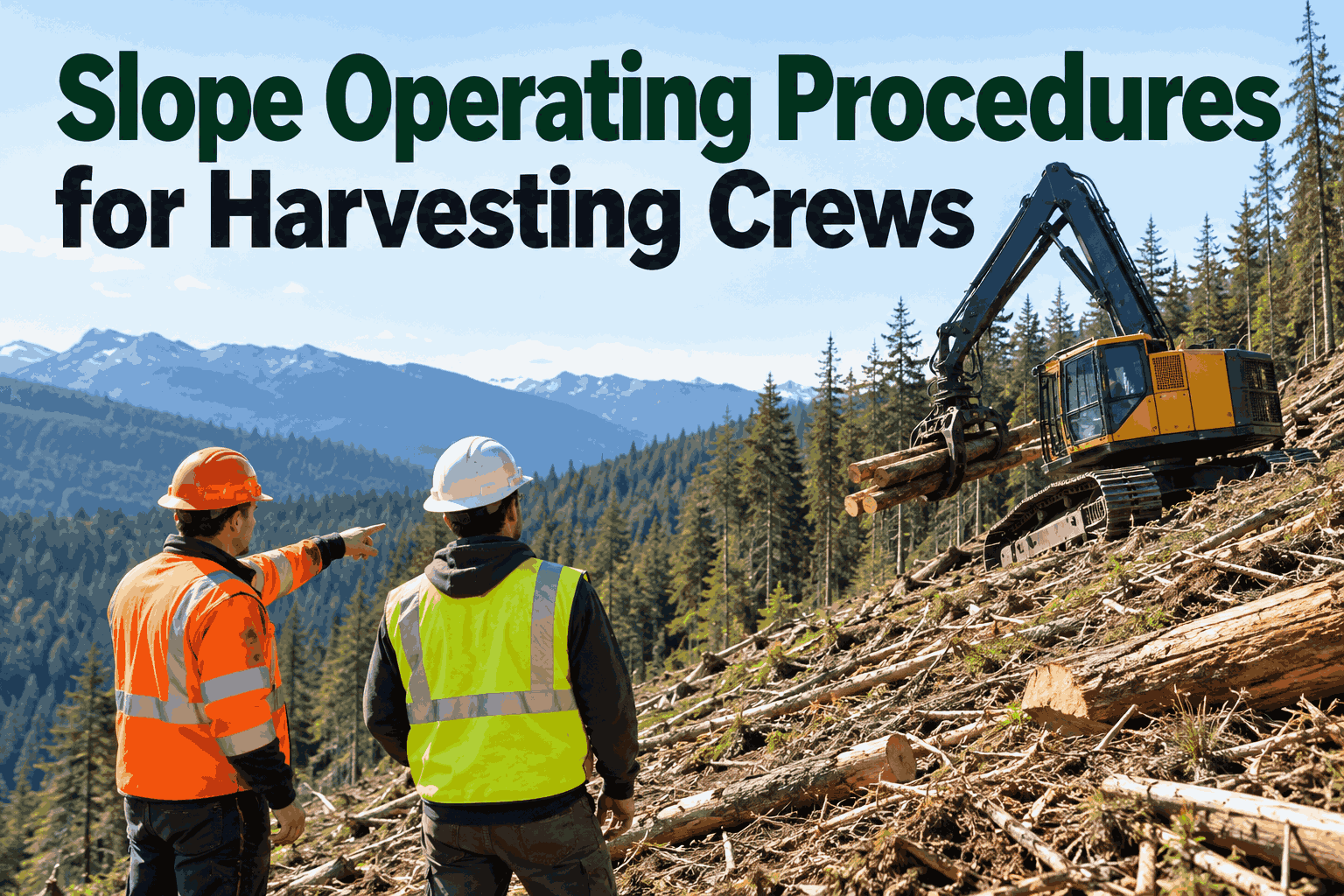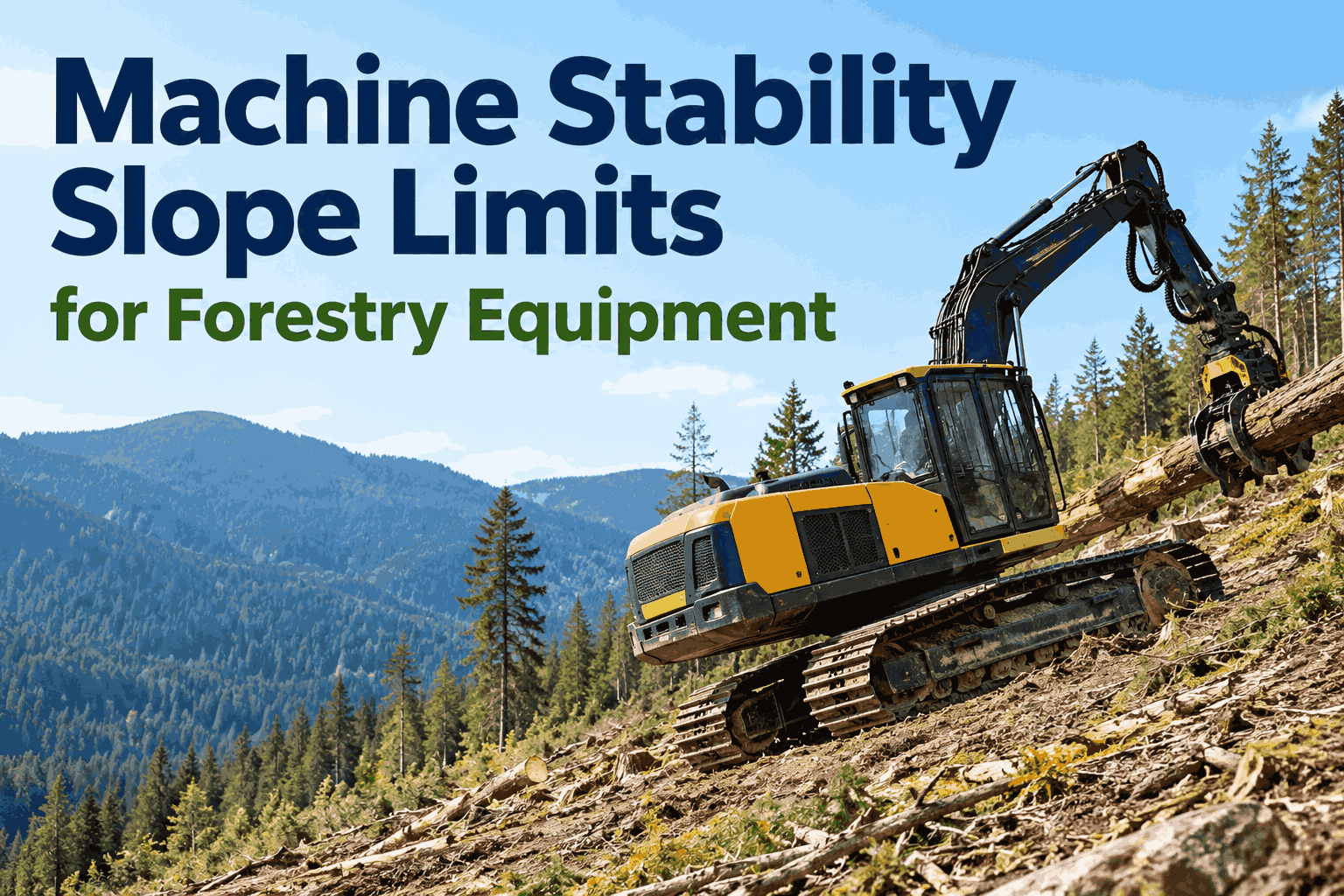
Machine stability on a slope is the whole game in steep-terrain logging — a feller buncher or harvester doesn't warn you before it tips, it just reaches the point where its centre of gravity passes outside the tracks and goes over. Understanding what sets a forestry machine's stability slope limit — load, terrain, ground and speed — is what keeps the machine, and the operator, upright. Here's what drives it, and how to build the checks into a routine — or start a free trial to document them.
A machine is stable until its weight moves past the tracks.
Stability on a slope isn't one fixed number — it's a margin that shrinks as the load goes up, the ground softens, the speed rises, or the hill steepens. Knowing what eats that margin is the first step to staying inside it.
First, the honest boundary: HVI doesn't calculate machine stability, measure tip angles, or set a machine's slope limit. Those come from the manufacturer's stability data and a competent on-site assessment — the engineering stays with your people and the OEM. What HVI does is turn the condition and terrain checks that affect stability into a consistent digital checklist, keep a record of the equipment inspections behind it, and document every assessment. It sits right beside your slope operating procedures. Start a free trial to document the checks.
Static vs. dynamic: two kinds of machine stabilitywhy the spec-sheet slope figure isn't the working limit
Most rollover thinking starts and stops at a single tip angle. In the field there are really two numbers, and the gap between them is where machines actually go over.
The angle a machine would tip at sitting still, from the manufacturer's data. It's a clean, measured baseline — the ceiling of what the machine can do under ideal, motionless conditions.
The best caseWhat happens once the machine moves — turning, braking, a load swinging out, a track dropping into a hole, ground giving way. Each adds force that lowers the angle it really goes over at. This is the working limit, and it's always below the static one.
The real caseTreating the static figure as the operating limit is one of the most common steep-slope mistakes — the margin you plan around has to sit below it. Start a free trial to build the margin into a checklist.
What moves a forestry machine's tipping pointthe factors behind every machine stability slope limit
Stability isn't a property of the machine alone — it's the machine, its load, the ground and how it's driven, all at once. These six factors do most of the moving.
Centre of gravity & load
A heavy or raised load lifts the centre of gravity — the higher it sits, the smaller the tilt it takes to carry it past the tracks.
Raises riskTrack or tyre base
A wider, well-maintained base resists tipping; worn tracks, low tyre pressure or a narrow stance give the weight less to balance on.
Check conditionSide slope vs. fall line
Working across the slope is the danger direction — side slope tips a machine far sooner than driving straight up and down the hill.
Raises riskGround conditions
Wet, frozen or loose ground cuts traction — a machine that slides sideways before it tips reaches its limit well below the dry figure.
Raises riskSpeed & dynamic forces
Turning, braking and sudden boom moves add sideways force the static figure never accounts for — speed is the quiet margin-killer.
Raises riskBoom & attachment reach
Reaching or swinging the head downhill throws the centre of gravity outward — the machine can be stable parked and unstable mid-swing.
Raises riskNone of these is measured by software — but each is a check an operator can confirm and record before and during work. Start a free trial to turn them into a checklist.
What erodes the stability marginthe same hill, different conditions, different safe limit
Start with a machine's full margin on firm, flat-enough ground, then watch each condition chip away at it. The bars below are relative, not measured — but they show why "it was fine yesterday" doesn't carry over.
A machine rated for a grade in the dry can be over its real limit on the same ground after rain. Logging the conditions is how the limit stays honest. Book a demo of condition-based safety checks.
Where HVI fits a machine stability programthe features that document steep-slope stability checks
HVI doesn't make the stability call — it makes the checks behind it consistent and the record permanent. Five features do the work.
Safety Management
Run stability and pre-work safety checks as a managed program across every crew and machine, not a loose habit.
Digital inspection checklists
Operators confirm terrain, load, ground and machine condition on a phone, with photos, before work starts.
Equipment inspection records
Tracks, tyres, ROPS, counterweight and hydraulics logged — the condition factors that quietly shrink the margin.
Safety documentation
Every stability assessment becomes a signed, time-stamped record — the proof an audit or incident review asks for.
Asset management
Each machine carries its own limits, specs and inspection history on one record the operator can see.
It's the same safety management and inspection backbone behind the rest of your forestry program. Book a demo of the safety checklist builder.
From a forestry safety manager
The thing operators underestimate isn't the hill — it's what the machine is doing on it. Standing still at 25 degrees is fine; it's the swing with a full head, or braking into a soft patch, that puts you over, and that's not on any spec sheet. We stopped arguing about tip angles and started logging the things that actually move the margin — the load, the ground, the track condition — as a check before work. It didn't tell anyone the limit; it made everyone think about it the same way, with a record to show for it.
Machine stability on slopes — FAQs
What determines a forestry machine's stability on a slope?
Stability comes down to where the machine's centre of gravity sits relative to its track or tyre base. As long as the gravity line stays inside that base, the machine is stable; when load, lean, speed or ground conditions push it toward the downhill edge, the margin shrinks and the machine approaches its tipping point. That's why machine stability on a slope depends on the whole picture — the machine, the load, the terrain direction, the ground and how it's driven — not a single number.
Does HVI measure machine stability or set the slope limit?
No. HVI doesn't calculate stability, measure tip angles, or decide a machine's safe slope limit — those come from the manufacturer's stability data and a competent on-site assessment by qualified people. HVI's role is to document the procedure: turn the terrain and condition checks that affect stability into a consistent digital checklist, keep the equipment inspection records behind them, and store every assessment as a signed, time-stamped record.
Why is the manufacturer's tip angle not the operating limit?
The spec-sheet figure is usually a static value — the angle a machine would tip at standing still, under ideal conditions. In real work the machine is moving: turning, braking, swinging a loaded head, crossing uneven or soft ground. Each of those adds dynamic force that lowers the angle it actually goes over at. The working limit should sit below the static figure, with a margin for conditions, which is exactly what a site assessment sets.
What's the most dangerous direction to work on a slope?
Across the slope — side-slope operation — is generally the critical direction, because a machine's sideways stability is far narrower than its fore-and-aft stability. Many procedures favour working up and down the fall line rather than traversing, and limit how far across a slope a machine operates. The exact approach depends on the machine and site, which is why it belongs in a documented procedure and a pre-work check rather than left to the moment.
How does logging these checks improve safety?
It makes the invisible factors visible and repeatable. A digital checklist completed before work confirms the load, ground, terrain direction and machine condition — the things that move the margin — and records them with photos and a sign-off. Over time you get a complete history per machine, so conditions are considered every setup rather than assumed, and you hold the proof an auditor or incident review will ask for.
Keep machine stability on the slope in front of every crew
The limit stays with the operator and the manufacturer who set it — and the checks that keep machines inside it become a consistent, signed record. On steep ground, "we knew it was marginal" turns into "here's the check we ran, and what we decided."
Condition checks · Terrain & load logged · Signed, time-stamped records