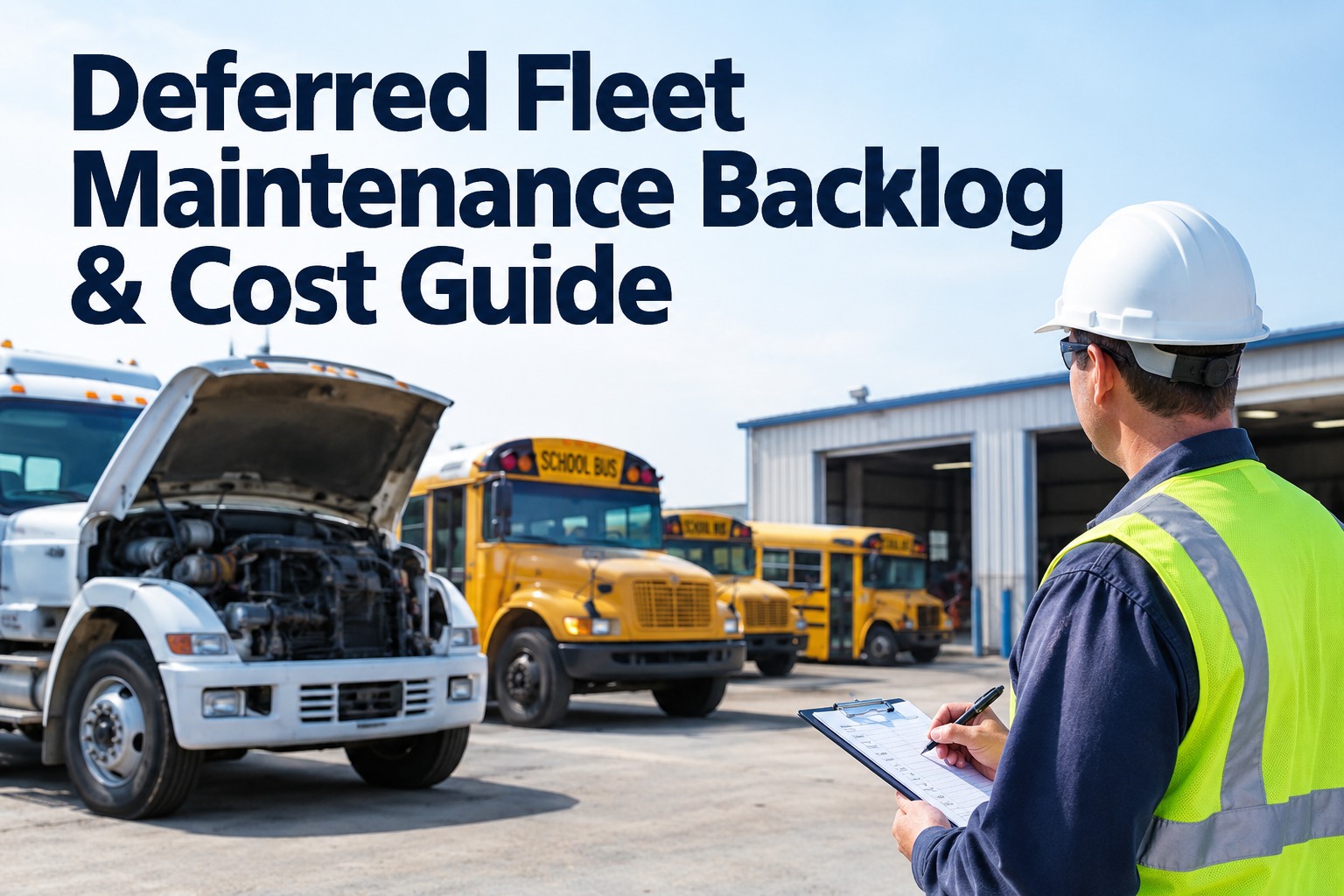
Somewhere in your shop right now is a list nobody wants to read out loud — a snowplow with a flagged hydraulic leak that's been "next month" for four months, a sedan with worn brake pads waiting on parts, a dump truck with a suspension defect that keeps getting bumped for a higher-priority job. That list is deferred fleet maintenance, and left untracked, it doesn't just sit still. It grows, it gets more expensive, and eventually somebody has to explain it to a finance officer or a council with nothing but a gut feeling and a shrug.
Deferred Fleet Maintenance: How a Quiet Backlog Becomes a Budget Emergency
Every fleet defers some work. The difference between a managed decision and an uncontrolled backlog is whether anyone can actually see, size, and prioritize it.
Planned Deferral vs. Uncontrolled Backlog — What's the Difference?
Not all deferred work is a problem. Every fleet manager occasionally pushes a non-critical repair a few weeks because parts are on backorder, a vehicle is needed for a storm response, or the shop is short-staffed that quarter. That's a decision. What turns it into deferred fleet maintenance risk is when the decision stops being tracked — when nobody can say how many jobs are overdue, how old the oldest one is, or what it would cost to clear them all tomorrow.
Planned deferral
- Documented reason and expected resolution date
- Reviewed on a schedule, not forgotten
- Safety-critical items are never on this list
- Visible to whoever owns the budget
Uncontrolled backlog
- Nobody knows the total count or age
- No consistent priority or cost estimate
- Safety-relevant defects mixed in with cosmetic ones
- Surfaces only after a breakdown or incident
The gap between those two columns is almost entirely a documentation problem, not a staffing or budget one. A fleet can defer plenty of work responsibly as long as every item is visible, dated, and reviewed — it's the invisible backlog that eventually becomes a crisis nobody saw coming. See how a deferred item gets logged and tracked from the moment it's first flagged during an inspection.
What Happens When Deferred Fleet Maintenance Piles Up
Postponed work rarely stays the same size or cost. A minor hydraulic seep left unaddressed can progress to a full line failure. A worn brake component ignored past its service interval puts more stress on rotors, calipers, and eventually the whole braking system. Industry analyses of deferred maintenance across asset types generally find that costs tend to compound the longer a repair sits — though the exact rate varies widely by component and isn't a fixed multiple that applies to every deferred job, so it's worth treating as a directional warning rather than a precise formula.
The safety consequence is the sharper number: FMCSA data cited in recent industry safety analysis found that motor carriers with active maintenance violations are about 65% more likely to be involved in a crash than those without. On the transit side, a real-world example makes the operational risk concrete — Pew's reporting on U.S. transit backlogs cites a South Florida electric bus fleet worth $126 million where maintenance backlogs left only a handful of buses running at a time. A backlog isn't an abstract accounting figure; it's the reason vehicles sit idle when they're needed most.
Quantifying Your Backlog: The Fields That Make It Real
"We have a maintenance backlog" isn't a number anyone can act on. A backlog becomes usable — for prioritization, for budgeting, for a council presentation — once it's broken into consistent fields for every deferred item.
Vehicle & asset class
Which unit, and what category it belongs to — light vehicle, heavy truck, specialized equipment.
Department
Which division owns the vehicle, so backlog cost and risk can be traced to a budget line.
Priority status
Safety-critical, operationally critical, or routine — never left as a single undifferentiated pile.
Days overdue
Time since the defect was first flagged — the single strongest predictor of escalating risk and cost.
Estimated labor & parts
What it would take to close the item, so the backlog converts into a real budget request.
Total estimated cost
Labor plus parts plus any outside service — the figure that turns into a dollar total leadership can act on.
Six fields, applied consistently to every open item, is what separates "we think we have a backlog problem" from a report a finance director can actually put in front of a budget committee. Pulling these fields by hand from paper work orders is exactly where most fleets lose the thread — see what a structured deferred-work list looks like when it's captured at the point of inspection instead of reconstructed later.
Why Backlog Age Changes the Math
Two deferred items with identical estimated repair costs are not equally urgent if one has been open three weeks and the other has been open eight months. Age is a proxy for both rising cost and rising risk.
-
0–30 daysManageable
Still within a reasonable scheduling window for most non-critical items.
-
31–90 daysWatch closely
Secondary wear often begins; parts on backorder should be actively chased, not just noted.
-
91–180 daysEscalate
Re-evaluate safety classification; a defect that was cosmetic can drift toward critical.
-
180+ daysReview urgently
Confirm the vehicle is still safe to operate under its current condition, and treat as a leadership-level item.
These bands are a general planning framework, not a regulatory standard — actual urgency always depends on the specific defect, vehicle, and applicable safety or manufacturer requirements, so age should inform prioritization alongside a qualified technician's assessment, not replace it.
Prioritizing the Backlog: Five Factors That Actually Matter
Once every item has its six fields, ranking the backlog comes down to weighing five factors together — not sorting by cost or by age alone. See a prioritized backlog view built from these factors before deciding what gets scheduled next.
-
1
Safety risk
Anything with a plausible path to a roadside failure, brake or steering issue, or out-of-service condition goes to the top, regardless of cost.
-
2
Vehicle criticality
A single-purpose unit with no backup (the only plow on a route, the only ladder truck) outranks a vehicle with easy substitutes.
-
3
Age of the deferral
Older items get a priority bump — they've had the most time to develop secondary wear or drift toward a safety concern.
-
4
Cost trajectory
Items likely to get significantly more expensive if delayed further move up, even if today's estimate looks modest.
-
5
Consequence of further delay
What breaks — operationally, legally, or publicly — if this specific item stays open another quarter.
Presenting a Backlog Finance Leaders and Councils Will Trust
A credible backlog report isn't a spreadsheet dump. It's a short, structured summary that answers the questions a finance officer or council member will actually ask: how many items are open, how old is the oldest one, how much would it cost to clear the safety-critical items first, and is the total trending up or down compared to last quarter. That last question matters more than any single snapshot — a backlog that's shrinking, even slowly, tells a very different budget story than one that's quietly growing every month.
Presenting the number this way turns a maintenance conversation into a documented budget request instead of a plea. Walk through how HVI generates a priority-based backlog report that's ready to hand to finance without a week of prep beforehand.
What a Public Works Director Actually Deals With
For years our "backlog" was a verbal understanding between two mechanics about what was still waiting. When a councilmember asked how many vehicles had open safety items, I genuinely didn't have a number — just a bad feeling.
Once we started logging every deferred item with an age and a dollar estimate, the backlog stopped being a mystery. We cleared the oldest safety items first, and for the first time I could show the council a number going down instead of just hoping it wasn't going up.
Frequently Asked Questions
What is deferred fleet maintenance?
Deferred fleet maintenance is preventive maintenance or repair work that has been postponed rather than completed on schedule, typically because of budget constraints, staffing limits, parts availability, or vehicle demand. Some deferral is a normal, managed part of running a fleet — the issue arises when deferred items aren't tracked, dated, or prioritized, at which point they form an uncontrolled backlog that's difficult to size, budget for, or safely manage. Any deferred item should still be evaluated against applicable safety and manufacturer requirements before a vehicle continues in service.
How do you quantify a fleet maintenance backlog?
A usable backlog figure comes from tracking consistent fields for every deferred item: the vehicle and asset class, the responsible department, a priority classification (safety-critical, operationally critical, or routine), how many days the item has been overdue, and an estimated labor and parts cost to close it. Summing these across the fleet produces both a total dollar figure and a breakdown by priority and department — far more useful for budget decisions than a single undifferentiated backlog count.
Does deferred maintenance always cost more the longer it's postponed?
In general, yes — postponed repairs often progress from minor to major issues, and industry analyses of deferred maintenance across various asset types typically find costs increase the longer work sits unaddressed. However, the rate and severity vary significantly by component and vehicle type, so it isn't accurate to apply a single fixed multiplier to every deferred repair. Backlog age is best used as one factor in prioritization, evaluated alongside a qualified technician's assessment of the specific defect.
How should a fleet prioritize which deferred repairs to complete first?
Effective prioritization weighs several factors together rather than ranking by cost or age alone: safety risk (anything with a plausible path to a roadside failure or out-of-service condition comes first), how critical the vehicle is to operations, how long the item has been deferred, whether the cost is likely to grow if delayed further, and the operational or public consequence of continued delay. Safety-critical items should always be addressed according to applicable regulatory and manufacturer requirements regardless of where they rank on other factors.
How do you present a maintenance backlog to a council or finance department?
An effective presentation is a short, structured summary rather than a raw data dump: total open items, the age of the oldest item, estimated cost to close safety-critical items first, and whether the total backlog is trending up or down compared to the prior reporting period. Framing it as a documented, prioritized list with clear dollar figures turns the conversation into an evidence-based budget request, which tends to be far more persuasive than describing the backlog in general terms.
Make deferred fleet maintenance a documented number, not a guess
HVI captures every deferred item at the point of inspection — vehicle, priority, age, cost estimate, and completion status — so your backlog is always ready to report, prioritize, and shrink.
No credit card · No hardware · Backlog reporting ready on day one