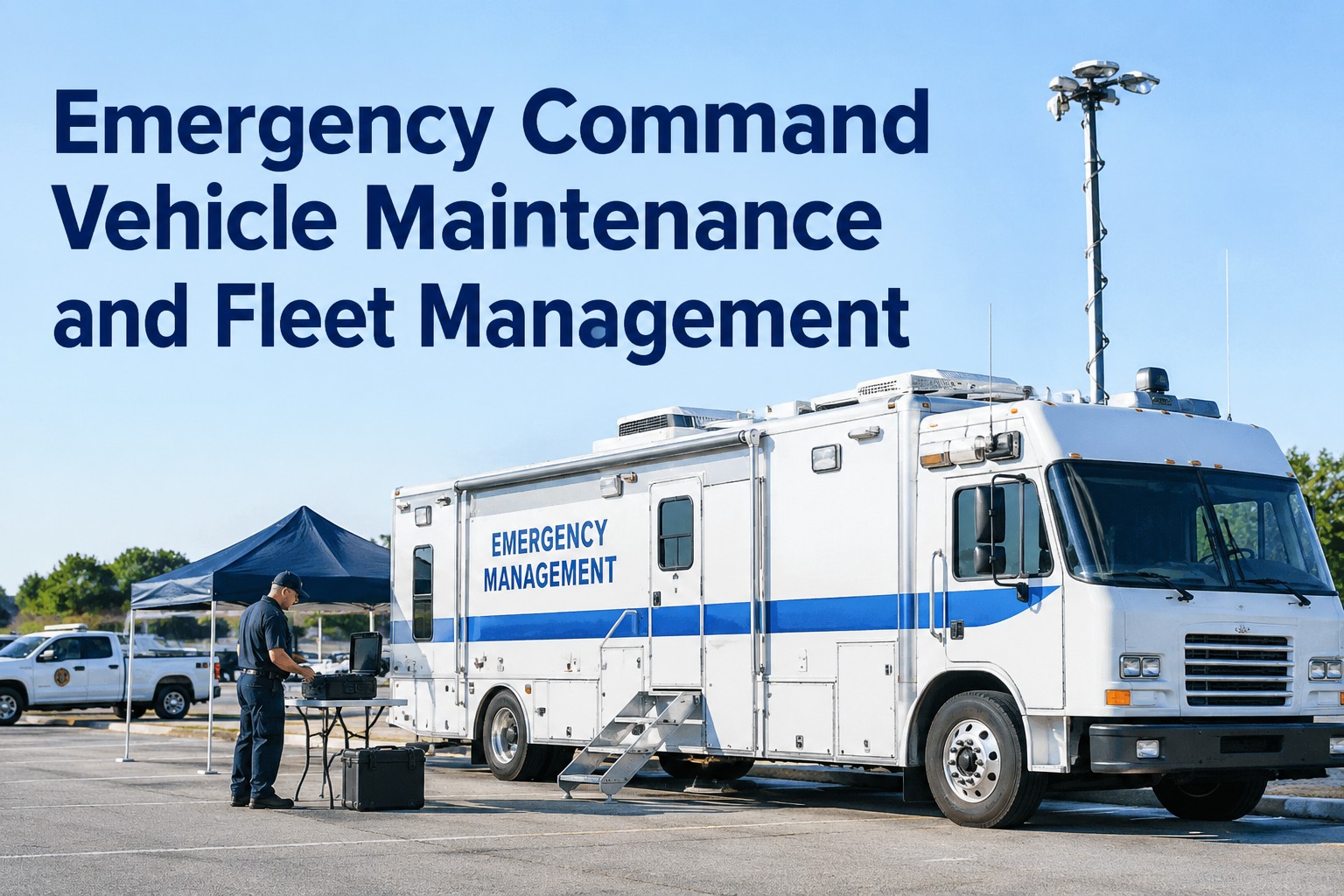
The call comes in, the command vehicle rolls, and forty minutes into the incident the generator won't hold load — so the radios, servers and situational-awareness screens go dark. The chassis was fine. It always is. Emergency command vehicle maintenance fails on the half most fleet programs never track: the mission-critical technology in the box. Book a demo to see both halves on one checklist.
A Command Vehicle Isn't a Truck. It's a Rolling Data Center on a Truck.
Most maintenance programs inspect the driving half and assume the technology half will just work. When it doesn't, it fails on scene — the one place you can't afford it.
Emergency command vehicle maintenance is the discipline of keeping both the chassis and the onboard mission systems — generator, communications, IT, HVAC and specialised equipment — ready to deploy at a moment's notice. It's fundamentally different from maintaining a fire engine or a plow, because a command vehicle spends most of its life parked and rarely-used, then gets asked to perform flawlessly under the worst conditions imaginable. This guide covers why the technology half is where readiness breaks, the five systems that decide whether a deployment succeeds, and the inspection cadence that keeps a unit mission-ready between calls.
The blind spotwhy the chassis is almost never the problem
A command vehicle's driving systems get inspected because they look like every other vehicle in the yard — a mechanic knows brakes, tires and engines. But the chassis is the reliable half. It's the generator that won't carry load after months idle, the satellite dish that won't acquire, the server that won't boot, the HVAC that can't cool a rack of electronics in a July parking lot — those are what turn a command post into an expensive box.
"It passed its annual DOT inspection and the engine runs fine, so the command vehicle is ready."
Covers the 30% of the vehicle that rarely fails on scene — and none of the mission-critical technology that actually does."The generator carries full load, comms acquire, the servers boot, HVAC holds the rack temp, and the mast deploys — verified, on a schedule."
Covers what fails when it's parked for weeks then asked to run flawlessly under pressure. That's readiness.The pattern is specific to low-utilisation, high-stakes assets. A command vehicle might deploy a handful of times a year, so failures hide during the long idle stretches and only surface under load, on scene, when there's no second chance. That's exactly why command vehicle maintenance has to be proactive and technology-inclusive, not reactive and chassis-only. Book a demo to see a command-vehicle inspection template that covers every onboard system
5 systemsthe mission-critical technology that decides a deployment
When agencies inspect a used command unit before purchase, they check five critical systems — and those same five are exactly what a maintenance program must keep ready in service. Each fails in its own way, and each needs its own checks built into the mobile command unit maintenance plan.
Generator & power
The backbone — it runs satellite uplinks, HVAC, lighting and every workstation at once. Test start-up and full-load capacity regularly, not just that it turns over. Most units carry redundant power (dual generators, battery banks, inverters); the backup only counts if the automatic transfer is verified.
Communications & satellite
The reason the vehicle exists — multi-band radio, satellite, LTE/5G, mesh and Wi-Fi, integrated so the unit stays connected when local infrastructure is down. Check signal acquisition, noise on handoff, and interoperability across agencies before it's needed, not on scene.
IT & servers
Servers, routers, VPN, storage and the video and mapping stack. Beyond hardware, this system needs its software maintained — firewall and OS patching, security updates, and tested data backup and recovery. An unpatched command post is a liability the moment it connects.
HVAC & climate
Not just crew comfort — it cools the electronics. A rack of servers and radios in a sealed box generates serious heat, and if HVAC fails the equipment throttles or shuts down. Clean filters and coils on a schedule; a clogged coil in summer is a mission-ending failure that looks like an IT problem.
Mast & antennas
The specialised, most-overlooked system. Pneumatic masts weigh hundreds of pounds, extend dozens of feet, and are highly weather-sensitive — seals and rings degrade with dust and moisture. Inspect seals, air pressure consistency and deploy/retract cycles so it raises cleanly and holds when it matters.
Notice how few of these a standard vehicle inspection touches. A command vehicle needs a purpose-built template that treats the box as seriously as the chassis — one checklist, both halves, every onboard system accounted for. Start free and build a custom command-vehicle inspection template for every system
The rhythmhow often each system needs checking
Because a command vehicle sits idle between deployments, readiness is a function of cadence, not mileage. A meter-based PM schedule won't catch a generator degrading in storage. The proven approach layers checks by frequency, so nothing critical goes months without verification.
-
WeeklyFunctional checkStart the generator and test under load, confirm comms and satellite acquire, run HVAC, verify data backups. The single most important habit — it catches idle-storage failures before they reach a scene.
-
MonthlyStructure & redundancyInspect frame and body for rust, panel warping and seal condition (especially after deployment), and run a functional test of every backup system — not just the primary.
-
QuarterlyCritical-component inspectionA deeper look at generators, batteries, routers, mast and HVAC — the systems whose slow degradation won't show up in a quick weekly start-up.
-
AnnualFull-systems drillA complete deployment test end to end, plus deep maintenance: replace worn parts, recalibrate, service power systems, and confirm vehicle safety and emissions compliance. Prove the whole unit under real conditions.
The critical addition after every deployment: a post-use inspection within a short window, the same way NFPA 1911 directs fire apparatus be checked within 24 hours of an emergency response. A unit that just worked hard in the field is exactly when hidden damage sets in. Book a demo to automate weekly, monthly and post-deployment command-vehicle checks
The readiness gapa backup you've never tested isn't a backup
Command vehicles are built with redundancy — dual generators, battery banks, backup comms paths, HVAC redundancy — precisely because they can't fail on scene. But redundancy is a promise, not a guarantee. A redundant system only proves its worth when it's tested under real-world conditions, and the most dangerous failure is the backup nobody knew had quietly died.
This is where digital records earn their place. A documented history of every functional test proves — to the agency, the auditor and the next incident commander — that the unit's backups have been exercised, not just installed. Readiness you can't prove is readiness you're only hoping for. Start free and log every redundancy test into a readiness record
From an emergency management fleet supervisor
Our command unit went out maybe six times a year, so it lived in the bay. We serviced it like any other truck — oil, brakes, annual inspection. Looked great on paper.
Then a wildfire callout: forty minutes in, the generator dropped load and everything went dark. Turned out the auto-transfer to the backup had failed silently months earlier, and nobody had load-tested it because it wasn't on any checklist. Now the whole box is on a weekly functional test — generator under load, comms up, mast cycled, backups fired — and it's all logged. The truck was never our risk. The technology we assumed was fine was.
The takeaway
A command vehicle is two assets in one — a chassis and a rolling data center. Emergency command vehicle maintenance fails when a program tracks only the driving half.
Keep five mission systems ready — generator, comms, IT, HVAC and mast — on a cadence, not a meter, because idle-storage failures only surface under load.
Test every redundancy and log it — a backup you've never fired isn't a backup, and readiness you can't prove is only a hope.
The command vehicle is the one asset in the fleet that has to work perfectly on its worst day, from a cold start, after weeks of sitting still. That standard is impossible to hit with a chassis-only checklist and a mileage-based PM schedule. It takes a purpose-built inspection that covers the generator, comms, IT, HVAC and mast; a cadence that verifies readiness between calls; and a digital record that proves every backup has been exercised. Track both halves of the vehicle with equal seriousness and the command post is ready before the call comes — not discovered broken forty minutes into the incident. Book a demo to keep your command vehicles mission-ready on one platform
Frequently asked questions
What makes emergency command vehicle maintenance different from regular fleet maintenance?
A command vehicle is effectively two assets in one: a drivable chassis and a rolling data center full of mission-critical technology — generator, communications, IT and servers, HVAC and specialised equipment like a pneumatic mast. Regular fleet maintenance focuses on the chassis (engine, brakes, tires, steering), which for a command vehicle is actually the reliable half. The failures that matter happen in the technology: a generator that won't carry load, a satellite dish that won't acquire, a server that won't boot, HVAC that can't cool the electronics. This is compounded by the vehicle's usage pattern. A command unit often deploys only a handful of times a year and spends most of its life parked, so failures develop silently during long idle periods and only surface under full load on scene, where there's no second chance. That combination — specialised onboard systems plus low-utilisation, high-stakes deployment — means command vehicle maintenance has to be proactive, cadence-based, and inclusive of every onboard system, not just the parts a standard vehicle inspection covers.
What systems should be inspected on a mobile command vehicle?
Beyond the standard chassis inspection, a mobile command vehicle has five mission-critical systems that decide whether a deployment succeeds. First, generator and power — tested for start-up and full-load capacity, with any redundant power (dual generators, battery banks, inverters) verified for automatic transfer. Second, communications and satellite — radio, satellite, LTE/5G, mesh and Wi-Fi checked for signal acquisition and cross-agency interoperability. Third, IT and servers — hardware plus software maintenance including security patching and tested data backup and recovery. Fourth, HVAC and climate — which not only keeps crews comfortable but cools the electronics, so filters and coils must be serviced on schedule to prevent equipment from overheating. Fifth, the mast and antennas — pneumatic masts are heavy, extend dozens of feet, and are highly weather-sensitive, so seals, air pressure and deploy cycles need regular inspection. A purpose-built inspection template should cover all five alongside the chassis, so the box is tracked as carefully as the engine.
How often should a command vehicle be inspected?
Because a command vehicle sits idle between deployments, readiness depends on a time-based cadence rather than mileage. A proven approach layers checks by frequency. Weekly: a functional check — start the generator and test it under load, confirm communications and satellite acquire, run the HVAC, and verify data backups. This weekly habit is the most important, because it catches idle-storage failures before they reach a scene. Monthly: inspect structural integrity (frame rust, panel warping, seals, especially after a deployment) and run a functional test of every backup system, not just the primary. Quarterly: a deeper inspection of critical components — generators, batteries, routers, mast and HVAC — whose slow degradation won't show in a quick start-up. Annually: a full-systems deployment drill plus deep maintenance, replacing worn parts and confirming safety and emissions compliance. Critically, add a post-deployment inspection within a short window after any use, mirroring the NFPA 1911 practice of checking fire apparatus within 24 hours of an emergency response, since a unit that just worked hard in the field is exactly when hidden damage appears.
Why do command vehicle failures happen during deployment rather than in the shop?
It comes down to how these vehicles are used and how their failures hide. A command unit spends the vast majority of its life parked in a bay, deploying only occasionally. Many of its critical systems — especially the generator, backup power transfer, and communications — can degrade or fail silently while sitting idle, and a routine chassis-focused service won't detect it because those systems aren't exercised or tested during normal maintenance. The failure only becomes visible when the vehicle is asked to run everything at full load simultaneously, which happens for the first time on scene, under pressure, often in extreme weather. That's the worst possible moment to discover a dead backup or a clogged HVAC coil. The fix is to reproduce deployment conditions on a schedule: load-test the generator, acquire the satellite signal, boot the servers, cycle the mast, and fire the backups regularly in the bay, so any failure surfaces during a controlled test rather than a live incident. Testing under realistic conditions is the only way to convert built-in redundancy into dependable readiness.
How can fleet software help keep command vehicles mission-ready?
A fleet inspection and maintenance platform helps in several ways specific to command vehicles. It lets an agency build a custom inspection template that covers both the chassis and every mission system — generator load test, comms acquisition, server boot, HVAC, mast cycle — rather than forcing a specialised vehicle into a generic checklist. It supports time-based preventive maintenance schedules (weekly, monthly, quarterly, annual, and post-deployment) suited to a low-utilisation asset where mileage-based PM doesn't apply. When any check fails, it automatically generates a work order so the defect is tracked to resolution rather than forgotten. And it preserves timestamped digital records of every inspection and functional test, which builds a verifiable readiness history — proof that redundant systems have actually been exercised, documentation for audits and after-action reviews, and confidence for the next incident commander that the unit is genuinely ready. In short, it ensures the technology half of the vehicle is tracked and documented with the same rigour normally applied only to the chassis.
Discover a dead backup in the bay — never on scene
HVI keeps emergency command vehicles mission-ready with custom inspection templates for every onboard system, time-based and post-deployment PM schedules, automatic work orders on any failed check, and digital records that prove every redundancy has been tested. The generator, comms, IT, HVAC and mast get tracked as carefully as the engine — so the command post works when the call comes.
No credit card · Custom templates for any onboard system · Readiness records on demand