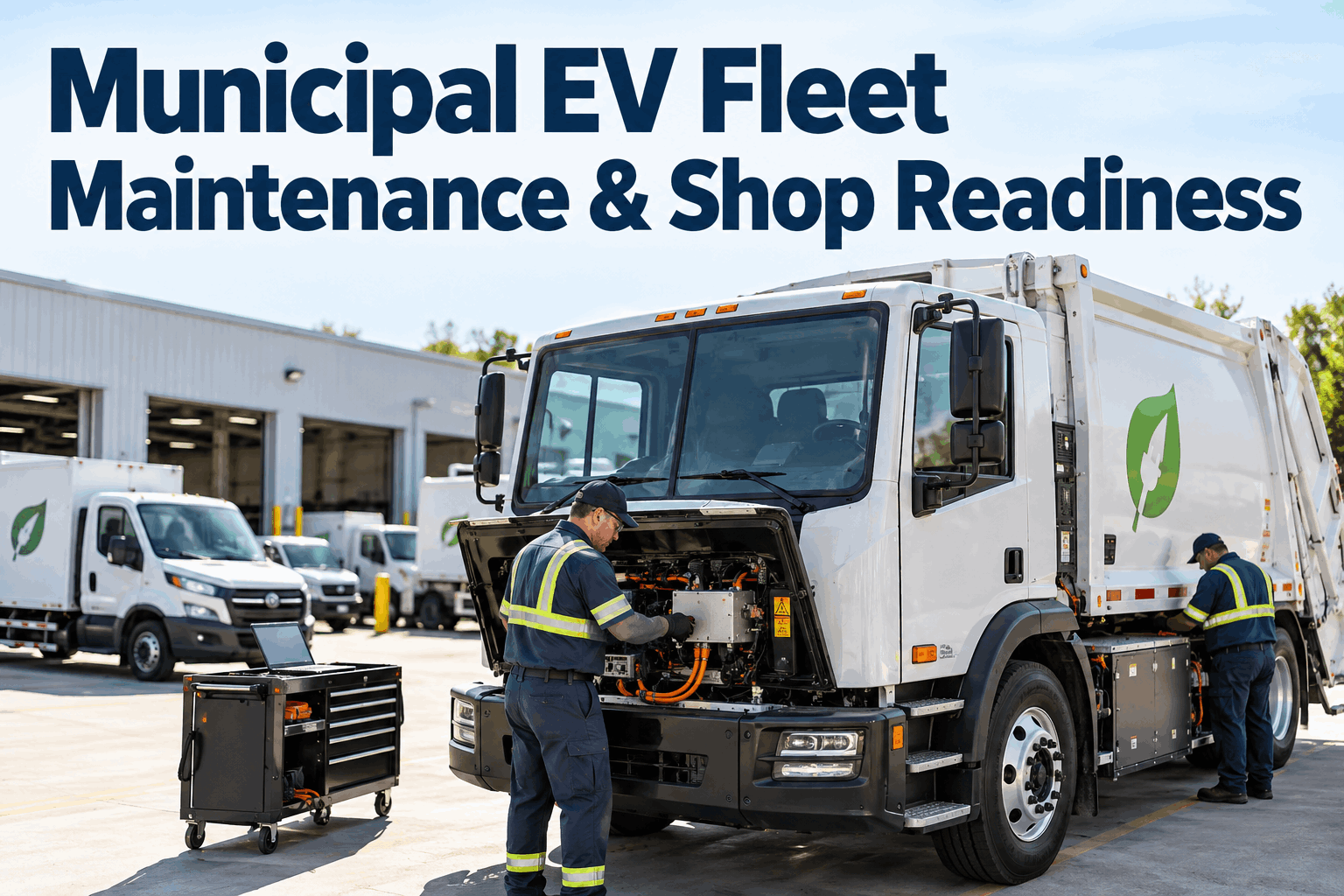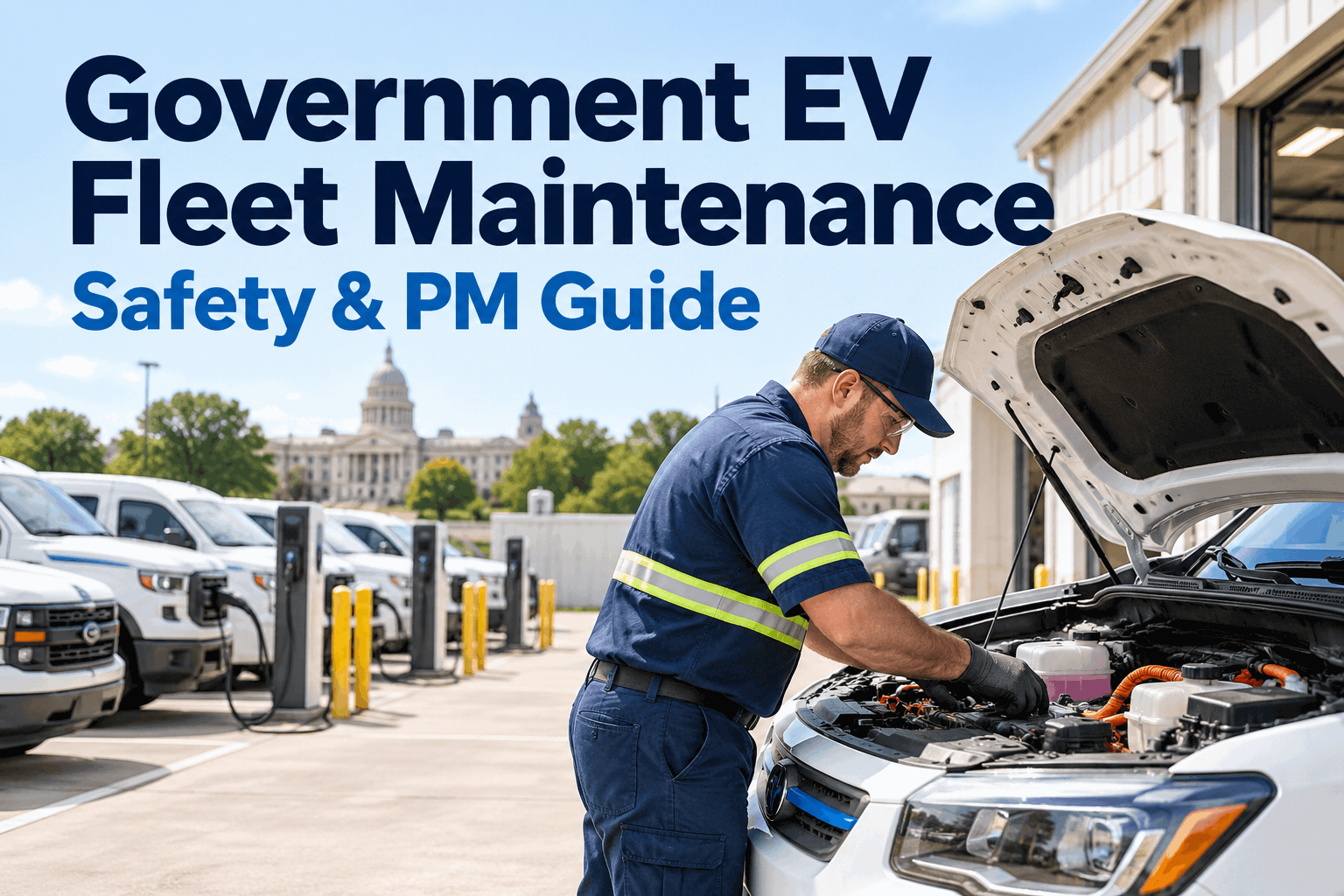
Government EV fleet maintenance changes more than the parts a technician replaces. A municipal shop that once planned oil changes and exhaust repairs now needs model-specific battery cooling checks, high-voltage safety procedures, tire and brake inspections, and technicians trained for the work they perform. This guide explains how to prepare a mixed-fleet workshop, build an electric vehicle preventive maintenance schedule, and keep service records useful for fleet directors and shop supervisors. Book a demo to review HVI EV preventive maintenance scheduling.
Government EV Fleet Maintenance: What Changes in the Shop?
Map the hazards. Assign qualified work. Schedule model-specific PM. Keep every vehicle's service history connected.
The shop changes in five specific ways
An EV is not a diesel truck with fewer maintenance tasks.
Hazard controls
High-voltage systems introduce electrical, stored-energy and thermal hazards. Establish task authorization, isolation procedures and emergency response before intrusive work.
Service intervals
Use the vehicle manufacturer's schedule for coolant, filters, brake fluid, reduction gear, battery-system checks and other components. Do not copy a diesel PM template.
Skills and equipment
Match technician training, insulated tools, test equipment and protective equipment to the actual task and applicable safety requirements.
Parts and consumables
Stock model-approved fluids, cabin filters, brake components and tires. Verify coolant specifications and handling rules before ordering.
Maintenance evidence
Record inspections, repair work, dates, mileage, observations and who performed each task. Keep safety decisions in the appropriate controlled procedure.
A fleet with electric sedans, light-duty vans and electric refuse trucks needs different checklists for each vehicle class. A single generic EV service interval can conceal important differences.
Inside an EV-ready service bay
A practical zoning illustration—not a substitute for a site-specific electrical safety assessment.
Tires, lights, wipers, visual inspections and approved service tasks
Authorized work, task-specific barriers, isolation and verification as required
Procedures, competent personnel, correct equipment and incident response
Start with the tasks your municipal workshop will perform in-house. Routine tire inspections and cabin-filter replacements are very different from opening a high-voltage battery enclosure. Define what is permitted, what requires additional qualifications, and what must go to the OEM or a specialist. Book a demo to organize EV service tasks and records
Build an EV preventive maintenance schedule by component
Intervals are vehicle- and duty-specific; this is a planning framework, not a universal service specification.
| System | What the shop should check | Planning trigger | Record to keep |
|---|---|---|---|
| High-voltage battery & cooling | Manufacturer-prescribed inspection, coolant condition or leakage checks; qualified diagnostics when indicated | OEM schedule, fault indication or observed condition | Inspection outcome, escalation, repair reference |
| Tires & alignment | Pressure, tread, wear pattern and alignment concerns; account for vehicle weight and torque characteristics | Routine inspection and wear condition | Tread readings, tire position, corrective action |
| Friction brakes | Corrosion, pad/rotor condition, hydraulic fluid and manufacturer-prescribed service | OEM interval and inspection findings | Brake inspection, fluid service, work order |
| Reduction drive & driveline | Leaks, noise and prescribed lubricant service where applicable | OEM interval and condition | Service date, findings, parts |
| Low-voltage electrical & HVAC | 12 V system, cabin filtration, heating/cooling operation and fault reports | Calendar, mileage, faults | Inspection checklist and follow-up |
| Charging interface | Visual damage, contamination, connector condition and reported charging faults | Pre-use checks, incidents, faults | Defect report and escalation |
Some EVs have fewer fluid-service tasks than combustion vehicles, but they still require inspections, wear-item maintenance and condition-based follow-up. For government EV fleet maintenance, schedule adherence matters more than assuming all electric models share one checklist. Sign up free to organize model-specific EV PM schedules
EV versus diesel: what disappears, what stays, what is new
Use this comparison to revise workshop procedures—not to assume EV maintenance is universally cheaper.
Regenerative braking may reduce friction-brake use, but low use can also make corrosion checks important. Similarly, tire wear depends on vehicle weight, torque, route and driving style—not simply whether a vehicle is electric.
Who is ready to do which task?
A technician-readiness matrix keeps qualifications aligned with the work—not just the job title.
Illustrative responsibility mapping only. Qualifications and permitted tasks must follow applicable laws, OEM instructions and site safety procedures.
Maintain an approved task matrix alongside training evidence and the current service procedure. Do not let a technician's general mechanical experience stand in for high-voltage authorization. HVI can support the maintenance record and task assignment context; your safety program must determine authorization.
How HVI fits a mixed municipal EV fleet
The maintenance system should preserve operational evidence without pretending to replace specialist diagnostics.
Vehicle ID, class, mileage and service requirements
OEM-based service due dates and inspection tasks
Observed tire wear or charging complaint documented
Repair assignment, completion details and history
Overdue PM, recurring defects and service costs
Government shops often operate EVs alongside diesel pickups, buses and specialized equipment. A consistent asset record helps supervisors see what's due without forcing every vehicle into the same checklist. Use maintenance history to discuss workload, parts demand, repeat defects and whether an outside service provider is needed. Book a demo to see HVI mixed-fleet maintenance reporting
A 90-day shop-readiness rollout
Start with the first vehicles and actual service responsibilities; expand only when the process is reliable.
Inventory vehicles and tasks
List EV models, OEM schedules, existing shop capabilities, safety requirements and outside-service arrangements. Identify tasks not yet authorized in-house.
Train, equip and schedule
Approve procedures, assign training, verify tools and emergency arrangements, and build model-specific PM plans for the first EV cohort.
Review every missed service
Audit inspection completion, overdue PM, repeat defects and vendor turnaround. Revise schedules and escalation rules from observed results.
Track a small set of operational measures: percentage of EV PM completed on time, overdue critical items, days awaiting outside service, repeat defect frequency and technician qualification coverage. Compare vehicles within similar classes and duty cycles. Sign up free to start tracking EV preventive maintenance
EV fleet maintenance checklist for government shops
Use this as a management review list, then adapt it to your vehicle models and local safety requirements.
Before the first EV service
- Confirm the OEM maintenance schedule for each model.
- Define routine, restricted and outsourced tasks.
- Approve electrical safety and emergency procedures.
- Verify technician qualifications and required equipment.
Every maintenance cycle
- Review upcoming PM by date, mileage or other applicable trigger.
- Complete inspections and document defects.
- Escalate charging, battery or HV-related faults appropriately.
- Close work orders with findings and service evidence.
Every monthly review
- Investigate overdue PM and repeat repairs.
- Check parts availability and specialist turnaround.
- Review tire, brake and thermal-system issues.
- Update training gaps and vehicle-specific procedures.
Government EV fleet maintenance: common questions
Answers for municipal maintenance managers and fleet directors.
What is different about government EV fleet maintenance?
Battery-electric vehicles remove many engine and exhaust maintenance tasks, but still need tires, brakes, steering, suspension, HVAC and inspections. They also require model-specific thermal-system maintenance, charging-related fault processes and appropriate high-voltage safety controls.
Do electric fleet vehicles need preventive maintenance?
Yes. Follow the vehicle manufacturer’s maintenance schedule and any applicable regulatory requirements. The schedule may cover tires, brakes, fluids, cooling systems, filters, software-related service actions and periodic inspections.
Can a regular municipal mechanic work on an EV?
A technician may perform tasks within their training and authorization, but high-voltage isolation, diagnosis or intrusive battery work requires the qualifications and procedures appropriate to the task. Do not assume all EV work is safe for untrained personnel.
How should a government fleet plan EV shop readiness?
Inventory vehicles and tasks, define work that will be performed in-house, assess hazards, establish procedures and emergency arrangements, train staff, procure approved equipment and build vehicle-specific PM schedules before scaling the fleet.
How can HVI help manage EV fleet maintenance?
HVI can support vehicle asset records, preventive maintenance scheduling, inspections, work orders and maintenance history for a mixed fleet. It should not be treated as a replacement for OEM battery diagnostics, electrical safety procedures or specialist technician training.