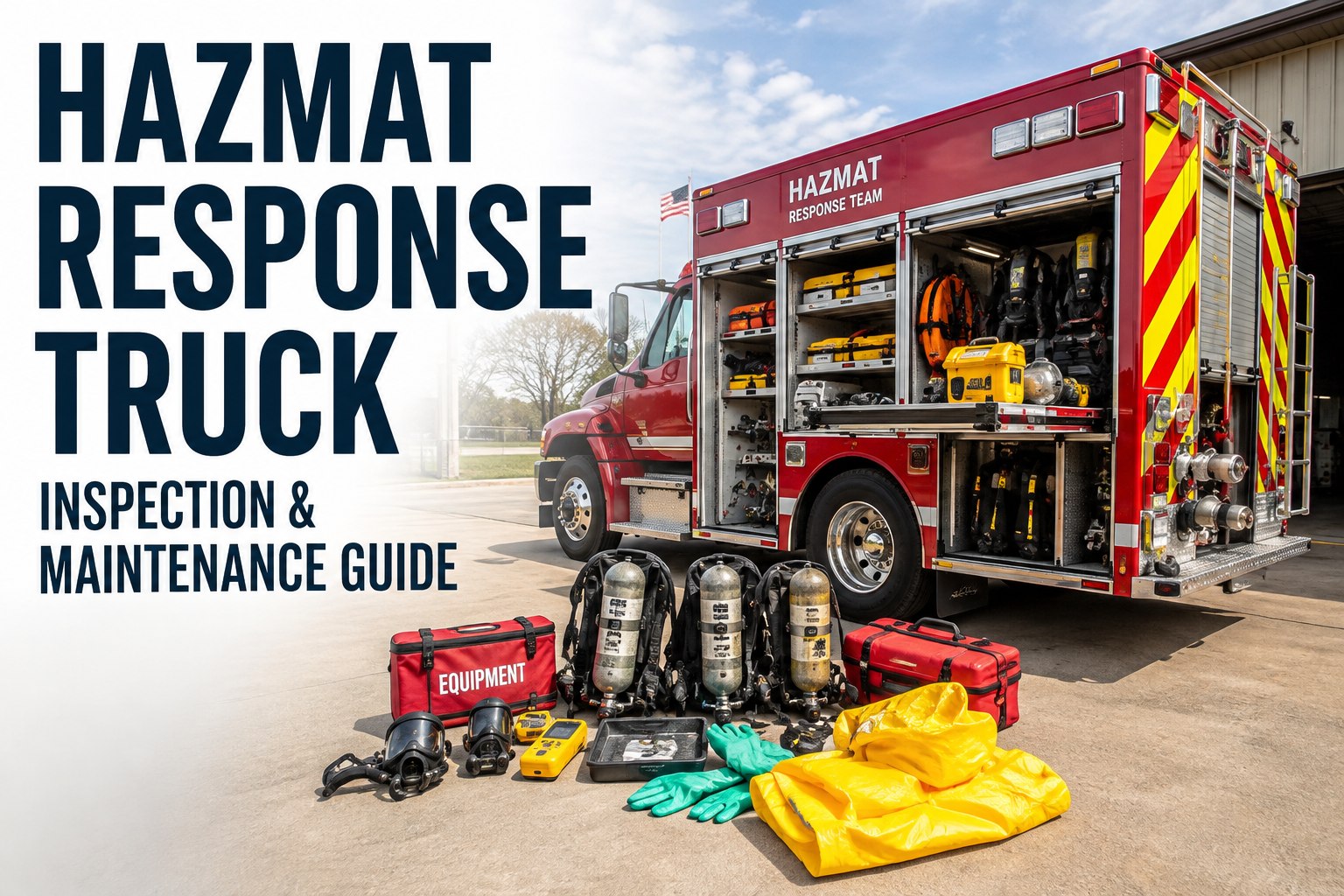
A hazmat response truck is a rolling equipment locker for a very specific kind of bad day. Every compartment carries something that has to work the first time — gas monitors, SCBA bottles, decon, containment, patch kits. Hazmat response truck inspection is not a walkaround. It's a documented verification that every locker is ready for the tone that hasn't dropped yet. Miss one calibration, one expired cartridge — and the incident escalates while your crew waits in staging for mutual aid. Book a demo
Hazmat Response Truck Inspection & Maintenance
Not a hauling rig. A response rig. The inspection discipline is completely different — and higher-stakes.
The truck backs into a highway spill or a warehouse leak. The IC calls for a 4-gas reading before entry. The tech pulls the monitor, hits the power button, and the calibration due date reads three months ago. That's the moment nobody wants — and it's the moment paper daily-check sheets, taped to a clipboard in the cab, quietly created six weeks ago. Digital, timestamped, audit-ready equipment records aren't administrative overhead for response fleets. They're the equipment.
The response-truck locker map
A hazmat rig isn't one asset — it's fifty. Each compartment is a mini-inventory with its own readiness state, expiration dates, and inspection cadence. A defensible hazmat vehicle checklist walks the truck compartment by compartment, not head to tail. Below is how most Type I hazmat response fleets structure the walk.
Respiratory protection
- SCBA cylinder pressure ≥ 4,000 psi (2,216 or 4,500 rated)
- Facepiece straps, lens, exhalation valve intact
- PASS alarm function test
- APR/PAPR cartridge expiration & seal condition
- Spare cylinder count matches rig loadout sheet
Chemical PPE ensembles
- Level A suits: seal integrity, glove & boot attachment, expiration date
- Level B splash suits: quantities per rig loadout, sizes stocked
- Chemical gloves & overboots — expiration & tear inspection
- Tape, tags, and doffing tools staged
- PPE decon-ready storage bags on rig
Gas detection & monitoring
- 4-gas monitor: bump test current, calibration in-date
- PID: lamp condition, calibration log
- Colorimetric tubes: quantity, expiration dates per tube
- Radiation detection: battery, source-check current
- Wind meter, thermal imager battery & function
Containment & spill control
- Absorbent booms, pads, socks — quantities per loadout
- Plug-and-dike, epoxy putty — expiration dates
- Overpack drums, salvage drums — count & condition
- Patch kits: A/B/C, mag patches, banding equipment
- Non-sparking hand tools, brass hammers, drum wrenches
Decontamination equipment
- Decon pools, showers, wands — setup & function
- Decon solutions, brushes, tarps — quantity check
- Runoff containment & disposal supplies
- Warm zone drying & re-dress area supplies
- Chemical waste bags, disposal drum, labels
Reference & documentation
- DOT Emergency Response Guidebook (current edition)
- NIOSH Pocket Guide, WISER access
- Chemical compatibility charts, SDS binder
- ICS forms 201, 208, 214 pre-staged
- Site safety plan template & entry logs
Communications & scene lighting
- Portable radios: battery, channel program, spare batteries
- Intrinsically safe radios where required
- Scene lighting: generator function, cord condition, GFCI test
- Warning beacons, cones, scene tape stock
- Command board, whiteboard markers, weather station
Carrier vehicle & chassis
- Full DVIR: brakes, tires, lights, mirrors, wipers
- Fuel >3/4, DEF topped, coolant & oil in-range
- Onboard air/hydraulic systems, PTO function
- Roof access, extendable mast, boom function
- Cab climate, defrost, radio, mobile data terminal
The pattern that matters: every locker has a defined content list, a defined inspection cadence, and a documented owner. Rigs that skip the locker-by-locker walk in favor of a "does everything look ok" pass are the rigs whose Level A suits expire in the bag. Book a demo to see per-compartment digital checklists
Inspection frequency — what's checked when
Different items on the rig have wildly different check intervals. A 4-gas monitor gets touched before every shift. An SCBA cylinder gets hydrostatic testing every five years. Treating them on the same schedule — either over-inspecting the cylinder or under-inspecting the monitor — is where paper systems fail. This is the tiered cadence most departments run against.
4-gas monitor bump test (ISEA guidance), SCBA pressure check, PASS alarm, radio & battery, cab & chassis walkaround (DVIR). If any item fails, unit is out of service until corrected. This is the check that catches the calibration-expired-three-months-ago moment before the tone drops.
Full locker walk: quantities against the rig loadout sheet, expiration date review, seal & storage condition. Consumables that fell below par level during the week are re-ordered. Any suit, boot, or glove past date is pulled and replaced.
Generator run under load, scene lighting cords tested, decon pump prime & flow test, containment tools inventoried and function-checked, thermal imager charge cycle, colorimetric tube expiration audit. Reference materials replaced with current editions where updated.
4-gas monitors full calibration per manufacturer minimum (MSA and similar OEMs specify 6-month floor). PID lamp cleaning & response check. Radiation instrument source check & certificate refresh. All calibration certificates filed against the specific serial number.
SCBA facepiece fit-test (annual per OSHA 1910.134), SCBA flow test (annual), Level A suit visual & pressure test per manufacturer, SCBA cylinder hydrostatic test (5 yr for carbon-wrapped, 3 yr for aluminum), fire extinguisher hydro cycles, generator load bank test.
The five tiers stack. A department running only the daily and annual checks — skipping weekly, monthly, and semi-annual — will still fail an audit and, worse, discover the gap at the scene. Start free and layer all five tiers into one system
OSHA HAZWOPER & NFPA 470 — the compliance floor
Two documents govern the readiness of a hazmat response rig in the U.S. OSHA 29 CFR 1910.120 (HAZWOPER) covers hazardous waste operations and emergency response — including gas monitor use for atmospheric hazards during response, training requirements for responders, and medical surveillance. NFPA 470 (Hazardous Materials Standards for Responders, current 2022 edition) is the consolidated consensus standard that replaced NFPA 472, 473, and 1072 — it covers competencies and equipment expectations from Awareness through Technician and Incident Commander levels.
Neither standard prescribes a single universal inspection schedule — both defer to manufacturer instructions and Authority Having Jurisdiction (AHJ) policy. That's important: the inspection program is the department's to define, but the documentation showing it was executed on a specific unit on a specific date is the department's to defend. Missing records don't just look bad in an audit — in the event of a responder injury or incident review, they become the case. Book a demo to see AHJ-configurable inspection templates
The five failures that end a mission
Response fleets that have run post-incident reviews across multiple events see the same handful of failure patterns repeat. Different departments, same list.
Sensor drift went unchecked, calibration due date slipped, and no one caught it until the scene. First entry gets delayed while mutual aid brings a working monitor.
Suits stored in the bag were never rotated. On dress-out, the tech notices a manufacturing date beyond the maker's recommended life. Suit unusable, mutual aid needed.
Cylinder charged after last use but pressure has bled off, or hydro sticker shows past due. Bottle is out of service, spare inventory doesn't cover the tech count.
Absorbent boom count is short from the last spill. Plug-and-dike epoxy is expired. Colorimetric tube for the identified chemical is missing from the bin.
The rig itself — brakes, battery, generator not starting on scene. The "vehicle" part of the vehicle inspection gets forgotten because the focus is on the equipment.
Every one of these is preventable at a check that should have happened days or weeks earlier. That's what a digital system is actually for: not extra work, but making sure the check that was supposed to happen actually did. Book a demo to see the readiness board , or start free and never miss a check again.
From a hazmat team leader who kept the paper for years
Our rig checks used to live in a three-ring binder in the cab. Every shift the crew signed off, and every quarter I'd audit — and every quarter I'd find missing signatures, back-dated entries, or checks that clearly weren't done because the item they were checking had been out of service for weeks.
Moving to a digital equipment record wasn't about tech — it was about integrity. Now every serial number has its own record. Calibration due dates alert the crew before they lapse. When a Level A suit expires, it doesn't sit in the bag another six months. The dispatcher can see rig readiness in one screen before the tones drop.
Frequently asked questions
How often should a hazmat response truck be inspected?
A defensible hazmat response fleet inspection program runs on five tiers because different items on the rig have very different check cadences. Daily or shift-start checks cover front-line readiness: 4-gas monitor bump test (per ISEA guidance, before each day's use), SCBA cylinder pressure and PASS alarm function, radio and battery, and a full DVIR-style walkaround of the carrier vehicle. Weekly checks are compartment inventory walks — quantities against the rig loadout sheet, expiration date review, storage condition. Monthly checks are function and deep-check items: generator under load, scene lighting, decon pump flow, thermal imager charge cycle, colorimetric tube expiration audit. Semi-annual (roughly every 6 months) covers instrument calibration — 4-gas full calibration per manufacturer minimum, PID lamp check, radiation instrument source check. Annual and multi-year covers certification cycles: SCBA fit-test (annual per OSHA 1910.134), SCBA flow test, SCBA cylinder hydrostatic test (5 years for carbon-wrapped, 3 years for aluminum), Level A suit visual and pressure test per manufacturer, and fire extinguisher hydro. Actual intervals should follow the manufacturer instructions and department AHJ policy for each specific item rather than a single universal schedule.
What equipment must a hazmat response truck carry?
A Type I hazmat response rig typically carries equipment across eight compartments. Respiratory protection: SCBAs, spare cylinders, APR/PAPR with cartridges, facepiece storage. Chemical PPE: Level A vapor-tight suits, Level B splash suits, chemical gloves and overboots, tape and doffing tools. Gas detection and monitoring: 4-gas monitor (LEL, O2, CO, H2S at minimum), photoionization detector (PID), colorimetric detector tubes, radiation detection, wind meter, thermal imager. Containment and spill control: absorbent booms, pads, and socks, plug-and-dike and epoxy putty, overpack and salvage drums, patch kits (A/B/C, mag patches), non-sparking hand tools. Decontamination equipment: decon pools, showers, wands, decon solutions and brushes, runoff containment, waste disposal supplies. Reference and documentation: DOT Emergency Response Guidebook current edition, NIOSH Pocket Guide, chemical compatibility charts, SDS binder, ICS forms. Communications and scene lighting: portable radios (intrinsically safe where required), generator, scene lights, warning beacons, command board. And the carrier vehicle itself: full DVIR items plus PTO, roof access, and any boom or mast systems. Exact loadout is set by the AHJ and department response profile.
What OSHA and NFPA standards apply to hazmat response operations?
Two primary standards govern U.S. hazmat response fleet operations. OSHA 29 CFR 1910.120 (HAZWOPER — Hazardous Waste Operations and Emergency Response) sets training requirements for responders (Awareness, Operations, Technician, Specialist, Incident Commander levels), medical surveillance requirements, PPE selection and use, atmospheric monitoring during response, and post-emergency decontamination procedures. Paragraph (c)(6) specifically references atmospheric monitoring instruments. NFPA 470 (Hazardous Materials Standards for Responders, 2022 edition) is the current consolidated consensus standard combining what were previously NFPA 472, 473, and 1072 — it covers professional qualifications and competencies for response personnel at every level. Other relevant references include OSHA 29 CFR 1910.134 (Respiratory Protection Standard) covering SCBA fit-testing and program requirements, and NFPA 1852 for SCBA selection, care, and maintenance. None of these standards prescribes a single universal inspection schedule for response vehicles or equipment — they defer to manufacturer instructions and department AHJ policy, which makes the department's documented inspection program the reference standard in any post-incident review.
How often should a 4-gas monitor be calibrated?
The industry consensus, per ISEA (International Safety Equipment Association) guidance referenced by OSHA, is that a bump test or full calibration of direct-reading portable gas monitors should be conducted before each day's use in accordance with the manufacturer's instructions using an appropriate test gas. In practice most departments perform a bump test daily (a functional check that exposes the sensor to a known concentration and verifies the alarm) and a full calibration on a scheduled interval. Manufacturers of common 4-gas monitors such as MSA typically specify a full calibration every 6 months minimum, with more frequent intervals for high-use or high-risk environments. If a bump test fails, the monitor must go through a full calibration before returning to service. Calibration gas should be NIST-traceable, and every calibration event should be logged against the specific instrument serial number with the technician's signature, the gas cylinder lot, and the pass/fail result. That log is the record that satisfies OSHA's expectation of documented instrument maintenance under 29 CFR 1910.120(c)(6) and confined space entry standards under 29 CFR 1910.146(c)(5)(ii)(C).
Can a CMMS help manage hazmat response fleet inspections?
Yes — and for hazmat response fleets specifically it addresses the exact failure modes that end missions. HVI captures every piece of equipment on the rig by serial number, tracks calibration due dates and PPE expiration dates with automated alerts before they lapse, digitizes daily and weekly compartment inspections with photos of any defect, auto-generates work orders when an inspection item fails, tracks parts and consumables so plug-and-dike, absorbent booms, and cartridges are re-ordered when they fall below par level, and maintains an audit trail with timestamps and digital signatures for every check. The dispatcher's readiness board shows in one view which rigs are fully in-service, which have deferred defects, and which items are approaching expiration. For post-incident review, insurance carrier questions, and OSHA or AHJ audits, the record of every inspection on every unit is one export away instead of a three-ring binder in the cab. The system doesn't replace responder judgment — it makes sure the checks that were supposed to happen actually did, and that the equipment on the rig at 3am is genuinely ready.
The first scene shouldn't be where you find the gap
A hazmat response truck that isn't inspection-current is a rig that becomes a liability the moment it rolls. HVI turns paper rig-check binders into a connected system for equipment records, calibration tracking, PPE expiration, PM, and audit-ready documentation across every response unit in your fleet. Live in under two weeks.
No credit card · No hardware · Setup in minutes