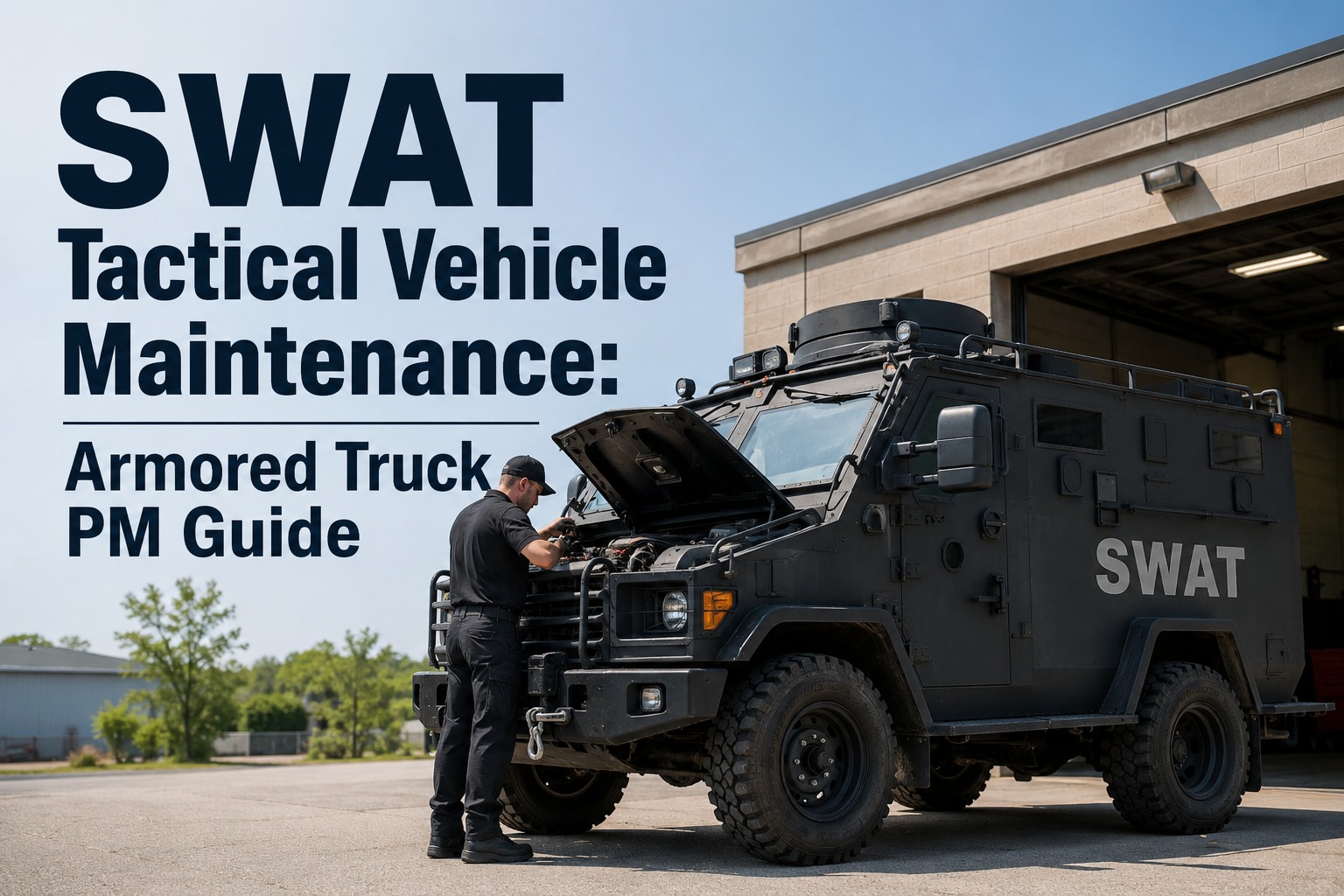
A BearCat that will not start when the callout comes in is not a maintenance problem — it is an operational failure. SWAT tactical vehicle PM for armored trucks like the Lenco BearCat G3, MRAPs, and armored personnel carriers demands a different discipline than a standard fleet truck: armor plate integrity checks, run-flat tire cycling, ballistic glass inspection, and severe-duty engine intervals on the 6.7L Power Stroke. Most tactical fleets still run this on paper binders and group chats, which is exactly why gaps appear. If your tactical fleet maintenance program is due for a rebuild, book a walkthrough of the HVI tactical template and see what a purpose-built SWAT truck CMMS looks like on your own units.
TACTICAL FLEET MAINTENANCE
Purpose-built preventive maintenance for SWAT armored trucks
Lenco BearCats, MRAPs and armored rescue vehicles operate under severe duty with armor, run-flats and gun ports that standard fleet PM templates do not cover. HVI tracks every tactical-specific interval in one cloud + mobile system.
THE REALITY OF TACTICAL UPTIME
What tactical fleet downtime actually costs your team
Armored trucks are low-mileage, high-consequence assets. They may roll only a few hundred miles a year, but every one of those miles is severe duty — and when a callout comes, the truck has to start, steer and stop with zero warning.
A tactical fleet of eight armored trucks running on paper DVIRs and spreadsheets typically loses six to ten unplanned shop-days a month to defects that were caught late or never logged. At a blended cost of $1,800 per lost operational day, that is $10,800 to $18,000 a month in exposure — before you count the risk of deploying a truck with a seized gun-port lock or a run-flat insert that has silently delaminated. See how HVI recovers those days — book a 30-minute demo and we will run the numbers on your own fleet.
TACTICAL-SPECIFIC PM CHECKLIST
SWAT tactical vehicle PM checklist: what standard templates miss
A standard commercial truck inspection form does not ask whether the ballistic glass is delaminating or whether the gun-port locks cycle cleanly. The checklist below is the baseline HVI loads into every tactical vehicle template — grouped by interval, not by system, so nothing falls through the cracks.
Before every deployment
- Run-flat tire visual and pressure check on all four corners
- Ballistic glass walk-around for cracks, stars and delamination
- Gun-port lock function test — open, close, lock from inside
- Tire tread depth and sidewall damage on all six tires
- Door hinge and latch operation on armored crew doors
- Fluid leak check — engine, transmission, axles, hydraulic ram
Specialty system cycling
- Thermal camera calibration and lens housing seal check
- Run-flat insert removal, inspection and re-seating
- Hydraulic ram and breaching tool cycle test
- Rotating light bar, siren and comms antenna integrity
- Battery load test and dual-alternator output check
- Severe-duty 6.7L PSD oil and filter service
Armor and structural integrity
- Armor plate integrity inspection — all panels and welds
- Ballistic glass certification review and edge-seal check
- Door and hatch armor gap measurement
- Floor plate inspection for deformation and corrosion
- Chassis and suspension torque audit under armor load
- Full driveline fluid analysis — engine, trans, diffs
These intervals are not theoretical. The armor plate integrity annual is the single most commonly lapsed inspection on gov armored fleets because it does not tie to mileage — it ties to calendar date, and calendar-based PM is exactly where paper systems fail. Start logging tactical inspections free with HVI and every one of these intervals is tracked, alerted and auditable.
PAPER VS PURPOSE-BUILT CMMS
Paper binders vs a SWAT truck CMMS: where the gaps kill readiness
Most tactical fleets do not have a CMMS problem — they have a visibility problem. The inspection gets done, the form goes in a binder, and nobody sees it again until something fails on a callout. The table below maps the exact gap between a paper-and-spreadsheet process and a tactical vehicle CMMS.
| PM Task | Paper binder + spreadsheet | HVI tactical CMMS |
|---|---|---|
| Armor plate integrity (annual) | Date-based, easy to miss. No alert when overdue. Proved only by finding the paper form. | Calendar-based PM with due and overdue alerts. Photo-backed record searchable in seconds. |
| Run-flat tire check (pre-op) | Verbal confirmation or unchecked box. No photo evidence of insert condition. | Mobile DVIR with mandatory photo capture. Defect auto-creates a work order. |
| Gun-port lock test | Logged as "OK" on a clipboard. No record of who tested, when, or the result. | Timestamped pass/fail with technician ID. Failed test blocks deployment clearance. |
| Thermal camera calibration (6 mo) | Tracked on a whiteboard. Often discovered during pre-deployment, not ahead of it. | PM trigger at exactly 180 days. Vendor calibration certificate uploaded to asset record. |
| 6.7L PSD severe-duty PM | Oil change logged in a spreadsheet. Filter part number and torque spec not captured. | Severe-duty PM template with parts, torque specs and labor time. Full service history per unit. |
| Audit readiness | Hours of pulling binders. Gaps and missing forms discovered during the audit itself. | Every inspection, work order and photo exportable in one report. Audit-ready in under a minute. |
The difference is not just convenience — it is readiness. A tactical fleet that cannot prove its last armor inspection is a fleet that cannot deploy with confidence. Walk through the HVI tactical template on a live demo and see how every one of these gaps closes.
BEARCAT G3 PM DEEP DIVE
Lenco BearCat G3 maintenance: the intervals that matter most
The Lenco BearCat G3 is the most common armored truck in North American tactical fleets, and it has a handful of failure modes that do not exist on a standard truck. Knowing them — and tracking them — is the difference between a truck that deploys and one that sits in the bay.
Armor plate integrity — annual
Every welded and bolted armor panel on the BearCat G3 needs a documented visual and tap-test inspection at least once every 12 months. The failure mode is not catastrophic penetration — it is edge separation and hairline cracking around welds that compromises the plate rating. HVI triggers this PM by calendar date, not mileage, and requires a photo of each panel before the work order can be closed.
Run-flat tire system — pre-op and 6-month
The BearCat G3 rides on run-flat inserts that allow limited mobility after a tire is deflated. Pre-operation, the check is visual and pressure-based. Every six months, the inserts should be removed, inspected for delamination and re-seated. Most fleets skip the removal step because it is labor-intensive — and that is exactly when a delaminated insert turns a rolling truck into a three-wheeled one. HVI tracks both intervals separately on the same asset.
Gun-port lock test — quarterly
Gun ports are simple mechanical locks, but they seize from disuse, grit and lubricant breakdown. A port that will not open is a tactical problem; a port that will not lock is a safety problem. The quarterly test cycles every port from inside the cabin — open, close, lock — and logs pass or fail per port. HVI captures the result per port, not just per truck, so you know exactly which unit has a sticking port.
6.7L Power Stroke — severe duty PM
The 6.7L PSD in the BearCat G3 runs a severe-duty profile: short run cycles, long idle periods, and heavy auxiliary load from lights, comms and hydraulic systems. Oil and filter intervals are shorter than a patrol truck, and fuel filter condition is critical because the truck may sit for weeks. HVI's severe-duty PM template includes oil, both fuel filters, air filter inspection, DPF status check and full fluid level audit — all triggered by engine hours or calendar, whichever comes first.
Tracking all four of these on paper is technically possible. Tracking them so that a safety officer can pull a complete readiness report in under a minute is not. Book a demo and see the BearCat template live — we will load one of your actual unit numbers and run an inspection end to end.
HOW HVI HELPS
HVI for SWAT tactical vehicle fleet maintenance
Four capabilities that directly map to the gaps in a typical gov armored fleet — and the measurable outcome each one delivers.
Tactical-specific DVIR with photo capture
Digital inspection forms built for armored trucks — run-flats, gun ports, ballistic glass, armor panels. Every defect requires a photo before submission, and every defect auto-generates a work order. No more text-message photos to the shop phone.
Calendar and engine-hour PM triggers
Armor inspections, thermal calibrations and severe-duty oil changes do not tie to odometer mileage. HVI triggers PM by calendar date, engine hours, or whichever comes first — with due and overdue alerts that reach the shop foreman and the fleet manager simultaneously.
Audit-ready records in one export
Every inspection, work order, photo and calibration certificate lives on the asset record. When your safety officer or an external auditor asks for the last 12 months of armor plate inspections, you export one report — timestamped, photo-backed, with technician ID on every entry.
Specialty parts and inventory across shops
Run-flat inserts, ballistic glass, gun-port locks and severe-duty filters are long-lead-time parts. HVI tracks stock levels across multiple shops, sets reorder points, and ties parts consumption directly to the work order — so you always know what is on the shelf and where it went.
THE WORKED EXAMPLE
What an 8-unit tactical fleet actually saves in the first year
A concrete example, based on the numbers that real tactical fleets report when they move off paper. Take a fleet of eight Lenco BearCat G3s and MRAPs running on a mix of paper DVIRs, spreadsheets and group chats.
That is a conservative figure — it does not include the insurance and compliance exposure of deploying a truck with a lapsed armor inspection, or the labor hours your shop spends pulling binders for an audit. Book a demo and we will build this same model with your fleet numbers, your truck count and your actual cost-per-day.
KEY TAKEAWAYS
SWAT tactical vehicle PM: what to act on now
Move armor plate integrity inspections off mileage-based tracking. They are calendar-based — 12 months maximum — and they are the first thing an auditor asks for. If you cannot produce the record in under a minute, you have a gap.
Run-flat inserts need both a pre-op visual check and a 6-month removal inspection. Visual-only is how delaminated inserts stay hidden until a tire goes down on a callout and the truck does not roll the way it should.
Gun-port lock tests and thermal camera calibrations are the two PM tasks most often discovered late. Both are calendar-based, both have real tactical consequences, and both are trivial to track in a CMMS — and invisible in a binder.
The 6.7L PSD in a BearCat G3 runs severe duty. If your PM template does not say "severe duty" and does not trigger by engine hours, you are running patrol-truck intervals on an armored truck — and that shortens component life.
Specialty parts — run-flat inserts, ballistic glass, gun-port lock assemblies — have long lead times. If your inventory system does not set reorder points on these, you will pay expedited freight or wait two weeks during a critical repair.
Audit readiness is not about doing the inspections — you are probably doing them. It is about proving you did them, with photos, timestamps and technician IDs, in a format a safety officer or external auditor can read in seconds.
We had three BearCats pass their armor inspection on paper, but when the state audit hit, two of the three forms were in a binder nobody could find. Now every panel inspection has a photo, a timestamp and a name on it in HVI, and I can pull all eight trucks in one report before the auditor finishes their coffee. The thing I personally track now is the overdue PM count — it has been at zero for six months.
FAQ