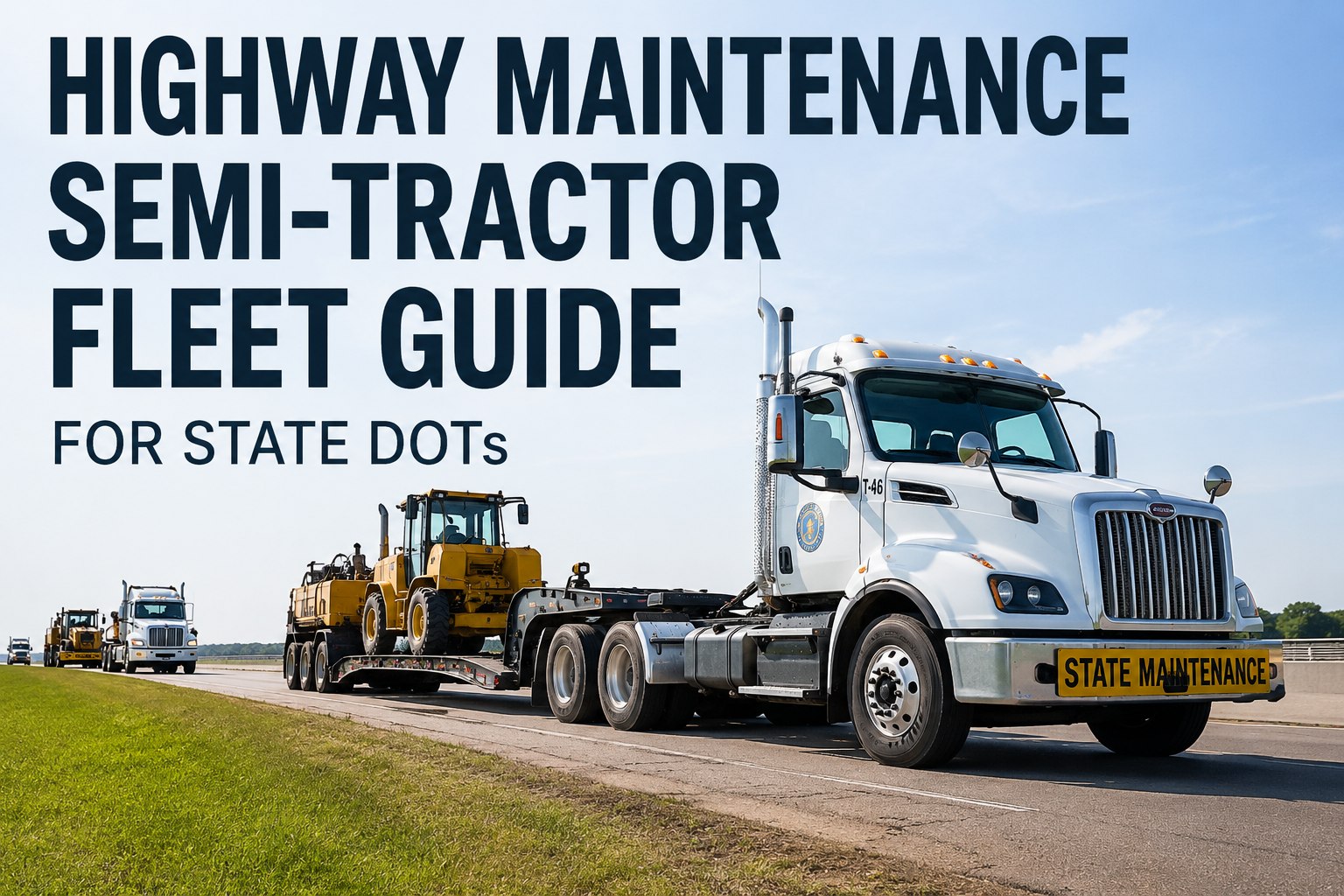
A state DOT highway maintenance semi-tractor fleet doesn't look like a commercial for-hire carrier. Same Class 8 tractors, but the mission is different: hauling asphalt, transporting graders and mills to and from job sites, hauling water and de-icing brine, and pulling plow trailers through winter. The maintenance discipline that keeps a linehaul carrier profitable doesn't map cleanly to a fleet that sits idle in July and runs 20 hours a day in January. This 2026 state DOT semi-tractor fleet guide walks the seasonal duty cycle, the FMCSA compliance layer that still applies, and the digital inspection workflow that fits. Book a demo .
Four Missions, One Class 8 Fleet — How State DOTs Actually Run Semi-Tractors
Same tractors, four completely different duty cycles across the year. The PM schedule that works in July doesn't survive January.
State DOT highway maintenance fleets sit in a category that doesn't fit standard commercial fleet templates. They operate the same Class 8 tractors as regional carriers — Freightliner, Kenworth, Peterbilt, Volvo, International — but the utilization pattern, load types, and operating environment are all different. Utilization is heavily seasonal. Loads shift from bulk material to oversize equipment to hazmat-adjacent (brine) across the year. Operating environment includes both interstate highway and off-pavement access to job sites and equipment yards. And the fleet still operates under the same FMCSA safety regulations as private carriers — 49 CFR Part 396 inspection and maintenance rules apply to a state DOT dump-truck operation as much as to a commercial for-hire trucking company.
The FMCSA layer that still applies to state DOT fleets49 CFR §§ 396.3, 396.11, 396.13, 396.17 apply regardless of ownership
A common misconception in state DOT maintenance shops is that "we're the DOT, we don't have to worry about DOT rules." State-owned CMVs used in interstate commerce (and often intrastate, per state adoption) are subject to the same FMCSA safety regulations as any commercial operator. Compliance is often audited by the state's own regulatory arm, but the underlying rule set is federal. Book a demo to see 49 CFR Part 396 workflows in HVI
§ 396.3 — Systematic PM program
Every motor carrier must "systematically inspect, repair, and maintain, or cause to be systematically inspected, repaired, and maintained, all motor vehicles" subject to its control. FMCSA doesn't dictate the specific PM contents or intervals — that's the fleet's responsibility to define and document.
§ 396.11 — DVIRs
Driver Vehicle Inspection Reports at end of each day's work when defects are found. Property-carrying CMVs (which includes most state DOT vehicles) don't require a DVIR on no-defect days since the 2014 rule change, but many state DOTs require them anyway as internal policy.
§ 396.13 — Pre-trip inspection
Driver must review previous DVIR before departure and be satisfied the vehicle is safe to operate. Pre-trip inspection under § 392.7 covers 11 categories of parts and accessories. Same requirement for state DOT drivers as commercial CDL drivers.
§ 396.17 — Annual DOT inspection
Annual inspection required for every CMV, meeting the minimum standards in Appendix G. Can be performed by a qualified inspector meeting § 396.19 requirements. State DOT shops often have qualified inspectors in-house; others contract to certified inspection facilities.
§ 396.21 — Records retention
PM records, inspection records, and repair records retained for the duration of the fleet's ownership plus a minimum of 6 months after transfer or disposal. Longer retention typical for state DOT fleets under civil-service records rules.
State-specific overlays
Many states adopt additional inspection or maintenance standards for state-owned fleets beyond FMCSA baseline — state fleet management manuals, environmental compliance for anti-idle policies, safety training requirements. State DOT maintenance programs typically layer these on top of the FMCSA floor.
Where the seasonal duty cycle breaks standard PM schedulesMileage triggers miss what condition triggers catch
A standard mileage-based PM schedule assumes consistent utilization. State DOT fleets don't have that. A tractor pulling brine tankers through 20-hour storm shifts in January accumulates wear that doesn't map to accumulated miles — it's engine hours, hydraulic cycles, brake heat events, corrosion exposure. Mileage-only PM misses this systematically.
Short-shuttle brake wear
Heavy-load drivetrain stress
Off-pavement undercarriage damage
Salt corrosion + brake freeze-ups
The 6 recurring maintenance failures on state DOT semi-tractorsWhat breaks at scale on highway maintenance operations — and what catches it earlier
Field data from state DOT maintenance managers converges on a short list of recurring failure modes that produce most unplanned downtime. Each has a defensible interval or condition trigger that catches it before roadside failure. Start a free trial to build inspection templates that flag these six specifically.
Air brake corrosion & moisture
Air dryer cartridge replacement at manufacturer interval prevents moisture that causes valve corrosion and winter freeze-ups. $40–$80 cartridge + $50–$100 labor at interval vs $500+ brake valve replacement plus downtime.
Steer + drive tire tread
FMCSA minimums are ≥ 4/32" steer, ≥ 2/32" other. State DOT shops typically replace at higher thresholds (5/32" steer, 4/32" drive) to reduce blowout risk on loaded units on rural highway. Tread-depth logging per axle position at PM interval.
Slack adjuster stroke out of spec
Drum-brake slack adjuster travel must be within spec (typically 1¾" max, depending on chamber size). Common OOS-eligible finding at CVSA roadside. In-shop stroke check at every PM interval; adjust or flag for auto-slack replacement.
Hydraulic system contamination (plow trucks)
Snowplow hydraulic pumps and cylinders operate at high pressure through winter. Fluid contamination + seal wear peaks by February. Post-season hydraulic flush + filter change protects pump for next winter's storm shifts.
Fifth wheel wear + lubrication
Multiple daily trailer swaps typical for state DOT tractors (dump trailer to lowboy to tanker in the same week). Fifth wheel jaws, pivot, lock mechanism, and top plate wear faster than dedicated-trailer service. Grease + inspection at every PM.
DEF system failures
DEF injector clogging, DEF tank heater failure (winter), and NOx sensor degradation are the recurring aftertreatment failures. Winter DEF tank thawing issues concentrate in states with sustained sub-freezing temps. Sensor + DEF flow test at seasonal transition PM.
From a state DOT district fleet manager on the seasonal transition problem
Our district runs 85 Class 8 tractors across 6 maintenance yards. For years, our PM was straight mileage — every 15,000 miles regardless of what those miles looked like. It worked fine when everything was consistent. It broke down when we started running the same tractors through snow plow duty in winter and asphalt hauling in spring. A tractor that finished a hard snow season looked fine on mileage but had corroded electrical connectors, moisture-saturated air tanks, and tired hydraulic seals.
We restructured to interval-plus-condition PM. Post-winter deep-clean and corrosion inspection is now a scheduled event, not an "if we get to it" event. Pre-winter hydraulic service on plow trucks is on the calendar in October. Our unplanned-repair spend dropped 30-something percent in the second full season. Same tractors, same mission — different discipline around the transitions.
Frequently asked questions
How do state DOT fleets manage semi-tractor inspections and maintenance?
State DOT highway maintenance fleets manage Class 8 semi-tractor inspections and preventive maintenance under the same FMCSA regulations that apply to commercial carriers — 49 CFR Part 396. Every carrier (state DOT included) must operate a systematic PM program under § 396.3, complete driver pre-trip inspections and DVIRs under §§ 392.7, 396.11, and 396.13, perform annual DOT inspections meeting Appendix G standards under § 396.17, and retain records under § 396.21. What differentiates state DOT operations is the seasonal duty cycle — the same tractor pool runs asphalt/material hauling in spring, equipment transport in summer, culvert work in fall, and snow/ice control in winter. Each mission produces distinct wear patterns that mileage-only PM schedules can miss. Effective state DOT fleet programs layer interval-based PM (miles, hours) with condition-based triggers (load type, exposure, seasonal transitions) and use pre-season and post-season deep-inspection events at the mission transitions.
What FMCSA regulations apply to state-owned CMVs?
State-owned commercial motor vehicles used in interstate commerce are subject to the FMCSA safety regulations in 49 CFR Parts 390–399. Most states also adopt these regulations for intrastate operations of state-owned CMVs. Key parts include Part 391 (driver qualification), Part 392 (driving of CMVs including pre-trip fitness), Part 393 (parts and accessories necessary for safe operation), Part 395 (hours of service), and Part 396 (inspection, repair, and maintenance including DVIRs, systematic PM programs, annual DOT inspection, and records retention). State DOT drivers operating Class 8 tractors must hold appropriate CDL with endorsements per Part 383. The audit and enforcement path may run through the state's own regulatory agency rather than a federal FMCSA reviewer, but the underlying rule set is federal. Many states also layer additional state-fleet-management standards on top of the FMCSA baseline — anti-idle policies, sustainability tracking, civil-service records rules, environmental compliance for maintenance shops.
What preventive maintenance intervals work for state DOT semi-tractors?
FMCSA § 396.3 requires a systematic PM program but does not mandate specific intervals or content — the fleet defines both. For state DOT semi-tractor fleets, effective PM combines three trigger types. Mileage triggers (typical intervals 15,000–25,000 miles for full service) work for consistent utilization. Engine-hour triggers (typical 300–500 hours) catch high-idle or low-mileage-per-hour operations like winter plow duty. Condition triggers (post-winter corrosion inspection, pre-winter hydraulic service, pre-material-hauling brake inspection, load-cycle-weighted service on lowboy tractors) catch wear patterns that mileage alone misses on multi-mission fleets. Two seasonal-transition inspection events — end of winter and end of paving season — are the state DOT standard that keeps the fleet aligned with mission transitions. Manufacturer service manuals for the specific tractor make (Freightliner, Kenworth, Peterbilt, Volvo, International) define the mechanical intervals; the operational overlay is the fleet's responsibility.
Does HVI support state DOT and government fleet inspection workflows?
Yes. HVI supports configurable digital inspection templates and preventive maintenance workflows for state DOT and government heavy fleets — inspection templates per tractor configuration and trailer type (dump, lowboy, tanker, plow-configured tractor), mileage + engine-hours + condition triggers that can be layered together, seasonal-transition inspection scheduling (pre-winter, post-winter, pre-material-hauling), digital DVIR capture per 49 CFR § 396.11 with defect flagging and photo evidence, annual DOT inspection record capture per § 396.17, work order generation from flagged defects, and long-retention records for state civil-service and public-records requirements. HVI is a digital inspection and maintenance-workflow platform — not a state procurement system, an ELD provider, a fleet-financial-planning tool, or a certified inspection service. Qualified inspectors performing annual DOT inspections under § 396.19 remain the credentialed authority; HVI stores the inspection records and organizes them for audit.
What recurring failures are most common on state DOT semi-tractor fleets?
Field data across state DOT fleet operations converges on a short list of recurring failures. Air brake system corrosion and moisture accumulation (mitigated by air-dryer cartridge replacement at manufacturer interval). Tire tread wear on steer and drive positions (FMCSA minimums are 4/32" steer / 2/32" other, but state DOT shops often replace at higher thresholds to reduce blowout risk). Slack adjuster stroke out of spec (a common OOS-eligible finding at CVSA roadside; checked at every PM). Hydraulic system contamination on snowplow trucks (peaks by February; post-season flush protects the pump for next winter). Fifth wheel wear from multiple daily trailer swaps (state DOT tractors change trailer type more often than commercial dedicated-trailer service, driving faster fifth wheel and lock mechanism wear). DEF system failures including injector clogging, tank heater failure in cold climates, and NOx sensor degradation. All six are catchable at scheduled inspection intervals when the inspection template is written for the actual duty cycle rather than a generic linehaul assumption.
Match inspection discipline to the state DOT mission calendar, not commercial linehaul
HVI supports configurable digital inspection templates per tractor and trailer configuration, mileage/hours/condition PM triggers, seasonal-transition inspection scheduling, 49 CFR Part 396 DVIR and annual-inspection record capture, work order generation from flagged defects, and long-retention records for state civil-service requirements. Qualified inspectors performing § 396.19 annual inspections remain the credentialed authority. HVI is the operational layer that connects daily inspections, PM scheduling, defect capture, and work-order execution.
No credit card · No hardware · State DOT templates ready on day one