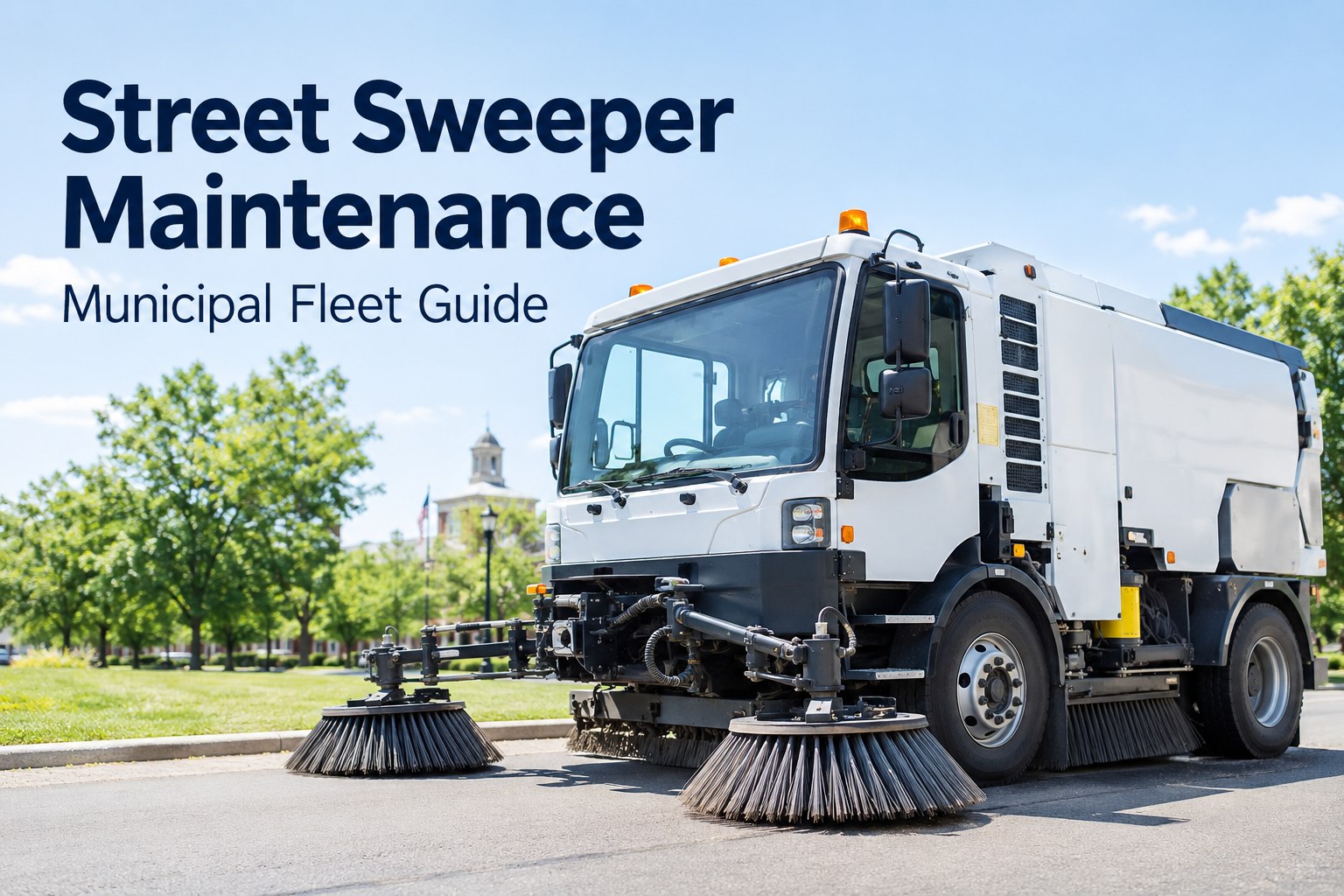
A street sweeper is really two machines welded together: a road chassis that drives to the route, and a hard-working sweeping body that does the actual job. And here's the catch most maintenance schedules miss — the sweeping body wears out far faster than the chassis ever racks up miles. A sweeper can show low mileage and still have a broom worn to the core, a caked hopper, and an auxiliary engine that's logged hundreds of hard hours. Street sweeper maintenance means servicing both halves on their own clocks. This guide walks the machine system by system, and shows why hours and consumables matter as much as the odometer. Book a demo to see hour-based PM in HVI.
A sweeper is a chassis plus a sweeping body — and they don't age together
Many sweepers even run two engines: a chassis engine for driving and a separate auxiliary engine that powers the sweeping system. Low road miles can hide an auxiliary engine that's been worked hard all season — which is exactly why the odometer alone tells you almost nothing about a sweeper's real service needs.
Getting sweeper maintenance right means knowing the working body as its own machine — what wears, how fast, and on what trigger. Below is the sweeper broken down system by system, from the brooms that grind down in weeks to the water system that fails an emissions test if it's neglected, plus the consumables, the daily checks, and the winter freeze problem.
The sweeping body, system by system
The working end of a sweeper is a set of distinct systems, each with its own wear pattern and service need. A road-truck PM schedule covers none of them — which is why the sweeping body needs its own inspection template and its own hour-based intervals. Here's what's actually on the machine.
Gutter brooms move debris from the curb into the path of the main broom or pickup head. Both grind down with use — bristle length drops steadily, and worn brooms stop picking up. Broom rotation matters too: gutter brooms target roughly 60–110 RPM, and a failed hydraulic flow-control valve letting a broom spin at 150+ RPM throws material back into the road and grinds the bristle tips off fast. Check wear often, adjust contact, and replace on condition — not on a guess.
A tank feeds a spray bar of several nozzles that mist water around the brooms and hopper to suppress dust. This isn't optional: run the spray bar dry and a regenerative-air sweeper can fail a PM10 emissions check within minutes — a mechanical sweeper with the water off is a net dust generator. Run it too wet and the hopper inlet cakes with mud. Check the tank, clear clogged nozzles, service the water filter, and confirm even spray every shift.
The hopper stores the abrasive debris the machine collects, load after load; a conveyor or the air stream moves material into it. Hydraulic cylinders tilt it to dump. It needs regular cleaning and washout — caked material corrodes the floor and fouls seals — plus checks of the dump cylinders, hopper screen, inspection doors, and seals. A hopper that doesn't seal lets dust escape and drops pickup efficiency.
Hydraulics drive the brooms, the hopper lift and dump, and the pickup head. The reservoir, pump, hoses, and cylinders all need regular leak checks, and the hydraulic filter and oil need servicing on schedule — contaminated hydraulic oil is what kills broom motors and flow-control valves. A creeping leak here shows up first as poor broom performance, not a puddle.
How debris gets into the hopper depends on the sweeper type. Regenerative-air and vacuum machines use a fan moving huge volumes of air — its blades and housing wear where you can't see, and the ducting and hoses abrade. Mechanical sweepers use a rubber-flighted conveyor that lifts debris. Either way it's a wear item that degrades pickup as it goes, and on air machines a tired fan or worn seals quietly kills suction.
On dual-engine sweepers the auxiliary engine powers the whole sweeping system and logs its own hours, completely independent of the chassis odometer. It needs its own oil, air filter, coolant, and PM schedule on operating hours — and it's the single clearest reason a sweeper can't be maintained on mileage alone. Belts, auxiliary drives, and cooling all ride on this engine's hours too.
Six systems, none of them tracked by a road-truck maintenance schedule — and every one of them wears while the odometer barely moves. That's the whole case for a sweeper-specific inspection template on its own hour-based clock. Book a demo to build a sweeper inspection template
Why mileage can't schedule a sweeper
Put the wear profile next to the odometer and the mismatch is obvious. A sweeper crawls its route at a few miles per hour with the auxiliary engine, brooms, water pump, and hydraulics all running the entire time. In a full shift it might cover a handful of miles while the sweeping body works for hours — so the odometer records almost nothing while the real wear piles up.
The right setup runs all three at once and services on whichever comes due first — chassis on miles, sweeping body on hours, seasonal work on the calendar. A sweeper scheduled on mileage alone gets its truck maintenance and misses everything that makes it a sweeper. Book a demo to see all three triggers on one sweeper Start free and schedule sweeper PM by hours and miles
Brooms are consumables — track them like it
Here's the operational reality that separates sweeper maintenance from ordinary vehicle PM: the brooms are consumables that get eaten by the job, and a route stops dead if a worn broom can't be replaced because none are on the shelf. Brooms aren't a repair — they're inventory, and they need to be managed like fuel or filters, not ordered reactively when one wears out.
Log gutter and main broom condition at inspection so wear is visible over time, not discovered when pickup drops off. A broom worn past its useful bristle length is a route running at half efficiency.
High-consumption parts like brooms need a minimum on-shelf quantity that triggers a reorder before you run out. A min/max alert turns "we're out of gutter brooms" from a route-day crisis into a routine restock.
A machine burning through brooms faster than its mates is telling you something — over-speed rotation from a bad flow-control valve, too much broom pressure, or an operator technique issue. Consumption rate is a diagnostic, not just a cost.
The same min/max discipline applies to nozzles, filters, seals, and other high-use parts — but brooms are the one that most directly stops a route. Tracking them at the asset level, with reorder alerts, is what keeps a sweeper on its schedule instead of parked waiting on a part. Book a demo to set min/max alerts on brooms and consumables
Daily checks and the winter freeze problem
Two more pieces round out a real sweeper program: the operator's daily inspection that catches problems before a route, and the seasonal freeze protection that a water-carrying machine can't skip in cold climates.
- Broom wear and contact; spray nozzles clear and spraying
- Water tank level; hopper empty, clean, sealing
- Hydraulic leaks; fluid, oil, and coolant levels
- Lights, warning devices, and chassis walkaround
A five-minute check at shift start catches a clogged nozzle or a worn broom before it costs a route.
- Drain or protect the water tank, pump, and spray lines
- Blow out nozzles and plumbing before hard freeze
- Recommission the water system before spring sweeping
- Seasonal service while the machine is off-route
A cracked pump or split spray line from an overlooked freeze is a spring-startup failure that was entirely avoidable.
Both belong in the maintenance system, not on a clipboard: the daily check as a guided template that routes any defect straight to a work order, and the winterization tasks as calendar-triggered PM that fires before the freeze, so a water system is never left to crack over winter. Start free with a guided sweeper daily check
From a shop foreman who runs the sweeper fleet
New guys always look at the odometer and think a sweeper's barely used. Meanwhile the aux engine's got triple the hours the mileage would suggest, the main broom's worn to a nub, and the water filter's caked solid. The truck part is the easy part — it's the sweeping body that eats you alive if you're not watching the hours.
The thing that actually changed our uptime was two fixes: putting the aux engine and the body on hour-based PM instead of guessing off mileage, and setting a min/max on gutter brooms so we stopped getting caught with an empty shelf on a route morning. Now the sweeper's on its own schedule, the brooms reorder themselves before we run dry, and I'm not pulling a machine off its route because somebody didn't order bristles.
Frequently asked questions
Why can't a street sweeper be maintained on mileage alone?
Because a street sweeper does the vast majority of its work — and accumulates the vast majority of its wear — while barely moving. A sweeper crawls its route at a few miles per hour with the sweeping system running continuously: the brooms spinning, the water pump feeding the spray bar, the hydraulics driving the pickup head, and on many machines a separate auxiliary engine powering all of it. In a full shift it might cover only a handful of road miles while the sweeping body works for hours, so the odometer records almost nothing while the real wear piles up on components mileage never touches. This is most stark on dual-engine sweepers, which run one engine for driving the chassis and a completely separate auxiliary engine for the sweeping system: the auxiliary engine logs its own hours independent of road mileage, and a sweeper with low miles can easily hide an auxiliary engine that's been worked hard all season. The correct approach is to maintain the road chassis on mileage-based truck PM, the entire sweeping body — auxiliary engine, brooms, hydraulics, fan or conveyor, water system — on engine or operating hours, and seasonal tasks like winterization on the calendar, servicing each on whichever trigger comes due first. A sweeper scheduled on mileage alone gets its truck maintenance done while everything that makes it a sweeper goes unserviced.
How often should street sweeper brooms be replaced?
Brooms should be replaced on condition rather than a fixed calendar interval, because their wear rate depends heavily on how much and what kind of material the machine sweeps — a sweeper working construction cleanup or road millings grinds brooms down far faster than one on a light residential maintenance route. Both the gutter brooms, which move debris from the curb into the sweeper's path, and the main broom or pickup head wear continuously with use, losing bristle length until they can no longer pick up effectively. The practical approach is to check broom wear frequently, ideally at every daily inspection, and replace when bristle length drops past the point of effective pickup rather than waiting for a scheduled date. A few things accelerate broom wear beyond normal and are worth catching: excessive broom rotation speed, since gutter brooms target roughly 60 to 110 RPM and a failed hydraulic flow-control valve letting a broom spin at 150-plus RPM grinds the bristle tips off quickly while throwing material back into the road; too much broom-to-pavement pressure; and operator technique. Because brooms are high-consumption items that a route can't run without, they should be treated as tracked inventory with minimum stock levels and reorder alerts, not ordered reactively when one wears out. Watching a machine's broom consumption rate also serves as a diagnostic, since a sweeper burning through brooms faster than its peers is signaling an over-speed, over-pressure, or technique problem worth investigating.
What maintenance does a street sweeper's water system need?
The water system needs consistent attention because it's both a wear point and an emissions-critical system, not a minor accessory. A sweeper's water system consists of a tank feeding a spray bar of several nozzles that mist water around the brooms and inside the hopper to suppress the dust that sweeping kicks up. Its maintenance centers on a few recurring tasks: keeping the tank filled and clean, inspecting and clearing the spray nozzles, which clog readily, servicing the water filter or strainer that protects the pump and nozzles, checking the pump and plumbing for leaks and weak flow, and confirming an even spray pattern across all nozzles. Getting this right matters for more than cleanliness: run the spray bar dry and a regenerative-air sweeper can fail a PM10 dust-emissions check within minutes, and a mechanical broom sweeper operating with the water off becomes a net dust generator that puts more fine particulate into the air than it removes from the pavement. At the same time, running the system too wet causes its own problem, caking the hopper inlet with mud that won't unload cleanly. In cold climates the water system also demands seasonal freeze protection, since a tank, pump, or spray line left full over a hard freeze can crack and become a spring-startup failure. Daily nozzle and flow checks, scheduled filter service, leak inspection, and calendar-based winterization together keep the water system doing its job.
What's the difference between mechanical, regenerative air, and vacuum sweepers for maintenance?
The three sweeper types share common systems — gutter brooms, a water and dust-suppression system, a hopper, and hydraulics — but differ in how they move debris into the hopper, which changes what wears and what to inspect. A mechanical broom sweeper uses a large rotating cylindrical main broom that flicks debris onto a rubber-flighted conveyor or elevator, which lifts it into the hopper; its distinctive wear items are the main broom and the conveyor, and it's favored for heavy, bulky debris like construction cleanup and road millings. Regenerative air and vacuum sweepers instead use a fan or blower moving large volumes of air to lift debris, so their critical and often overlooked wear happens inside the air path: the fan blades and housing wear where you can't see them, and the ducting, suction hoses, and elbows abrade and can develop holes, while worn seals or a tired fan quietly reduce suction. On these air machines, confirming the system still holds suction is an important check that has no equivalent on a mechanical unit. Regenerative air sweepers are common on high-frequency maintenance routes and lighter material, while pure vacuum machines suit porous pavements and deep gutter cleaning. For maintenance, the takeaway is that the sweeping-head and pickup mechanism should be inspected according to the machine's type — broom and conveyor wear on mechanical units, fan, ducting, seal, and suction integrity on air and vacuum units — which is why a one-size inspection template doesn't serve a mixed sweeper fleet well.
How do you keep municipal sweepers available during scheduled routes?
Availability comes from maintaining the sweeping body proactively on its own schedule and never getting caught without the consumables a route depends on, rather than reacting to failures. Municipal sweepers run scheduled routes and seasonal programs where a machine down for an avoidable reason means streets don't get swept and, in dusty conditions, potential air-quality and compliance consequences. Several practices protect availability. First, schedule the sweeping body on engine and operating hours rather than mileage, so the auxiliary engine, brooms, hydraulics, and fan or conveyor get serviced before they fail, catching wear the odometer would miss entirely. Second, treat brooms and other high-consumption parts as tracked inventory with minimum stock levels and automatic reorder alerts, so a worn broom is a routine swap from the shelf rather than a route-morning crisis with an empty parts bin. Third, run a guided daily operator inspection that catches a clogged nozzle, a hydraulic leak, or a worn broom at shift start rather than mid-route, with any defect routing straight to a work order. Fourth, use calendar-triggered maintenance for seasonal needs like winterization, so a freeze-cracked water system never sidelines a machine at the start of a season. Finally, keep full maintenance history per machine so recurring problems surface as patterns. Together these keep the machine on its route instead of parked in the shop, which for a municipal fleet is the whole point of the maintenance program.
See hour-based PM for sweepers in HVI
HVI maintains a street sweeper as the two machines it really is — scheduling the chassis on mileage and the sweeping body on engine hours, with a configurable sweeper inspection template crews complete offline in the field, full service history per machine, defect-to-work-order workflows, and min/max tracking on brooms and other high-use parts so a route is never delayed waiting on a consumable. Keep every municipal sweeper on its route. Live for your department in days.
No credit card · Hour-based PM · Broom min/max tracking · Onboard in days