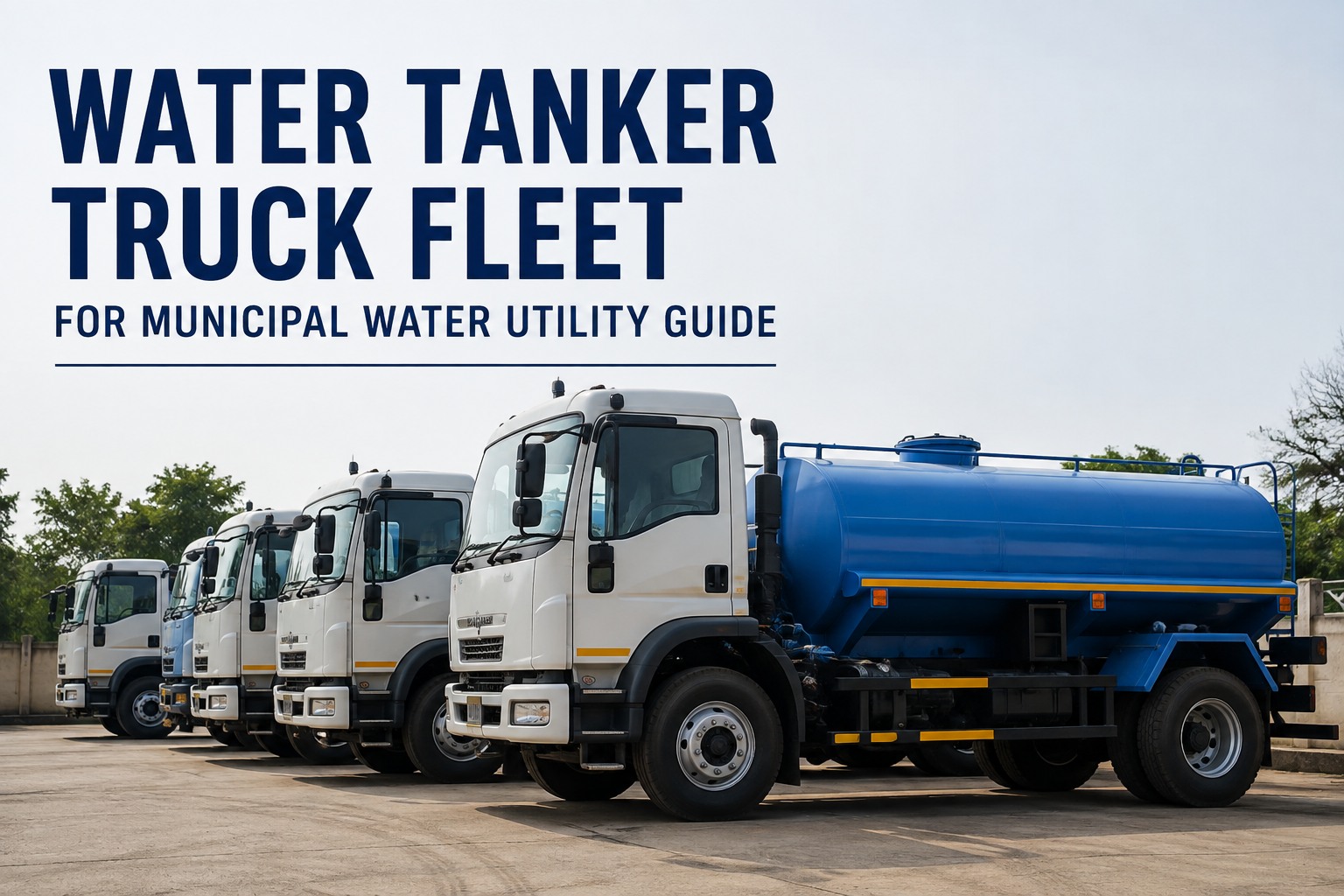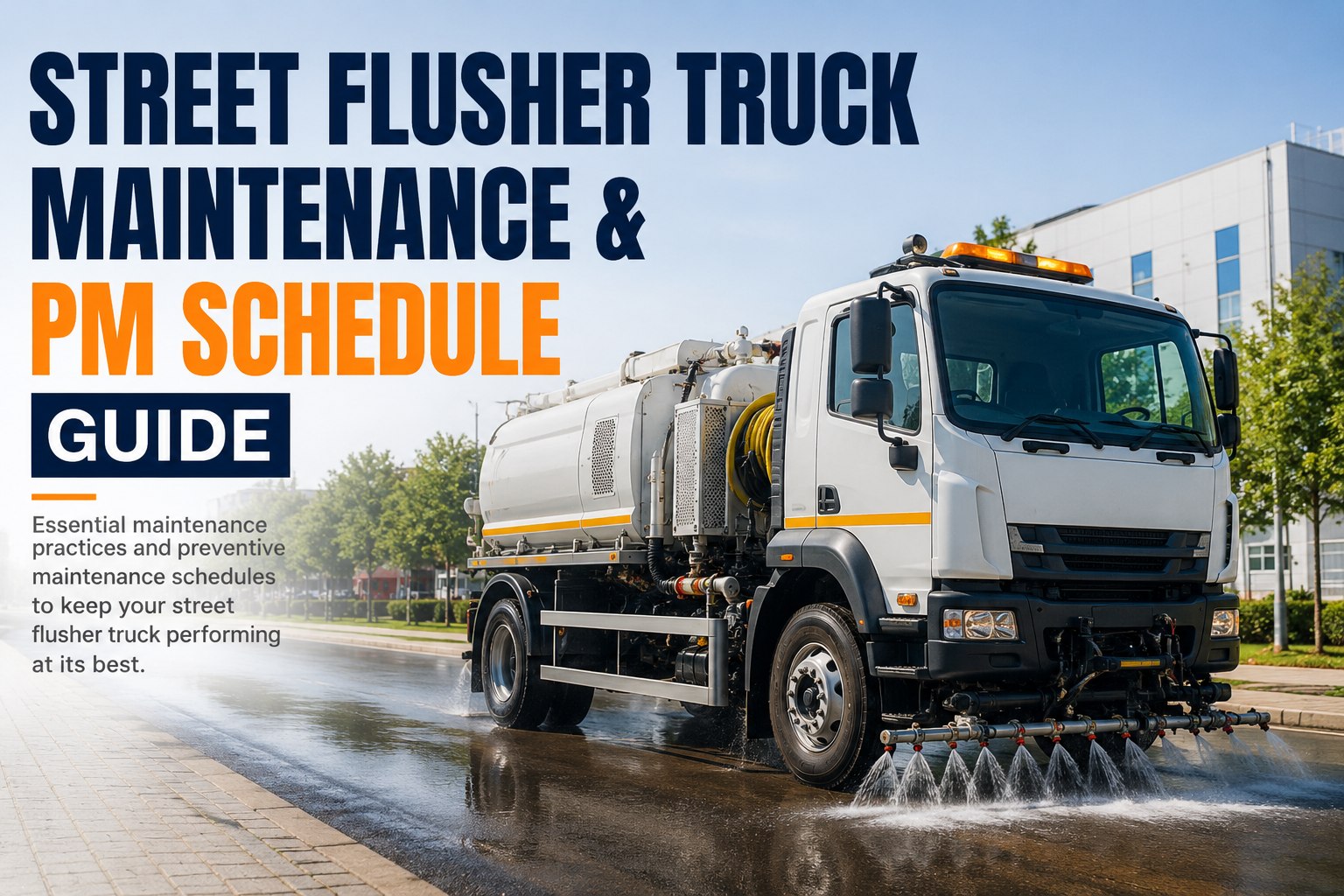
Street flusher trucks are the most water-abused vehicles in a municipal fleet — a 3,000-gallon tank cycles two to four times a shift through a 750 GPM pump, feeds a spray bar hitting pavement at 50-80 PSI, and returns to base with wet running gear that corrodes anything it touches. Every subsystem has a specific PM interval; the pump has a specific dry-run failure mode; the tank interior is where the corrosion problem accumulates unseen. Book a demo .
Street Flusher Trucks — The System Anatomy and PM Interval Map
Water pump, spray bar, tank, hoses — each subsystem has its own failure mode and its own PM interval. Miss one and the failure surfaces on the route, not in the shop.
Municipal street flusher trucks live a punishing operating cycle that no other municipal vehicle matches. Pre-sweep wetting routes, catch basin flushing, dust suppression at construction zones, ice rink flooding in winter, brine application for anti-icing, and emergency-standby fire suppression backup — the same chassis moves between all of them, and each application layers different stress on the water system. The chassis itself is standard Freightliner, Kenworth, International, or Peterbilt equipment maintained on OEM PM schedules; the failure risk sits in the water body, pump, and spray delivery system that turn a truck chassis into a flusher. Get the water-system PM discipline right and the truck runs a 10+ year municipal service life; get it wrong and the fleet spends the truck's replacement budget on emergency pump rebuilds and tank corrosion repairs before the chassis reaches half its rated life.
The water pump — the single most expensive failure modeHydraulically driven 750 GPM pump, dry-run damage, packing wear, and the 200-hour PM cycle
The water pump is the flusher's most expensive single failure. A hydraulically driven 750 GPM pump operating at 50-80 PSI takes constant load through every route, and its two catastrophic failure modes — dry running and cavitation from low tank levels — produce internal damage that typically requires full pump replacement rather than field repair. Understanding the pump PM cycle is what keeps replacement events on schedule rather than on emergency call. Book a demo to see HVI's pump-hour tracking and PM scheduling
The failure: Pump operated with empty tank or after tank runs dry mid-route. Internal seals, impeller, and packing overheat within minutes without water for cooling and lubrication.
Prevention: Manufacturer instruction is explicit — "do not run when pump is dry." Anti-cavitation sump designs allow water draw to low levels without air ingestion; operator training on tank-level monitoring and shutdown discipline is the operational backstop.
The failure: Pump packing seals degrade over hours of operation, causing water leakage past the shaft, air ingestion, pressure loss, and eventual bearing damage from packing failure.
Prevention: Repack at manufacturer-specified interval — commonly around 200 pump-hours depending on model. Track pump-hours separately from chassis engine hours since flusher use varies by season and route type. Inspect packing gland during weekly and monthly PMs for early leak signals.
The failure: Pump draws air with water at low tank levels or with plugged fill strainer, causing cavitation that erodes impeller and internal surfaces. Even without complete dry-run, sustained cavitation shortens pump life significantly.
Prevention: Anti-cavitation sump designs address most of the risk; fill line strainer cleaning per monthly PM prevents restricted flow that induces cavitation at higher tank levels; PLC controllers with tank level and pump pressure monitoring provide operator visibility.
The tank interior — where corrosion accumulates unseenSteel vs stainless considerations, sediment, coating condition, and the annual interior inspection
Tank interior condition is the most consistently under-inspected element of flusher truck PM programs. The manway typically opens once a year at most; between openings, sediment accumulates, coatings degrade, and corrosion progresses on interior surfaces that no external inspection reveals. By the time an interior issue surfaces externally — through leak, contamination, or coating failure — the repair cost has commonly multiplied.
Standard steel tank interiors require annual inspection for corrosion, coating degradation, weld condition, and sediment accumulation. Interior coating protects the base metal; where coating has failed, corrosion progresses rapidly in the wet interior environment. Recoating or spot repair at annual inspection is the standard corrective action.
Stainless steel tanks are commonly specified for extended service life or specific applications. 304L stainless is typical for water; 316 stainless is used for brine and anti-icing applications where chloride corrosion resistance matters. Stainless tanks reduce corrosion risk but do not eliminate the annual interior inspection requirement.
Even clean municipal water sources deposit sediment and support algae growth over time. Sediment restricts pump intake, clogs strainers, and abrades pump internals. Regular tank drain and clean cycles reduce accumulation; annual interior inspection catches whatever the drain cycles missed.
Tank cracks and weld failures typically initiate at stress concentrations — baffle mounts, drain fittings, sight glass ports. Annual inspection includes visual assessment plus dye penetrant testing where indicated. Cracks caught early are field-repairable; cracks caught after failure typically require tank replacement.
Tank interior inspection scheduling is exactly the workflow where digital PM systems earn their place — the annual reminder tied to the specific truck, with an inspection template that includes coating condition, weld check, and sediment assessment, prevents the "we'll do it next year" pattern that produces the emergency discovery. Book a demo to see HVI's annual PM scheduling and tank-inspection templates
The spray delivery system — nozzles, spray bar, and hosesDaily inspection items that produce visible route failures if missed
The spray delivery system is the flusher's most visible failure point — a clogged nozzle produces uneven spray that the driver sees in the mirror; a failed hose fitting produces a route-ending leak. Because these failures are visible, they're commonly caught quickly, but the underlying wear that produces them typically develops over weeks before the visible failure. Daily inspection catches the developing issues before they become the operational failures. Start a free trial to add spray-delivery daily inspection templates to your fleet workflow.
What to check: Clogging from debris; wear on nozzle slot surfaces (uneven or narrowed spray pattern); mounting integrity; drain condition when out of service.
Common failure: Debris in nozzle slot narrows the spray pattern before the operator notices the reduced coverage. Manufacturer instruction is to keep nozzle slot surfaces smooth and remove nozzles for cleaning rather than back-flushing with the pump.
What to check: Bar alignment against pavement (angle matters for spray coverage); mounting hardware condition; internal debris; drain function when out of service.
Common failure: Vibration loosens mounting hardware over route hours; misaligned bar produces uneven pavement coverage that operators report as "pump problem" when the actual issue is bar angle.
What to check: Vibration wear at fitting connections; UV degradation on exterior hose surfaces; internal collapse under vacuum on suction sides; fitting seal condition.
Common failure: Hose fittings fail at connection points first — where the flex + vibration + water hammer converge. Weekly visual inspection with occasional pressure test during scheduled maintenance catches most developing issues.
What to check: Air-operated dump valve function; pneumatic diaphragm valves on nozzle circuits; PLC controller readings against actual conditions; drain valve function.
Common failure: Air valve diaphragms harden and crack over months of operation. PLC pressure readings drift from actual pressure without periodic verification. Monthly function testing catches control issues before they produce operational failures.
The spray delivery system is where a well-run PM program pays off in visible ways — drivers stop reporting "pump problems" that were actually spray-bar alignment issues, and the shop stops fielding emergency calls for failures that started as inspection findings weeks earlier. Book a demo to see HVI's daily and weekly spray-delivery inspection templates
From a municipal fleet manager on flusher truck PM discipline
Our first flusher was a 3,000-gallon Freightliner running catch basin flushing and pre-sweep wetting. The chassis was on standard OEM PM cycles — oil changes, filters, brake inspections — and that side stayed in good shape. What broke was everything downstream of the PTO. In year three, the water pump packing failed mid-shift; in year four, we cracked a tank baffle weld that we hadn't caught in an interior inspection because we hadn't done an interior inspection; in year five, we replaced the spray bar entirely because vibration wear had opened up two of the nozzle mounts.
None of that was equipment failure — it was PM failure on the water-system side. Once we split the PM tracking into chassis (OEM cycles) and water body (pump hours, spray bar daily, tank annual, hoses weekly), the emergency failures stopped. Same truck, same routes, same crew — different tracking discipline. The digital PM scheduling did the heavy lifting; the hard part was building the mental model that a flusher is really two vehicles sharing a chassis, and each vehicle needs its own PM cycle.
Frequently asked questions
What is the PM interval for a street flusher water pump?
Water pump PM intervals depend on the specific pump model and manufacturer guidance, but the widely cited practical interval for pump packing repack and inspection is approximately 200 pump-hours for hydraulically driven 750 GPM pump systems common on municipal street flushers. Pump-hours should be tracked separately from chassis engine hours because flusher pump use varies by season, route type, and application (street washing, catch basin flushing, ice rink flooding, anti-icing brine application). Manufacturer instructions are explicit on the critical failure mode: "do not run when pump is dry" — dry running produces internal seal, impeller, and packing damage within minutes because the water provides both cooling and lubrication. Cavitation from low tank levels or plugged fill strainer produces similar though slower-developing damage. Anti-cavitation sump designs allow water draw to low tank levels without air ingestion, addressing much of this risk when the design is present. The other pump PM items — hydraulic system lubrication and filter changes, PTO drive alignment — follow manufacturer specifications and should be integrated with the chassis OEM PM schedule where practical. Specific intervals for a specific pump model should be confirmed with the manufacturer's operation and maintenance manual for that unit.
How often should a flusher truck tank interior be inspected?
Annual interior inspection is the common practice for flusher truck tanks — sufficient to catch corrosion progression, coating degradation, sediment accumulation, and weld condition changes at stages where corrective action is repair rather than replacement. Higher-frequency inspection (semi-annual) may be appropriate for fleets running high-hour operation, brine and anti-icing applications on standard steel tanks, or older equipment approaching end of service life. Standard steel tanks require the most attention to interior coating condition; where coating fails, corrosion progresses rapidly in the wet interior environment. Stainless steel tanks (304L for water, 316 for brine applications) reduce corrosion risk but do not eliminate the annual interior inspection requirement — sediment accumulation, weld inspection at stress concentration points (baffle mounts, drain fittings), and coating condition where applicable still require regular assessment. Interior inspection is commonly the flusher PM item most often postponed until the truck is out of service for another reason, which produces the "several years of change discovered at once" pattern that drives emergency-repair cost rather than planned-intervention cost. Scheduling standalone annual interior inspection with the tank drained specifically for access is the operational discipline that catches issues at manageable stages.
What are the main failure modes of a street flusher truck?
The most common failure categories on street flusher trucks concentrate in the water-system components downstream of the PTO rather than in the chassis itself, which typically follows standard Freightliner, Kenworth, International, or Peterbilt OEM PM cycles. Water pump failure is the single most expensive failure mode — dry-run damage (pump operated with empty tank or after tank runs dry), cavitation from low tank levels or plugged fill strainer, and packing wear that develops over pump-hours of operation. Tank interior corrosion is the most consistently under-inspected failure — coating degradation on steel tanks, sediment accumulation, weld cracks at stress concentrations, and algae buildup that progresses between annual inspections. Spray delivery system failures include nozzle clogging from debris, spray bar mounting hardware loosening from vibration, hose fitting failure at connection points, and air-operated valve diaphragm degradation. Corrosion generally is the #1 failure category driver — wet running gear, tank interior sediment, standing water in unused valves, and salt/brine residue for units running anti-icing applications all accelerate corrosion on the wet-side components. The fleets that avoid emergency failures split their PM tracking into chassis (OEM cycles) and water body (pump hours, daily/weekly/monthly/annual water-system items) and treat both with equal discipline.
Should flusher truck pump hours be tracked separately from chassis engine hours?
Yes — and it's the single most consistent tracking discipline difference between fleets that keep flusher trucks on planned PM cycles and fleets that fight emergency failures. Chassis engine hours accumulate whenever the truck is running, including transit to and from routes, staging, and any operating time that doesn't involve the water system. Pump-hours accumulate only when the PTO is engaged and the water pump is under load — commonly a fraction of engine hours during pre-sweep wetting or catch basin flushing operations, potentially closer to engine hours during sustained ice rink flooding or continuous anti-icing application. Using chassis engine hours as a proxy for pump PM cycles over-schedules pump service on trucks with lots of transit and under-schedules on trucks with heavy pump duty cycles. Tracking pump-hours separately — through PTO-engaged time capture, PLC controller output, or dedicated hour meter — produces the accurate baseline for pump packing repack, seal inspection, and other pump-hour-based PM items. Digital fleet inspection and maintenance systems that support per-subsystem hour tracking make this straightforward; paper-based or engine-hour-only systems typically don't.
How does HVI support street flusher truck PM?
HVI provides the PM scheduling, inspection template, defect capture, work order routing, and parts records layer supporting street flusher truck maintenance across the six subsystem categories: water pump (pump-hour tracked), spray bar and nozzles (daily), hoses and valves (weekly), fill line strainer (monthly), tank interior (annual), and PTO and hydraulic system (per OEM). Features that apply to flusher fleet workflows include: configurable inspection templates per subsystem with the specific checklist items and defect criteria; pump-hour tracking separate from chassis engine hours (via PTO engagement time or PLC output where integrated); PM scheduling with automated triggers when hour or calendar intervals approach; defect-to-work-order routing for issues found during inspection; parts consumption records for pump packing, nozzles, hoses, seals, and other consumables; searchable per-truck maintenance history for warranty support, budget planning, and fleet lifecycle decisions; and audit-ready records for municipal fleet management reporting. HVI is not a flusher truck manufacturer, water pump service specialist, tank fabrication or repair vendor, or municipal fleet consultant — those services remain with equipment manufacturers, specialized service providers, and qualified fleet professionals. What HVI provides is the digital PM scheduling and inspection records infrastructure that keeps the six-subsystem PM map operational rather than aspirational.
Flusher trucks are really two vehicles sharing a chassis — the water body needs its own PM discipline to hit 10+ year service life
HVI schedules PM per subsystem, tracks pump-hours separately from engine hours, captures inspection findings with photo evidence, and routes defects to work orders — producing the maintenance records infrastructure that keeps water pump replacements planned instead of emergency and tank corrosion caught at repair stage instead of replacement stage.
No credit card · No hardware · Setup in minutes