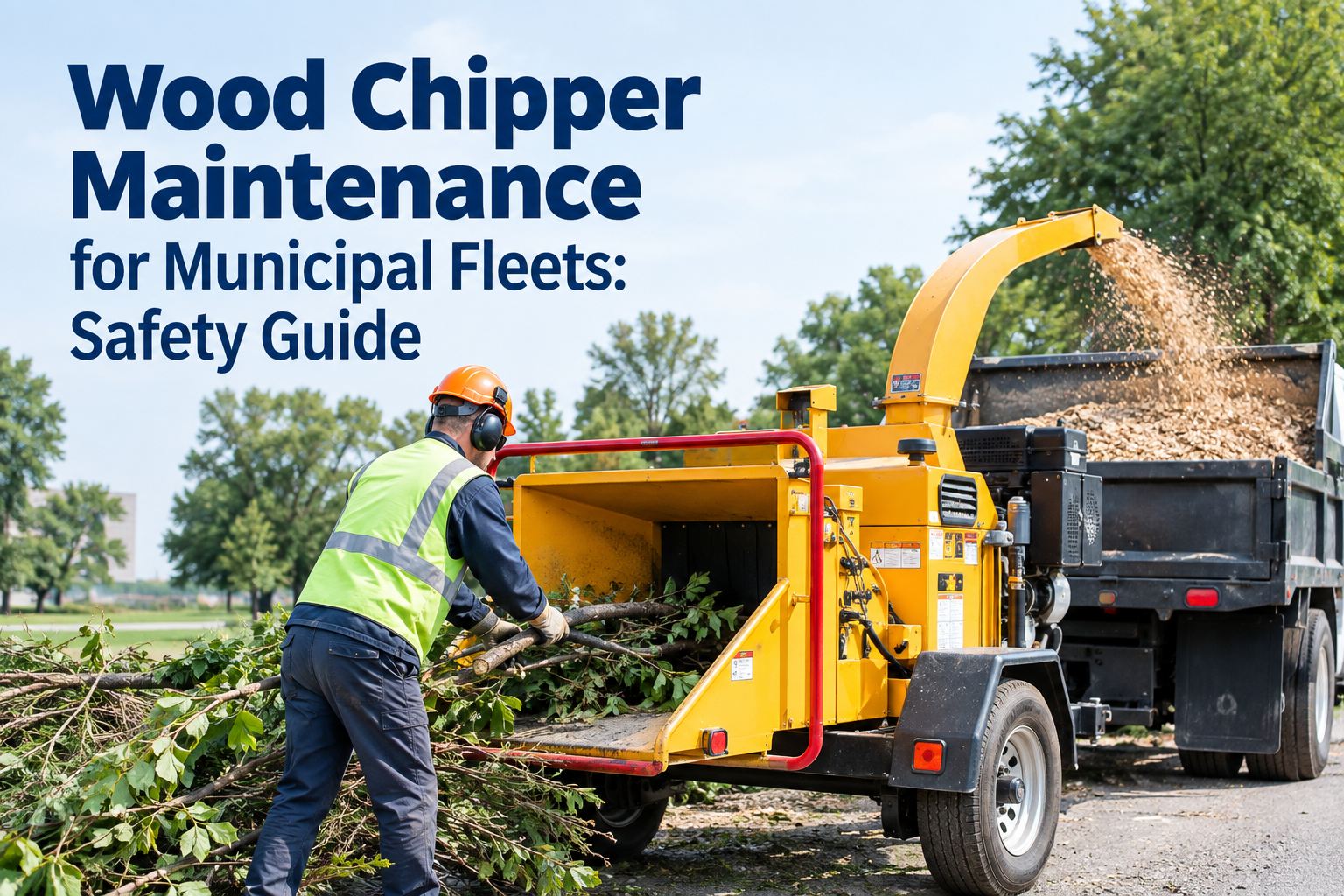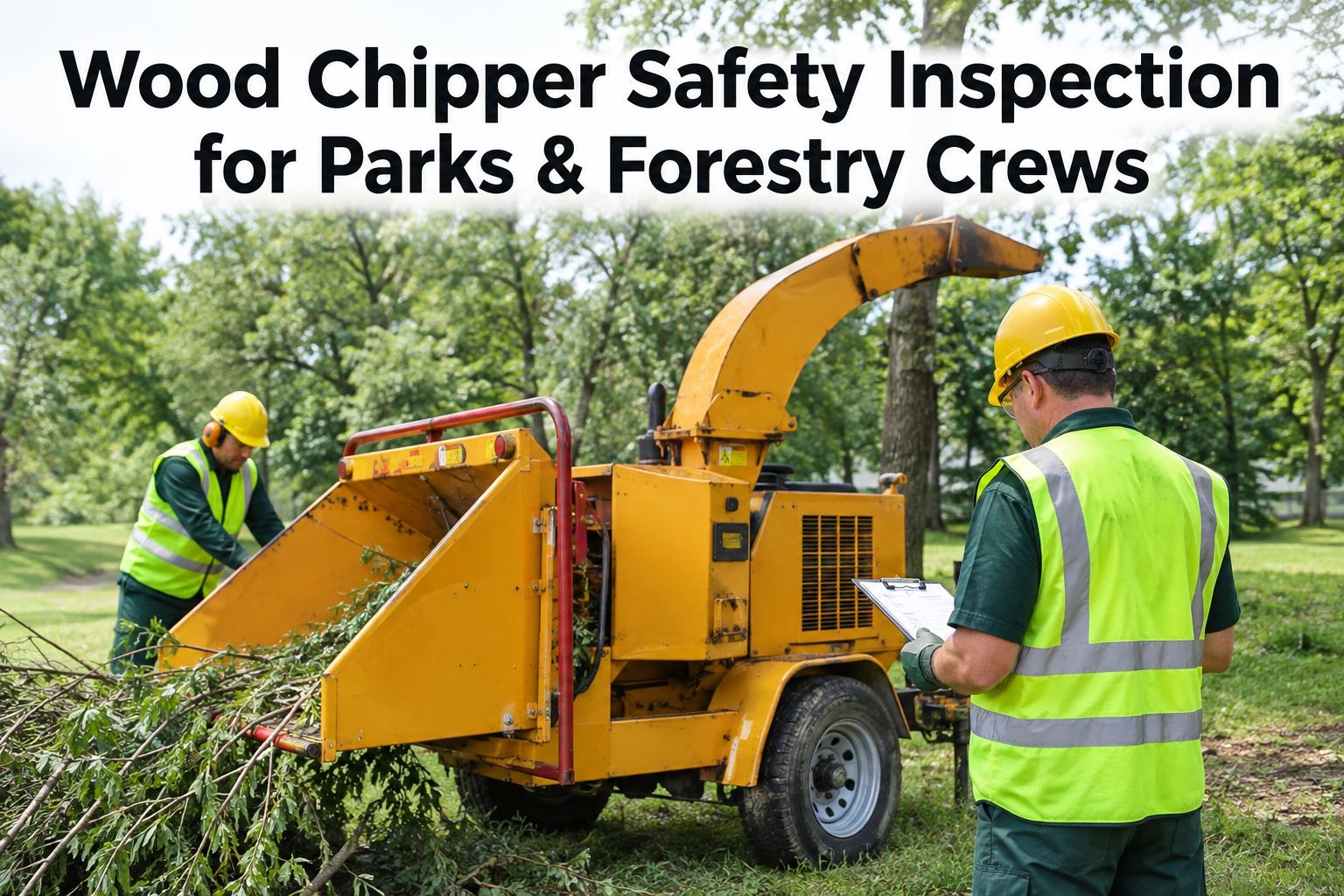
It's 6:40 AM at the municipal yard. Your chipper crew is fueling up a Bandit 200XP, and somewhere between the coffee and the tailgate meeting, the daily wood chipper safety inspection becomes a checkbox nobody actually checks. The feed control bar gets a quick slap. The E-stop gets a glance. Nobody measures anvil clearance because nobody remembers it should be 0.030 to 0.060 inches. Then, three weeks later, a knife lets go at full drum speed, or worse, a feed roller grabs a glove that should never have been near the infeed. Wood chipper fatalities average 4 per year according to BLS data, and nearly every investigation traces back to a safety interlock or inspection step that was skipped, not broken. If your crew is still running paper checklists that live in the truck door pocket, you are one missed E-stop test away from a headline. You can see how HVI enforces every ANSI Z133 stop on your own units in a 30-minute walkthrough.
Is Your Chipper Crew Actually Testing the E-Stop Every Morning?
Four fatalities a year. Dozens of amputations. Most traced to a feed control bar or emergency stop that "worked fine last week." Here is the daily checklist that closes the gap.
The Real Numbers Behind Chipper Safety Inspections
Every skipped step on the daily checklist has a dollar figure attached. These are not abstract safety statistics. They are your workers' comp premium, your OSHA citation, your drum replacement, your crew sitting idle.
The ANSI Z133 Daily Wood Chipper Safety Inspection, Step by Step
This is not a "look it over" walkaround. ANSI Z133-2017 spells out specific functional tests that must happen before the first branch goes in. Here is what your crew should be doing, in order, every single morning.
E-Stop Function Test
Start the engine. Hit every emergency stop button on the machine. The engine must kill immediately. If any button is sticky, slow or dead, the chipper does not leave the yard. This is the single most-skipped step and the one that shows up in every fatality report.
Feed Control Bar Cycle
Run the bar through its full range: forward feed, neutral stop, reverse. It must snap back to neutral when released. A bar that sticks in forward is how a feed roller grabs a hand before the operator can react. Test it with the engine at operating RPM, not idle.
Anvil Clearance Check
Measure the gap between the knife edge and the anvil with a feeler gauge. Spec is 0.030 to 0.060 inches on most drum chippers. Too tight and you crack knives. Too loose and you get long, dangerous slivers instead of chips. Log the reading.
Knife Edge Inspection
Every 50 operating hours, pull the access panel and check each knife for chips, cracks and edge rollover. A chipped knife at 2,000 RPM is a grenade fragment. Torque bolts to spec when you reinstall. Record the hour meter reading.
Drum Brake & Clutch Test
Disengage the drum and time how long it takes to stop. If the drum is still spinning after 30 seconds, the brake is worn. A drum that freewheels for two minutes is a drum that is still lethal when someone opens the housing to clear a jam.
Hydraulic System Scan
Check feed motor hoses, lift cylinder lines and fittings for weeping, chafing or bulges. A hydraulic line that bursts at 3,000 PSI injects oil through skin. On a Bandit 200XP, the 500-hour hydraulic service interval is where most of these failures get caught early.
Chipper Preventive Maintenance Intervals: Bandit, Morbark and Vermeer
Every OEM publishes different intervals, and if you are running a mixed fleet of Bandit, Morbark and Vermeer chippers across parks and forestry crews, tracking them in a spreadsheet is how intervals get missed. Here is a side-by-side reference.
| Service Item | Bandit 200XP | Morbark Beever | Vermeer BC Series |
|---|---|---|---|
| Daily safety inspection | Every shift, before start | Every shift, before start | Every shift, before start |
| Knife inspection / rotation | Every 50 hrs | Every 50 hrs | Every 50 hrs |
| Anvil clearance check | Every 50 hrs (with knives) | Every 50 hrs (with knives) | Every 50 hrs (with knives) |
| Hydraulic fluid & filter | Every 500 hrs | Every 500 hrs | Every 400–500 hrs |
| Engine oil & filter | Every 250 hrs | Every 250 hrs | Every 250 hrs |
| Drum bearing grease | Every 40 hrs | Every 40 hrs | Every 40 hrs |
| Feed roller bearing check | Every 100 hrs | Every 100 hrs | Every 100 hrs |
| Full drum inspection | Every 1,000 hrs | Every 1,000 hrs | Every 1,000 hrs |
These intervals assume normal municipal and parks use. Heavy production chipping (storm cleanup, land clearing) shortens every interval. If you are managing this across 5, 10 or 20 units, book a demo and see how HVI tracks every interval by engine hours automatically.
How a Digital Chipper Inspection Actually Works in the Field
The difference between a paper checklist and an enforced digital inspection is not the form. It is what happens when someone tries to skip a step. Here is the flow your crew follows with HVI on any phone or tablet.
Crew Lead Opens the Chipper Checklist
On their phone, at the unit, before the engine starts. The checklist is specific to that chipper's make and model. A Bandit 200XP gets Bandit-specific items. A Vermeer BC1000XL gets Vermeer items. No generic one-size-fits-all form.
Each Safety Item Requires a Tap and a Photo
E-stop test: tap pass or fail, take a photo of the button. Feed control bar: tap pass or fail, photo of the bar position. Anvil clearance: enter the feeler gauge reading. The app will not let the crew submit until every item is answered. No blank fields, no "N/A" shortcuts.
A Failed Item Creates a Work Order Instantly
If the E-stop fails, the chipper is flagged out of service and a work order is created with the photo, the timestamp and the defect description already attached. The shop sees it before the crew finishes the checklist. No phone call, no text message, no sticky note on the dashboard.
Records Are Timestamped and Audit-Ready
Every inspection is stored with the operator's name, the date, the time, the GPS location and every photo. When OSHA, your insurance carrier or a client's safety auditor asks for proof, you pull it up in seconds instead of digging through a filing cabinet. You can start running digital chipper inspections free and see the difference on your first unit.
Four Ways HVI Closes the Chipper Safety Gap
HVI is not a generic checklist app. It is a full CMMS built for fleets that run heavy equipment in the field, from municipal forestry crews to private tree services to DOT roadside clearing operations.
Enforced Digital Inspections
Every ANSI Z133 item must be answered before the checklist submits. Photo capture on every safety-critical step. If the E-stop fails, the unit is flagged out of service automatically. No more pencil-whipped paper forms.
Defect-to-Work-Order Pipeline
A failed knife inspection becomes a work order with the photo, the hour meter reading and the part number already attached. Your shop orders the knife set before the crew gets back to the yard. Cuts days off the repair cycle.
PM Scheduling by Engine Hours
Set the 50-hour knife check, the 500-hour hydraulic service and the 1,000-hour drum inspection once. HVI tracks engine hours and sends due and overdue alerts to your phone. No more guessing which chipper is due for what.
Audit-Ready Safety Records
Every inspection is timestamped, photo-backed and stored in the cloud. When OSHA or your insurance carrier asks for proof of daily E-stop tests on Unit 7 from last March, you pull it up in seconds. See it on your own fleet in a 30-minute demo.
Your Chipper Crew Deserves Better Than a Paper Checklist
See HVI running a full ANSI Z133 chipper inspection on your own units. Thirty minutes, your fleet, your questions.
What Every Parks and Forestry Fleet Manager Should Walk Away With
The E-Stop Test Is Not Optional
Four chipper fatalities a year, and the common thread is a safety interlock that was assumed to work. A 30-second functional test every morning is the cheapest insurance your fleet will ever buy. If your current process does not force the test, it is not a process.
Anvil Clearance Is a Number, Not a Feeling
0.030 to 0.060 inches. Measure it with a feeler gauge, log the reading, trend it over time. When the gap starts drifting, you know the anvil is wearing before it starts throwing shrapnel. Guessing is how knives shatter.
Mixed Fleets Need Mixed PM Schedules
A Bandit 200XP, a Morbark Beever and a Vermeer BC1000XL all have different hydraulic intervals, different grease points and different torque specs. One spreadsheet cannot track them all reliably. One CMMS can. Walk through your mixed fleet setup in a demo and see how HVI handles it.
Paper Records Lose Audits
When OSHA or your insurance carrier asks for six months of daily chipper inspections, a shoebox of crumpled forms is not an answer. Timestamped, photo-backed digital records are. The fleets that pass audits are the ones that can produce proof in seconds, not days.
The bottom line: a wood chipper safety inspection is not a formality. It is the difference between a crew that goes home and a crew that does not. The tools to enforce it exist, they work on any phone, and they cost less than one OSHA citation. Sign up free and run your first digital chipper inspection today.
I used to find chipper checklists stuffed in the glove box, all checked off in the same pen, all dated the same day. Now I get a notification on my phone the second a crew finishes their morning inspection, with photos. Last month the system caught a feed control bar that was sticking in forward on our Morbark. That is a hand injury that did not happen. I track one number now: days since last safety defect found. It is 34 and climbing.
Wood Chipper Safety Inspection FAQs
What does ANSI Z133 require for daily chipper inspections?
How often should chipper knives be inspected and rotated?
What is the correct anvil-to-knife clearance on a wood chipper?
Can I use a mobile app for chipper safety inspections instead of paper?
What is the 500-hour service on a Bandit 200XP chipper?
Stop Hoping Your Crew Checked the E-Stop. Know They Did.
HVI enforces every ANSI Z133 safety step, tracks every PM interval by engine hours, and gives you audit-ready proof in seconds. See it on your own chippers.
Free to start — Works on any phone — No card needed