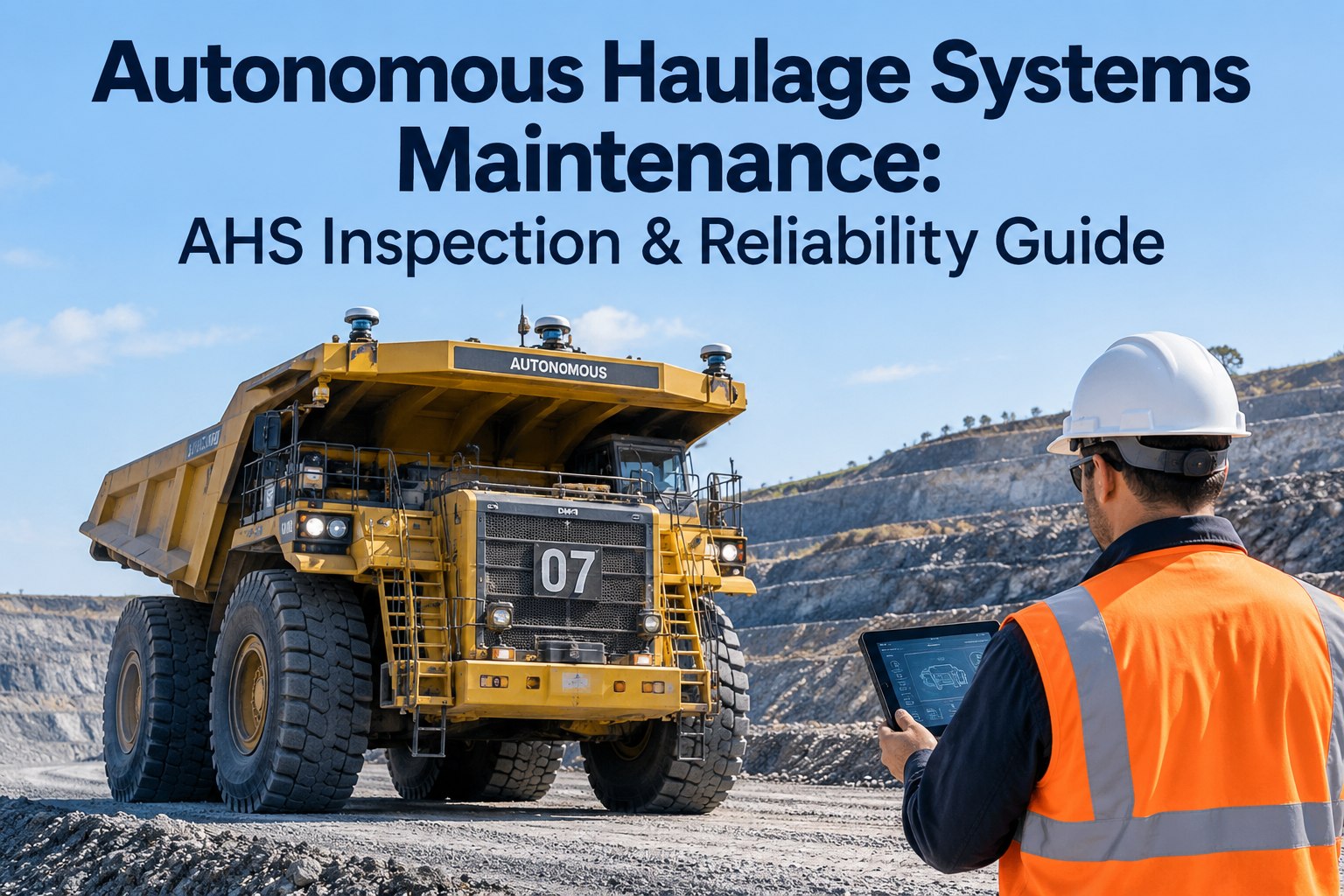
On a manned haul truck, your best condition-monitoring sensor was the operator. They heard the bearing whine, felt the vibration, spotted the leak at walkaround — and wrote it up. Take the operator out of the cab and that entire early-warning layer vanishes. That's the real shift in autonomous haulage systems maintenance: not just maintaining a truck without a driver, but replacing the driver's senses with data, and taking on a whole new category of equipment — the perception and autonomy hardware — that a conventional truck never had. This guide covers what changes, what's new, and why reliability becomes the whole game.
Remove the Driver, Lose the Early Warning
The operator wasn't just driving — they were inspecting, monitoring, and reporting all shift. Autonomy has to replace every one of those jobs with something else.
- A new noise or vibration
- A leak or hot component at walkaround
- A rough-running system by feel
- The daily pre-shift inspection
- Continuous condition monitoring & telematics
- Scheduled technician inspections
- Predictive analytics on component data
- Maintaining the perception hardware itself
If you're a maintenance, reliability, operations, or automation manager on an autonomous or transitioning mine site, the maintenance model doesn't just get more technical — it changes shape. The trucks are still trucks, with engines, tires, brakes, and drivetrains that wear the same as ever. But the person who used to be the first to notice something wrong is gone, and in their place is a suite of sensors, controllers, and data feeds that themselves have to be maintained. Getting AHS maintenance right means covering both the conventional machine and the autonomy layer — and building the data discipline to replace the operator's eyes and ears.
What an AHS Actually Isfive integrated parts, each with its own maintenance
You can't maintain what you don't map, and an autonomous haulage system is not one thing — it's an integration of several. Knowing the parts tells you what your maintenance program now has to cover beyond the truck itself.
The one highlighted above — perception and sensors — is where AHS maintenance diverges most from conventional heavy-equipment maintenance. Everything else either exists on manned trucks already or is managed by the OEM's platform. The sensors are the genuinely new, safety-critical category, and they're this guide's focus alongside the reliability discipline that ties it together. Book a demo to track the truck and its autonomy hardware as one asset record
Maintaining the Perception Suitethe new, safety-critical category
The sensors that let an autonomous truck see are also the ones that keep it from hitting things — so their maintenance isn't optional upkeep, it's safety-critical work with no equivalent on a manned machine. And these sensors live in the harshest possible environment: a dusty, vibrating, weather-exposed open pit.
LiDAR, radar, and cameras are sensitive to dust, mud, and snow — the exact conditions a mine produces constantly. A fouled sensor degrades perception or, more often, triggers the truck's safety system to stop unnecessarily. Cleaning the perception suite is a routine, frequent task, not an occasional one.
Constant vibration and impacts knock sensors out of alignment, and calibration drifts over time. A misaligned LiDAR or miscalibrated camera doesn't see the world where the truck thinks it does — so alignment checks and calibration are recurring, precision maintenance tasks.
Inspect sensor mounts for damage, connectors and harnesses for wear, and confirm redundant systems are healthy — because AHS designs build in redundancy so a single sensor failure drops to a fail-safe rather than a crash. That redundancy only works if it's maintained.
Here's the operational sting that makes sensor maintenance a reliability issue, not just a safety one: a dirty or misaligned sensor doesn't quietly under-perform the way a worn part might — it makes the truck stop. The autonomy system is deliberately conservative, so a perception problem triggers a safety halt, and a halted autonomous truck can block a haul road and stall the trucks behind it. Neglected sensors turn straight into lost availability. Start free and schedule sensor cleaning, alignment, and calibration checks
Condition Monitoring: The Operator's Replacementdata becomes the eyes and ears
With no operator to notice the early symptoms, the machine has to report on itself — which is why condition monitoring and telematics move from "nice to have" to the core of the maintenance program. The autonomous truck is already instrumented and connected; the maintenance win is turning that stream of data into early warnings the operator used to provide by feel.
In practice the fleet system continuously logs the signals a component's health shows up in — temperatures, pressures, vibration where monitored, fluid condition, fault codes, load and cycle data — and flags the drift before it becomes a failure. A bearing that once announced itself as a whine the operator reported now shows up as a rising temperature or vibration trend, if someone's watching. That's the shift: from a human catching symptoms in real time to a system catching them in the data, and from reactive fixes to predictive ones. The technology to collect the data usually comes with the fleet; the discipline to act on it is what a maintenance program adds. Book a demo to turn telematics and condition data into maintenance triggers
Scheduled & Predictive PM Without an Operatordiscipline replaces the human catch
On a manned fleet, a slipped PM interval was often forgiven because the operator would catch a developing problem in the meantime. On an autonomous fleet, that safety net is gone — there's no one aboard to notice the thing the missed service would have caught. So preventive maintenance discipline stops being good practice and becomes structural.
Two habits carry the load. First, meter-based PM: schedule service by the truck's actual accumulated hours or distance from its own data, not a wall calendar, so a truck running near-continuously gets serviced on its real duty cycle rather than an assumed one. The autonomous fleet's high utilization makes this essential — these trucks accumulate hours fast. Second, predictive maintenance built on the condition data: use the trends to service a component when the data says it's degrading, catching failures in the window between "the data noticed" and "the truck stops." Together they replace the operator's judgment with a scheduled, data-driven cadence — which is exactly what a driverless fleet needs, because nothing on the truck is going to tap someone on the shoulder. Start free and schedule PM by real run hours across the autonomous fleet
Why Availability Is the Whole Gamea stopped autonomous truck costs more than a stopped manned one
Autonomous fleets exist to run continuously — through breaks, shift changes, and around the clock — which is a large part of their value. That same fact makes downtime more costly than on a manned fleet, because you're not just losing a truck, you're losing the continuous operation the whole system was built to deliver. Availability — the share of time trucks are running productively — becomes the metric maintenance is judged on.
Two things make availability especially fragile on an autonomous fleet. First, the safety stops: the autonomy system is designed to halt on any uncertainty — a fouled sensor, a comms dropout, an unexpected obstacle — so maintenance failures that would merely degrade a manned truck can fully stop an autonomous one. Second, the blocking effect: a stopped autonomous truck on a single-lane haul road can hold up every truck behind it, turning one unit's problem into a fleet-wide stall. Both mean the maintenance goal isn't just fixing trucks fast — it's preventing the stops in the first place through clean sensors, healthy comms, and caught-early component wear. On an AHS, prevention is worth far more than a fast repair, because the repair happens after the whole route has already backed up. Book a demo to catch component wear before it becomes a fleet-stopping safety halt
Asset Records & Defect Management Across a Driverless Fleetno operator report means the system is the record
On a manned fleet, the operator's defect report and the paper inspection were a big part of the maintenance record. Remove the operator and every defect, every sensor calibration, every PM has to be captured by the maintenance system itself — there's no one in the cab to write anything down. That makes disciplined digital record-keeping not just good practice but the only way the fleet's condition is documented at all.
A complete asset record on an autonomous truck spans more than the conventional machine: engine and drivetrain history, but also the sensor suite's cleaning, alignment, and calibration log, software and map versions, condition-monitoring trends, and every data-flagged defect and its resolution. When a component or sensor is replaced, capture it against that specific unit, so the fleet's full history — mechanical and autonomy — lives in one place. That's what lets you spot a drifting truck, compare units, and prove the maintenance happened. Book a demo to keep a full per-truck record spanning machine and autonomy hardware
From a reliability manager running an autonomous fleet
The thing nobody warns you about going autonomous is how much you relied on the operators for maintenance without realizing it. They were my first alert on everything — "truck 12 has a new noise," "there's a leak on 8." Overnight that just stopped. The trucks don't complain.
We had to rebuild the whole model around the data. Condition monitoring became the thing that tells us a truck's in trouble, and we added an entire maintenance line for the sensors that didn't exist before — cleaning them, checking alignment, calibrating. Half our early availability losses weren't the truck at all, they were dirty LiDAR triggering safety stops. Once we treated the perception suite like the critical system it is, the fleet actually delivered the uptime we bought it for.
Autonomous haulage systems maintenance: the takeaway
Autonomous haulage systems maintenance comes down to one honest reframe: taking the driver out of the cab doesn't lighten the maintenance load, it changes its shape. You still maintain a heavy haul truck, but you now also maintain a suite of safety-critical sensors, you replace the operator's senses with condition-monitoring data, you tighten PM discipline because nothing on the truck will warn you, and you protect availability because a single stopped unit stalls the fleet. Do all of that with disciplined records and a real maintenance program wrapped around the OEM's autonomy platform, and a driverless fleet delivers the round-the-clock reliability it was bought to provide. Book a demo to run AHS inspections, condition monitoring, and PM in one platform
Frequently asked questions
How does autonomous haulage change mining maintenance?
Autonomous haulage relocates maintenance rather than reducing it. The haul truck itself still has an engine, drivetrain, tires, brakes, and hydraulics that wear and require the same heavy-equipment preventive maintenance as a manned machine. What changes is threefold. First, the operator who was the traditional first line of defect detection — hearing a new noise, feeling a vibration, spotting a leak at walkaround, and filing the daily inspection — is gone, so that human early-warning role must be replaced by continuous condition monitoring and telematics that flag component problems from the data. Second, the fleet gains an entirely new, safety-critical maintenance category: the perception and autonomy hardware — LiDAR, radar, cameras, GPS/GNSS, inertial measurement units, and the communications network — which has no equivalent on a conventional truck and must be kept clean, aligned, and calibrated. Third, preventive maintenance discipline becomes structural rather than optional, because there is no operator aboard to catch a developing problem that a slipped service would have missed. The net effect is a maintenance program that must cover both the conventional machine and the autonomy layer, built on data rather than operator reports.
What sensors need maintenance on autonomous haul trucks?
An autonomous haul truck carries a perception suite that typically includes LiDAR, radar, cameras, GPS/GNSS positioning, and inertial measurement units (IMUs), all of which require maintenance that manned trucks never needed. These sensors are safety-critical because they are how the truck detects obstacles, maintains safe following distances, and stays within its mapped route, so their upkeep is not routine cosmetic cleaning but essential safety work. The core maintenance tasks are: keeping the sensors clean, since LiDAR, radar, and cameras are highly sensitive to the dust, mud, and snow that mines produce constantly, and fouling degrades perception or triggers unnecessary safety stops; keeping them aligned and calibrated, since constant vibration and impacts knock sensors out of position and calibration drifts over time, causing the truck to misperceive where objects actually are; and inspecting mounts, wiring, connectors, and redundant systems, since AHS designs build in sensor redundancy so a single failure drops the truck to a fail-safe state rather than causing a collision, but that redundancy only protects if it is maintained. Because a perception problem makes an autonomous truck stop rather than merely under-perform, sensor maintenance is directly tied to fleet availability as well as safety.
How do you monitor the condition of driverless haul trucks?
Because there is no operator aboard to notice early symptoms, driverless haul trucks are monitored through continuous condition monitoring and telematics that replace the operator's senses with data. An autonomous truck is already heavily instrumented and connected, so the maintenance opportunity is to use that data stream to catch developing problems before they become failures. In practice, the fleet system continuously logs the signals in which component health shows up — temperatures, pressures, vibration where monitored, fluid condition, fault codes, and load and cycle data — and trends them to flag drift early. A bearing that on a manned truck would have announced itself as a whine the operator reported now shows up as a rising temperature or vibration trend, provided someone is watching for it and the system is configured to alert on it. This enables predictive maintenance: servicing a component when the data indicates degradation rather than waiting for failure or relying on a fixed calendar. The data collection generally comes with the autonomous fleet and its OEM platform; the value a maintenance program adds is the discipline to turn those signals into maintenance triggers, work orders, and timely action.
Why is availability so important for autonomous haulage fleets?
Availability — the share of time trucks are running productively — matters more on an autonomous fleet because these systems exist specifically to run continuously, through breaks and shift changes and around the clock, and that continuous operation is a large part of their value. When an autonomous truck goes down, you lose not just one unit but the uninterrupted operation the whole system was designed to deliver. Two factors make availability especially fragile. First, the autonomy system is deliberately conservative and halts on any uncertainty — a fouled sensor, a communications dropout, or an unexpected obstacle — so a maintenance issue that would merely degrade a manned truck can fully stop an autonomous one. Second, a stopped autonomous truck on a haul road can block every truck behind it, turning a single unit's problem into a fleet-wide stall. Together these mean the maintenance objective shifts from fixing trucks quickly to preventing stops in the first place, through clean and calibrated sensors, a healthy communications network, well-maintained haul roads, and component wear caught early by condition monitoring. On an autonomous fleet, prevention is worth far more than repair speed, because by the time a repair begins the whole route may already have backed up.
Does autonomous haulage require less maintenance staff?
Not in the way people often assume. Autonomous haulage reduces the need for truck operators, but it does not reduce — and in some respects increases — the demand for maintenance and technical staff, while changing the skills required. The conventional mechanical maintenance of the haul trucks continues unchanged, since the machines still wear the same. On top of that, autonomy adds new work: maintaining the perception sensors (cleaning, alignment, calibration), managing the condition-monitoring and telematics data that replaces operator reporting, supporting the communications network the fleet depends on, and coordinating software and map updates. This shifts the maintenance workforce toward more technical and data-oriented skills — technicians who can service sensors and interpret condition data alongside traditional heavy-equipment mechanics. It also raises the stakes on maintenance discipline, because the operator safety net that used to catch developing problems is gone. So while an autonomous operation changes the labor profile and can reduce operator headcount, the maintenance function generally becomes more important and more specialized, not less staffed. Planning a transition should account for building or hiring these new maintenance capabilities rather than expecting overall staff reductions across the board.
Wrap a real maintenance program around your autonomous fleet
Your AHS platform runs the trucks — HVI runs the maintenance that keeps them running. Integrate telematics and condition data into meter-based and predictive PM, schedule the technician inspections and sensor cleaning, alignment, and calibration autonomy requires, track each truck and its perception hardware as one asset record, and route every flagged condition into a managed defect and work order. The maintenance layer that turns a driverless fleet's promised availability into delivered availability.
No credit card · No hardware required to start · Mining inspections & condition monitoring on day one