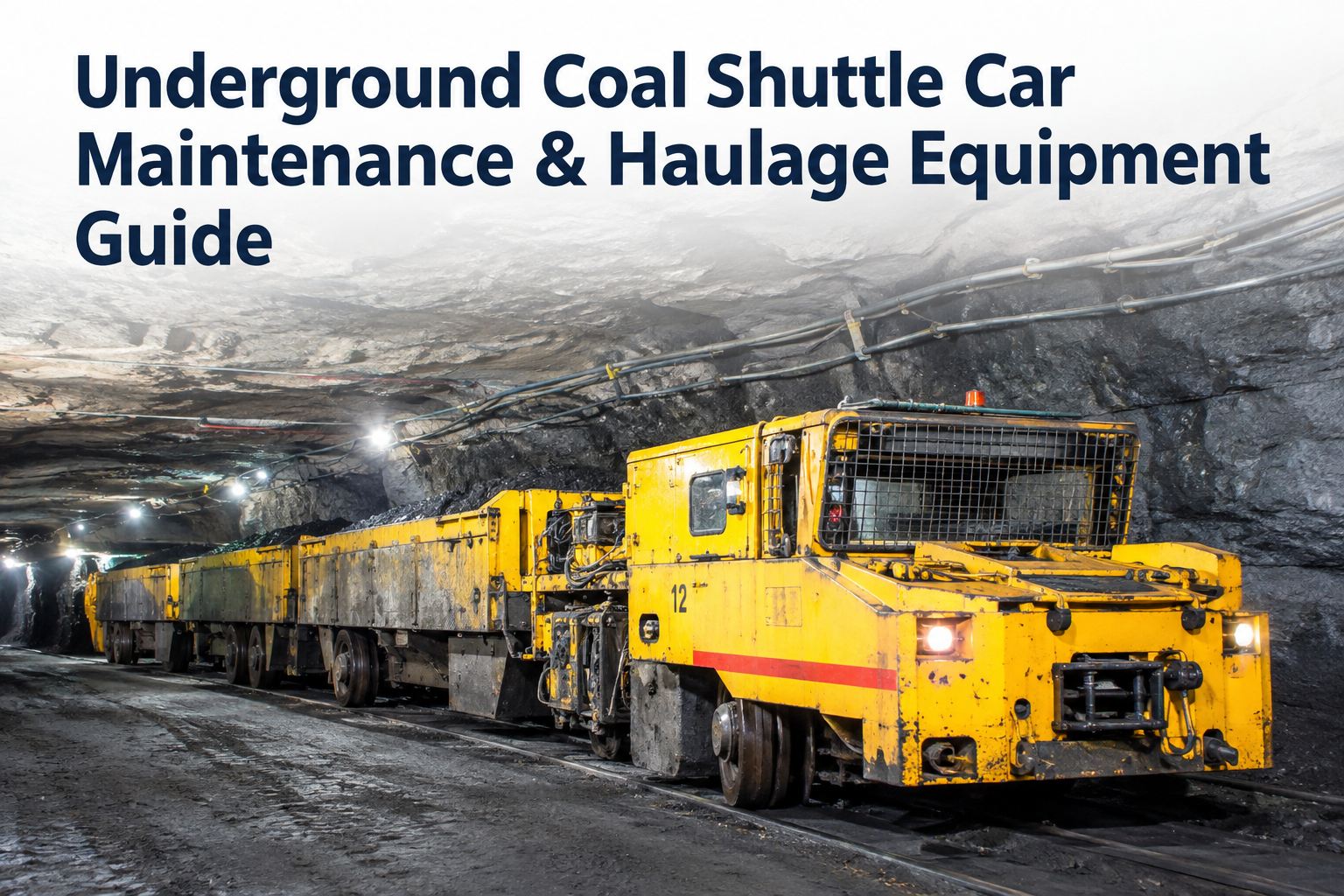
A shuttle car does the same thing a few hundred times a shift: tram to the miner, take a load, tram back, dump onto the belt, repeat. That relentless short-cycle duty is why underground coal shuttle car maintenance is really about the things the cycle chews up first — the trailing cable dragged over the floor, the brakes that stop a loaded car in a confined entry, the conveyor chain that empties it. Miss a defect on any of those and you don't just lose a machine, you can stall the whole section behind the miner. This guide walks the systems that actually fail and how a shuttle car inspection turns into a maintenance action. Book a demo to see it on your own car templates.
The four systems that decide a shuttle car's shift
Pick a system. See what it does, what wears it out down here, and the failure to catch before it strands the car.
Trailing cable & reel
The car's lifeline: a high-voltage reeling cable paid out and reeled in by a hydraulic reeler as the car trams. It's also the single biggest source of shuttle car downtime and one of its most serious hazards.
Braking system
A loaded car has to stop reliably in a tight, congested entry with people and other equipment nearby. Hydraulic brakes with a brake-pressure switch in the circuit do that work, cycle after cycle.
Discharge conveyor
The chain-and-flight conveyor running the length of the car moves the load in during loading and pushes it out at the belt. High-wear, high-duty, and the reason a "healthy" car can still fail to empty.
Steering & tramming
Four-wheel drive with hydraulic steering linking both ends so the car trams and turns in either direction without turning around. Steering arms, drag links, and the cross shaft take constant reversing loads.
Every one of these is a different wear pattern with a different fix — which is exactly why a generic vehicle checklist misses what matters on a shuttle car. Book a demo to see a car-specific template with these checkpoints built in
Section haulage lives and dies on the shuttle car. When one goes down mid-shift, the continuous miner behind it fills its surge and stops cutting, and the whole unit's production waits on a machine that's usually stranded somewhere it's hard to reach. That's why shuttle car maintenance isn't a shop-schedule afterthought — the inspection at the start of the cycle is the cheapest place to catch what the cycle is about to break.
Why the trailing cable is the machine's weak point
Ask any section crew what puts a shuttle car down most often and the answer is the cable. It gets run over by the car's own wheels, crushed against the rib, pinched at change-out points, and snagged as the reel pays it out and hauls it back through every tram. Unlike a bolt-on part, the cable is in motion the entire shift, dragging across a rough floor in coal dust — so it accumulates damage no walk-around from ten feet away will catch.
The stakes are higher than downtime. A damaged cable can arc, and underground that arc can ignite methane or set off a coal-dust fire. Protective relays isolate power on earth leakage or a broken ground conductor, but the relay is the last line, not the first — the first is a close, hands-on cable and reel inspection that flags a nick or a crushed section before it becomes exposed conductor. Documenting cable condition with a dated photo at each inspection turns "the cable looked rough" into a tracked, trendable defect. Start a free trial and cable checkpoints become a required, photo-backed step instead of a glance.
Cable-reel vs. battery haulers: different machines, different checklists
Not all section haulage is tethered. Battery-powered shuttle cars and battery haulers cut the cable out of the picture — and with it, the single biggest maintenance headache. But they trade it for a different set of items, so running one template across both is a mistake.
- Trailing cable & reel condition dominate the inspection
- Cable arc / methane-ignition risk to manage
- Reeler hydraulics and cable cut-off switches to verify
- Travel range tied to cable length and anchor points
- Battery condition, charging, and connectors take center stage
- No trailing cable to run over — but battery-handling hazards instead
- Charge cycles and state-of-health to track over time
- Free-roaming range changes traffic and proximity exposure
The shared items — brakes, discharge conveyor, steering, lighting, and any fitted proximity or collision-warning system — still need checking on both. But the machine-defining system is different, and the template should reflect it. A configurable template per asset means the cable-reel car gets its cable checkpoints and the battery hauler gets its battery checkpoints, without either crew wading through items that don't apply. Book a demo to see separate templates per haulage type
Meter-based PM: maintaining to the cycle, not the calendar
A shuttle car on a hard-running unit and one on a light section rack up wear at completely different rates, so a flat calendar schedule either over-services the light car or under-services the hard one. Meter-based preventive maintenance ties the PM to actual utilization — hours or cycles run — so the reeler service, conveyor chain check, and brake service come due when the machine has earned them, not when a month happens to end.
That matters most on the high-wear systems. The discharge conveyor chain stretches with load cycles, not days. The cable takes its damage per tram, not per week. Pinning PM to the meter means the intervals track the reality of a high-utilization machine, and the schedule tightens automatically when the unit runs hot. Confirm the specific intervals and any regulatory examination frequencies that apply to your equipment and mine with the manufacturer and the applicable authority, then build them into the schedule. Book a demo to see meter-based PM triggered off each car's hours
From defect to done: what a shuttle car inspection should trigger
An inspection that only produces a checkmark is wasted effort. The value is in what happens after a defect is found — the severity call, the out-of-service decision, the routing to a work order, and the verification that the fix actually held. On a machine as production-critical as a shuttle car, that chain has to be fast and it has to be provable.
When a recurring steering pull or a repeat conveyor jam shows up, the asset history makes the pattern visible — the same fault three times in a month is a component problem, not three separate incidents, and the record is what tells you that. That's the difference between chasing symptoms and fixing the machine.
From a section maintenance lead who runs cable cars
Cables were killing us. We'd lose a car mid-shift, drag a spare in, and half the time the "spare" had a cable somebody wrote up two weeks ago that never got fixed because the note lived on a clipboard in the dinner hole. The miner sat while we sorted it out.
Putting the cable check on the car's record with a photo changed how we run the section. Now a flagged cable is a work order the same shift, and I can see which car keeps eating cable and go find out why — usually a change-out point where they keep running over it. The inspection stopped being paperwork and started telling me where my downtime actually comes from.
Shuttle car maintenance FAQs
What is the most common cause of shuttle car downtime?
On cable-reel shuttle cars, the trailing cable is consistently the largest single source of downtime. Because the cable is paid out and reeled back in through every tramming cycle and drags across a rough floor in confined roadways, it is exposed to being run over by the car's own wheels, crushed against the rib, pinched at change-out points where cars pass, and snagged as the reel works. That constant motion accumulates cuts, crush damage, and eventually exposed conductors far faster than any bolt-on component wears. Beyond lost production, a damaged cable is a safety hazard: it can arc, and in a gassy underground coal environment an arc is a potential ignition source for methane or coal dust. This is why a close, hands-on cable and reel inspection each cycle—not a distant glance—is the highest-value check on the machine, and why documenting cable condition with dated photos helps catch damage before it becomes a failure or a hazard.
What should a shuttle car inspection checklist cover?
A shuttle car inspection should be organized by system rather than as a generic vehicle walk-around. Core areas include the trailing cable and reel arrangement (cuts, crush damage, exposed conductors, reeler function, cable cut-off switches); the braking system (stopping performance, hydraulic pressure, leaks); the discharge conveyor (chain wear and stretch, flights, drive sprockets, buildup); steering and tramming (linkage wear, drag links, cross shaft, recurring pull, traction and gearbox condition); tires or traction components; lighting and visibility; any fitted proximity detection or collision-warning system; and electrical components subject to applicable permissibility requirements. Battery-powered haulers replace the cable and reel items with battery condition, charging, and connector checks. Because each system fails differently and carries different severity, the checklist should let a defect drive a clear out-of-service decision on safety-critical items like brakes and cable damage, and route the rest to a work order with appropriate priority.
How is a battery shuttle car different to maintain than a cable-reel car?
The defining difference is the power source, and it reshapes the inspection. A cable-reel car's maintenance centers on the trailing cable, reel, and reeler hydraulics—the highest-wear, highest-hazard systems on that machine. A battery-powered hauler removes the cable entirely, eliminating run-over and cable-arc concerns, but shifts the focus to battery condition, charging systems, connectors, and state-of-health tracked over charge cycles, along with the battery-handling hazards that come with it. A cable car's travel is limited by cable length and anchor points, while a battery hauler roams more freely, which changes traffic patterns and can change proximity and collision exposure on the section. Shared systems—brakes, discharge conveyor, steering, lighting, and any collision-warning system—need checking on both, but running one identical template across both machine types either buries a crew in irrelevant items or misses the ones that matter. Configurable, machine-specific templates handle this cleanly.
Should shuttle car PM be scheduled by calendar or by meter?
Meter-based preventive maintenance—scheduling by hours or cycles run—generally fits shuttle cars better than a flat calendar because utilization varies widely between a hard-running unit and a light section. The highest-wear systems wear by use, not by time: the discharge conveyor chain stretches with load cycles, the reeler and cable take damage per tram, and brakes wear per stop. Tying PM intervals to the meter means services come due when the machine has actually earned them, so a busy car is serviced more often and a lightly used one isn't over-serviced. A purely calendar-based schedule tends to either over-maintain low-use machines or let high-use machines run past the point where a component should have been checked. Many operations use a hybrid—meter-based intervals for wear items plus calendar or regulatory-driven checks where a fixed frequency applies. Confirm the specific intervals for your machines with the manufacturer, and verify any examination frequencies required by the applicable mining authority.
Why do shuttle cars need offline inspection capture?
Shuttle cars work at and near the mining face, deep in the section where there is typically no cellular or Wi-Fi signal. If an inspection tool only works online, crews fall back to paper underground and re-enter it later—or skip the documentation—which is exactly how a cable defect noted at the face never reaches surface maintenance until the car fails. Offline inspection capture lets the operator or maintainer complete the full inspection, including photos of a damaged cable or worn conveyor chain, right at the machine with no signal, then sync automatically when the device comes back into coverage. The result is that the defect, its severity, and its photo evidence are recorded at the point and time they were found, the out-of-service decision happens immediately, and the record is intact and searchable rather than sitting on a clipboard in the dinner hole. For section haulage, where a stranded car stalls the whole unit, closing that gap between finding a defect and acting on it is where most of the value is.
Turn shuttle car inspections into maintenance actions that stick
HVI puts shuttle-car-specific templates, configurable cable and component checkpoints, photo evidence, offline capture for the face, meter-based PM, defect-to-work-order routing, and full asset history on one platform — so a crushed cable flagged this shift becomes a work order this shift, and the car that keeps eating cable stops being a mystery. See it on your own section haulage.
No credit card · Car templates ready on day one · Works offline underground