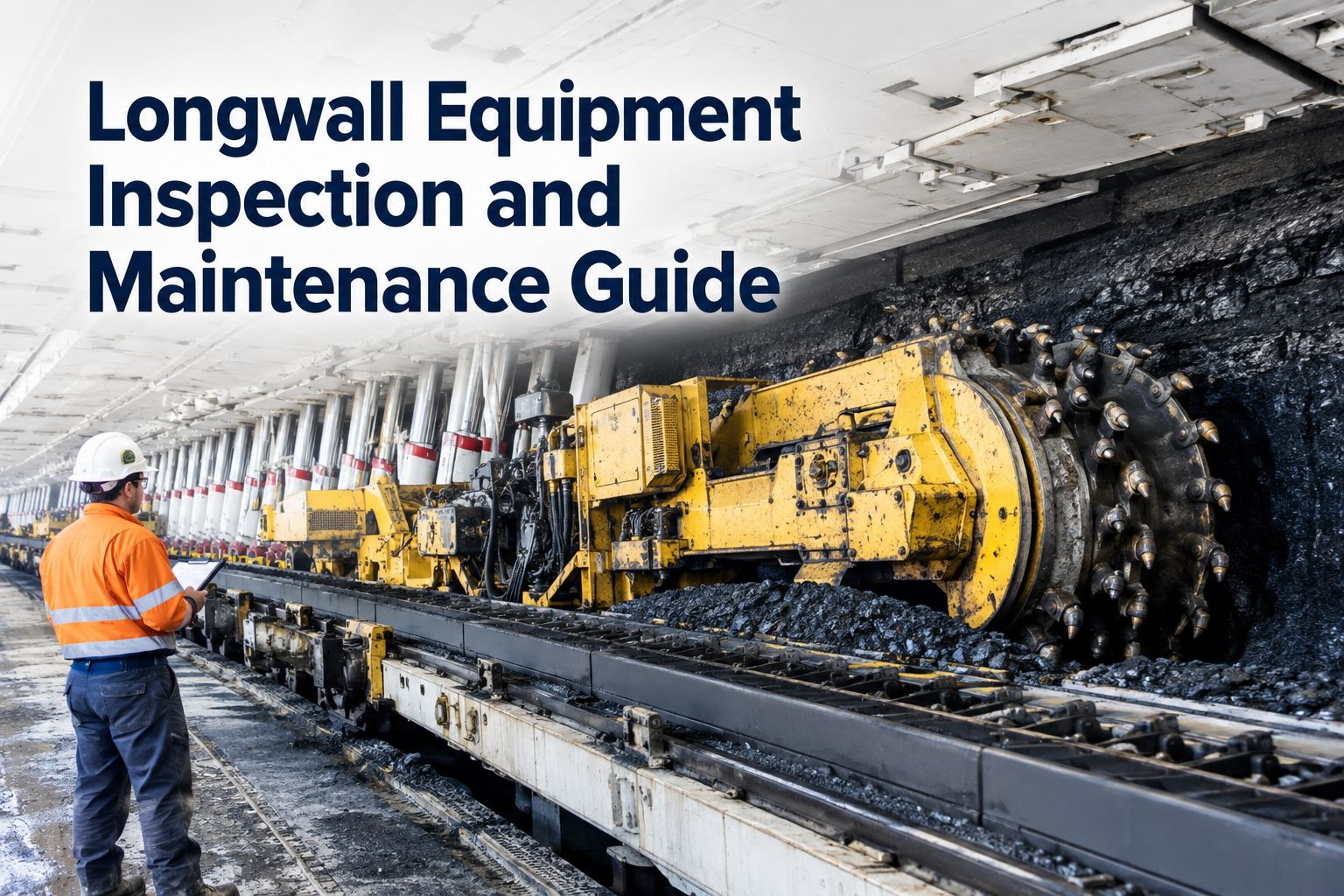
A hydraulic hose fails on one powered roof support out of two hundred. On any other operation that's a single-unit repair. On a longwall, the entire coal face stops — because the shearer, the supports, and the conveyor are one machine spread across three hundred meters, and there is no second face to switch to. That's what makes longwall equipment maintenance a discipline of its own: you're not maintaining a fleet of assets, you're protecting the availability of one integrated system. This guide covers the critical components, how to inspect them, and how to keep the face producing. Book a demo to see longwall maintenance managed as a system.
One Machine, Three Hundred Meters, No Spare
The shearer cuts, the roof supports advance, the conveyor moves the coal and carries the shearer — a synchronized cycle where every component depends on the others. Take any one out and the whole face stops. Maintenance isn't about assets; it's about availability.
A longwall is the most productive method in underground coal — and the least forgiving. A single face can run 150 to 300 powered roof supports, a multi-tonne shearer, and an armored face conveyor moving thousands of tonnes an hour, all working as one continuous system with no redundancy. That's the trade-off: enormous output when it runs, a total production stop when any critical link fails. Effective longwall equipment maintenance is built entirely around that reality — keeping the integrated system available rather than treating each machine in isolation.
The three critical systemsshearer, roof supports, and AFC
Longwall equipment maintenance starts with the three components that define the face. Each one both drives production and, if it fails, stops it — so each needs its own focused inspection regime. Here's what each does and what you're inspecting for.
The cutting machine that travels the face, shearing coal with rotating drums. Inspect cutting picks and drums for wear and damage, haulage and traction systems, water sprays for dust suppression, and the electrical and cooling systems on the machine. Worn picks don't just cut poorly — they raise vibration, heat, and dust, accelerating other failures.
The electro-hydraulic shields — often 150 to 300 of them — that hold up the roof and advance the whole system forward. Inspect hydraulic legs and cylinders for leaks and pressure loss, canopy and base structure for damage, and the electro-hydraulic control valves and connections. A support that won't set or advance breaks the cycle and exposes the roof.
Moves the cut coal to the maingate and doubles as the rail the shearer rides. Inspect the chain and flight bars for wear and tension, the drive sprockets and gearboxes at the maingate and tailgate, and the pans and rack bar the shearer runs on. A thrown or broken chain is one of the longest stoppages on the face.
These three don't fail independently — a worn AFC chain strains the drives, a sagging roof support misaligns the pan line, a hard-cutting shearer hammers everything around it. Inspecting them as an interconnected system, not three separate machines, is what catches the failure that's about to cascade. Book a demo to build inspection templates for each face system
Hydraulics & the support fleetmanaging 200 units that all matter
The powered roof supports deserve their own focus, because they're where longwall maintenance meets a genuine scale problem. A face might carry 200-plus supports, each an electro-hydraulic machine with legs, valves, sensors, and connections — and each one matters, because the roof is only as supported as its weakest shield. You can't treat them as one asset, and you can't realistically hand-track two hundred of them on paper either.
Legs holding set pressure, cylinders free of leaks, and hoses and fittings intact. A pressure-loss pattern across nearby supports often signals a developing problem before any single unit fails.
Valves, solenoids, and control connections that let supports set and advance automatically. Faults here break the automated cycle and force slow manual operation.
Every support tracked individually, so a repeat-offender shield — one that keeps losing pressure or throwing valve faults — is visible and can be scheduled for attention before a move.
This is exactly where custom inspection templates and per-asset records earn their place: a structured check that a crew can run down the face, logging each support against its own history, turns two hundred anonymous shields into a managed fleet where the weak units surface early. Start free and track every roof support as its own asset
PM that protects availabilityservicing on duty cycle, not guesswork
Because there's no spare face, unplanned downtime on a longwall is the most expensive event in the operation — every hour the face is stopped is production lost that can't be made up elsewhere. That flips the maintenance philosophy: the goal isn't to minimize maintenance, it's to make sure failures happen on your schedule during planned windows, not on the coal's schedule during a shift. Preventive maintenance driven by real duty cycle is how you get there.
Longwall components wear by use, not by calendar. A shearer that cut hard tonnage all week is due before one that idled; AFC chain stretch tracks tonnes moved; roof-support cycles accumulate with every advance. Meter- and runtime-based PM — triggering service on cutting hours, tonnage, or cycle counts rather than a fixed date — matches the maintenance to the actual load each component carried. That precision is what lets you retire a wearing part during a planned maintenance shift instead of discovering it when it strands the face mid-production. Pair that with condition signals — vibration, temperature, pressure trends — and you shift from reacting to failures toward catching them while they're still developing. Book a demo to set up meter-based PM on face equipment
Parts & the longwall moveplanning the shutdowns that make or break output
Two planned events dominate longwall maintenance economics: routine maintenance windows and the longwall move — relocating the entire face to a new panel, one of the most demanding jobs in underground mining. Both live or die on preparation, and both are where good record-keeping turns into real recovered production.
Underground, a part you don't have is a face you can't run. Your inspection and failure history reveals exactly which components wear — picks, chain, seals, valves, hoses — so those critical spares are stocked and staged before a maintenance window, turning a potential multi-shift stoppage into a planned swap.
A longwall move is a massive coordinated shutdown. Planning it against complete equipment records — what's due, what's worn, what needs replacing while access is easy — lets you fold overdue work into the move instead of taking a separate stoppage later. Every deferred job done during a planned window is a stoppage you never take mid-production.
The connecting thread across all of it is records. When inspections, meter readings, failure history, and parts all live in one system, a maintenance window becomes a data-driven plan — you walk in knowing exactly what to service, what to replace, and what spares are staged — instead of a hopeful list. That's how a single-face operation protects the availability its entire output depends on. Book a demo to plan shutdowns against live equipment records Or start free and bring your longwall records into one system
From a maintenance planner on the face
People outside underground don't get it — one shield out of two hundred losing pressure can stop the whole face. There's no running the other line, because there is no other line. So my whole job is making sure nothing fails when the coal's moving. It all has to break on my calendar, not on its own.
What changed things for us was tracking every support and running PM off cutting hours and tonnage instead of dates. The weak shields started showing up in the data weeks before they'd have stranded us, and we rolled those fixes into the next planned window. Our availability climbed and stayed there. On a longwall, availability is the only number that matters, and it's built entirely out of the maintenance you did before the stoppage, not after.
Frequently asked questions
What are the main components of a longwall system?
A longwall mining system has three critical, interconnected components. The shearer is the cutting machine that travels back and forth along the coal face, removing coal with rotating cutting drums. The powered roof supports — also called hydraulic shields, and typically numbering 150 to 300 on a single face — are electro-hydraulic units that hold up the roof over the working area and advance the entire system forward as mining progresses. The armored face conveyor (AFC) runs the length of the face, carrying the cut coal to the maingate while also serving as the rail the shearer rides along. These three work as one synchronized cycle: the shearer cuts a web of coal, the roof supports advance to support the newly exposed roof, and the supports then push the AFC toward the face so the shearer can take the next cut. Supporting equipment includes the beam stage loader that transfers coal from the AFC to the main belt, plus the drives, gearboxes, and electro-hydraulic control systems that run it all. Because the components depend on each other, the failure of any one can halt the entire face.
Why is longwall equipment maintenance so critical?
Because a longwall is a single integrated system with no redundancy, so the consequence of a failure is uniquely severe. On most equipment-heavy operations, if one machine goes down, work continues with others. On a longwall, the shearer, roof supports, and AFC form one continuous production line spread across the width of the face — often several hundred meters — and if any critical component fails, the whole face stops. There is no second face to switch to. A single powered roof support losing pressure, a thrown AFC chain, or a shearer haulage fault can each halt thousands of tonnes per hour of production. That means unplanned downtime is the most expensive event in the operation, and every hour the face is stopped is output that generally can't be recovered elsewhere. As a result, longwall maintenance is oriented entirely around protecting system availability rather than minimizing maintenance activity. The objective is to ensure that component wear and failures are caught early and addressed during planned maintenance windows, so the face keeps running when coal is being cut.
How often should longwall equipment be inspected?
Longwall equipment is inspected on a layered schedule rather than a single interval, because the components carry very different duty. Routine visual and functional checks of the shearer, roof supports, and AFC are typically performed frequently — often each shift or daily — focusing on the items most likely to cause a stoppage or a safety issue, such as hydraulic leaks, chain condition, cutting picks, and control faults. Beyond those routine checks, more thorough preventive maintenance is best driven by actual duty cycle rather than the calendar, since longwall components wear by use: shearer service tracks cutting hours and tonnage, AFC chain wear tracks tonnes moved, and roof-support maintenance tracks advance cycles. Triggering service on these meters ensures a hard-worked component is attended to before a lightly used one, matching effort to real load. Many operations also layer in condition monitoring — vibration, temperature, and pressure trends — to catch developing faults between scheduled checks. The most demanding inspection and overhaul work is often concentrated around planned shutdowns and the longwall move, when access is easiest. The right cadence combines frequent routine checks, duty-based PM, condition signals, and shutdown-based major work.
What is a longwall move and how does maintenance factor in?
A longwall move is the relocation of the entire longwall system — the shearer, all of the powered roof supports, the AFC, and supporting equipment — from a mined-out panel to a new one, and it's considered one of the most demanding logistical operations in underground mining. It requires disassembling, transporting, and reinstalling hundreds of tonnes of equipment underground, and it represents a major planned production stoppage. Maintenance factors in heavily because the move is the ideal window to perform work that's difficult or impossible while the face is producing: components can be inspected with full access, worn parts replaced, and overdue overhauls completed while the equipment is being handled anyway. Planning the move against complete, current equipment records — knowing exactly what's due, what's worn, and what should be replaced while access is easy — lets an operation fold deferred and upcoming maintenance into the move rather than taking a separate stoppage for it later. This is where good record-keeping directly converts into recovered production: every job done during the planned move is a stoppage the operation never has to take mid-production. Staging the right critical spares in advance, informed by failure history, is equally essential, since a missing part during a move extends the single most costly downtime event in the cycle.
How does software help manage longwall maintenance?
Maintenance software addresses the specific challenges that make longwall maintenance hard: scale, interdependence, and the extreme cost of downtime. First, it allows every asset — including each individual roof support out of a fleet of two hundred or more — to be tracked with its own inspection and maintenance history, so a repeat-offender unit that keeps losing pressure or faulting is visible in the data rather than lost in a paper pile. Custom inspection templates let crews run structured, consistent checks on the shearer, the supports, and the AFC, capturing defects against the right asset. Meter- and runtime-based preventive maintenance triggers service on real duty — cutting hours, tonnage, cycle counts — instead of fixed dates, matching maintenance to actual wear and catching components before they strand the face. Parts and inventory tracking, informed by that failure history, ensures the critical spares that wear on your equipment are stocked before a maintenance window rather than discovered missing during one. And shutdown planning tools turn a maintenance window or a longwall move into a data-driven plan built from live equipment records, so the operation walks in knowing what to service, what to replace, and what's staged. Together these protect the system availability that a single-face operation's entire output depends on.
Keep the coal face available, shift after shift
HVI manages the longwall as the single integrated system it is — custom inspection templates for the shearer, every roof support, and the AFC; meter-based preventive maintenance tied to cutting hours and tonnage; critical-spares tracking driven by your real failure history; and shutdown planning that turns maintenance windows and longwall moves into data-driven plans. Failures happen on your schedule, in planned windows — not on the coal's. Live in under two weeks.
No credit card · Per-asset tracking & shutdown planning from day one · Built for underground operations