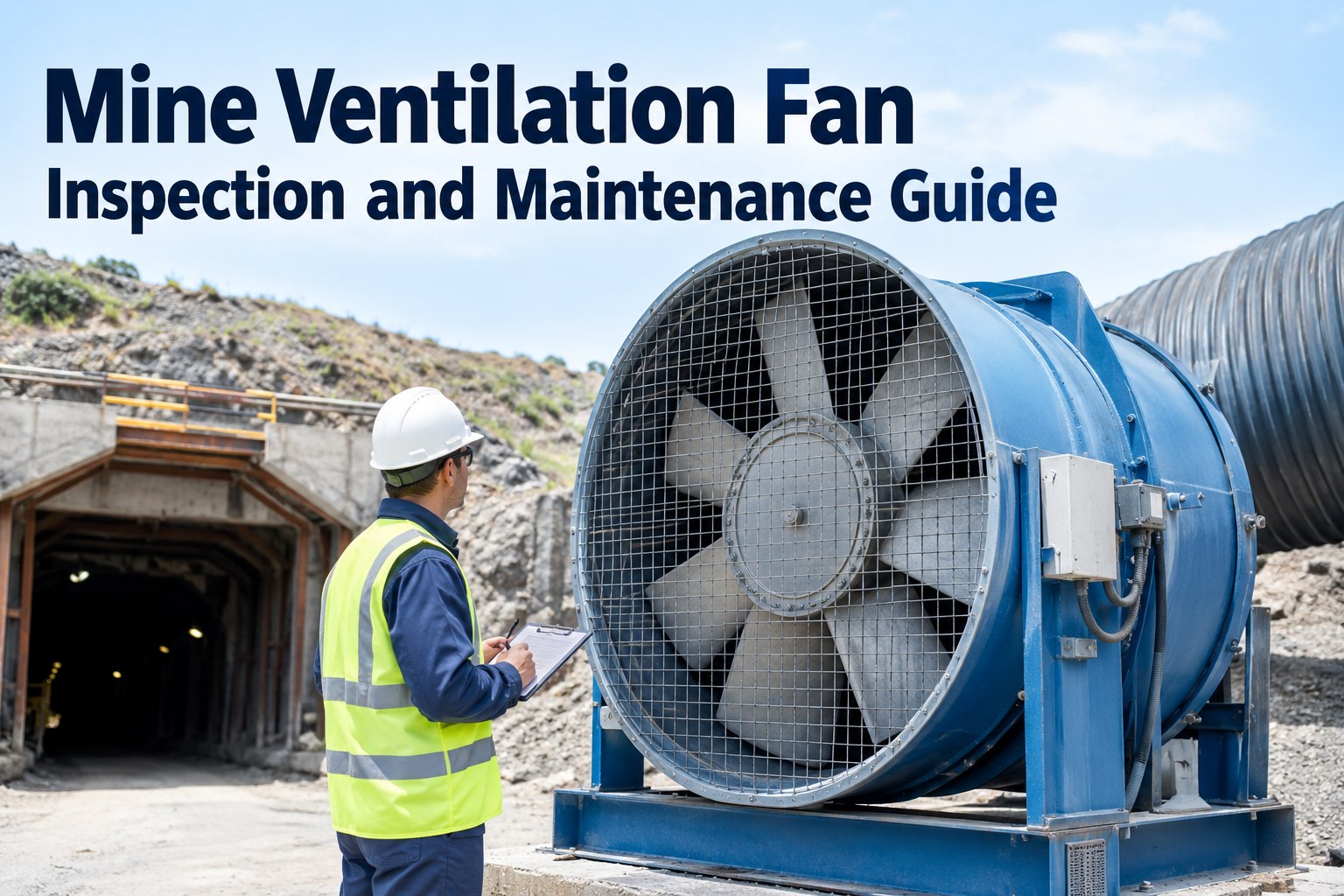
A bearing on the main fan starts to go. For three weeks it announces itself — a creeping rise in vibration that every sensor on the machine can see. Nobody's reading the trend, so it stays invisible until the fan trips, and now the whole mine is losing the air it breathes. Mine ventilation fan maintenance lives and dies on catching that signal. Fans warn you through vibration long before they fail, and the entire discipline is learning to read that warning — against how the fan is actually being run, not a fixed number on a gauge. This guide covers the fan hierarchy, what to inspect, and how vibration tells you what's coming. Book a demo to see fan condition trended intelligently.
Three Tiers of Fans Move the Air a Mine Breathes
Ventilation isn't one fan — it's a connected network. Primary fans set the whole-mine airflow, booster fans push it through deep and distant sections, and auxiliary fans reach the dead-end headings nothing else can. Each tier fails differently, and each one matters to the air below.
Underground ventilation fans are life-safety infrastructure. They supply breathable air, dilute and sweep out methane, carbon monoxide, diesel particulate, and dust, and keep hazardous gas concentrations below dangerous levels. A loss of ventilation isn't a production problem — it's an atmosphere problem, and in a gassy coal mine it can become an explosion risk. That's why fan maintenance is treated as critical, and why the goal is always the same: catch a developing fault early enough to fix it on a plan, never on an emergency. Below is how the fan network is built, what to inspect, and how vibration reveals trouble before it arrives.
The fan hierarchythree roles, three failure profiles
Mine ventilation fan maintenance starts with understanding that not all fans are the same job. The three tiers carry different loads, sit in different places, and fail in different ways — so each needs its own inspection focus. And because they form one connected airflow network, a change or fault in one tier ripples through the others.
The large surface fans that establish airflow across the entire mine — the heart of the system. They run continuously at high capacity, so their bearings, drives, and impellers accumulate duty relentlessly. A main-fan failure affects the whole mine at once, which is why they're the most heavily monitored and often the most redundant.
Installed underground at strategic points to overcome resistance and maintain air velocity in deep, distant, or heat- and gas-prone sections the main fan can't fully pressurize alone. Mounted in bulkheads or hung from the backs, they work in dust, moisture, and corrosive air — so access for inspection and impeller cleaning is a real design and maintenance concern.
Secondary fans that push air through ducting into dead-end development headings and working faces a primary circuit can't reach. They're the closest fans to where people work, so their reliability is immediate and personal — and because they're often numerous and moved frequently, they're the easiest tier to lose track of without per-unit records.
Because they interact, ventilation is a balance, not a set of independent machines — adjusting or losing one fan shifts airflow and pressure across the network. That's a maintenance insight as much as a ventilation one: a fan's readings only make sense in the context of how the whole system is being run. Book a demo to track every fan tier as its own asset
Vibration is the languagehow a fan tells you what's wrong
If pumps warn you mainly through flow and pressure, fans speak through vibration. A ventilation fan is a large rotating mass spinning continuously, and almost every mechanical problem it can develop shows up first as a change in how it vibrates. Learning to read that vibration — ideally through spectrum analysis, not just an overall level — is the single most powerful tool in fan condition monitoring, because the pattern points to the specific fault.
Dust and material build-up on the impeller, or blade wear, throws the rotor out of balance — a leading cause of fan vibration, and often fixed by cleaning or rebalancing.
Motor and fan shaft out of true shows a distinct signature — catching it early prevents the accelerated bearing and coupling wear it causes.
Worn or failing bearings emit rising amplitude in characteristic frequency bands — the earliest reliable warning of the most common serious fan failure.
Loose mounts, fasteners, or housing components create their own vibration pattern — cheap to fix if caught, damaging if left to shake the machine apart.
Left unread, rising vibration doesn't stay contained — it drives up motor current, overheats components, accelerates wear across the machine, and ends in the catastrophic failure and unplanned downtime you were trying to avoid. Read early, each pattern points to a targeted, planned fix: clean the impeller, correct the alignment, replace the bearing before it seizes. Start free and trend vibration on every fan
Read vibration in contextwhy a fixed limit causes false alarms
Here's the nuance that separates good fan monitoring from frustrating fan monitoring: a fan's vibration isn't only a function of its mechanical health — it also changes with how hard the fan is working. When ventilation demand rises and a fan runs at higher airflow and pressure, its vibration naturally increases even if nothing mechanical is wrong. Judge that against a single fixed vibration limit and you get false alarms every time the mine's ventilation load changes.
This matters because false alarms are corrosive — chase enough of them and crews start ignoring the alarm that finally means something. The better approach reads vibration in context: comparing the current vibration to what's expected given the fan's actual airflow, pressure, and motor load, so you're flagging the vibration that's genuinely abnormal for the conditions rather than just high. In practice, that means trending each fan's normal operating behavior over time and watching for the departures from its own baseline — the residual that a load change doesn't explain. That's the difference between a monitoring system crews trust and one they mute. The foundation is simply having the history: enough of each fan's own data, across enough operating conditions, to know what normal looks like for that machine. Book a demo to see fan condition trended against its own baseline
The maintenance programinspection, PM, and turning findings into fixes
Condition monitoring catches what's developing; a structured maintenance program handles the rest. Effective ventilation fan maintenance layers routine inspection with runtime-based service and a reliable path from finding a problem to fixing it.
Check blades and impeller for wear, cracking, and material build-up; belts, drives, and couplings for condition; bearings and lubrication; ducting and housing integrity; and electrical controls. Impeller cleaning matters especially underground, where dust build-up drives imbalance.
Lubrication, bearing service, belt and coupling replacement, and drive maintenance scheduled on actual running hours. Auto-greasing systems and accessible designs extend intervals, but the schedule should follow real duty, not a fixed date.
Every fault an inspection or vibration alert surfaces should route straight to the shop as a work order — no fault sitting in a notebook waiting to be forgotten. This is the step that converts detection into an actual fix.
Patterns across all fans — recurring failure modes, which units run hot, bearing life by location — inform better intervals, spares holdings, and replacement decisions across the whole ventilation network.
The connective tissue, as with any critical rotating equipment, is records in one place: each fan's inspections, vibration and temperature trends, runtime, and defect history together. That's what makes the program predictive rather than reactive — you service on real wear, read vibration against real baselines, and never let a detected fault fall through the gap between finding it and fixing it. Book a demo to run fan PM and defect routing from one system Or start free and bring your fan network into one record
From a reliability engineer on ventilation
We had vibration alarms on the main fans for years and the crews had learned to ignore them — because every time production ramped up and the fan worked harder, the alarm went off and nothing was wrong. The alarm had cried wolf so many times it was useless.
The fix wasn't a better sensor, it was better context. Once we trended each fan against its own normal behavior at different loads, the noise dropped away and the real signal stood out. When a bearing actually started to go, the residual climbed in a way the load change couldn't explain, and we caught it with weeks to spare. On ventilation, a fan you catch early is a planned outage. A fan you miss is the whole mine losing air. There's no in-between worth having.
Frequently asked questions
Why is mine ventilation fan maintenance so important?
Because ventilation fans are life-safety infrastructure, not just production equipment. Underground fans supply the breathable air a mine depends on and continuously dilute and remove hazardous gases and contaminants such as methane, carbon monoxide, diesel particulate, and dust, keeping their concentrations below dangerous levels. A loss of ventilation is therefore an atmosphere problem: air quality deteriorates, hazardous gases can accumulate, and in a gassy coal mine the loss of ventilation can create an explosion risk. Because a main fan failure affects the entire mine at once, the consequences of an unplanned fan outage are severe and immediate. Ventilation fans also run continuously in harsh underground conditions — dust, moisture, vibration, and corrosive air — which steadily wears bearings, impellers, drives, and controls. The combination of high consequence and constant wear is why fan maintenance is treated as critical and why the objective is always to detect a developing fault early enough to address it during a planned window rather than in an emergency. Proactive inspection, condition monitoring, and disciplined preventive maintenance are what keep the air moving safely.
What are the main types of mine ventilation fans?
Mine ventilation uses three main tiers of fans that work together as a connected airflow network. Primary or main fans are the large, high-capacity fans — usually on the surface — that establish airflow across the entire mine and set the baseline for air exchange; they are the heart of the system, and a failure affects the whole mine. Booster fans are installed underground at strategic points to overcome airflow resistance and maintain air velocity in deep, distant, or heat- and gas-prone sections that the main fan cannot fully pressurize on its own; they are commonly mounted in bulkheads or hung from the backs. Auxiliary fans are secondary fans that deliver air through ducting into dead-end development headings and working faces that a primary ventilation circuit cannot reach on its own — they are the fans closest to where people are working. Some systems also use dedicated exhaust fans to extract contaminated air to the surface, and increasingly fans are fitted with variable-frequency drives to match airflow to real-time demand and save energy. Because the tiers interact, adjusting or losing any one fan shifts airflow and pressure across the whole network, so ventilation must be managed as a balanced system.
How does vibration monitoring help maintain ventilation fans?
Vibration monitoring is the most powerful condition-monitoring tool for ventilation fans because a fan is a large continuously rotating mass, and nearly every mechanical problem it can develop shows up first as a change in vibration. By placing vibration sensors at critical points — bearings, shafts, and motor mounts — and analyzing the data, ideally through spectrum analysis rather than just an overall level, maintenance teams can identify the specific developing fault from its characteristic pattern. Rotor imbalance, often caused by dust build-up on the impeller or blade wear, is a leading source of vibration and is typically corrected by cleaning or rebalancing. Shaft misalignment between the motor and fan shows a distinct signature and, caught early, prevents the accelerated bearing and coupling wear it causes. Bearing defects produce rising amplitude in characteristic frequency bands and are the earliest reliable warning of the most common serious fan failure. Structural looseness in mounts or housing creates its own pattern. Left unaddressed, rising vibration increases motor current, causes overheating, accelerates wear, and can end in catastrophic failure. Caught early through monitoring, each pattern points to a targeted, planned repair scheduled before the fan fails.
Why do fixed vibration limits cause false alarms on fans?
Because a fan's vibration depends not only on its mechanical health but also on how hard it is working. When ventilation demand rises and a fan operates at higher airflow, pressure, and motor load, its vibration naturally increases even when nothing mechanical is wrong. If that vibration is judged against a single fixed limit, the fan will trip alarms every time the ventilation load increases, generating frequent false alarms that have nothing to do with mechanical degradation. This is a real problem because false alarms erode trust: when crews see repeated alarms that turn out to be nothing, they start to ignore the alarm that finally does matter. The more reliable approach reads vibration in context by comparing the current level to what would be expected given the fan's actual operating conditions — airflow, pressure, and electrical load — and flagging only the vibration that is genuinely abnormal for those conditions. Practically, this means trending each fan against its own baseline behavior across a range of operating conditions and watching for departures a load change cannot explain. That condition-normalized view is what turns vibration monitoring from a source of nuisance alarms into a trusted early-warning system, and it depends on having enough of each fan's own history to know what normal looks like.
What should a ventilation fan maintenance program include?
A strong ventilation fan maintenance program layers several elements. Routine inspection covers the blades and impeller for wear, cracking, and dust build-up; belts, drives, and couplings; bearings and lubrication; ducting and housing integrity; and electrical controls — with impeller cleaning being especially important underground where dust drives rotor imbalance. Condition monitoring, centered on vibration along with temperature and bearing condition, trends each fan's health over time and, read against the fan's own operating baseline, catches developing faults early. Preventive maintenance — lubrication, bearing service, belt and coupling replacement, drive maintenance — should be scheduled on actual running hours rather than fixed calendar dates so effort matches real duty, with auto-greasing and accessible designs helping extend intervals. A reliable defect-to-work-order path ensures that any fault an inspection or vibration alert surfaces is routed straight to the shop as a work order rather than being forgotten, converting detection into an actual repair. Finally, analytics across the whole fan network reveal patterns — recurring failure modes, units that run hot, bearing life by location — that inform better maintenance intervals, spares holdings, and replacement decisions. Keeping every fan's inspections, condition trends, runtime, and defect history together in one system is what makes the program predictive rather than reactive.
Catch a failing fan weeks before the mine loses air
HVI tracks every primary, booster, and auxiliary fan as its own asset, trends vibration and temperature against each fan's real operating baseline, schedules preventive maintenance on actual runtime, and routes every detected fault straight to a work order. Fleet analytics show you which fans are drifting before they fail. The rising vibration that would have been ignored becomes a planned bearing replacement — not a mine-wide ventilation emergency. Live in under two weeks.
No credit card · Per-fan condition monitoring & PM from day one · Built for underground operations worldwide