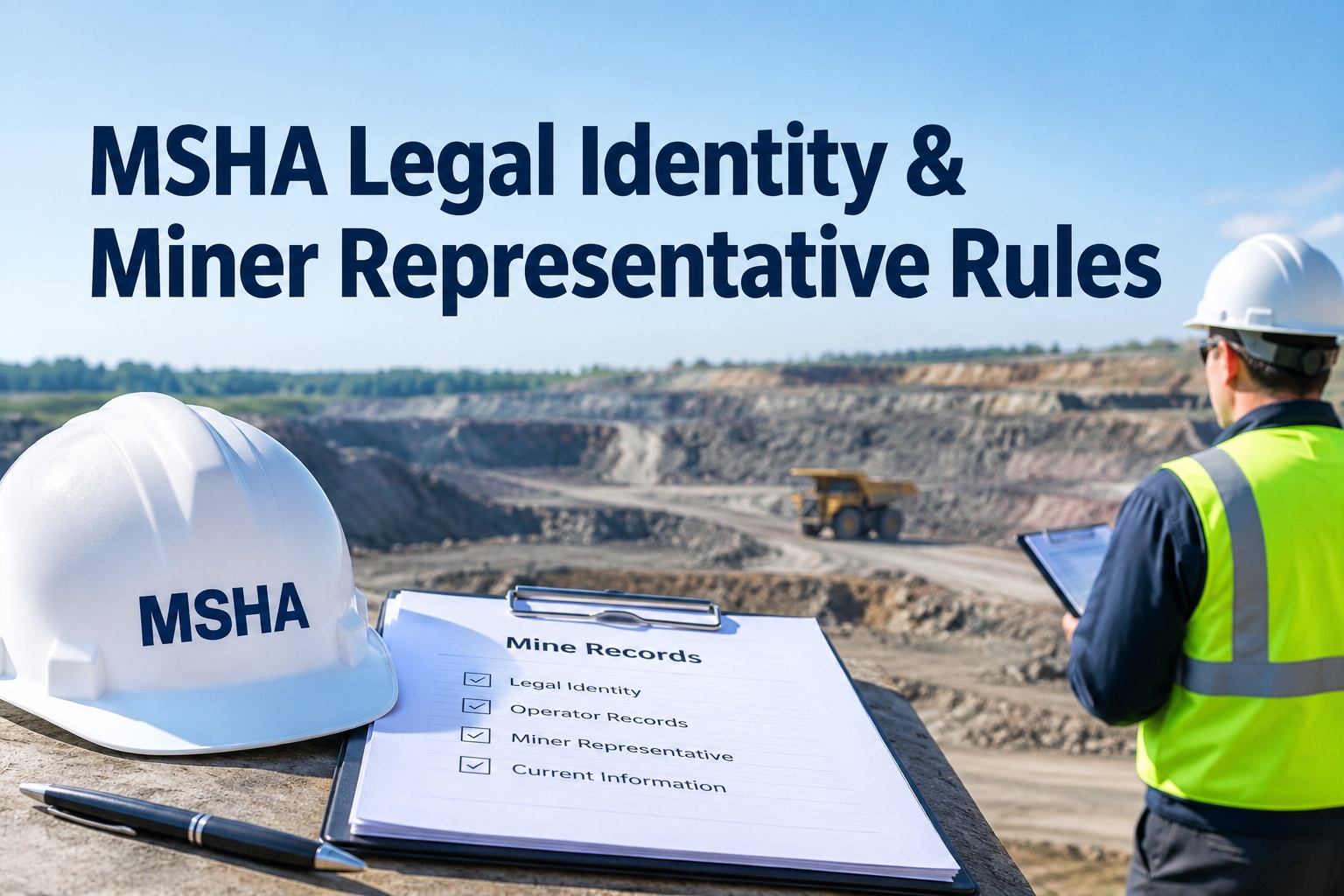
Every mine has a paper identity MSHA holds on file — who owns it, who runs it, where to serve legal documents, and who the miners have chosen to represent them. When that record goes stale — ownership changes but the filing doesn't — the gap surfaces at exactly the wrong moment: a penalty assessment or an inspection. MSHA legal identity and miners' representative rules are pure recordkeeping, but they decide who is legally answerable for the mine. See how compliance records stay current and audit-ready
Your Mine Has a Legal Identity on File. So Do the People Who Represent Your Miners.
Two required records, two sets of rules. Pick one to see what it must contain — and what change forces you to update it.
Under Section 109(d) of the Mine Act, every operator must file the mine's legal identity — and every change to it — on Form 2000-7 with their MSHA district manager. It's how MSHA knows who is legally answerable for the mine.
Miners have the right to a representative, designated in writing to MSHA under Part 40. That representative can accompany inspectors on walkaround inspections under Section 103(f) — with no loss of pay — and receives inspection information.
Neither of these records is complicated to maintain — the failure mode is simply letting them drift out of date. Below is what the legal identity report captures and why it matters, the changes that force an update, how the miners'-representative designation works, and how to keep both current instead of discovering a lapse during an inspection.
What the legal identity report actually establishes
The Legal Identity Report isn't a formality — it's the document that tells MSHA who to hold responsible. When a violation is cited or a civil penalty is assessed, the legal identity on file determines which person and entity are charged. Get it wrong or let it lapse, and the mine's official record of accountability is wrong.
Who controls and operates the mine
The name and address of the operator and the person who controls the mine — the core of who is legally answerable for it.
The person in charge of health & safety
MSHA needs a named safety contact for the operation, captured on the form alongside the ownership information.
A physical address of record
A real street address — not a PO Box — because it's the official address for serving legal documents on the operator.
The 7-digit Mine ID & commodity
The mine's unique identifier and what it produces — how MSHA ties every inspection, citation, and record to the right operation.
One practical note worth knowing: independent contractors don't file a Part 41 legal identity report — they're identified separately under the contractor rules. But for the mine operator, keeping 2000-7 accurate is foundational to every other MSHA interaction. Start free and keep your core compliance records in one place.
The changes that require a new filing
The legal identity obligation is ongoing, not one-and-done. Mining ownership turns over, officers change, operations relocate — and each change to the identity on file has to be re-filed. These are the events that most often make a 2000-7 stale without anyone noticing.
Ownership or operator change
A sale, a new operating company, or a change in who controls the mine — the most consequential update, and the one penalty assessments turn on.
New safety contact or officers
A change in the person in charge of health and safety, or in the officers named on the filing, needs to be reflected.
Address or contact change
Since the address of record is where legal documents are served, a move that isn't filed can mean missing a served notice entirely.
The risk isn't the filing itself — it's forgetting to trigger it when the underlying change happens. A move or a sale is busy enough that a form update slips, and the stale record sits until it causes a problem. Treating "update legal identity" as a step in your change process is what prevents it. Book a demo to see compliance updates tracked as recurring tasks.
The miners' representative — designation and rights
The second record is about the miners' side. The Mine Act gives miners the right to be represented in dealings with MSHA, and Part 40 sets out exactly how a person or organisation becomes that official representative — a designation the operator needs to recognise and have on file.
Designated in writing to MSHA
Under Part 40, a representative is identified by filing a written designation with the MSHA district manager — including who they are and the miners they represent.
The walkaround right under §103(f)
The representative can accompany an MSHA inspector during an inspection — the "walkaround" right — and suffers no loss of pay for the time spent participating.
Terminated in writing when it ends
If a representative can no longer serve, Part 40 requires a written statement to the district manager terminating the designation — keeping the record accurate.
For the operator, the obligation is recognition and record: know who the current designated representative is, respect the walkaround and information rights, and keep the designation on file. Like legal identity, it's a living record — a representative can change, and the paperwork has to keep up. Start free and keep representative designations on record.
Keeping both records current — and provable
Both obligations share the same failure mode and the same fix. The failure is drift: a record that was accurate when filed and quietly went stale. The fix is treating currency as a tracked, recurring responsibility rather than something you remember when prompted — and being able to prove the current state on demand.
An inspection or a penalty assessment is the wrong time to discover a record is out of date. Tracking legal-identity currency and representative designations as recurring compliance items — with the documents retained and retrievable — is what keeps a routine records question from becoming a finding.
This is exactly the kind of low-drama, high-consequence recordkeeping that a compliance checklist and a retrievable record store exist for. It's not hard — it just has to not be forgotten, and it has to be provable when someone asks. Book a demo to see recurring compliance items and retained records together.
The legal-identity & representative readiness checklist
Run this to confirm your mine's identity and representative records are current and audit-ready. Use this compliance-records checklist online free, with each recurring item and retained document tracked in one place.
Confirm Form 2000-7 is current
The legal identity on file matches actual ownership, operator, safety contact, and address today.Verify the address of record
A physical street address where legal documents can actually be served — not an outdated or PO Box address.Build updates into change events
Make "re-file legal identity" a step whenever ownership, operator, officers, or address change.Know your current miners' representative
Have the current Part 40 designation on file and recognise the representative's rights.Respect the walkaround right
Ensure the designated representative can accompany inspectors under §103(f) with no loss of pay.Keep both records retrievable
Store the current filings so they can be produced on demand for an inspector or an audit.
From a mine administrator who inherited a stale filing
We'd acquired a small operation and, in the rush of taking it over, nobody updated the legal identity report. Months later a penalty notice went to the previous operator's address and bounced around before it reached us — we nearly missed a response deadline over a record that was simply out of date. It wasn't a safety failure; it was an administrative one, and it was entirely avoidable.
Now legal identity and the miners'-representative designation are both tracked items on our compliance calendar, with the filed forms stored where I can pull them in seconds. When ownership or a contact changes, updating MSHA is a checklist step, not something we hope someone remembers. It's boring — which is exactly what compliance records should be.
Frequently asked questions
What is MSHA legal identity and Form 2000-7?
Legal identity is the official record of who owns and operates a mine, filed with MSHA on Form 2000-7. Required under Section 109(d) of the Mine Act and 30 CFR Part 41, it captures the mine name and 7-digit ID, the operator and the person who controls the mine, the person in charge of health and safety, a physical address of record, and the commodity. It establishes who is legally answerable for the mine and is used when citations are issued and penalties assessed, so it must be filed and kept current.
When does a mine have to update its legal identity report?
Whenever the identity information changes. The obligation is ongoing, not one-time: a change in ownership or the operating company, a new person in charge of health and safety, a change in officers, or a change of address all require re-filing Form 2000-7 with the MSHA district manager. The address matters most because it's where legal documents are served, so an unfiled move can mean missing a notice. The reliable approach is making a legal-identity update a standard step in any ownership, personnel, or location change.
Who is a miners' representative and how are they designated?
A representative of miners is a person or organisation that miners designate to represent them in dealings with MSHA. Under 30 CFR Part 40, the representative is identified by filing a written designation with the MSHA district manager, stating who they are and the miners they represent. Once designated, the representative has rights under the Mine Act, including accompanying inspectors on walkaround inspections. If the representative can no longer serve, Part 40 requires a written statement to the district manager terminating the designation, so the record stays accurate.
What is the Section 103(f) walkaround right?
Section 103(f) of the Mine Act gives a representative of miners the right to accompany an MSHA inspector during an inspection of the mine — commonly called the walkaround right. The representative can participate in the inspection and, importantly, suffers no loss of pay for the time spent doing so. The purpose is to involve miners directly in the inspection process. For the operator, the obligation is to recognise the current designated representative and allow them to exercise this right during inspections rather than obstructing it.
Do independent contractors file a legal identity report?
No. Independent contractors working at mines are not required to file a Part 41 legal identity report on Form 2000-7. They are identified separately through MSHA's contractor identification procedures and receive a contractor ID rather than a mine ID. The Part 41 legal identity obligation applies to the mine operator. That said, contractors have their own MSHA requirements, including training records under Part 48, so the exemption from legal-identity filing doesn't mean an absence of recordkeeping obligations for contractors.
Keep the records that say who answers for your mine current
HVI keeps recurring compliance items — legal-identity currency, miners'-representative designations, required record retention — on an audit checklist that doesn't lapse, and holds the filed documents retrievable on demand. So the records that decide who is legally answerable for your mine stay current as ownership and people change, and a routine compliance question never turns into a finding.
No credit card · Recurring compliance checklist · Audit-ready record retrieval