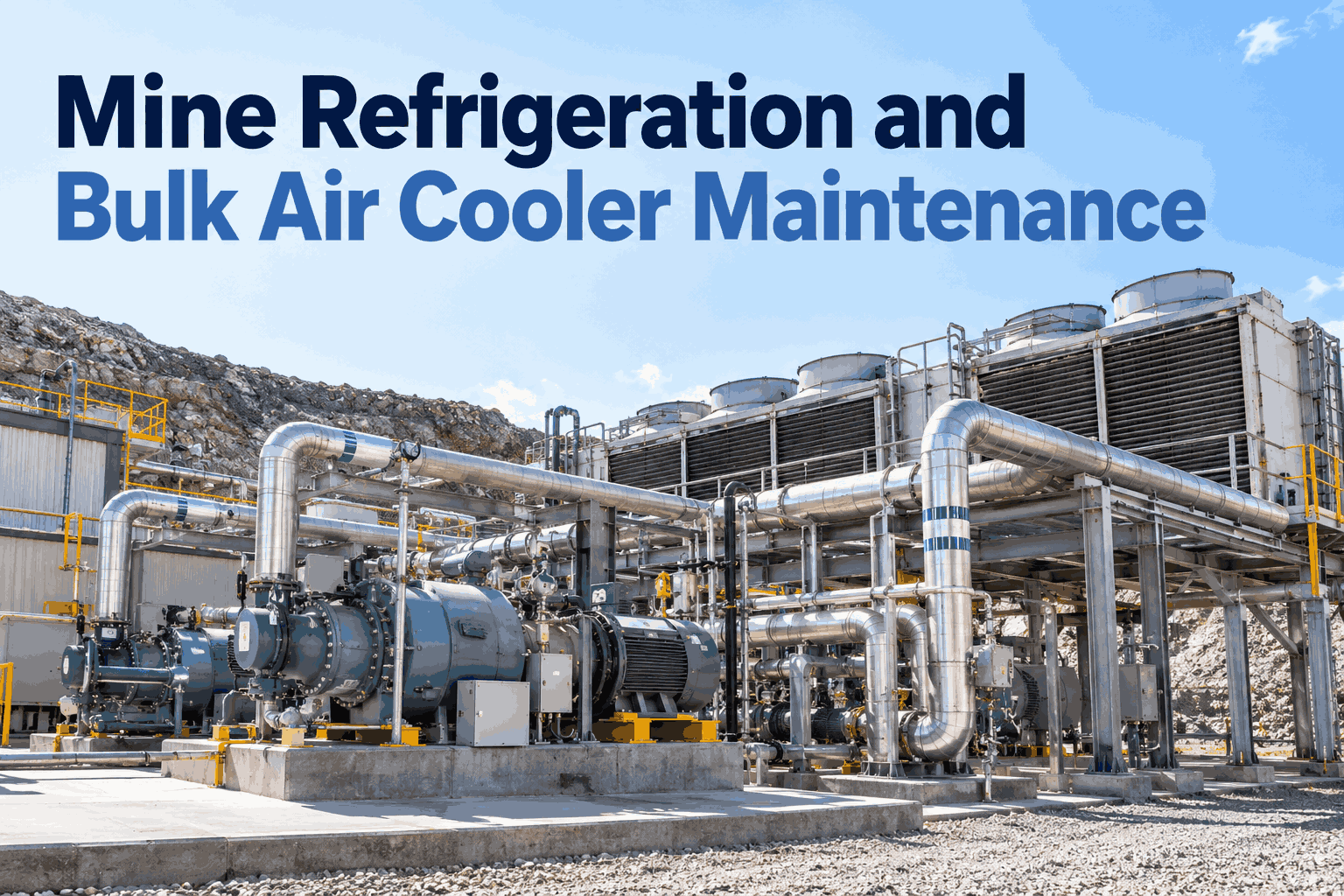
When a surface bulk air cooler or an underground compressor goes down at a deep, hot mine, nobody calls it a comfort problem — they call it a production problem, because the moment wet-bulb temperature at the working face climbs past the site's trigger point, crews get pulled back and the stope goes quiet. Mine refrigeration maintenance isn't an HVAC line item buried under facilities; it's the system standing between a planned shift and a shutdown. This guide covers the compressors, bulk air coolers, chilled water circuits, and cooling towers that keep a deep mine workable, where they actually fail and how a preventive maintenance program built on running hours and condition data keeps the plant ahead of the heat instead of reacting to it. Book a live HVI demo to see refrigeration plant PM running on one equipment record.
Every degree the plant loses, the mine loses production
Step through the wet-bulb bands used at deep, hot mine sites and see what happens underground as the refrigeration plant falls behind.
The refrigeration plant is holding working-face wet-bulb temperature in the range most deep, mechanized operations design around — roughly 27.5–28.5°C. Crews work full shifts at planned output, and the compressors, bulk air coolers, and chilled water circuit are simply doing the job they were sized for.
Once wet-bulb crosses roughly 27–28°C, heat stress management programs at many sites call for extra controls — more frequent rest breaks, closer monitoring, additional hydration. The plant isn't failed yet, but it's no longer giving the margin the site was designed to run on, and a maintenance manager should already be asking why.
Above roughly 30°C wet-bulb, work performance measurably decreases and the risk of heat-related illness rises sharply. This is the band where a site either throttles activity, pulls crews off the hardest physical tasks, or starts running behind on development and production targets — all because cooling capacity fell short somewhere upstream.
Above roughly 32.5°C wet-bulb, work should not normally continue at all. This is the outcome a refrigeration maintenance program exists to prevent — not an HVAC complaint, but a face standing idle, a shift lost, and a safety incident risk the mine never wanted to test.
The refrigeration plant is the only thing standing between "normal operations" and "work stops." That's the real argument for mine refrigeration maintenance, in one chart. Book a demo to see compressor and BAC condition tracked against your site's own thresholds
Most maintenance managers inherit a refrigeration and bulk air cooling plant that was commissioned years ago, sized for a mine that was shallower and cooler at the time, and now runs flat-out just to hold the line as workings push deeper and hotter. Mine refrigeration maintenance is the discipline of keeping that plant performing at its design capacity — not just keeping it running — because a compressor that starts but can't hit its tonnage, or a bulk air cooler whose coils have fouled, fails quietly long before it fails completely.
The mine refrigeration system, component by component
A deep-mine cooling plant is really several connected systems, each with its own failure modes and its own service clock. Surface bulk air cooling tends to be the first system most sites lean on, since it offers large cooling capacity, easier maintenance access, and lower installation cost than pushing refrigeration infrastructure underground — but every link in the chain below it still has to hold up its end.
Refrigeration compressors
The heart of the plant, and the component most sites schedule on running hours — bearings, seals, lubrication systems, and condenser-side fouling all degrade with hours run, not calendar days, so hour-based PM is what catches a compressor losing tonnage before it trips.
Bulk air coolers & coils
BAC coils transfer heat from intake air to chilled water, and scaling, fouling, or airflow blockage across the coil face quietly erodes cooling capacity long before anyone notices the plant can't hit its design temperature anymore.
Chilled water pumps & reticulation
Getting chilled water from surface to the working face and back depends on pumps, pipework, and insulation that lose efficiency to wear, scale, and insulation breakdown — every degree picked up in transit is cooling capacity the working face never sees.
Cooling towers & water treatment
Where the plant rejects heat to atmosphere, fill media, fans, and drift eliminators need regular inspection, and water treatment has to stay on schedule — a neglected tower loses heat-rejection efficiency and becomes a biological risk at the same time.
Spot coolers & underground plant
Where development heat outruns the bulk system, miniature underground refrigeration units targeted at the heading carry their own compressor and fan maintenance needs, often in the dustiest, hardest-to-access part of the mine.
See how HVI's preventive maintenance scheduling runs compressors on hours, BAC coil inspections on a condition-based calendar, and cooling tower water treatment on its own cycle — all on one plant record.
What skipping mine refrigeration maintenance actually costs
lower availability is typical for underground mining equipment compared to surface equipment, largely due to access constraints and the ventilation and cooling conditions crews depend on to keep working — per HVI's own mining fleet data.
wet-bulb is the point at which work should not normally continue at all in underground mine workings, per ILO ventilation and cooling guidance — a line a failing refrigeration plant can cross in hours, not days.
is the typical coefficient of performance (COP) range for mine cooling systems in recent engineering research — a figure that drops fast once coils foul, pumps lose head, or compressors run outside their design envelope.
MSHA inspections at underground mines happen quarterly at minimum — and a refrigeration or ventilation system that's been quietly degrading is exactly the kind of gap a documented PM program is built to catch before an inspector does.
None of these numbers are abstract once a BAC coil fouls mid-summer or a compressor trips during a production shift. Book a demo and see what hour-based PM and condition tracking would have caught on your own plant's last breakdown.
Put together, these numbers describe a plant with almost no margin for a maintenance gap — a narrow band between "crews working full shifts" and "work stops entirely." Book a live HVI demo to see where your own plant's margin actually sits today.
Where refrigeration plant failures actually start
A compressor rarely just stops. It loses capacity for weeks first, quietly, in places a walk-through inspection skips because nothing looks obviously broken.
A structured inspection that names each of these points — not a generic "check the plant" walk-through — is what catches degrading capacity while it's still a work order, not a production stoppage. See how HVI's mining inspection templates are built for exactly this kind of fixed-plant and underground equipment coverage.
Reactive refrigeration maintenance vs. a scheduled HVI program
| Reactive / calendar-only maintenance | Mine refrigeration maintenance on HVI | |
|---|---|---|
| Compressor service | Scheduled by month, regardless of actual running hours | Triggers on running hours, matched to manufacturer intervals |
| Coil & condenser fouling | Found during a breakdown call-out | Caught by scheduled condition inspections with photo records |
| Water treatment | Tracked on a whiteboard or a technician's memory | Scheduled cycles with completion records per asset |
| Audit readiness | Paper logs scattered across the plant room | Digital service history, exportable for site and MSHA review |
| Fleet visibility | Refrigeration plant tracked separately from mobile equipment | Fixed plant and mobile fleet on one dashboard |
Start a free trial and see a compressor, a cooling tower, and an underground LHD scheduled correctly on the same dashboard — each on the trigger that actually fits it.
From a maintenance manager who stopped chasing the plant
We used to find out a BAC coil had fouled when production called asking why the working face was running three degrees hotter than it should've been. By then we were already behind — pulling crews back, scrambling a shutdown to clean coils we should have caught a month earlier.
Now compressor service triggers on actual hours, not a date on a calendar, and coil and water treatment checks are scheduled instead of hoped for. We haven't had a heat-related production stoppage tied to the plant in over a year, and when MSHA or our own site auditors ask for the refrigeration maintenance record, it's a export, not a search through the plant room filing cabinet.
If your refrigeration plant's failures still show up as a production call instead of a work order, book a live HVI demo and bring your last breakdown with you.
Mine refrigeration maintenance FAQs
What does mine refrigeration maintenance actually cover?
Mine refrigeration maintenance covers the full cooling chain that keeps a deep or hot underground mine workable: surface and underground refrigeration compressors, bulk air coolers (BACs) and their coils, chilled water pumps and reticulation pipework carrying cooled water to the working face, cooling towers and associated water treatment where the plant rejects heat, and any spot coolers or underground refrigeration units targeting specific development headings. Each component has a different failure mode and a different ideal service trigger — compressors typically on running hours, water treatment on a calendar cycle, and coils and pipework on condition-based inspection — which is why a single generic PM schedule rarely fits the whole plant well.
Why does mine refrigeration plant need hour-based preventive maintenance?
Refrigeration compressors and many bulk air cooling components wear based on how many hours they've actually run under load, not how many days have passed on a calendar. A compressor that runs near-continuously through a hot season accumulates wear far faster than one serviced on a fixed monthly date regardless of use, which means calendar-only scheduling either over-services underused equipment or, more dangerously, under-services equipment running flat-out to hold temperature. Hour-based preventive maintenance ties service intervals to actual operating hours, catching bearing wear, seal degradation, and lubrication needs on the schedule the equipment is actually experiencing.
How does a failing refrigeration plant affect underground production?
Underground work in deep or hot mines is typically governed by wet-bulb temperature thresholds: as temperature at the working face climbs, many sites first require additional heat stress controls such as more frequent rest breaks, then restrict the type and intensity of work permitted, and ultimately require work to stop entirely once temperature crosses a defined limit, commonly cited around 32.5°C wet-bulb in ventilation and cooling guidance. A refrigeration or bulk air cooling plant that's lost capacity due to fouled coils, a struggling compressor, or chilled water losses in transit can push a working face across these thresholds well before anyone expected a problem, converting a maintenance issue directly into lost production shifts.
What are the most common causes of bulk air cooler and compressor failure?
The most common failures develop gradually rather than suddenly. Coil and condenser fouling from scale, dust, or biological growth reduces heat transfer well before any alarm triggers. Water treatment that falls behind schedule in a cooling tower or chilled water circuit reduces heat-rejection efficiency and increases corrosion and biological risk. Sensor and control drift can have the plant's control system reporting normal operation while actual cooling delivered to the working face has degraded. Pipework and insulation losses between the surface plant and the underground heading quietly consume cooling capacity that never reaches the crew. Each of these is detectable through scheduled condition inspections well before it causes an outright equipment failure.
How should a mine track refrigeration and bulk air cooler maintenance records?
Refrigeration and bulk air cooler maintenance records should be tracked per individual asset — each compressor, cooling tower, and major pump logged separately rather than as one undifferentiated "refrigeration plant" entry — with running hours, inspection results, defects found, corrective work orders, and water treatment cycles all tied to that specific asset's history. Digital tracking that generates an exportable, timestamped record is particularly valuable for sites under MSHA or equivalent regulatory oversight, since it turns an audit request into a report export rather than a search through paper logs scattered across a plant room. Keeping fixed refrigeration plant and mobile mining equipment on the same platform also gives maintenance managers one dashboard view across everything that affects underground workability.
Run mine refrigeration maintenance on hours and condition, not hope
HVI schedules compressors on running hours, triggers water treatment and coil inspections on their own cycles, and tracks defects and service history per asset — across refrigeration plant, bulk air coolers, and every other piece of mobile and fixed mining equipment on one dashboard. See what it would have caught on your last breakdown.
No credit card · Hour-based PM built in · One record across fixed plant and mobile fleet