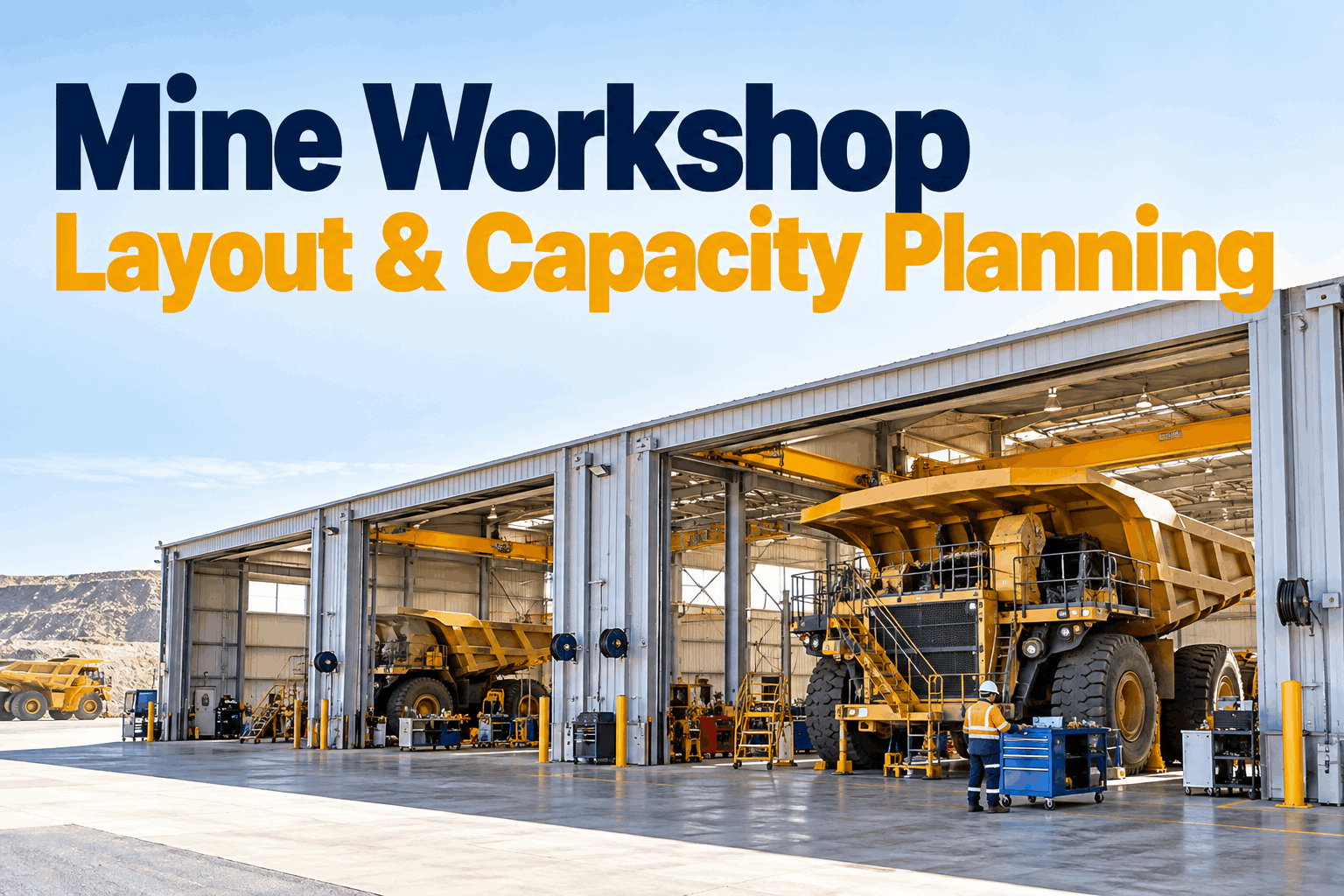
Mine workshop capacity planning gets difficult when the maintenance calendar says five machines are due but the workshop can realistically handle only three of those jobs at the same time. Bay count alone does not define capacity. Equipment size, job duration, lifting needs, parts readiness, technician availability and incoming breakdown work all determine how much maintenance a mining workshop can actually absorb.
A Workshop With Six Bays Does Not Always Have Six Bays of Capacity
Plan workshop demand around the work actually coming through the door. HVI gives maintenance teams visibility into assets, upcoming preventive maintenance, open work orders and service history so bay decisions can start before equipment arrives.
The planning problem is therefore two-sided. The workshop has physical constraints—doors, bay dimensions, lifting coverage, access routes and support areas—while the maintenance plan creates changing demand. A good mine workshop layout handles the first problem; good maintenance visibility helps the team manage the second.
Mine Workshop Capacity Planning Starts Beyond the Bay Count
Counting service bays is useful, but it can overstate usable capacity. One bay may be suitable for routine service but not a major component change. Another may have the necessary lifting coverage but already be committed to a multi-shift repair. A large machine may also require more approach, isolation and working space than a smaller support asset.
A bay is not truly available simply because it is empty. It becomes useful capacity when the incoming machine fits, the job can be supported and the required resources can be available for the expected duration.
HVI does not design the building or specify structural crane capacity. Its role is on the maintenance-demand side: keeping asset records, planned service and work history visible so managers can understand what work is approaching the workshop. See how HVI can give a mine workshop earlier visibility into upcoming maintenance demand.
Mine Workshop Layout Should Follow Equipment and Maintenance Flow
A useful mining workshop layout is not simply a row of equally sized rectangles. Haul trucks, loaders, graders, dozers and support vehicles bring different dimensions and service requirements. Major component work can also depend on lifting coverage, parts staging, tooling and safe movement around the machine.
Route the machine according to the work required—not just whichever bay appears open first.
Workshop planning should also consider how equipment enters, turns, exits and moves between service areas without creating unnecessary interference. Actual dimensions, clearances, lifting systems, ventilation and safety requirements must be engineered for the specific mine and equipment fleet rather than copied from a generic workshop template.
Once the physical zones are established, maintenance management records help connect that workshop design to the jobs the fleet actually generates. See how HVI can organize the asset and maintenance information behind workshop planning.
Maintenance Bay Planning Needs a Demand Forecast, Not Just a Floor Plan
The building may stay the same for years, but workshop demand changes every day. Preventive maintenance becomes due, inspections uncover defects, breakdowns arrive without warning and long-duration repairs continue into the next shift. That is why practical mining workshop capacity is also a scheduling problem.
A useful planning horizon starts with known demand. Upcoming preventive maintenance schedules show work that can be anticipated, while open work orders expose corrective demand already competing for workshop time. See how HVI can bring upcoming PM and active maintenance work into the same planning view.
The Most Constrained Resource Can Set Mining Workshop Capacity
Workshop throughput is often constrained by more than floor space. A job may need a particular lifting system, specialist technician, tooling set or component before it can progress. If several jobs require the same constrained resource, an apparently spacious workshop can still develop a queue.
This is why scheduling every bay to its theoretical maximum can be misleading. Maintenance research on heavy earth-moving equipment treats bay assignment alongside resource availability such as manpower, spares and tools rather than as an isolated space problem. For a real mine, the exact constraints should come from local work methods, equipment requirements and site engineering.
HVI's role is to improve the maintenance information feeding those decisions. Work orders and asset history can help managers understand recurring job types and planned work before deciding whether the problem is scheduling, resource availability or a genuine physical-capacity shortage. See how HVI can make workshop workload and maintenance history easier to review before capacity decisions.
Use Maintenance History to Test Whether the Workshop Really Needs More Capacity
When queues grow, adding another bay can look like the obvious answer. But the visible queue does not always identify the root constraint. Long repair durations, repeated defects, waiting for parts, poor PM timing or a shortage of a specialist resource can all make existing capacity appear smaller than it is.
A digital maintenance history gives that review more context than a snapshot of today's workshop floor. HVI can retain service records and work-order history against each asset, helping teams examine what kinds of jobs repeatedly consume workshop time. Teams ready to replace disconnected maintenance records can also start an HVI account and build an asset-level maintenance record.
Understand demand, job duration, resource constraints and existing bay suitability first. Expansion decisions should then be supported by site-specific engineering and operational evidence.
Make Mine Workshop Capacity Planning an Ongoing Maintenance Decision
A well-designed workshop provides the right physical environment for the fleet, but capacity is ultimately consumed by maintenance work over time. Mine workshop capacity planning becomes more useful when managers can see upcoming PM, active repairs and asset history before equipment competes for the same bay or support resource.
HVI helps provide that maintenance visibility. It does not replace facility engineering, lifting studies or site safety requirements; it gives the maintenance team better operational records to support workshop scheduling and planning decisions.
Mine Workshop Capacity Planning FAQs
What is mine workshop capacity planning?
Mine workshop capacity planning is the process of matching expected maintenance demand with suitable service space and supporting resources. It considers more than the number of bays: equipment dimensions, job duration, lifting needs, technician availability, tools, parts and the mix of planned and unplanned maintenance can all influence practical workshop capacity.
How should a mine workshop layout be planned?
Start with the equipment fleet and maintenance work the facility must support. Consider machine dimensions, entry and exit movement, working clearances, service types, lifting requirements, specialist work areas, parts and component staging, utilities and site-specific safety requirements. Building dimensions and lifting systems should be designed and verified by appropriately qualified professionals for the site.
How many maintenance bays does a mining workshop need?
There is no universal number. Required bay capacity depends on fleet size and mix, maintenance frequency, expected job durations, operating hours, planned versus corrective work, bay suitability and available resources. Historical work-order demand and upcoming preventive maintenance can provide better planning inputs than fleet count alone.
What causes mine workshop capacity bottlenecks?
Common bottlenecks can include unsuitable bay size, long-duration repairs, competing demand for lifting equipment, unavailable parts, specialist labour constraints, tooling requirements and poorly coordinated preventive maintenance. The bottleneck may therefore be a resource or scheduling issue even when physical floor space appears available.
How can HVI help with mine workshop capacity planning?
HVI supports the maintenance-planning side of workshop capacity by keeping asset records, preventive maintenance schedules, work orders and maintenance history connected. That visibility can help workshop managers understand upcoming demand and existing maintenance workload before allocating workshop time. HVI does not replace architectural, structural, lifting or safety engineering for the physical facility.