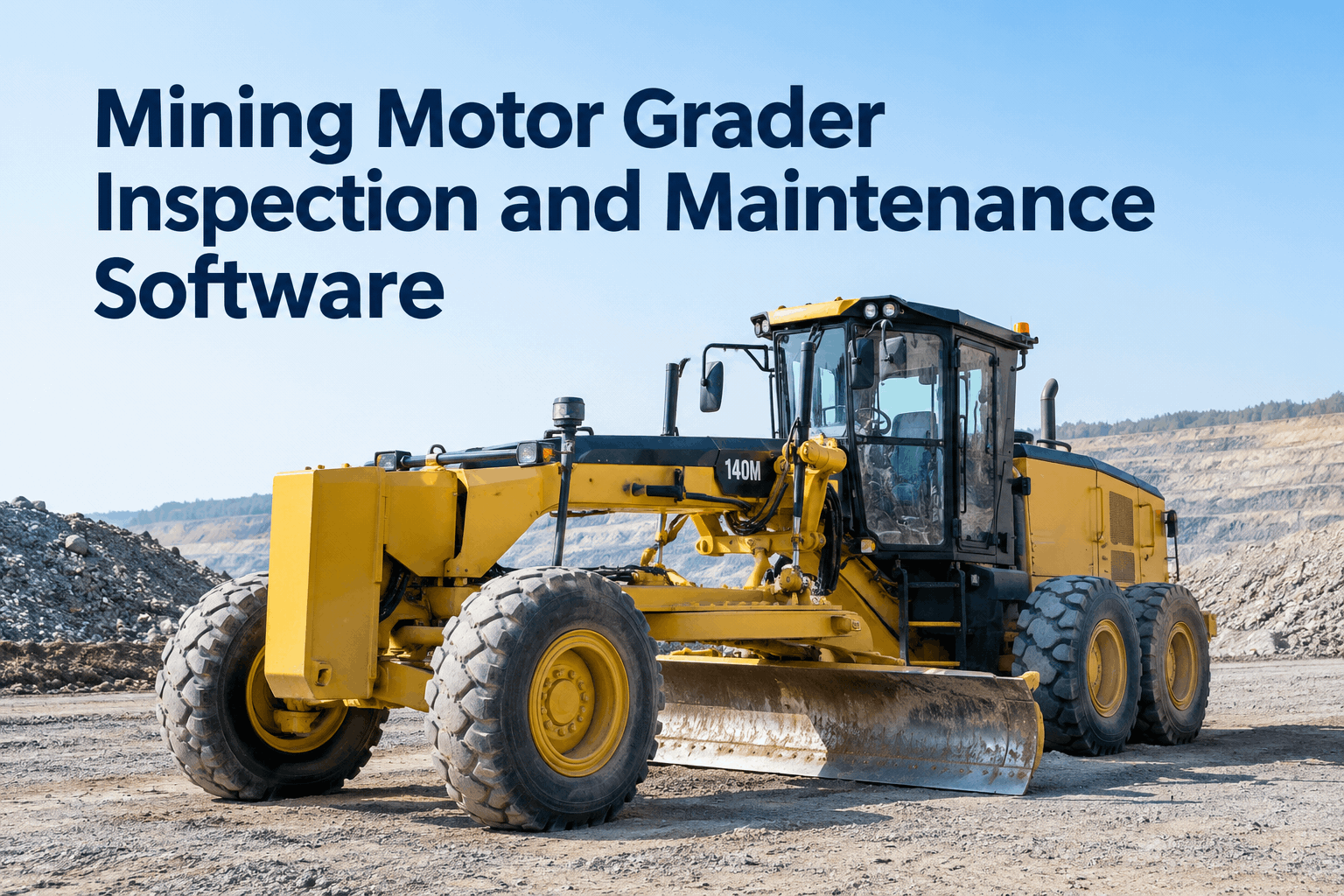
A mining motor grader isn't just blading dirt — it's the machine standing between a smooth haul road and every truck on it running slower, burning more fuel, and eating tires faster. Mining motor grader inspection and maintenance software keeps the blade, circle, and drivetrain tracked so the road stays in spec, and the grader doesn't become the reason production slows. Book a demo to see it on your mining fleet .
One Ungraded Haul Road Segment Ripples Through the Whole Mine
A grader that's inspected and serviced on schedule keeps the haul road in spec. A grader that slips keeps nothing in spec — and every truck on that road pays for it.
A motor grader on a mine site carries more weight than its size suggests. It's not grading a parking lot — it's maintaining the surface every haul truck, water truck, and light vehicle on the pit runs across, dozens of times a shift, loaded. When the grader is down, undermanaged, or running a dull edge, the road doesn't just look rough. It starts costing the whole haul fleet in tires, fuel, and cycle time — which is why mining motor grader maintenance software earns its keep differently than a generic PM app: it's protecting the road, not just the machine.
What mining duty does to a graderthe components abrasive haul-road material wears fastest
Construction grading and mining grading aren't the same job. A mine-site grader runs longer hours, cuts more abrasive, rockier material, and rarely gets the luxury of a clean, prepared surface to start from. Five systems carry that load.
Moldboard & cutting edge
Direct contact with haul-road rock and ore fines wears the edge fast; a dull edge stops cutting to grade and the road surface degrades even while the grader is "working."
Circle & drawbar
The circle wear strips, shoes, and drawbar ball take constant torque under load; grease intervals matter more on mine material than almost anywhere else on the machine.
Articulation joint & pins
Articulated frame pins and bushings see constant flex on uneven haul surfaces; play here shows up as grading inaccuracy long before it shows up as a breakdown.
Tandem drives & final drives
The heaviest repair on the machine. Contaminated oil or a missed interval turns a filter change into a multi-day tandem rebuild and a grader off the road for a week.
Blade control & GPS
On GPS-guided mine fleets, sensor and cable condition decides whether the grader is actually cutting to design grade or just moving material around.
A generic grader checklist glosses over all five. A mining-specific one on HVI's inspection platform puts each on the operator's phone, with photo capture, so wear is caught as a flag — not discovered as a breakdown. Book a demo to see the mining grader checklist built around your models
The mining motor grader daily examination checklistwhat every pre-shift inspection should cover — and why it's not optional
MSHA requires a daily examination of self-propelled mobile equipment for safety defects (30 CFR §56.14100 for surface mines), and a grader is squarely inside that rule. Paper satisfies the letter of it. A digital, photo-backed inspection satisfies it and gives maintenance a usable record instead of a filed form nobody reopens.
This is the exact checklist that belongs in HVI's mobile inspection app — tick, flag, photo, done in minutes, with every defect timestamped to that machine. It's also the fastest way to prove the daily examination actually happened if a regulator or site safety audit ever asks. Start a free trial and load this checklist against your grader fleet today
PM tiers built for mine-severe dutymeter-hour preventive maintenance, pulled in for abrasive conditions
A construction-site PM interval is a starting point, not the answer, on a mine. Dust, heat, and constant load on abrasive material mean filters clog faster and oil breaks down sooner than the OEM's base schedule assumes — so the interval needs to flex with the site, not sit fixed on a calendar.
-
250 hr
Basic service
Engine oil and filter, fuel filter and water separator, circle and articulation greasing, cutting-edge wear check.
-
500 hr
Intermediate service
Hydraulic filter and fluid sample, tandem oil sample, circle wear-strip measurement, full undercarriage and pin inspection.
-
1,000 hr
Major service
Tandem oil change, transmission service, full hydraulic system inspection, blade-control calibration check.
HVI's meter-hour PM scheduling auto-generates the work order when a grader's hours cross an interval, and lets you shorten intervals site-by-site for dust or abrasive-material duty — so a tandem oil sample happens on actual condition, not on a calendar that assumes easier work than the grader is doing. Book a demo to see tiered PM set against your mine-site intervals
From flagged defect to closed work orderhow one grader's inspection connects to every pit on site
A mine rarely runs one grader. It runs several, across pits, benches, and haul segments — which means a defect caught on one machine is useless if it sits on a clipboard in a site office forty minutes away.
-
1
Operator runs the daily examination
Moldboard, circle, articulation, tandems, hydraulics — the mining-specific checklist, on a phone, before the shift starts.
-
2
A defect is flagged with photo & severity
A worn cutting edge or a tandem leak gets logged with a photo, tied to that grader, and timestamped the moment it's found.
-
3
It becomes a work order in one tap
The flag converts to a work order and lands with the shop or field tech — visible before the grader even finishes its shift.
-
4
Repair closes against that machine's history
Parts, labor, and sign-off record against the grader's own file, feeding cost-per-hour analytics across the whole grader fleet.
From a mine-site maintenance superintendent
Everyone watches the haul trucks. Nobody watches the graders until the road's already torn up and the truck operators are complaining about ride and tire wear — at which point you're two steps behind and the damage is already on the tires, not just the road.
Putting a real inspection in front of the grader operators changed that. Cutting-edge wear and circle play get flagged before the road shows it, not after. We're not chasing tire complaints anymore — we're catching the grader issue that would have caused them.
Frequently asked questions
What is mining motor grader inspection software?
A mobile digital checklist built around a grader's mining-specific wear points — moldboard, circle, articulation, tandems — that flags defects with photos and routes them straight to a work order.
Why does haul-road condition matter beyond the grader itself?
Poor road surfaces are linked to roughly 44% more breakdown incidents fleet-wide, plus higher tire wear, slower cycle times, and more fuel burn — the grader's upkeep protects every truck running on that road.
How often should a mining motor grader be serviced?
Typically 250-hour basic, 500-hour intermediate, and 1,000-hour major service tiers, pulled in for dust and abrasive conditions. HVI auto-fires the work order when meter hours cross each interval.
Does this help with MSHA daily examination requirements?
Yes. MSHA requires a daily equipment examination for safety defects (30 CFR §56.14100 for surface mines); a digital, photo-backed inspection gives you a usable, timestamped record of that exam.
Can HVI track multiple graders across different pits?
Yes. Each grader gets its own inspection history, PM schedule, and cost record, with defects and work orders visible site-wide the moment they're flagged, not after shift-end.
Protect the road, protect the fleet running on it
HVI gives every grader operator a mining-specific daily examination, routes flagged defects to a work order in one tap, fires PM on real meter hours, and keeps a cost-tracked history per machine — so a worn cutting edge gets caught before it becomes a torn-up haul road and a fleet of trucks paying for it in tires and fuel. Live on site in under two weeks.
- Mining-specific daily examination
- Defect → work order in one tap
- Meter-hour PM, pulled in for severe duty
- Cost-per-hour per machine, fleet-wide