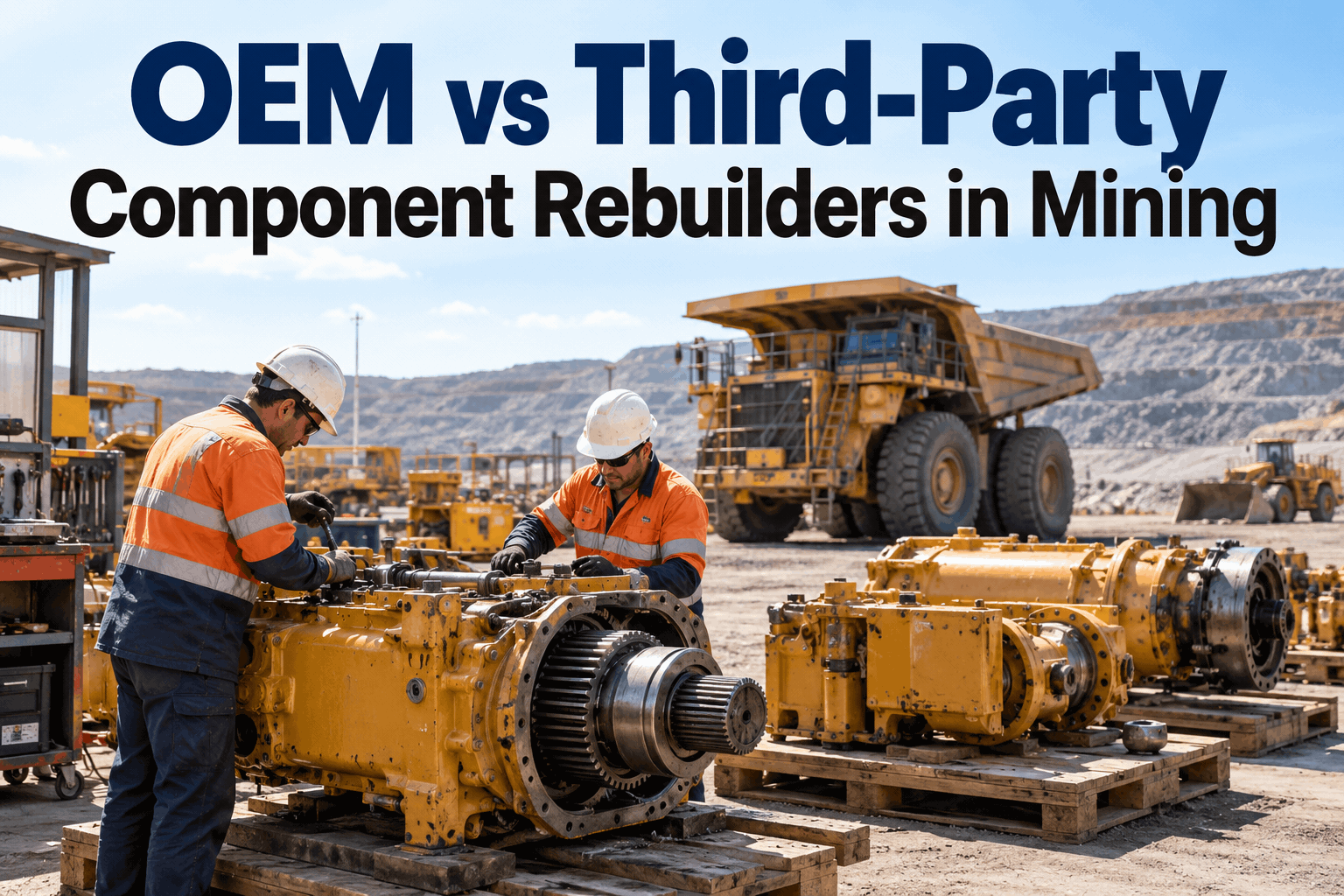
The OEM vs third-party component rebuilders question shows up the moment a final drive or transmission lets go and three quotes land on your desk: the dealer's reman exchange, an independent rebuild for a lot less, and maybe a new unit on backorder. They'll all get the machine running again — but they are not interchangeable on cost, warranty, turnaround, or what's backing you if it fails again. Picking well on a mining fleet is worth real money every rebuild cycle. Book a demo of rebuild cost and reliability tracking.
Same Failed Component. Two Very Different Rebuild Paths.
OEM reman and independent rebuild each win on different machines, in different situations. Here's the trade-off at a glance — before the deep dive.
- Factory-backed warranty
- Built & tested to original spec
- Highest price of the options
- Lower cost, often custom scope
- Faster when they hold your core
- Warranty & quality vary by shop
There's no universal right answer here, and anyone who tells you otherwise is selling something. The OEM reman program and the independent rebuilder are built for different priorities — one optimizes for certainty and warranty, the other for cost and flexibility. The real skill isn't picking a side; it's knowing which factor matters most for the specific machine in front of you, and having the data from past rebuilds to back the call.
Head to headOEM reman vs third-party rebuilders across the factors that decide it
Strip it down to the five things a maintenance or procurement manager actually weighs. Neither column is "better" — each is better at something, and the right choice depends on which row you can't compromise on for this component.
| Factor | OEM reman / exchange | Independent rebuilder |
|---|---|---|
| Cost | Higher — roughly 20–40% below new OEM | Lower — often well below dealer reman |
| Warranty | Factory-backed, equal to or better than new | The rebuilder's own warranty, varies by shop |
| Build spec | Original spec, genuine OEM parts, dyno-tested | Meets/exceeds OEM; may add design upgrades |
| Turnaround | Fast via exchange; special-order can lag | Fast when they stock your core; custom work slower |
| Machine under warranty | Keeps factory coverage intact | Non-OEM parts may affect coverage — check first |
| Failure reporting | Standardized OEM process | Often detailed failure analysis & rebuild report |
One honest caveat that cuts across every row: on the independent side, quality is real but shop-dependent — a top rebuilder meets or beats OEM, a cheap one doesn't, and the low price is often reflected in the result. Your own track record with a given provider is the best filter you have. Book a demo of per-provider reliability history.
The five leverswhat each factor really means for your fleet
The table is the summary; here's the substance behind each lever, so you're weighing them on what they actually cost and protect — not on a sales pitch from either side.
OEM reman saves against buying new, but an independent rebuild is usually the cheapest route to serviceable. The gap is real money on a haul-truck component — just weigh it against the warranty you're trading away.
OEM reman carries factory-backed coverage honored across the dealer network. An independent warranty is only as good as the shop standing behind it — strong with a proven rebuilder, thin with an unknown one.
Exchange programs can swap a unit in days because the reman sits on a shelf. Independents are fastest when they already hold your core; a from-scratch custom rebuild takes longer but can fix a root cause.
OEM reman offers the most consistent, predictable outcome. A great independent can match or exceed it with upgrades; a weak one won't. Consistency is the question, and your failure history answers it.
This is the tiebreaker people forget. If the machine is still under OEM warranty, using non-OEM rebuilt components can jeopardize that coverage. On a covered asset, OEM reman is often the only choice that keeps the bigger warranty whole — which ties straight into how you Read our guide to mining warranty & goodwill claims.
Which path, whena decision guide for the component in front of you
Skip the agonizing. Most rebuild decisions sort cleanly once you name the one constraint that dominates. Use this as a quick filter, then let your own cost and reliability history settle the close calls.
- The machine is still under factory warranty you must protect
- Compliance or resale terms require genuine OEM
- You need a fast, guaranteed exchange and predictable result
- Reliability certainty outweighs the price premium
- The asset is out of factory warranty
- Lowest cost of ownership is the priority
- You want a custom scope or a root-cause design upgrade
- OEM lead times are too long and you trust the shop
The deciding line in the close calls is almost always a number you either have or don't: what the last three rebuilds of this component cost, and how long each lasted. Fleets that track that choose confidently; fleets that don't re-argue it every time. Sign up free and start logging rebuild outcomes.
Compare on datathe records that turn a sourcing debate into a decision
Whichever way you lean, the choice compounds: every rebuild is a data point about which path actually performs on your machines, in your conditions. Capture it and the decision gets easier each cycle. Here's what to track per component to make OEM vs third-party an evidence-based call.
Tracked against each asset, these four turn the whole OEM-versus-independent argument into a chart: this provider's rebuilds on this component last X hours and cost Y. That's the record HVI keeps, and it's the one that makes the next call obvious. Explore component maintenance history and cost tracking.
From a mining reliability manager running a mixed-OEM fleet
We argued OEM-versus-independent on gut feel for years — whoever shouted loudest in the meeting won. What ended it was finally having the numbers per component: our best independent rebuilder's final drives were actually outlasting the dealer reman on two truck models, at two-thirds the cost, while a third shop's were failing early. Without that history we'd have kept overpaying on one and getting burned on another. Now the decision is just reading the chart, and warranty-covered machines go OEM, full stop.
OEM vs third-party component rebuilders — FAQs
Is an OEM reman component better than an independent rebuild?
Not automatically — it's more consistent and carries factory-backed warranty, but a top independent rebuilder can match or exceed OEM spec, sometimes with upgrades, at lower cost. The gap is in warranty and predictability, not always in the finished component itself.
How much cheaper is a third-party rebuild?
It varies by component and shop, but independent rebuilds are typically well below dealer reman and far below a new unit. OEM reman itself runs roughly 20–40% under new. The savings have to be weighed against warranty coverage and quality consistency.
Will a non-OEM rebuild void my equipment warranty?
It can, if the machine is still under factory warranty. Using non-OEM rebuilt components on a covered asset may affect that coverage, so confirm the terms before sending work out. On out-of-warranty machines this constraint usually disappears.
What's the difference between reman and a rebuild?
Remanufacturing is a full teardown — every part inspected, worn ones replaced, the unit tested to original spec with a full warranty. A rebuild or recondition is typically less complete and may not carry the same warranty. The scope, not the label, is what matters.
How does HVI help with rebuild decisions?
HVI doesn't rebuild components or recommend a provider — it tracks the data that decides. It records rebuild cost, turnaround, and post-rebuild service life per component and provider, tied to the asset, so you compare OEM versus independent on your own fleet's results.
Make every rebuild a data point for the next one
OEM or independent, the smart sourcing call comes from your own numbers. HVI logs rebuild cost, turnaround, and service life per component and provider, tied to each asset — so your next OEM-versus-third-party decision is a chart you read, not a debate you have.
No credit card · No hardware · Per-component rebuild history from day one