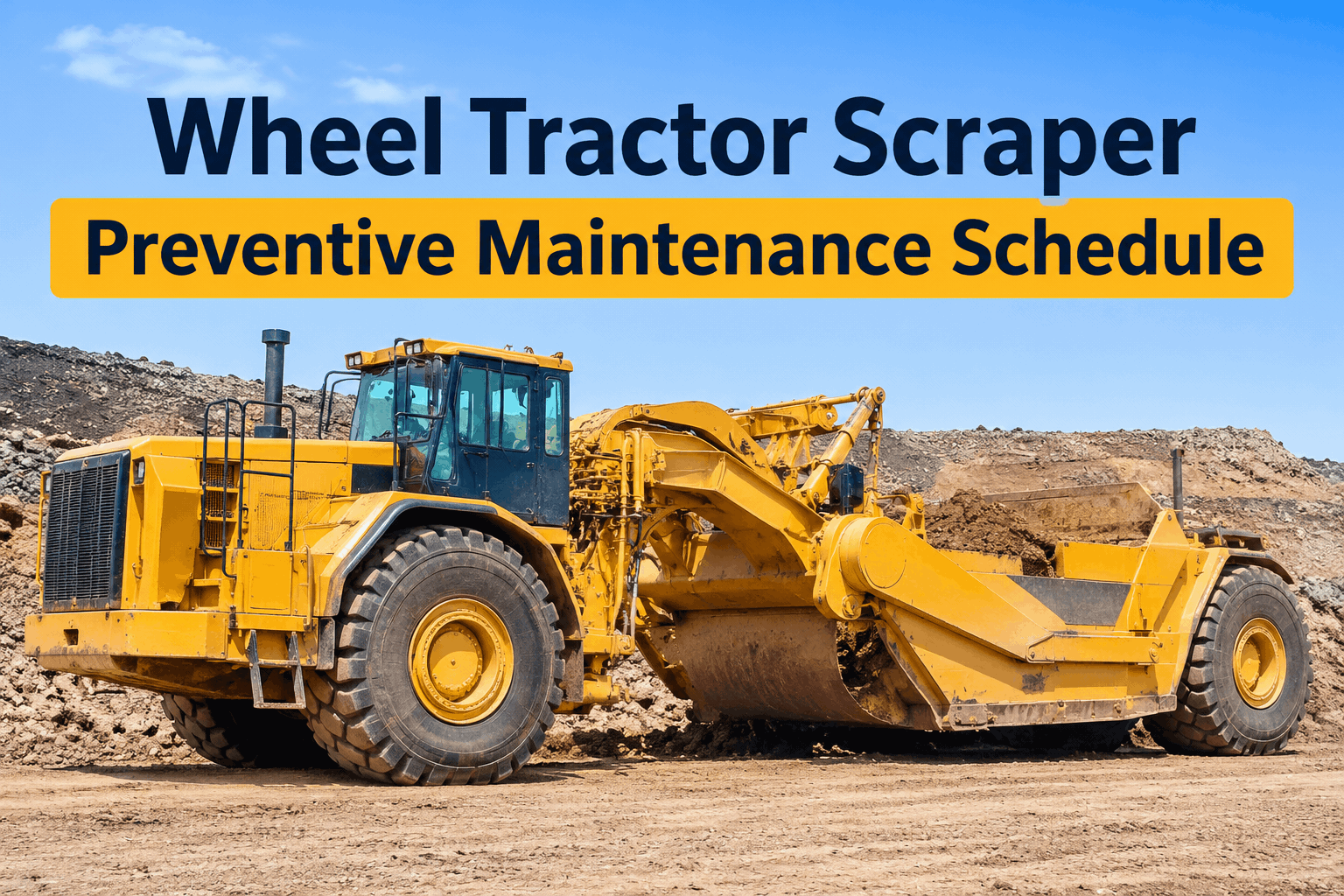
One crew runs every scraper on the same "service it every 250 hours" rule — and the cutting edge is already three weeks overdue while the transmission got touched too early. A scraper doesn't wear on one clock. It wears on five, and a blanket schedule gets most of them wrong. See a meter-hour PM schedule built per component
Five Components, Five Clocks — One Schedule That Actually Fits
A scraper's bowl, cutting edge, hydraulics, drivetrain, and tires don't wear at the same rate. HVI tracks each one against its own meter-hour interval, so the PM schedule matches the machine instead of a single blanket guess.
Confirm exact intervals against your OEM service manual and model — tiers vary by machine, but the principle doesn't.
Build the schedule around meter hours, not the calendar, and around the component, not the machine as a whole. That's the entire difference between a wheel tractor scraper that gets ahead of its wear and one that's always catching up to it.
Why one blanket schedule gets most of a scraper wrongfive components, five different wear curves
None of that is visible from a single "service interval" field on a spreadsheet. It only shows up when the cutting edge is replaced three weeks late because the transmission's schedule was driving the whole machine's PM date. Book a demo to see component-level PM instead of one blanket interval.
Why each component needs its own intervalthe wear logic behind the ladder
Bowl & apron
Direct material contact wears these on a load-cycle basis more than a strict hour basis — high-utilization units reach service thresholds faster than their peers.
Cutting edge
Ground condition drives wear more than hours alone — rocky or abrasive material shortens the interval regardless of what the schedule says.
Hydraulic cylinders & seals
Seals drift slowly before they leak visibly — a fixed interval catches the drift only if it's actually shorter than the failure curve.
Drivetrain & transmission
Fluid analysis trends matter more than a flat hour count here — the interval should flex with what the oil sample actually shows.
For the full inspection walkthrough of each of these points, see HVI's mining scraper inspection checklist. Book a demo to see a component-level schedule built for your own fleet.
One blanket interval vs. five tracked separatelythe same scraper, two very different service records
- A single "every 250 hours" rule covers every system
- The cutting edge runs past its real wear point before the date arrives
- The transmission gets touched before fluid analysis says it's due
- Parts get ordered after a defect is found, not ahead of the interval
- The schedule looks complete on paper and still misses the real wear
- Each component carries its own meter-hour PM schedule
- A tier coming due opens a work order automatically, by component
- Cutting edges and seals get serviced on their own real wear curve
- Parts sit ready ahead of the tier that needs them
- The schedule matches what's actually wearing, not a single guess
The machine doesn't care which schedule it's on — the components wear the same way either way. What changes is whether the schedule actually matches that wear. Start free and put your own fleet on a component-level schedule.
What to look for in scraper PM scheduling softwarea short list before the schedule is driving a production fleet
Separate meter-hour triggers per component
Bowl, cutting edge, hydraulics, and drivetrain each need their own interval, not one shared field.Automatic work orders when a tier comes due
No one should have to remember which component is approaching its interval.Parts tied to the upcoming service
A cutting edge or seal kit should be on hand before the interval arrives, not ordered after.Visibility across every unit on the site
A fleet planner needs one view of every scraper's schedule, not one spreadsheet per machine.A report that shows cost by component
Knowing which component drives the most repair cost is what makes the next interval better, not just the current one.Works offline on remote pit roads
Meter readings and flagged defects should log in the field and sync when signal returns.HVI is built to clear every item on that list for wheel tractor scrapers and the rest of a mining mobile fleet — start free and build your own component-level schedule this week.
From a maintenance planner who stopped running one schedule for five systems
We ran every scraper on the same 250-hour rule for years, because that's what fit neatly on a spreadsheet. It meant the cutting edges were always a little late and the transmissions were always serviced a little early, and nobody noticed because the PM compliance number still looked fine.
Once we split the schedule by component — bowl, edge, hydraulics, drivetrain, each on its own meter-hour clock — the compliance number actually meant something. We're not fixing fewer things, we're fixing the right things at the right hour instead of one average guess across five systems that don't wear the same way.
Want a meter-hour schedule built per component for your own scraper fleet? Book a 20-minute demo walked through your site.
Frequently asked questions
Why use meter hours instead of calendar days for scraper PM?
Utilization varies significantly week to week on a mining earthmoving cycle, so a fixed calendar date either over-services a lightly used unit or under-services a heavily used one.
Should every component on a scraper share one PM interval?
No. The bowl, cutting edge, hydraulics, drivetrain, and tires wear at different rates, so a single blanket interval inevitably over-services some and under-services others.
What are typical PM tiers for a wheel tractor scraper?
A common structure moves from daily lubrication, to hydraulic checks around 250 hours, wear-component service around 500 hours, drivetrain service around 1,000 hours, and major overhaul points around 2,000 hours. Confirm exact intervals against your OEM manual and model.
Can a PM tier automatically generate a work order?
Yes. When a component's meter-hour threshold is reached, HVI can open a work order automatically rather than relying on someone to track and remember the due date.
Does this replace the daily inspection checklist for a scraper?
No. PM scheduling covers the planned service intervals; the daily inspection is a separate check that catches defects between those scheduled services.
Stop running five wear curves on one schedule
HVI tracks each scraper's bowl, cutting edge, hydraulics, drivetrain, and tires against their own meter-hour interval, opens a work order the moment a tier comes due, and keeps the parts for that service ready ahead of time.
No credit card · Component-level meter-hour PM · Works offline on remote sites