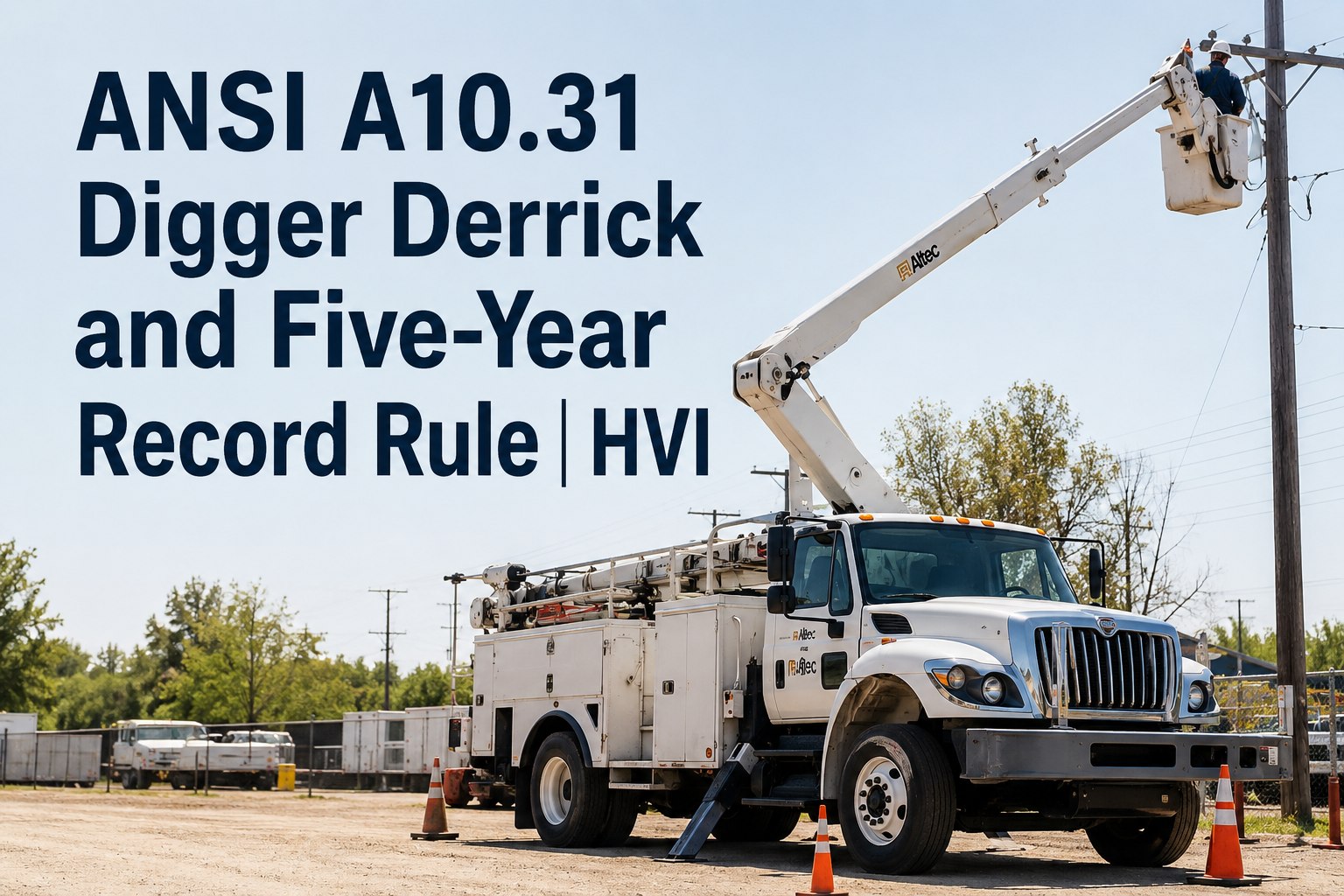
You remember the morning a digger derrick rolled out to set poles without a current dielectric test on the boom, and the line crew asked you afterward whether the fiberglass was still good. That is the kind of question that ends careers, not just shifts. The ANSI A10.31 digger derrick standard exists exactly for that moment: it makes the owner and the user jointly responsible for inspections carried out by a qualified person, with records kept for five years and a daily pre-shift check before every use. If you want to see how that maps to your own units, you can walk through the A10.31 requirements on a live demo.
ANSI ASSP A10.31 DIGGER DERRICK COMPLIANCE
One missed inspection. One energized line. Five years of records to prove you did it right.
A digger derrick digs holes, hoists poles, winches loads and, on insulated units, puts a worker near energized conductors. An inspection lapse here is an electrocution and structural-failure risk, not a breakdown. The A10.31 digger derrick inspection standard puts that responsibility on you, the owner, and the operator on the ground.
WHAT A10.31 ACTUALLY COSTS YOU
The numbers that turn a paperwork gap into a safety incident
Every figure below is tied to a real cost you carry when a digger derrick inspection is missed, late or undocumented under the ANSI A10.31 framework.
SYSTEMS INSPECTION SCOPE
What a digger derrick inspection must actually cover
The A10.31 derrick inspection requirement is not a walk-around. It is a systems-level check across six critical areas, each with its own failure mode that can injure or kill.
Boom
Welds, geometry, extensions, pivot pins, wear pads. A cracked boom weld under load drops the pole, the auger or the worker bucket.
Winch & Cable
Wire rope condition, drum spooling, brake holding, load-hook latch. A winch that free-spools under a suspended pole is a drop event.
Outriggers
Cylinders, pads, hold-down valves, bearing wear. An outrigger that retracts under load tips the entire unit toward the hole.
Hydraulics
Hoses, fittings, relief valves, drift. Hydraulic drift while a worker is in the bucket near energized conductors is a fatal hazard.
Auger
Drive shaft, teeth, flighting, engagement. A worn auger drive stalls mid-hole and torques the boom sideways under load.
Dielectric Integrity
Fiberglass boom and liner condition, cleanliness, surface tracking. On insulated digger derricks, this is the barrier between the worker and electrocution.
CUT BY CADENCE
The tiered inspection cadence A10.31 expects you to run
Digger derrick compliance is not one inspection. It is four overlapping cadences, each with its own scope, signer and retention obligation. Missing any one of them breaks the chain.
Daily pre-shift inspection
Before every use, the operator runs a documented walk-around covering boom, winch, outriggers, hydraulics, auger and, on insulated units, dielectric integrity. This is the check that catches the overnight hydraulic leak before the boom drifts into a conductor. On insulated units, a daily visual and wipe-down of fiberglass is the minimum, not the annual test.
Periodic inspection
At intervals defined by the manufacturer and usage intensity, a qualified person performs a more detailed structural and mechanical inspection. This is where you catch the wear pad that is about to let the boom chafe, the winch brake that is oil-contaminated, and the outrigger cylinder that is starting to drift. If you want to map these intervals to your own fleet and usage, you can set up the periodic schedule on a demo.
Annual dielectric test
On insulated digger derricks, all fiberglass components must undergo an annual dielectric test to confirm the boom still insulates the worker from energized conductors. Surface contamination, moisture ingress and invisible tracking can degrade fiberglass long before it looks damaged. This test is the single most skipped and most safety-critical item on the calendar.
Five-year record retention
Every one of the above inspections, by every qualified person, on every unit, must be retained for five years. That is the retention window that buries paper binder systems. When an auditor, insurer or incident investigator asks for proof, "we did it" is not proof. A timestamped, photo-backed, searchable record is proof.
REQUIREMENT TO EVIDENCE
Mapping A10.31 requirements to the records an auditor will ask for
If you cannot produce the right column within minutes of being asked, the left column does not exist as far as compliance is concerned.
| A10.31 Requirement | What It Means in Practice | Record You Must Produce | Retention |
|---|---|---|---|
| Owner and user responsibility | Both parties are named in the standard; neither can delegate away the inspection duty | Named owner and operator on every inspection record | 5 years |
| Inspection by a qualified person | Inspector must have training, knowledge and authority to evaluate the equipment | Qualified-person sign-off with credentials and timestamp | 5 years |
| Daily pre-shift check | Before every use, covering boom, winch, outriggers, hydraulics, auger, dielectric | Daily checklist with defects noted and resolved | 5 years |
| Annual dielectric test (insulated units) | All fiberglass components tested for insulation integrity every 12 months | Dielectric test certificate with test value and date | 5 years |
| Defect resolution | Defects found must be repaired before return to service or tagged out | Work order closing the defect, linked to the inspection | 5 years |
See HVI running on your own digger derricks
Book a 30-minute demo and we will build the daily, periodic, annual and dielectric cadence for one of your actual units, live.
THE QUALIFIED-PERSON QUESTION
Who counts as a "qualified person" for digger derrick inspections?
The ANSI A10.31 digger derrick standard does not let just anyone sign off. A qualified person is someone who, by possession of a recognized degree, certificate or professional standing, or who by extensive knowledge, training and experience, has successfully demonstrated the ability to solve or resolve problems relating to the subject matter and work. In practice, that means the operator can run the daily pre-shift check, but the periodic and annual inspections, especially the dielectric test, must be signed off by someone whose qualifications you can prove on demand.
This is where most paper systems collapse. The binder has a checklist with a signature, but no credential, no scope and no link to the person's training record. When an incident occurs, the investigator asks for the inspector's qualifications and the connection to that specific inspection. If you cannot produce that chain in minutes, you are exposed. If you want to see how HVI ties inspector credentials to every record, you can see the qualified-person tracking on a live demo.
A qualified person record includes
- Named individual with role and employer
- Training credential or certification reference
- Scope of inspections they are authorized to sign
- Timestamp and unit-specific sign-off
- Link to the underlying checklist and photos
A signature alone does not prove
- That the inspector was trained on that equipment class
- That the dielectric test was actually performed
- That the scope covered all six required systems
- That defects were resolved before return to service
- That the record still exists five years later
PAPER VS DIGITAL
Why the five-year retention rule buries paper DVIR binders
Five years of daily inspections on a 12-unit digger derrick fleet is roughly 21,900 inspection records. If you are running paper, that is a wall of binders no one can search.
The status quo
A driver fills out a carbon-copy checklist, tears off the yellow sheet, drops it in a tray. A clerk files it in a binder. Six months later the binder is in a cabinet. Two years later no one knows which cabinet. When an auditor asks for the dielectric test on unit 407 from eighteen months ago, three people spend an afternoon looking and may not find it.
The way it should work
The operator opens the HVI app on their phone, runs the A10.31-tailored checklist, photographs any defect, and submits. The record is timestamped, geo-tagged and stored in the cloud. When the auditor asks for the same dielectric test, you search the unit number, filter by inspection type, and the certificate is on screen in under ten seconds.
The cost difference is not just clerical. A utility fleet in the US running 15 digger derricks can easily spend 40-plus labor hours a month chasing, filing and searching paper inspection records. At a loaded shop rate, that is real money before you count the cost of a failed audit or an incident investigation where the records cannot be found. You can start logging inspections free and see the time savings on your own units within the first week.
HOW HVI HELPS
Built for the A10.31 digger derrick inspection standard
HVI maps directly to the four cadences, the six systems and the five-year retention rule. Here is what that looks like on a real fleet.
Tailored checklist per equipment class
HVI ships with digger derrick-specific checklists covering boom, winch, outriggers, hydraulics, auger and dielectric integrity. The daily, periodic, annual and dielectric cadences are pre-loaded, so the operator sees the right form on the right day with no guesswork.
Automated schedule by date, hours or mileage
Preventive maintenance and the annual dielectric test are scheduled automatically with due and overdue alerts. No more tracking the dielectric anniversary on a whiteboard. If a unit is overdue, HVI flags it before the operator leaves the yard.
Searchable, timestamped, photo-backed records
Every inspection is stored with timestamp, geo-location, inspector identity and defect photos. Search by unit, date range or inspection type. Five years of records are retrievable in seconds, not afternoons. To see the search in action, book a demo and we will pull a mock audit.
Defect-to-work-order in one tap
When a defect is flagged on a daily inspection, HVI generates a work order instantly, assigns it, and tracks it to closure. The closed work order is linked back to the inspection record, so the audit trail from defect to repair is unbroken.
KEY TAKEAWAYS
What A10.31 digger derrick compliance really comes down to
Responsibility is shared. The owner and the user are both on the hook. You cannot push the entire inspection burden onto the operator and walk away.
Inspections must be by a qualified person. A signature is not enough. You need to prove the inspector's training, scope and authority on demand.
Four cadences, not one. Daily pre-shift, periodic, annual and dielectric. Missing any one breaks the compliance chain and the safety case.
Five years of records. If you cannot retrieve a specific inspection in seconds, your paper system has already failed the audit before it begins.
Always confirm with the standard. A10.31 is the framework, but manufacturer requirements and local jurisdiction can add layers. Verify before you certify.
The dielectric test anniversary was the one date I used to track on a sticky note on my monitor. Then we added three insulated units in one quarter and the sticky note system died. Now I just open HVI, filter by annual dielectric, and every overdue unit is red before it rolls out of the yard. That is the one number I check every Monday morning.
FAQ
ANSI A10.31 digger derrick inspection questions, answered
Who is responsible for digger derrick inspections under ANSI A10.31?
What is the five-year record retention requirement for digger derricks?
How often must an insulated digger derrick be dielectrically tested?
What systems must a digger derrick daily inspection cover?
What qualifies someone to inspect a digger derrick under A10.31?
Get every digger derrick inspection audit-ready
Book a 30-minute demo and we will set up the daily, periodic, annual and dielectric cadence on one of your real units, live.
Free to start - Works on any phone - No card needed