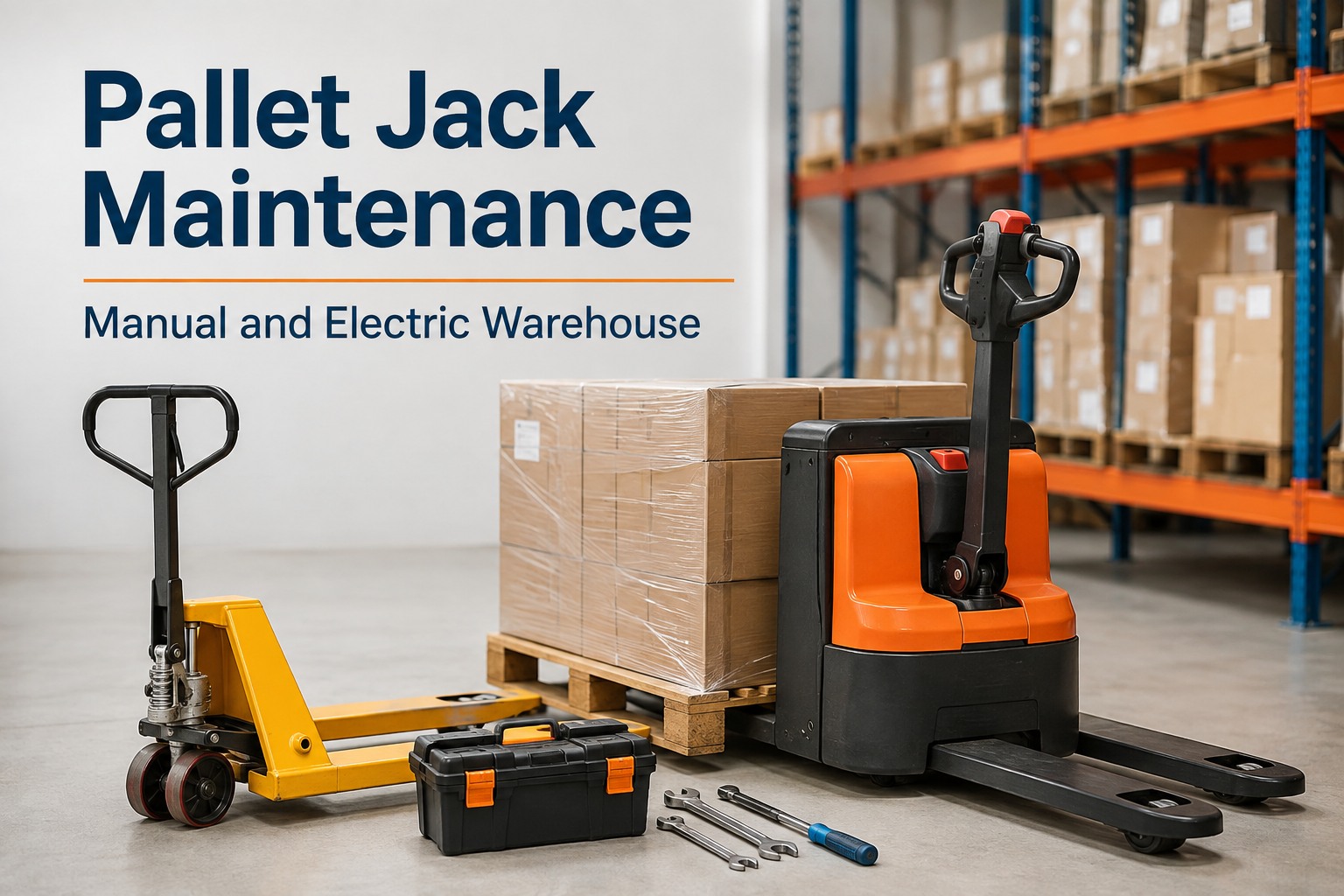
You notice it when the pump handle takes three extra strokes to lift a skid, or when a walkie pallet truck creeps instead of driving and the operator just grabs another unit and leaves the dead one by the shrink-wrap station. Pallet jack maintenance is the most skipped discipline in the warehouse: manual and electric pallet trucks are the simplest and most numerous material handling assets you own, so they get the least attention, fail unpredictably, and end up abandoned in corners with a "DO NOT USE" tag that nobody wrote. The fix is not complicated — daily operator checks plus a monthly deeper service beat hour-based scheduling on manual units, while powered walkies genuinely need hour-based intervals on battery, drive and controls. The hard part is doing it across a population of forty or sixty low-value units when your ten forklifts already eat all the oversight. That is exactly the numbers problem a CMMS solves, and you can see how it handles a whole pallet truck fleet in a 30-minute demo before you change a single process.
How many dead pallet jacks are sitting in your corners right now?
A failed jack never pages anyone. It just quietly slows a whole pick zone while operators walk further, double-handle freight, and wait on the one working unit. Here is the inspection and service rhythm that keeps a large, cheap, invisible fleet alive.
What neglected pallet trucks actually cost you
Individually they are cheap. Collectively they are your warehouse's circulatory system — and the numbers below are what poor circulation looks like on a P&L.
Units per site is normal
A mid-size DC can run 40–80 pallet jacks against 8–12 forklifts — yet the forklifts get the PM program and the jacks get nothing.
Push effort from worn wheels
Flat-spotted load rollers and chipped steer wheels can triple the force needed to move a loaded pallet — a slow-motion strain injury and a floor-scraper in one.
Typical hydraulic seal kit vs $700+ jack
A weeping pump caught early is a seal kit and an hour of labour. Ignored, it scores the ram and you are pricing a replacement unit.
To feel a dead walkie
One electric pallet truck down in a two-unit dock zone means queues at the wrap station inside hours — productivity bleeds before anyone files a ticket.
The 2-minute pallet jack inspection that prevents 80% of failures
Every failure mode that strands a pallet jack mid-shift is visible or feelable days earlier. Train operators to run this check at shift start — on paper it gets pencil-whipped, so most teams start logging these checks free on a phone where a skipped item actually flags.
Hydraulics and leaks
- Pump the handle through a full stroke — it should lift smoothly with no sponginess or drift-down under load.
- Look under the pump body and around the ram for wet oil or a dust ring stuck to old seepage.
- Check the release lever: forks should lower at a controlled speed, not slam or creep.
- Top up with the correct hydraulic oil only — wrong viscosity kills seals in cold docks.
Wheels and load rollers
- Spin each steer wheel — flat spots, chunking and embedded shrink-wrap all add push effort.
- Inspect both load rollers at the fork tips; these take every pallet entry and wear first.
- Check the entry/exit rollers and linkage for bent pins from dock-plate strikes.
- Worn polyurethane on polished concrete also marks and chews the floor — a cost your landlord notices.
Forks and load backrest
- Look along each fork for heel wear, bending or cracks at the heel — a 10% heel thickness loss means derate or retire.
- Check fork tips are level with each other; a twisted chassis shows up here first.
- On units with a load backrest, check welds and mounting bolts — it is the only thing between a shifting pallet and the operator's legs.
- Confirm the capacity plate is legible; an unreadable plate fails most safety audits on its own.
Electric units: battery and controls
- Check battery charge and cable condition — frayed cables and corroded connectors are the top walkie killer.
- Test the emergency reverse (belly) button, horn, and dead-man brake every single shift.
- Run lift/lower and drive in both directions; hesitation or error codes get logged, not ignored.
- Opportunity charging habits matter — deep-cycling a lithium or lead pack past its spec halves its life.
Manual vs electric pallet jack PM schedules: what actually works
The mistake is treating both types the same. Manual jacks have no hour meter and no engine — calendar rhythm wins. Powered walkies wear by the hour, like any truck. Split your program accordingly.
| Service task | Manual pallet jack | Electric walkie / rider |
|---|---|---|
| Operator daily check (leaks, wheels, forks, controls) | Every shift, 2 minutes | Every shift, 3 minutes incl. battery and E-reverse |
| Deep inspection: rollers, pins, bushings, chassis, torque check | Monthly | Monthly or every 150–200 hours, whichever first |
| Hydraulic oil level and condition | Monthly; change annually or when milky | Monthly; change per OEM hours |
| Grease steer bearing, push-rod pivots, linkage | Monthly | Monthly |
| Battery service: water/equalise (lead) or BMS check (lithium) | N/A | Weekly water check; full service per hour meter |
| Drive motor brushes, contactor, wiring harness | N/A | Every 500 hours or 6 months |
| Full load test and fork measurement | Annually | Annually (document for audit) |
Hour-based triggers only work if someone reads the meter. In HVI, powered units fire PM alerts off engine-hour entries while manual jacks run on calendar dates — both visible on one due/overdue board. Worth a look if you want to walk through mixed scheduling on your own unit list.
Why 60 cheap assets get less oversight than 10 expensive ones
Your forklifts have VINs, telematics, dealer service contracts and a line in the budget. Your pallet jacks have a Sharpie number on the handle — maybe. That asymmetry is why they fail silently.
No identity, no history
Without an asset ID per jack, "the blue one with the bad wheel" is your maintenance record. Give every unit a tag and a digital file and suddenly repeat offenders become visible — the same jack failing three times in a quarter is a replace decision, not a third repair.
Failures hide in plain sight
A downed forklift stops a loading dock and gets reported in minutes. A downed pallet jack gets dragged to a corner and the operator borrows the neighbouring zone's unit. By Friday, three zones are short and nobody logged a single defect.
The worked example
Take a 50-jack fleet. If 8% are dead or limping at any time — typical for an unmanaged pool — that is 4 units out. At roughly $35/hour for a warehouse associate losing even 20 minutes a shift to workarounds, you are burning about $45–50 per shift, over $11,000 a year, on assets that cost $400–$700 each to replace. A monthly service round costs a fraction of that.
See every jack, every check, every overdue PM on one screen
Book a 30-minute demo and we will load a sample pallet truck fleet so you can watch daily checks, monthly services and defect-to-work-order flow live.
Built for big fleets of small assets
HVI is a cloud + mobile inspection and maintenance work order CMMS. It treats a $500 pallet jack with the same discipline as a $500,000 haul truck — because your warehouse feels both when they stop.
Distinct checklists per equipment type
Manual jack, walkie, rider and stacker each get their own daily checklist — battery and E-reverse items only appear where they belong. Operators complete them on any phone with photos, and a failed item can spawn a work order instantly.
Calendar and hour-based PM in one board
Run manual jacks on monthly calendar service and powered units on engine-hour triggers — due and overdue alerts fire automatically, so the monthly grease round never slips because someone was on holiday.
Asset tracking across large populations
Every unit gets an ID, a photo, a location and a full history — inspections, repairs, parts and cost. Filter 60 jacks by status in seconds and spot the repeat offenders that should be replaced, not repaired again.
Audit-ready records and uptime analytics
Timestamped, photo-backed inspections satisfy safety, client and insurance audits without a paper chase, and per-asset cost and uptime reports show exactly what the corner of dead jacks was costing you. Book a demo and see the reporting on real sample data.
Pallet jack maintenance in five lines
Pallet jack maintenance is a volume game. The units are cheap and numerous, so failures hide — you manage the population, not the individual jack.
Daily 2-minute checks catch 80% of failures early — hydraulics, wheels and rollers, forks and backrest, plus battery and controls on electric units.
Manual jacks run on calendar rhythm (daily checks plus monthly deep service); powered walkies need hour-based PM like any truck.
Worn wheels are a double cost — triple the push effort for your crew and scraped floors for your facility.
A CMMS closes the oversight gap — asset IDs, per-type checklists, mixed PM triggers and defect-to-work-order, at a per-unit cost any warehouse can justify. You can set up your first units free and prove it on one zone this week.
"My gripe was never the repairs — it's that nobody told me. I'd find four dead jacks behind the baler on a Friday walk. Now every unit has a number, operators scan it at shift start, and I watch the defect list instead of the corner. We went from about six dead units at any time to one, and that one's usually waiting on a $12 roller. I track 'walkarounds avoided' and it's the cheapest win in my budget."
— Daniel Reyes, Site Maintenance Supervisor, regional 3PL distribution centre
Questions warehouse and maintenance managers actually ask
How often should a manual pallet jack be serviced?
A 2-minute operator check every shift, plus a deeper monthly service: grease the steer bearing and pivots, inspect rollers and pins, check hydraulic oil level and condition, and torque the chassis hardware. Change the hydraulic oil annually or whenever it looks milky. Hour-based schedules do not apply — there is no meter, so calendar rhythm is the honest approach.
What are the first signs of pallet jack hydraulic failure?
Spongy pumping, forks that drift down under load, and a slow or jerky lift are the early warnings, usually alongside a wet film of oil around the ram or pump body. Caught there, it is a seal kit and an hour of labour. Left alone, the ram scores and the pump is uneconomical to rebuild on a low-value unit.
How do I know when pallet jack wheels and rollers need replacing?
Flat spots, chunking, cracks, embedded shrink-wrap, or a loaded pallet that suddenly takes two people to move. Load rollers at the fork tips wear first because they absorb every pallet entry. Replace in pairs, and treat recurring wheel damage in one aisle as a floor or dock-plate problem, not a parts problem.
What maintenance does an electric pallet jack battery need?
Lead-acid packs need weekly water checks, clean terminals and an equalise charge on schedule; lithium packs need BMS checks and sensible charging habits — avoid deep discharges and constant opportunity top-ups past spec. Inspect cables and connectors daily; corrosion and fraying strand more walkies than dead cells do. Hour-based PM reminders in a CMMS keep this from slipping — a quick demo shows how the alerts work.
How do I keep track of maintenance across 40 or 50 pallet jacks?
Give every unit a unique asset ID, attach a per-type digital checklist, and let the system track due dates and history instead of a whiteboard. That is the core of HVI: asset tracking across large populations, calendar and hour-based PM, and instant defect-to-work-order. You can sign up free and tag your first zone of jacks in an afternoon.
Empty the corner of dead jacks for good
Start with one zone: tag the units, load the checklists, and watch the first month of real data come in. Most teams see their hidden failure count inside two weeks.
Free to start · Works on any phone · No card needed