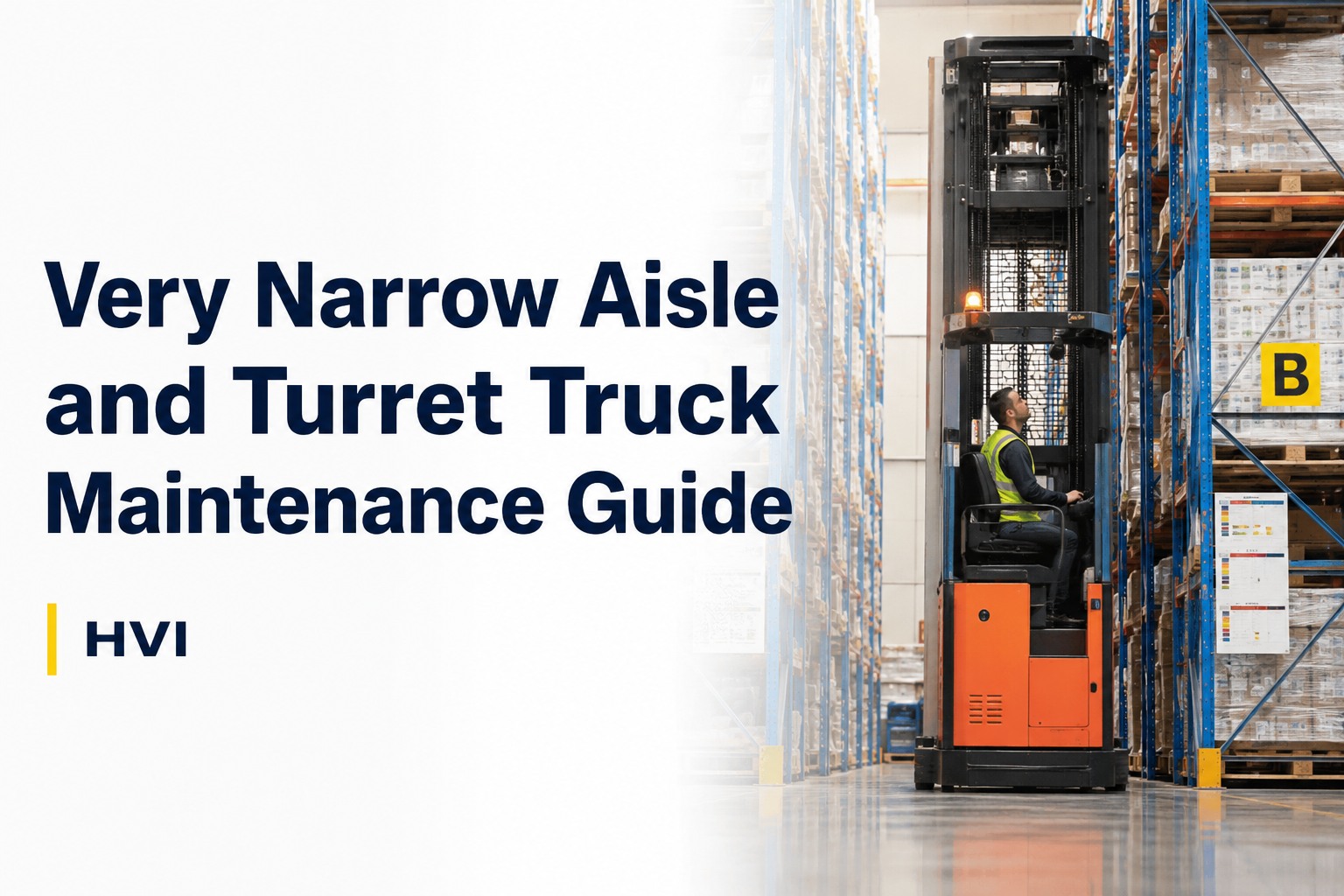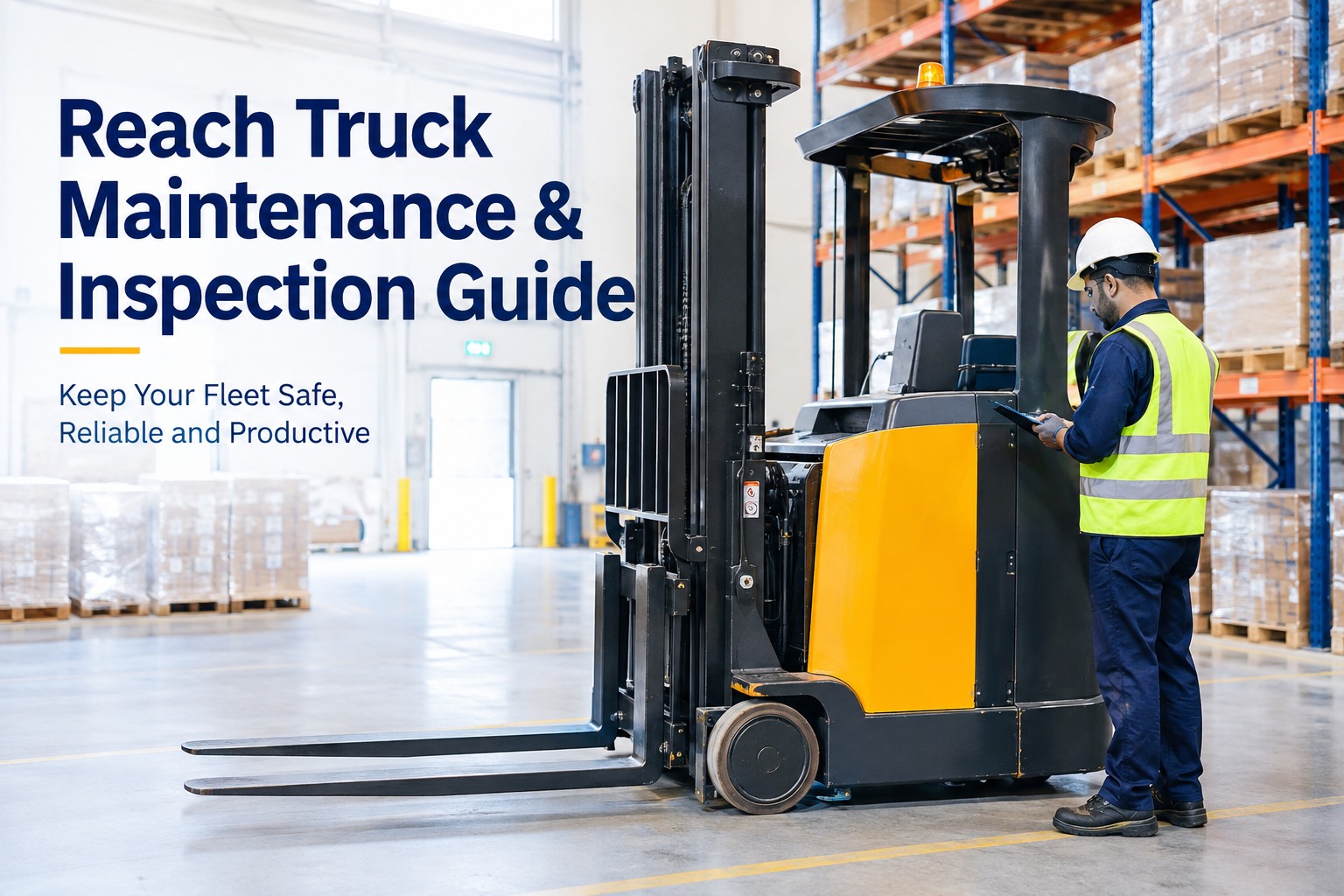
Run a reach truck on the same maintenance schedule as your counterbalance forklifts and you're servicing the wrong machine. A reach truck works narrow aisles at high racking heights, which gives it wear areas a counterbalance simply doesn't have — the reach mechanism, a tall multi-stage mast, and load wheels that carry the whole machine's manoeuvrability. Reach truck maintenance and inspection has to target those, because when this machine fails, it often fails at height with a load up. See a reach-truck-specific PM schedule per unit
A Reach Truck Wears Where a Forklift Doesn't
Tap a wear point. Each one takes stress a counterbalance forklift never sees — and each is a reason a generic forklift PM schedule leaves a reach truck under-served.
The pantograph extends the forks into the rack and back hundreds of times a shift under load. Rollers, guides, and the hydraulic circuit all wear — a counterbalance has nothing like it, and a forklift checklist has no field for it.
Miss it → sloppy reach drops a pallet at the rack faceTaller and worked higher than a counterbalance's. The same channel wear that's a rough ride at floor level becomes a load-placement and stability problem at the top of a high rack.
Miss it → drift or sway with a load elevatedThey carry the machine's manoeuvrability and a share of its stability, and they wear low and out of the operator's eyeline. Worn or flat-spotted wheels make steering vague — a safety issue in a tight aisle.
Miss it → vague steering, marked floor, truck off mid-shiftThe reach truck is electric, so the battery decides whether it finishes the shift. Watering discipline, charge condition, and connector health all determine runtime — capacity fades invisibly until it dies at the worst moment.
Miss it → a truck that quits two hours before the shift endsA reach truck is an OSHA Class 2 electric, narrow-aisle machine, and every wear area below comes from that duty: reaching into racking, lifting high, and turning tight. Here's what each one needs — and why it belongs on the reach truck's own schedule, not the forklift's.
The reach mechanism: the wear area a forklift doesn't have
This is what makes a reach truck a reach truck — and it's the number-one thing a generic forklift schedule ignores, because a counterbalance has nothing like it. The extension carriage pantographs the forks out into the rack and back, hundreds of times a shift, under load. Every part of that motion wears.
Catch reach-mechanism wear on a scheduled inspection and it's a roller or a seal; miss it and it's the carriage dropping a pallet at height. Because a forklift template has no field for any of this, the reach truck needs its own. Book a demo to see a reach-mechanism inspection built into the schedule.
Mast and high-level handling: where wear becomes a stability problem
A reach truck's mast is taller and works higher than a counterbalance's, so the same wear has bigger consequences. At floor level, a slightly worn mast is a rough ride. At the top of a high rack with a pallet extended, it's a load-placement and stability issue — the kind of failure that damages stock, racking, and people.
The reach truck's whole job is precise handling at height, so mast condition isn't cosmetic — it's the difference between placing a pallet and dropping one three levels up. Book a demo to log mast checks with photos per unit.
Load wheels and battery: the two that end shifts early
These two don't sound dramatic, but they're the most common reasons a reach truck comes off the floor mid-shift — one wears out of sight, the other dies at the worst moment.
They carry the machine's manoeuvrability and a share of its stability. Worn or flat-spotted wheels make steering vague, mark up the floor, and change how the truck sits under load — and in a tight aisle, vague steering is a safety issue. They wear low and out of the operator's eyeline, so they're an easy miss without a scheduled check.
The reach truck is electric, so the battery decides whether it finishes the shift. Watering discipline, charge condition, connector health, and even wear all determine runtime. A battery quietly losing capacity turns into a truck that dies two hours before the shift ends — right when you need every machine.
Both wear invisibly and both end shifts — which is exactly why they belong on a scheduled, hour-based check rather than a run-till-it-quits routine. Book a demo to see load-wheel and battery checks on an hour-based schedule.
Operator protection and visibility during high-rack work
A reach truck operator works fast in a tight aisle, looking up at a load three or four levels high. The safety and visibility systems that support that aren't optional extras — they're part of what makes high-rack work survivable, and they belong in every inspection.
OSHA requires powered industrial trucks to be examined before being placed in service, and after each shift when run round-the-clock. For a machine that lifts loads high in a shared aisle, that examination isn't paperwork — it's the check that keeps a visibility or control fault from becoming an incident. Start free and capture the pre-shift safety check with photo proof.
Why a reach truck needs its own PM interval
Here's the thread through everything above: a reach truck has wear areas a counterbalance doesn't, so it can't share the counterbalance's schedule. A generic forklift PM either skips the reach mechanism, mast-at-height, and load-wheel checks entirely, or lumps everything into one interval that fits neither machine.
No field for the reach mechanism, mast-at-height, or load wheels. The unique wear areas go unchecked until they fail — usually with a load up and a truck stuck in the aisle.
An equipment-specific template checks the reach, mast, load wheels, battery, and safety systems on intervals triggered by that unit's hours — so the machine's real wear points are caught on time.
Hours run, not the calendar, should trigger the interval — a reach truck on double shifts wears twice as fast as one that runs half a day. Per-asset, hour-based PM is how each machine gets serviced for what it actually does. Book a demo to see hour-based PM per reach truck.
The reach truck pre-shift inspection checklist
This is the walk that catches a reach-truck-specific problem before the operator takes it up a rack — the wear areas a forklift check would miss. Run it before every shift and log any find with a photo. Use this reach truck checklist online free, so a defect auto-creates a work order and holds the truck out of service until it's fixed.
From a maintenance lead who split the schedules
We ran everything — counterbalances, reach trucks, pallet jacks — off one forklift PM checklist. Then a reach mechanism let go with a pallet up at the third level; the carriage had been getting sloppy for weeks and nobody had a place to note it, because the checklist didn't ask about the reach at all.
We built a proper reach-truck template — reach, mast, load wheels, battery, safety — on its own hour-based interval. The next sloppy carriage got flagged on a Tuesday walkaround and fixed that night. Same machines, same crew; the difference was checking the reach truck for what a reach truck actually does.
Frequently asked questions
How is reach truck maintenance different from a counterbalance forklift?
A reach truck has wear areas a counterbalance forklift doesn't: the reach mechanism (extension carriage, rollers, guides, and its hydraulic circuit), a taller multi-stage mast that works at high rack heights, and load wheels that carry the machine's manoeuvrability. It also works in narrow aisles, so failures happen at height with a load up. A generic forklift schedule has no field for any of that, which is why a reach truck needs its own equipment-specific inspection and PM interval.
What is the primary wear area on a reach truck?
The reach mechanism — the pantograph that extends the forks into the rack and back, hundreds of times a shift under load. Its rollers and guides wear, the carriage develops play, and the hydraulic circuit can leak or drift. Worn reach hardware shows up as sloppy, jerky, or hesitant extension, which puts the load in the wrong place at the rack face. Caught early it's a roller or seal; missed, it can drop a pallet at height.
How often should a reach truck be inspected and serviced?
Operators should complete a pre-shift inspection before use — OSHA requires powered industrial trucks to be examined before being placed in service, and after each shift when run round-the-clock. Deeper PM should run on intervals triggered by the truck's actual hours, not the calendar, since a reach truck on double shifts wears far faster than one used part-time. Follow the manufacturer's service intervals and adjust for your duty cycle.
Why do load wheels matter so much on a reach truck?
Load wheels carry the machine's manoeuvrability and a share of its stability, and they wear low and out of the operator's eyeline. Worn or flat-spotted wheels make steering vague, mark up the floor, and change how the truck sits under load — and in a narrow aisle, vague steering is a safety problem, not just a comfort one. Because they're an easy visual miss, they need a scheduled check rather than waiting for someone to notice.
Can I use one PM schedule for my whole warehouse fleet?
You can, but you shouldn't — counterbalance forklifts, reach trucks, order pickers, and pallet jacks wear on different clocks and have different critical components. One blanket schedule either over-services the simple machines or under-serves the complex ones like reach trucks, whose reach mechanism and high-level handling go unchecked. Equipment-specific templates with per-asset, hour-based intervals give each machine the maintenance its actual duty requires.
Maintain the reach truck for what it actually does
HVI runs equipment-specific checklists and hour-based PM intervals per asset, captures photo defects that auto-create work orders, and keeps full maintenance history and cost per truck — so the reach mechanism, mast, and load wheels get caught on a walkaround, not at the top of a rack. Less downtime, fewer surprises, safer high-bay work.
No credit card · Equipment-specific templates · Hour-based PM per asset